An hour into a long bike ride last week, I had an epiphany. Though I’d ridden through the city, on streets and sidewalks, and then turned south on a fast paved trail to ride for several miles, I had not once touched the brakes.
My bike, a skinny tire single-speed made by Co-Motion Cycles Inc. (www.co-motion.com) of Eugene, Ore., was a unique creature. Though it was equipped with high-end caliper brakes, the bike’s speed — both acceleration and deceleration — could be controlled without ever calling on their influence.
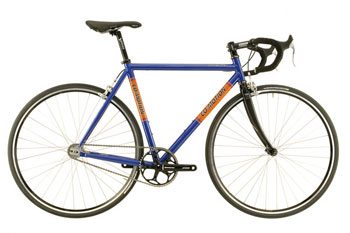
The Streaker, as the Co-Motion bike is called, was set up as a fixed-gear bike. Like a unicycle or a child’s tricycle, fixed-gear bikes lack a freewheel, which is the component that allows the rear wheel to spin freely and the rider to coast. On a fixed-gear bike, the pedals, chain, chainring and rear-tire gear — and thus your legs and the bike’s back tire — all are connected, moving in sync, never stopping while on the go.
Basically, as long as the wheels are turning, your feet are spinning around on the pedals. Coasting is not an option.
In lieu of brakes, speed can be controlled on a fixed-gear by applying reverse pressure on the pedals while they are spinning. The action, which is much like downshifting the transmission in a car to slow before a red light, will not stop you abruptly. But with time fixed-gear bikers learn to slow down, stop and then reaccelerate all with their feet, no shifting or braking involved.
Fixed-gear bikes have garnered a small following in the past five years, with urban commuters and bike messengers being some of the earliest adopters. Proponents cite increased control, focus and awareness of your technique. Some even wax silly about a oneness with the bike.
I found the fixed-gear setup on the Streaker to be just plain fun. It forced me to change my riding technique, with no coasting and no slop in my style. It was a great workout, too, as my legs were kept spinning nonstop for miles and miles.
Other advantages to fixed-gear bikes include their pared-down component list, which decreases the bike’s cost, its overall weight and its propensity to break down. Shifters, derailleurs, pulleys and extra gears are eliminated. Many fixed-gear riders even eliminate brakes, which are seen as superfluous once speed can be controlled with pedal motion.
Fixed-gear bikes are not good in hilly terrain or off-road, where a freewheel and multiple gears are necessary. Hopping curbs and potholes on a fixed-gear bike is difficult, and the riding style, in general, requires solid cycling technique. I would not recommend a fixed-gear bike to an inexperienced rider.
The bike I tested, the Co-Motion Streaker, has a unique feature for riders that want a fixed-gear bike only some of the time: The Streaker’s rear wheel has a fixed gear on one side and a freewheel-equipped single-speed gear on the other, letting you flip the wheel around to choose a riding style of the day.
The Streaker is an amazing bike, with a smooth, fast ride and great response, plus a sweet retro orange-and-blue paintjob. It’s built around an Easton Ultralite 7005 double-butted aluminum frame that weighs a mere 2.6 pounds. (The complete bike weighs about 16.5 pounds.) It has a carbon fork and is built with top-shelf components all around, giving it a healthy price tag of $2,395.
Other fixed-gear bikes, however, cost much less. Redline Bicycles’ (www.redlinebicycles.com) 925 model, for example, goes for $500 at some shops. Many independent bike shops also refurbish used bikes, converting them into solid, non-nonsense and low cost fixed-gear rides.
Other bike-related reviews on TheGearJunkie.com:
Kona Paddy Wagon
Winter Biking Tops
Single Speed Bike Conversion
Critical Mass: The Inside View
Critical Mass Bike Ride
Bike-Jor, or “How to wear down your hyper dog”
Professional Bike Fitting
Ice Bike Racing

