Bamboo Tent Poles - The Gear Junkie Scoop
September 15, 2008, 8:19 am / Categories: Camping, Technology
The Gear Junkie Scoop: Nemo’s Bamboo Tent Poles
By STEPHEN REGENOLD
In the muggy tropics from Indonesian to Vietnam, sprouting like grass on the prairie then seeking the sun, bamboo is the fastest-growing woody plant on the planet. It is a perennial evergreen of the Poaceae family, a closer relative to Kentucky bluegrass than an oak tree, its cells multiplying with water and sunlight in a fit of photosynthesis to perpetuate shoots that might grow three feet in a single day.
In much of the world bamboo is an essential commodity, employed in everything from bridge construction to chopsticks. It is locally available and renewable, and it’s touted as an environmental panacea in the West where its fibers are woven into T-shirts and its glossy boards cut to lay polished kitchen floors.
So why not tent poles?
Indeed, NEMO Equipment Inc. of Nashua, N.H., in a “quest for innovation and environmentally conscious design,” as stated in press material, recently unveiled plans to manufacture thin bamboo tent poles for a pair of its lightweight tent models beginning in late 2009.
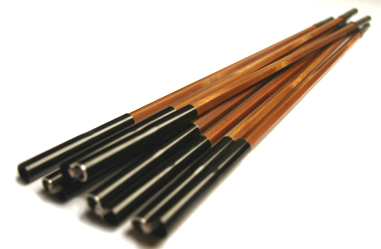
They look like chopsticks, but Nemo’s thin bamboo tent poles are made to endure the same stresses as their aluminum and carbon-fiber cousins.
The plan is to bank on a bamboo variety called Tonkin cane, which is sometimes dubbed “steel bamboo” for its dense fibers and long sections between nodes. Working with an Alaskan fly rod maker, NEMO’s prototype poles — which I handled and flexed at a recent press meeting — click together like any typical tent pole and whisk into nylon sleeves to support a shelter that might be put to endure hurricane-force winds.
But initial tests at NEMO (www.nemoequipment.com) give bamboo a green light for its strength and performance under pressure. “The benefits of bamboo are that it is lightweight, flexible and highly elastic,” wrote Kate Ketschek, the company’s director of marketing, in an email interview. “Fishermen have been using bamboo for its strength and flexibility for over 100 years and NEMO believes that these benefits will correlate with the essential properties of tent poles.”
The prototype poles I handled, which were made for the company’s two-person Nano OZ, weighed just over 6 ounces apiece at 145 inches long. This is about an ounce less than the company’s comparable aluminum poles.
But the bigger advantage, Ketschek noted, comes when you look at the environmental picture. “The idea for bamboo came out of talking about how aluminum is the most environmentally-costly part of our tents,” she wrote.

Nemo will employ a bamboo variety called Tonkin cane — sometimes dubbed “steel bamboo.”
Ketschek cites several eco-advantages to bamboo over aluminum, including its fast-growing nature and renewability; the availability of local product near Asian manufacturing plants; the fiber’s biodegradability; and bamboo’s natural carbon-balancing properties when growing in a field. Aluminum, in contrast, Ketschek notes, requires “huge amounts of energy to dig up and process into a high-grade alloy.”
NEMO plans to use eco-friendly glues with negligible toxic chemicals and processes in the building of its bamboo poles. And economically, Ketschek said, bamboo is a less expensive resource than aluminum or carbon fiber.
Over the next year NEMO will be testing its prototype poles and working out production processes with a leading tent pole manufacturer. Expected availability to campers and backpackers hoping to hop on the bamboo train will be end of 2009.
—Stephen Regenold writes the weekly Gear Junkie Scoop for Outsidemag.com and TheGearJunkie.com.
Don’t have the measurement of the sections, but when I handled them they did not strike as overly long. I think they are similar to any normal two-person backpacking tent’s poles on the market now, i.e., about a foot long per section. Nemo’s final design is still to come, however.
Cane rods have a tendency to take a “set” when they are placed under extreme stresses for long periods of time (i.e. when fighting a fish). I would expect these to eventually set, too, especially if they remained set up for a long period.
Also, those look to be what is called “flamed cane,” meaning the builder passed them over an alcohol lamp to heat and thus slightly strengthen the outer fiber. It makes a rod stiffer; a desirable characteristic for anglers used to graphite rods nowadays, but very time-consuming.
Cane rod building takes a really long time; those hexagonal strips must be planed from wood, sized, glued up, wrapped in string, and then heated in an oven to cure. It’s not an easy process to mechanize. I don’t see how these could be very cost effective and they would be very hard to scale up to meet high demand.
We talk a lot about cane rods here:
http://www.itinerantangler.com
- Weekly E-Newsletter
Sign up for our e-news for a weekly update on new gear, adventure travel, and prize giveaways.
- Latest Articles
- Shoelace of the Future? Tour of Boa Technology in Denver
- Hot or Cold? Thermos 'Travel Tumbler' Test
- Video: 'Gear Junkie Challenge" Urban Adventure Race
- Winners! 'Ragnar Trail' Sweepstakes with Salomon
- 'Pro-Level' Air Attack Helmet Put to Test
- Stomping Grounds: Photo Shoot and Shoe Test in 'Urban Outdoors'
- 'Golden Axe' award at GoPro Mountain Games
- Video: Three Weeks of Pristine Climbing in Greenland (in three minutes)
- Glacier Trek, Waterfalls, 'Blue Lagoon' highlights of Iceland Trip
- Seeking 'Mountain Bike Action' in photo contest with The North Face
- Popular Articles
- Shoelace of the Future? Tour of Boa Tech in Denver
- Hot or Cold? Thermos 'Travel Tumbler' Test
- Workout Wear
- 'Pro-Level' Air Attack Helmet Put to Test
- Survival Gear: 10 Items To Survive
- Video: 'Gear Junkie Challenge" Urban Adventure Race
- 'Fat Bike' Trend: Overrated or For Real?
- World's 10 Most Dangerous Mountains
- Camping Gear Reviews | Gear Reviews
- 50 Miles in Flip-Flops? Luna sells sandals to ultra-running market
- Fat Bike trend Dead? Walmart sells 'Beast' bike for $199
- Call from Anywhere. SPOT launches Satellite Phone for Outdoors
- Climber makes couch out of old rope (and 9 other odd uses)
- First Look: Suunto 'Ambit 2' for multisport market
- Jumping dogs, battling kayakers, slackline stunts: Sports of 'GoPro Games'
- Chimney Stove: Boil Water with Sticks and Grass
- 10 Rules: Running with your Dog
- SylvanSport GO Camper Trailer Review
- Winners! 'Ragnar Trail' Sweepstakes with Salomon
- Stomping Grounds: Photo Shoot and Shoe Test in 'Urban Outdoors'
- Friends of Gear Junkie
- Monopoint Media
- The Goat
- Alpinist
- Adventure Blog
- YogaSlackers
- Checkpoint Tracker
- Outdoorzy
- Get Outdoors
- Gear Flogger
- Feed The Habit
- Gear.com
- Adventure Journal
- SuperTopo
- Trailspace
- Outside Online
- iRunFar.com
- UpADowna
- About Adventure Travel
- Cold Splinters
- UpNorthica
- Sender Films
- Venture There
- Wend Magazine
- No Boundaries
- Breathe Magazine
- Elevation Outdoors
- Rock and Ice Magazine
- Trail Runner Magazine
- REI Blog


How about “collapsibility”? In other words, my lightweight alloy poles now come in fairly short segments. Perhaps it’s just the angle of the photo, but these bamboo pole sections appear a slight bit longer, which might be an issue when I want to carry them in/on a backpack. Don’t get me wrong, I’m all for the eco benefits (I grow bamboo myself), but just wondering. Thanks. Press