Dispatch from Nepal, April 11, 2010. . . The tiny white pills are bitter on my tongue. But I gulp and force them down, ingesting a medication I hope will help my body cope with the thin air all around. It is 10pm, a starry night at Mount Everest Base Camp, a tent city perched below the world’s tallest peak in a glacial field at 17,500 feet.
I gulp some water to help the pills slide down. Acetazolamide. That’s what’s written on the bottle. Diamox is its more common commercial name, and because of its aid in acclimatization, the medication is among the most popular with trekkers and climbers in the Khumbu Region of Nepal.

In two weeks, I have come from Minneapolis to Mount Everest, from about 1,000 feet above sea level at home to the thin air of Base Camp. I pushed one day higher still to 18,600 feet, ascending a small peak near Everest (Kala Patthar) for a view of Mount Pumori and the stark black pyramid of Everest itself, an angle of rock piercing to 29,035 feet in the sky.
Diamox has helped. So has hydration. I carry a one-liter water bottle as I hike. The regional hot drinks — Sherpa tea, milk coffee, hot lemon, as well as plain old hot water — are forced upon me, poured from giant insulated bottles at meals and breaks at least four times a day. Porters have helped carry my bags. Over the eight days it took to approach Everest, our guides governed a pace.
My body slowly adapted, blood cells multiplying, headaches going away.
“About 50 percent of trekkers experience headaches and minor altitude sickness by 16,000 feet,” said Luanne Freer, a doctor at the Himalayan Rescue Association’s Everest ER clinic at Everest Base Camp. Far fewer people — about two percent, according to Freer — experience the more serious high-altitude pulmonary edema (HAPE) or high-altitude cerebral edema (HACE) sicknesses, which can be fatal.

From Lukla at 9,000 feet, where my trek began, up into the Khumbu Region, I watched for the signs of altitude troubles. But I had only minor struggles with the air. My group took it slow and used a common formula of stopping at villages that sit increasingly higher in the range. We would trek a few miles and then rest for the night, letting the body reconfigure to the thinner air.
At 13,000 feet, in the Sherpa village of Pangboche, I was winded hiking up a hill. My head swooned when I trekked too fast. Step, breathe, pause — that’s the slow method of progress when you aren’t feeling up to the task.
We rested in Pangboche two nights. Then we shouldered packs to trek higher still. Dingboche for a night. Then the village of Lobuche at 16,000 feet. Finally, the penultimate stop before Base Camp, Gorak Shep, was a dusty layover for one night at 17,000 feet.
We left Gorak Shep after breakfast for Everest Base Camp, a rolling trail that gained just 500 feet. But my head was fuzzy and my pace was slow when we arrived. I found my tent and collapsed, a nap at 17,500 feet in the sky.
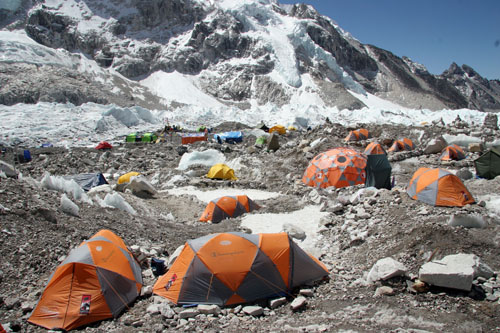
Minneapolis was on the other side of the world, day here in Nepal and nighttime there back home. It was more than three miles below my feet, as well, a 16,000-foot gain from my front steps in Minneapolis to my temporary home at Everest’s base.
I gazed up the mountain to elevations much higher still. The climbers with Expedition Hanesbrands will soon depart for camps increasingly lofty, tents perched past 20,000 feet and beyond en route toward the top of the world.
It’s my third day at Base Camp, and the air no longer feels so thin. I take a deep breath and exhale. It’s getting late. Camp is quiet. Residents of the tent city are drifting now into sleep.
—Stephen Regenold reported live from Nepal and Everest Base Camp for Expedition Hanesbrands’ https://climbwithus.com site and on Gear Junkie at our Everest Blog.