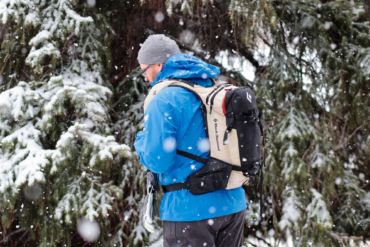
Think of Cascade Designs’ MSR Denali Evo Ascent as the SUV of the snowshoe world: Made to be equally effective on both crusty, wind-blown snow as well as when the powder measures in feet, the Denali Evos are versatile and stout.
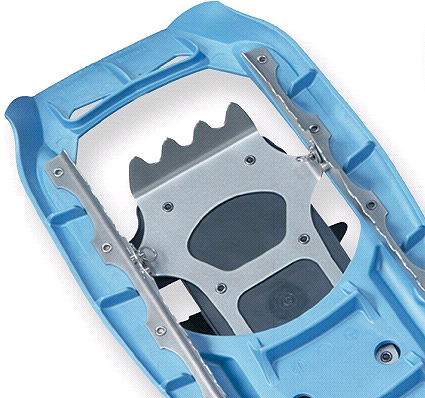
Toothy steel rails underfoot provide plenty of bite for traction — they can ascend hard-pack snow that’s verging on ice. Add the shoes’ four-tooth steel crampon spikes and you can dig in to front-point up steep slopes with ease.
For long ascents, the company’s “Televator” heel block — a metal-wire brace that you manually flip up and down under the heel of your boot — reduces calf fatigue. They make ascending steep slopes more efficient.
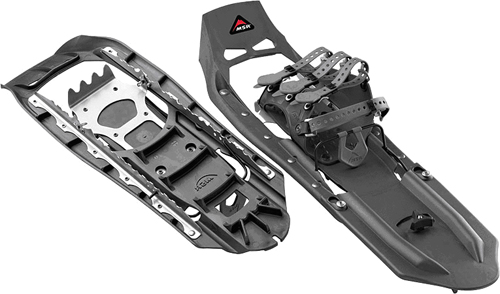
A tough plastic deck provides a rigid platform, and molded “braking bars” aid in stability when going downhill. Another advantage to the rigid plastic deck: The MSR shoes (www.cascadedesigns.com/msr) can double as an emergency snow shovel or as a bomber buried snow anchor for guying out a tent. I’ve employed them for both.
With the newer version of these popular snowshoes, MSR redesigned the pivot area underfoot to make them rotate more smoothly. By implementing a simple pin-and-ring design, there is no tension on the shoes while lifting your foot, reducing heel drag as you walk. The setup also helps eliminate the ever-annoying effect of snow flipping up from behind after each step.
For bindings, the snowshoes’ rubber strap system can be difficult to adjust initially. But with practice entering and exiting becomes effortless. I have used these snowshoes for many backcountry trips over the past three years. The bindings have not disappointed after much use. Bonus: The rubber straps remain pliable down to temps below zero, letting you cinch the snowshoes on tight in any weather and with most any size boot.
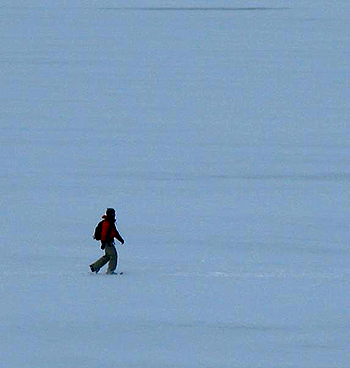
While they are not designed as a race snowshoe, the Denali Evos performed adequately for me last winter in the Leadville 20 Mile Snowshoe Race, which as it sounds is a 20-mile snowshoe challenge held outside Leadville, Colo. The shoes tip the scale at about four pounds a pair, so they are heavier than the “running” snowshoes many competitors used for the event. I plodded along and had no problem transitioning from the deep powder I encountered in the trees to the icy surface during the crossing of Turquoise Lake.
On the race’s steepest section — a nearly 1,500-foot climb up to Uncle Bud’s Hut — the shoes proved their worth. This climb to one of the 10th Mountain Division’s huts is the most challenging section of the event. But the solid platform plus the shoes’ amazing grip helped me push through.
With roughly 176 square inches of surface area — or at about 22 inches long by 8 inches wide — the Denali Evos float moderately well in dense powder. Even under full pack weight I experienced little problem in deep snow, aside from simply dealing with the trials of wearing planks on my feet. Given my weight at roughly 150 pounds, combined with a pack and clothing weight of 32 pounds, I was still under the company’s recommended 200-pound use weight for these shoes.
If you’re planning to carry a lot of weight or if you will be traveling in deep, loose powder, the company sells 6-inch flotation tails that add surface area to the back of the shoes and bump up recommended total user weight to 240 pounds. But be warned that these shoes are designed primarily for hard-pack conditions and do not provide as much flotation as other snowshoes designed for deep powder.
Built to last, the Denali Evo Ascent is an expedition snowshoe meant specifically for the adventurer that plans to cover distance in a variety of less than desirable conditions. They cost $199 and should be thought of as an investment which is backed by MSR’s lifetime warranty.
—Steve Hitchcock is a Colorado-based writer, teacher, organic farmer, and outdoors guide. He blogs at www.UpaDowna.com.