Every car owner knows the small dramas that come with keeping a vehicle in good shape. The sun can fade paint and cloud headlights. A stray shopping cart or the brush of a jean rivet can leave a mark you swear wasn’t there yesterday. Phones slide off laps and across floors. And every so often, a mysterious light pops up on the dashboard as if your car is speaking in riddles.
Driving is freedom, but it also comes with upkeep and the occasional headache. That’s where the right car accessories make all the difference. Today’s options can help protect your investment, support safe driving habits, keep your vehicle clean, or decode what’s going on under the hood. Some tools offer peace of mind. Others simply make everyday driving easier.
Whether you’re trying to prevent wear, clean up the inevitable grime, stay connected safely, or get ahead of maintenance issues, there are accessories designed to help. And while each solves a different problem, they all have one goal: making life on the road smoother and a little less stressful.
In this guide, we break down the essentials every car owner should consider and what to look for before you buy. The right gear doesn’t just make your vehicle look better, it helps it work better and last longer, wherever the road takes you.

How to Choose the Right Car Accessories
Choosing the right accessories starts with one question: what problem are you trying to solve? Accessories should protect your investment, improve safety, simplify everyday tasks, or make maintenance less painful.
Use the checklist below to match an accessory to your needs:
- Define the problem. Do you need protection from weather, help staying hands-free while driving, tools to diagnose issues, or products to restore appearance?
- Consider where you park and drive. Outdoor exposure, a garage, or frequent long trips all change which features matter most.
- Think about compatibility and fit. Size, mounting points, vehicle electronics, and vehicle type (car, truck, van, SUV) determine whether an accessory will work for you.
- Prioritize durability and materials. Accessories that live outside or see heavy use should be made from weather-resistant, breathable, and abrasion-resistant materials.
- Balance convenience vs. capability. Some solutions are simple and cheap; others are more involved but deliver better results or longer life.
- Factor cost of ownership. For items that require subscriptions, replacement parts, or frequent consumables, include ongoing costs in your decision.
- Look for warranties and return options. A clear warranty and easy returns reduce risk when trying something new.

Key Features to Look for in Protective Gear (Car Covers & Scratch Solutions)
When you’re choosing protective gear for your vehicle, the goal is either to prevent new damage or to repair minor imperfections that have already occurred. Car covers fall into the first category, and the best ones balance fit, durability, and climate-appropriate materials.
A well-fitted cover, ideally one sized specifically for your vehicle, reduces wind flapping and ensures full protection. Material matters just as much: outdoor covers should offer water resistance, UV protection, and enough breathability to prevent trapped moisture, while indoor covers focus more on softness, dust protection, and gentle contact with the paint.
Features like elastic hems, tie-down straps, grommets for cable locks, and built-in vents all help the cover stay secure and functional over time. Weight, ease of installation, and clear care instructions also determine how realistic it is to use the cover regularly.
The biggest dividing line is whether the cover will be used indoors or outdoors. Indoor covers tend to be lighter and emphasize breathability and scratch-free contact, making them ideal for garage-kept vehicles. Outdoor covers prioritize weatherproofing and secure attachment points to handle sun, rain, and wind. Before buying, consider where the car is parked, how often you’ll remove the cover, and whether you need added security features for public or windy environments.
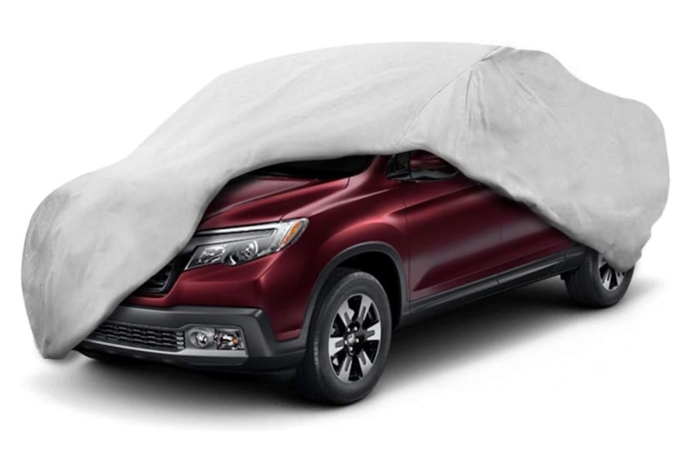
Motor Trend T-850

Specifications
Pros & Cons
Pros
- Custom-fit for year/make/model
- A breathable outer layer allows moisture to escape
Cons
- Heavy construction makes it cumbersome to cover and remove
- Grommet for cable lock unprotected
Odds are you have your pride and joy parked on the driveway or in the garage. However, left uncovered and unprotected, that sparkling ride will fade fast from the sun, exposure to the elements, or possibly picking up a small ding or scratch — even when parked safely inside the garage.
Investing in the right truck or car cover is the right move and will save you from future agony. The Motor Trend T-850 ($84) truck cover carries name recognition and stays true to its automotive roots with the right features anyone would seek in light protection.
The truck cover’s heavy construction makes it cumbersome to drape over and remove after pulling it from the storage bag, which uses the same material as the cover. We purchased a T-850 for a 2008 Honda Ridgeline (1st generation) and discovered that folding in the side mirrors helps with fitment since mirror side pockets are absent. The elastic hem is snug and grabs the bumpers tightly. On gusty days, we took the precaution of securing it with the attached underbody straps.
Grommets for the cable lock are exposed. Typically, it is not a big issue since the possibility of leaving a mark would likely occur on the undercarriage or somewhere where it would go unnoticed. Nicer covers, such as the Coverking, will sew a piece of material on the underside as a preventive measure against potential scuffs.
Wrapping a cover over a truck or any vehicle has its challenges. Thankfully, the cover has the Motor Trend name stamped on the front end for quick orientation. Fitment isn’t perfect because this cover will fit over the first-generation and second-generation Ridgeline. Since the second gen has different angles and is 4 inches longer and almost an inch wider, the cover-up of our 2008 model wasn’t perfect.
This T-850 truck cover gets high marks for water resistance. Rainwater did not leak through in the low areas where the cover drops into the truck bed. More importantly, we didn’t detect condensation build-up anywhere due to the truck cover’s ability to breathe and allow moisture to evaporate.
We’ve been using the Motor Trend T-850 truck cover on and off for about 3 months, and it has retained its shape so far. Many low-cost car jackets start showing signs of age when you see fading, water seepage, and overall fit getting looser and looser.
In short, the T-850 car cover offers reliable protection for your vehicle, helping to prevent sun damage, exposure to the elements, and potential scratches. While it may require folding in side mirrors for a perfect fit, the cover’s snug elastic hem and straps help secure it, even on windy days. Its water resistance and ability to prevent condensation buildup are notable features. After 3 months of use, it has maintained its shape and performance, making it a worthwhile investment for preserving your vehicle’s appearance and condition.
Kayme 6-Layer Truck Cover
Specifications
Pros & Cons
Pros
- Driver side zipper allows for easy access
- The lining feels soft and friendly to the paint finish
- Outstanding protection against rain and snow
- The light weight makes it easy for one person to cover and uncover a truck
Cons
- Rainwater will pool in the truck bed if it doesn’t have a soft or hard cover
- Storage bag is poor quality
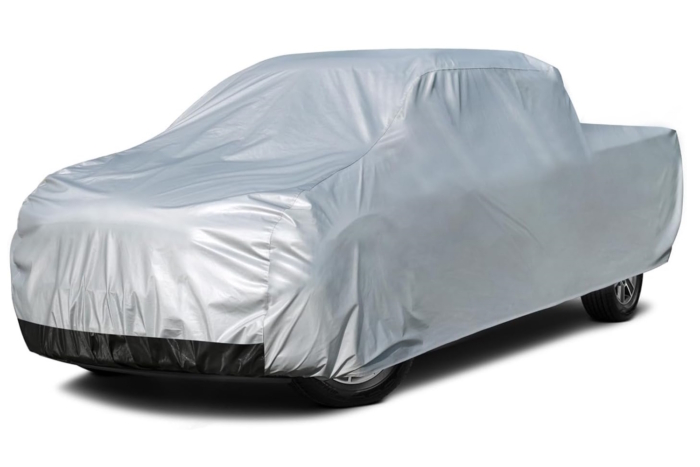
We purchased a Kayme 6-Layer Truck Cover ($67) to protect an older Ford F-250 that doesn’t get driven much. In the past, the owner has used other truck covers to help slow down the aging process of being outside all the time. Comparatively, Kayme’s multilayer construction is about mid-range in quality. The material feels better than a low-cost truck cover but doesn’t match up to a premium brand.
This design’s bright silver finish is highly reflective in the sun, while the cotton lining feels soft. The six layers are bonded together and don’t add up to too much weight. Removal and folding it up were easy tasks. For example, we liked how easy it was to move it around and get it tucked under the bumpers.
The fitment is pretty snug, and we were confident it would stay on the truck on those gusty days. For added security, the Kayme truck cover has front and rear underbody straps and buckles if you’re fearful of having it blow away. Fortunately, Idaho had some rain and snow pass through the state this spring. We noted that the truck cover sheds water wonderfully, but had to tent the truck bed portion to prevent water from pooling.
To sum it up, the 6-Layer Truck Cover offers mid-range quality protection for a budget-friendly price. While not as premium as some brands, its multilayer construction provides better durability and protection than low-cost options. The truck cover’s reflective silver finish and soft cotton lining add to its appeal, and the snug fit, along with the underbody straps and buckles, ensure it stays secure even on windy days.
Its ability to shed water effectively is a plus, although some tenting may be needed to prevent pooling in the truck bed portion. Overall, the Kayme truck cover is a solid choice for protecting your vehicle from the elements.

Scratch removers and polishing solutions address the other side of protection, repairing small blemishes before they worsen. Hand-applied scratch compounds work well for tiny hairline marks or surface-level swirls, while drill-assisted pads and orbital polishers are better suited for deeper scuffs or more consistent finish correction.
All of these products work by removing a microscopic layer of clear coat, which means they’re only effective on scratches that haven’t penetrated down to primer or bare metal. Deep gouges usually require professional repair.
Using these products correctly matters. Work on a clean, dry surface and avoid heat or direct sunlight, which can alter how compounds behave. Start with light pressure, make several short passes rather than one aggressive attempt, and stop frequently to wipe away residue and check progress.
More advanced techniques, like wet sanding, should only be used with care and the right materials, and ideally after testing the process on a less visible area. Matching the pad, compound, and technique to the severity of the blemish ensures you remove only as much clear coat as needed while restoring a smooth finish.
Before choosing a scratch remover, assess how deep the mark is, whether you plan to apply the product by hand or with a tool, and whether you have the right space and supplies to complete the process safely. Together, the right cover and the right scratch-care products go a long way toward keeping a car’s exterior looking sharper for longer.
Meguiar’s Scratch Eraser Kit
Specifications
Pros & Cons
Pros
- Easy to use with any household drill
- Quick and straightforward
- Got to scratches hand-only buffing can’t
Cons
- Doesn’t resolve deeper scratches in the clearcoat and beyond
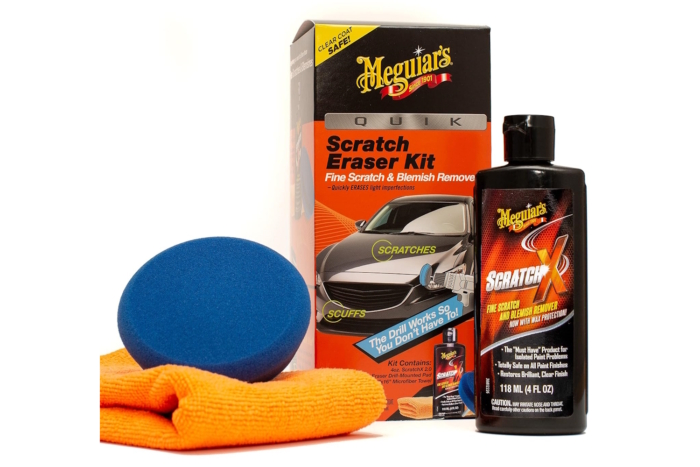
Unlike the other systems, the Meguiar’s Scratch Eraser Kit ($23) doesn’t come with sandpaper or two different “grits” of drill sponge, and there’s only one level of polish. And, as you would guess, that meant we didn’t find it was as useful for attacking deeper damage to any car’s clear coat. But it also means there’s less involved. You clean the area, dab some of the compound onto the drill sponge, and work through the scratch while keeping the drill on at about medium speed.
What’s pretty heartening, however, is that when we couldn’t get a hand application to cut the mustard, the Meguiar’s Kit was generally up to the task, and the process never took more than a few minutes. We found it was also very good at buffing out tiny, hairline scratches. And, because it’s drill-based, you can work over a larger area more quickly than operating by hand.
Since the bottle that comes with the system is a generous 4 ounces, we were able to try it on a bunch of other cars, too, like a friend’s old MG, his VW, our tester’s Honda, and even his old tractor. It shined on each one.
That said, we’re talking about a $6 difference between this setup and the 3M one, and we’d probably recommend the latter if you’ve got some pretty deep gouges. Because at that point, you really do need that extra-fine sandpaper and to go through both steps of buffing and polishing.
As with the 3M, using a drill has drawbacks. It is difficult to get into the crannies of your car’s sheet metal, and again, you could end up over-buffing a creased edge. Use caution and always work the drill slowly, keep it moving, and don’t press too hard. Let the material do the work.
If we could change one thing with Meguiar’s Scratch Eraser Kit, it would be to allow the applicator sponge to be removable from the drill bit, as it is with the 3M system. It’s easier to wash and thoroughly clean that way, but as it is, this is a very good value that gave us great results.
Shine Armor Revive Scratch Repair
Specifications
Pros & Cons
Pros
- Easy to use with a microfiber towel
- Application is simple
- Handled swirl marks and fingernail scratches like a champ
Cons
- Can’t get to deeper scratches
- Does not come with drill attachment
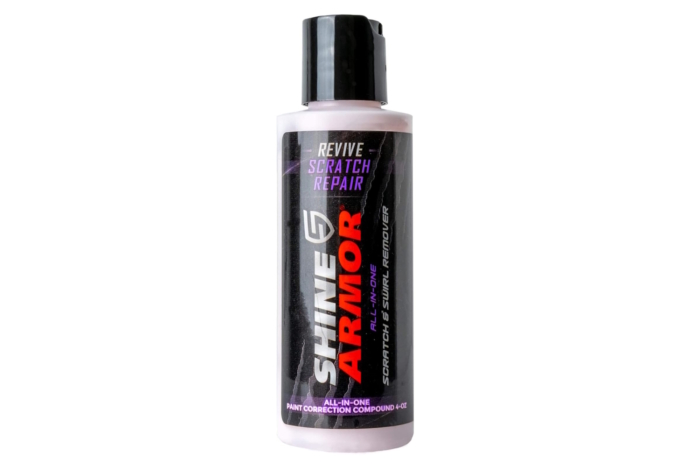
Shine Armor Revive Scratch Repair ($8) attacked swirl marks left by car washes and door handle fingernail micro-scratches. Like all of the hand-application polishers we tested, the game plan is very simple — make sure the surface is clean and dry (and cool), add a very small amount to a clean, dry microfiber towel, and apply medium to hard pressure as you spread the polish around and rub.
We were consistently impressed with this product. It removed surface scratches from the clear coats of several different cars, and we felt like the restoration value of what we saw, even with a haggard paint job, like on my old Honda, was pretty impressive.
After fixing up the door handle of a friend’s VW — which had pretty bad fingernail scratches — he went after scratches all over his car. (Spoiler alert: No, he couldn’t miraculously restore rock chips that went all the way through to bare metal on the edge of his car’s hood.)
Another reason to like Shine Armor Revive Scratch Repair was that it left less residue than competing brands. We were able to just keep polishing, and it left virtually nothing behind once we were done. Several of the others required coming back and really rubbing away the remaining dust, or you’d have swirls left by the compound that were nearly as hard to remove as the scratches themselves.

What to Consider When Buying Car Restoration & Detailing Products
Car cleaning and detailing products fall into two broad categories: kits designed to clean and protect your vehicle from top to bottom, and restoration products that address specific problems, such as hazy headlights. No matter what you’re shopping for, the goal is to improve your car’s appearance and to extend the life of its surfaces.
A good car detailing kit should give you everything you need to clean the exterior, remove grime from the wheels, refresh the interior, and finish with protective layers. The most helpful kits pair gentle, paint-safe soaps with microfiber mitts or towels, brushes for tight areas, and products that won’t strip wax. Many also include wheel cleaners, glass cleaners, and simple tools like applicators or interior brushes.
Some sets come with extras like a foam cannon attachment to help loosen dirt before you scrub. What matters most is that each product is formulated for its specific task and won’t introduce scratches, streaks, or residue.
Finish care is a major part of detailing. Kits that follow the standard “clean, correct, protect” sequence are ideal. They wash away dirt, use mild compounds or polishes to remove swirls or light imperfections, and add a wax or sealant to guard against future damage.
Tire and wheel care is another essential element. Look for cleaners that cut through brake dust without harsh acids and tire dressings that leave a clean, dark finish rather than a greasy shine. Interior cleaners should be gentle enough for vinyl, plastics, and displays while still offering UV protection to slow fading or cracking. Higher-end kits may even include products formulated for leather seats or stubborn carpet stains.
Meguiar’s Complete Car Care Kit
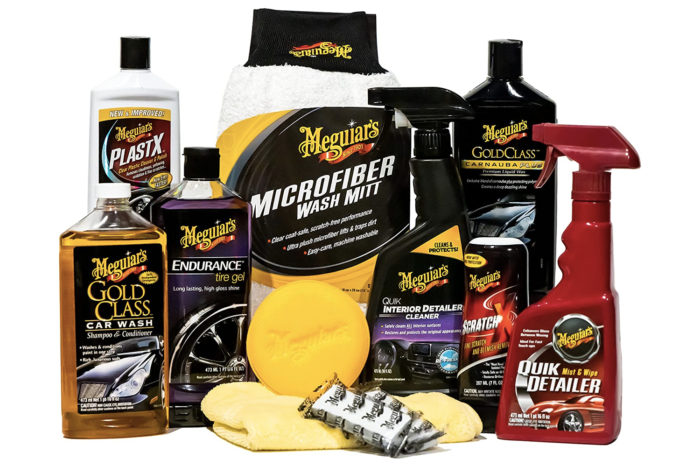

(Photo/Meguiar's, Inc.)
Meguiar’s is featured a lot on our “10 Best” lists. That’s because they have a reputation for quality car cleaning products. These powerful cleaning products, when used together, produce a comprehensive, professional car detail that will turn your car into the envy of the block.
We like Meguiar’s Complete Car Care Kit because it includes nearly all of those high-quality and dependable products. You won’t find yourself running back to the automotive store because this all-in-one kit includes everything you could need to achieve a showroom shine, including a microfiber wash mitt, applicator pad, and microfiber towel.
The best part about Meguiar’s Complete Car Care Kit is the remarkable value for detailing products that work exceptionally well. For less than the price of professional car detailing, you can ensure that your car achieves a spotless finish month after month.
Armor All Premier Car Care Kit
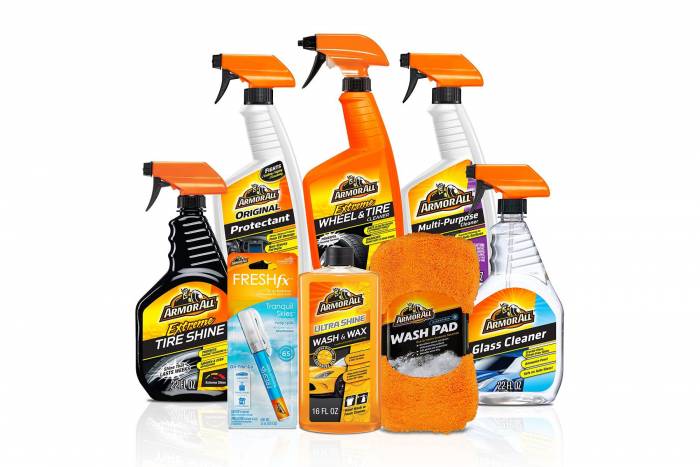
(Photo/Armor All)
The Premier car cleaning kit from Armor All comes with eight top-notch car cleaning products to keep your car sparkling inside and out. Designed to tackle tough messes on the interior, exterior, wheels, and tires, this kit will give your car a next-level clean.
Thanks to the easy-to-use spray bottles, your car is a few quick sprays away from a like-new finish and a spotless shine.
We like the Armor All Complete Care Kit because it combines the brand’s most reliable and powerful car cleaners into a comprehensive, easy-to-use auto detailing kit. The mix of products ensures the complete removal of all dirt, dust, and grime from all of your car’s interior and exterior surfaces. You also get a gel tire cleaner and tire protectant because no detail job is complete without shiny black tires and spotless wheels.
The Armor All Complete Car Care Kit accomplishes less with more, and that is why we consider it one of the ten best car detailing kits. This collection of Armor All products is suited to keeping up the appearance of a well-cared-for car, truck, or SUV. Jobs that require more intensive cleaning and care are listed below.
The Armor All’s eight-piece kit comes with the following:
– Armor All Ultra Shine wash and wax shampoo
– Armor All Extreme wheel and tire cleaner
– Armor All Extreme Tire Shine
– Armor All Original Protectant spray
– Armor All Glass Cleaner
– Armor All Multipurpose Cleaner
– Wash pad
– Armor All air freshener pump
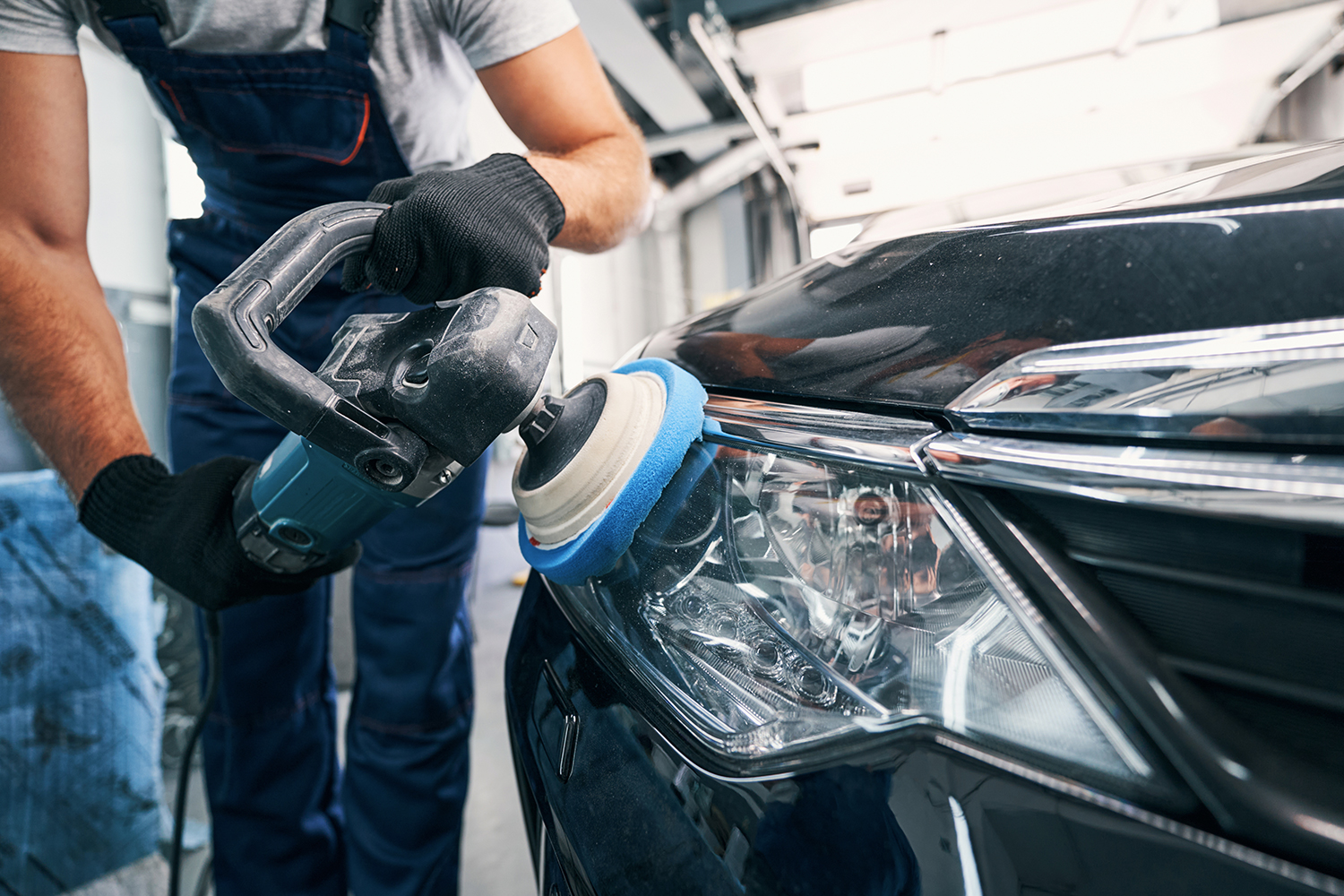
Headlight restoration products serve a different purpose but follow a similar logic: clean the surface, remove oxidation, and protect the lens so the results last. When choosing a kit, consider how cloudy your headlights are and whether you want a fully manual process or something compatible with a power drill.
Most kits include a cleaning solution, a series of sanding discs, a polishing compound, and a sealant. Kits designed for drill use make the process faster, but manual options work well for lighter oxidation or more delicate areas. What matters most is that the kit provides clear instructions and includes everything necessary to complete the job without buying additional tools.
Because polycarbonate headlights degrade from UV exposure, sealants with built-in UV blockers are worth prioritizing. These coatings help prevent the quick return of haziness, extend the life of the restoration, and reduce the need for frequent reapplication. Many reputable brands include this feature, and it’s a major differentiator in how long your results will hold.
Finally, think about longevity, ease of use, and brand reputation. Detailers and DIYers often stick with companies that have a long track record of producing safe, effective automotive products. Whether you’re restoring headlights or cleaning your entire vehicle, the right kit should simplify the process, improve visibility and safety, enhance appearance, and ultimately help preserve your car’s value over time.
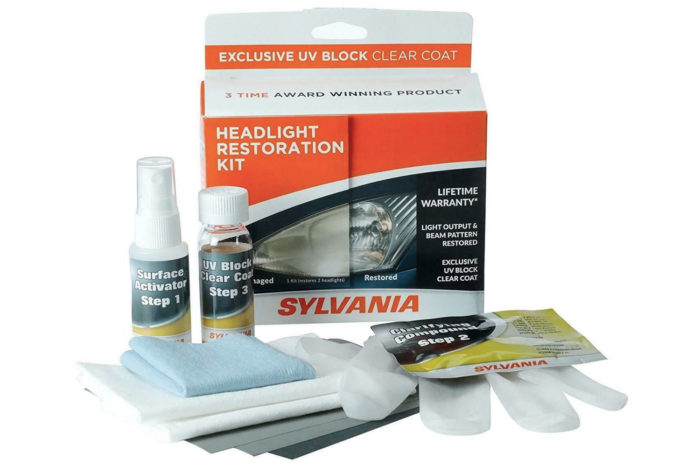
Sylvania Headlight Restoration Kit
Specifications
Pros & Cons
Pros
- Clarity is outstanding
- No tools required
- Warranty good for the life of the car
Cons
- Manual process of sanding is time consuming
- Kit contains materials to restore two headlights, only
If you prefer doing things the old-fashioned way, which requires some sweat equity, the SYLVANIA Headlight Restoration Kit ($25) comes with everything you need. This kit is ideal for folks who prefer to do projects by hand and see their headlights return to their former glory. It’s also the best kit to get the job done.
Inside the box you’ll find sandpaper, plastic gloves, and two types of paper towels. There’s a surface activator that quickly removes the top layer of oxidation. You’ll also see a polishing compound, masking tape, and a protective clear coating compound. Following the instructions will restore your headlights to a clear finish with lasting UV protection.
The restoration process begins by spraying the surface activator onto the headlight to soften the plastic. This step is followed by progressively sanding and polishing out the haziness and scratches on the headlight lens.
The last step is the application of the UV blocker coating, which will achieve clarity and make the lenses look almost new. Since this coating offers long-lasting UV protection, SYLVANIA guarantees a polished appearance for the vehicle’s lifetime.
After enduring 15 Idaho summers and winters, our tester’s 2008 Honda Ridgeline headlights were heavily oxidized and cloudy. Following 90 minutes of manual labor, which included sanding and polishing, we applied the UV blocker.
The clear coat brilliantly restored the clarity of the headlight to like-new condition in addition to protecting the lens from future oxidation. This SYLVANIA kit only provides enough materials for one set of headlights, but the warranty lasts as long as the vehicle’s life.
3M Ultra Headlight Restoration Kit
Specifications
Pros & Cons
Pros
- Kit comes with everything you need to restore headlights except a cordless drill
- Clarity restored to like-new condition
- Excellent quality kit materials
- The headlight clear coat contains a UV blocker
Cons
- Heavily oxidized headlights require lots of sanding steps before applying the clear coat
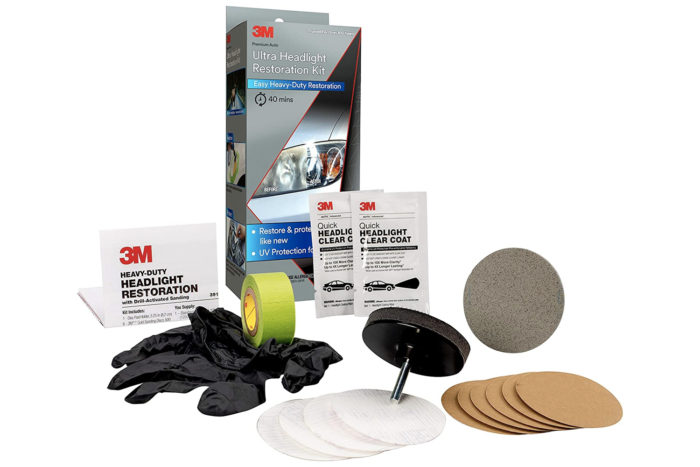
This Ultra Headlight Restoration Kit from 3M ($19) includes almost everything you need to remove years of haze. The only things you need from your garage are a cordless drill (or DA orbital) plus an hour of your time.
We removed years of oxidation from a 2012 Mazda3 typically garaged at home. The owner had the headlight lenses cleaned up by the local dealership about 5 years prior, but the unforgiving sun brought back the cloudiness.
Since this is a kit put together by 3M, they include a couple of indispensable materials: a small roll of their green automotive performance masking tape and a Trizact sanding disc. The remaining contents of the kit include several types of sanding discs (P200, P500, and P800), a disc pad holder drill attachment, a nitrile glove, and 3M Quick Headlight Clear Coat wipes.
What makes the Trizact disc special is its 3D-patterned, precise mineral structure, which delivers a fast cut and consistent finish. Equivalent to a 3000-grit sanding disc, it’s used in the final step of polishing to remove abrasive marks and super-fine scratches.
The green automotive performance masking tape will stick even if it gets wet during the sanding process and doesn’t leave behind a sticky residue. It also helps prevent accidental damage, so we always mask the area surrounding the headlights as standard practice. Yes, it takes extra time, but it’s the first line of defense if the spinning disc pad holder happens to touch the paint.
During our process, the Mazda3’s lenses were sanded and polished until smooth but left with a cloudy haze. Two coats of the 3M Quick Headlight Clear Coat were needed to restore clarity and achieve the best results. Bubbling of the liquid will occur if you apply too much with each swipe. Allow the first coat to dry before applying the second coat. Don’t get disappointed if the first coat doesn’t look brilliant, as the second pass will clean things up and restore the clarity to almost new.
The Ultra Headlight Restoration Kit gave us professional-grade results and is easy enough for first-timers to use. Restoring a set of heavily oxidized lenses requires a little less effort than the Sylvania kit, which was the most labor-intensive of the kits tested. Thankfully, we won’t have to repeat the process down the road if the warranty is an indication of how long the coating will last.

How to Evaluate Tech and Diagnostics Tools
Modern car accessories increasingly rely on technology, and choosing the right device often means balancing convenience, reliability, and long-term usefulness. Whether you’re considering a phone mount or an OBD2 scanner, the best options integrate cleanly into your vehicle.
Phone mounts illustrate this balance well. The most effective designs place your device within easy reach while keeping it out of your line of sight. Custom mounts can provide a cleaner fit because they are engineered for specific dashboards or vents, but universal mounts can work just as well if they use sturdy materials and offer enough adjustability to fine-tune position and angle.
Stability and build quality matter more than aesthetics; a mount that feels solid and uses metal components rather than flimsy plastic is far more likely to hold up over time. Ease of installation, the ability to remove the mount without damaging it, and optional charging features also influence how useful a mount feels in day-to-day driving.
Peak Design Car Vent Mount
Specifications
Pros & Cons
Pros
- Minimalist design with premium materials
- Easy to install and adjust
- Includes USB-C charging cord and 12V car adapter
- Routing clips minimize stray cords around dash
- Non-charging version available for $35 less
Cons
- Expensive
- May require a Peak Design case or universal adapter
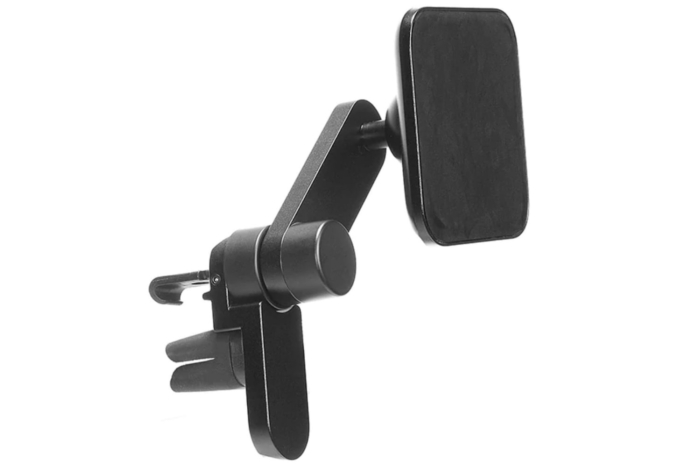
Although we hesitate to describe any car phone mount as sexy, the Peak Design Car Vent Mount ($100) sure gets close. It sports a minimalist design. And despite its diminutive stature, it has a weighty, premium feel in the hand, thanks to its anodized aluminum construction.
Installation was a breeze. We hooked the retractable arm onto an upper vent slat and tightened the rear control knob as we slid the rubber brace onto a lower vent slat. That was pretty much it. The rubber brace can slide up and down, accommodating air vents with various spaces between the slats. But this system — as with most vent mounts — doesn’t work with curved or criss-crossed vent slats, or on the dental-floss-thin air vents found in Teslas.
Although this sturdy mount works right out of the box with MagSafe-compatible phones and cases, the magnetic connection is especially strong when using one of Peak Design’s cases with its proprietary SlimLink locking system, which was primarily how we tested this product.
If you love your current case but want that stronger magnetic sticking power, you can pop on Peak Design’s Universal Adapter (which we didn’t test). The caveat is that “wireless charging may not be possible or optimal.”
In terms of adjustability, both of the unit’s control knobs are easy to use, but they are so flush to the mount’s body that we almost missed seeing them. The forward knob adjusts the arm’s tightness so it can swing the mounting pad into an ideal viewing position.
When it comes to tilting, unlike other units, this one does so without needing to loosen and tighten an awkward knob on the backside of the phone holder. Peak Design has apparently found the amount of tension necessary for the assembly to stay perfectly stable under the weight of a phone and still allow manual tilting as needed.
That may seem like a little thing, but it shows how much engineering went into the Peak Design Car Vent Mount. If you’re willing to pay the premium price for that level of thoughtfulness — whether for this or the less expensive non-charging version — this is the phone mount for you.
Baseus Joyride Pro Series Car Backseat Mount
Specifications
Pros & Cons
Pros
- Very inexpensive
- Super simple to install
- Accommodates a wide variety of device sizes
- Easy to angle and extend
Cons
- Can be hard to find online
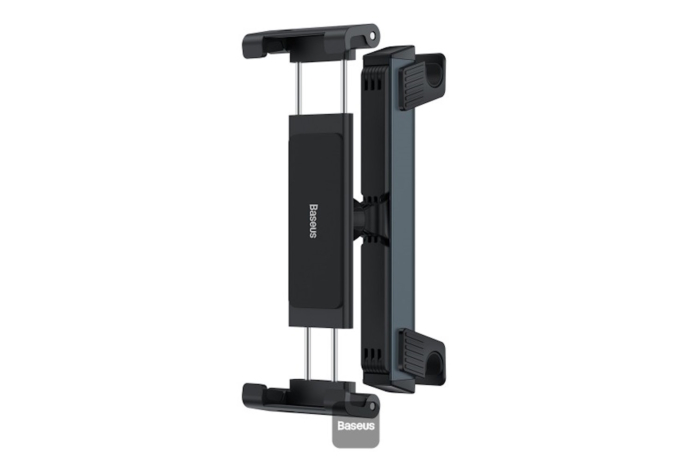
At least among backseat denizens, the Baseus Joyride Pro Series Car Backseat Mount ($14) has the magical ability to create peace in the universe. It can deftly hold mobile devices with 4.7- to 12.9-inch diagonals, which covers most phones and tablets available today.
The word “installation” seems a bit strong to describe the setup process, which simply involves squeezing the spring-loaded holder and snapping it into the headrest bars. From there, you could lower the headrest to stabilize it, but it doesn’t need the help.
Besides its laughably low price tag, we were most impressed with how adjustable this mount is. It can slide side to side, pull forward or push back, and swivel 360 degrees (for portrait or landscape viewing).
Unlike the Peak Design Car Vent Mount, this one has the usual control knob in the back that adjusts the tension, allowing you to tilt your device in the stand. Once you’ve found that happy angle, it’s plenty stable. And easy enough to readjust.
We were already familiar with Baseus for its charging products, but just happened to stumble upon this auto accessory. So, in a sense, it’s not surprising that its Baseus Joyride Pro Series Car Backseat Mount isn’t widely available. But if you’re looking for an easy, affordable, and competent way to hold a mobile device on a headrest, snag this one where you can.

OBD2 scanners shift the focus toward diagnostics, offering insight into the systems that trigger check-engine lights and other warning indicators. At their core, scanners read and clear trouble codes, but more advanced models translate those codes into plain-language explanations and even supply potential fixes.
Bluetooth scanners extend this functionality by pairing with a smartphone app, which often makes the interface easier to navigate and allows access to online databases for deeper research. Many scanners also display live sensor data so you can see how engine components behave in real time, which helps diagnose intermittent issues or monitor performance during a drive.
Wired scanners tend to be straightforward and self-contained, while wireless designs rely on a strong connection and a charged device but offer richer visuals and more flexible dashboards.
OBDLINK MX+
Specifications
Pros & Cons
Pros
- Offers advanced data for Ford and General Motors vehicles (like cooled/heated seats)
- Battery drain and overvoltage protection
- Compatible with IOS, Android, Windows, and third-party apps
Cons
- Limited compatibility with new vehicles 2022 or newer
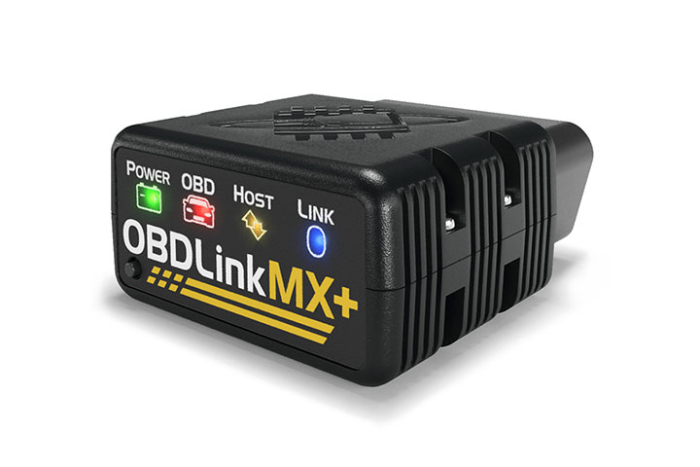
The OBDLINK MX+ ($140) is a top-of-the-line tool for getting all the information possible from your vehicle’s OBD2 port. In a compact design, the scanner is an easy-to-use plug-and-forget system that you can leave in your OBD2 port 24/7, thanks to the battery drain and overvoltage protection. Additionally, this piece claims to be hacker-proof using a unique security mechanism that prevents unauthorized access.
We found the MX+ to deliver the most information for our vehicle. While diagnosing, the codes were clear to read and understand. The device also generated detailed trip reports and logs that were filled with hundreds of parameters — like fuel consumption — ultimately providing more metrics than any other scanner we tested. For many late-model General Motors, Ford, Mazda, Nissan, and Toyota vehicles, including our test rigs, we were able to read and clear the codes of advanced automotive networks like airbags, anti-lock braking systems, tire-pressure monitoring systems, and more.
What also set the MX+ apart was its ability to connect with third-party apps. This computer is compatible with hundreds of apps that unlock enhanced performance, let you change vehicle settings, remote start the engine on select vehicles, and even connect with electric vehicles for diagnostics. On top of the enhanced log data and graphs, there is an additional heads-up display mode that offers 13 different preset parameters, which are readable in straightforward gauges on your phone or tablet screen. This component expands the data you can live monitor while driving.
For off-street driving, there is even a performance mode that clocks variables like 0 to 60 miles per hour (performance), ¼-mile time, ½-mile time, and more. For modern vehicles, 2022 models and newer, there is much less compatibility with this scanner. But new vehicles are being added as fast as possible, and software updates are free.
Overall, while this was the priciest Bluetooth scanner we tested, it delivered the most information about our vehicle. The interface was the easiest to keep plugged in for frequent use, and the design was our favorite for monitoring live data. For anyone who wants to get the most possible from their OBD2 scanner, the MX+ is the one for you.
Motopower MP69033
Specifications
Pros & Cons
Pros
- Priced affordably
- Large buttons for ergonomic use
Cons
- Not as feature-rich
- Basic code reader
- Screen isn’t the most clarion
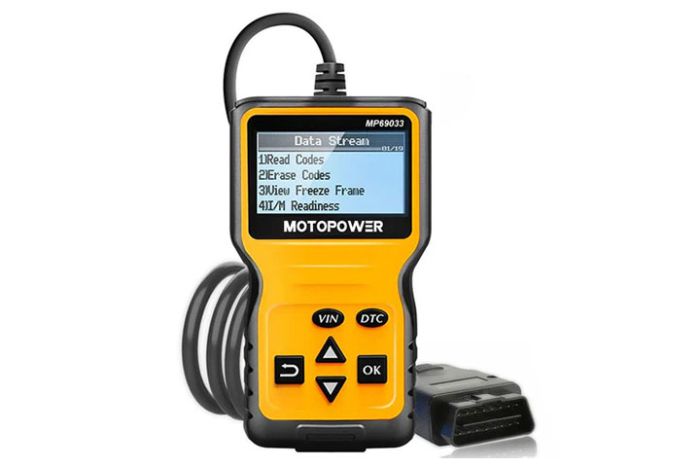
Looking for a basic reader at a bargain? The Motopower MP69033 ($24) is a friendly-priced scanner that won’t let you down. This wired scanner easily connects to your vehicle to read and clear codes. It features large buttons for ease of use and a simple menu of functions.
This plug-and-play OBD2 scanner is relatively small with a 2.8-inch LCD screen that’s in black and white. Its 2.5-foot wired cord lets you plug in under the dash and work from the front seat with plenty of slack. It doesn’t need batteries or to be charged, because it’s powered by your vehicle when plugged in.
Available in six languages and compatible with most modern cars, this design matches many models. What are you giving up? While it does provide live data, the screen can be hard to read, and it only offers one parameter at a time. It doesn’t have some of the features like enhanced diagnostics or full data logs that other scanners have.
But the snazziest technology isn’t for every driver, nor does it always fit the bill. If you want an analog scanner that just works for basic code reading and clearing, look no further than the MP69033.

Safety, Compatibility, and Ease of Use
Across the wide range of car accessories, the most useful products integrate safely into your vehicle and are intuitive enough that you actually use them. Safety is often the first consideration: a phone mount, for example, should keep your device at eye level without obstructing your view, while an OBD2 scanner should operate without interfering with the car’s electronics.
Accessories that attach to vents, dashboards, or windshields need to stay secure under heat and vibration, because a mount that loosens or detaches can create a distraction or even a hazard.
Some categories, such as custom phone mounts, rely on vehicle-specific designs to achieve a clean fit, while others, such as universal mounts or most detailing products, rely on adaptable materials and formulations.

Even tools like OBD2 scanners must match your vehicle’s protocol and offer the right connectors or software support, especially if you want to read ABS or airbag codes.
Scratch-removal compounds and headlight restoration kits also benefit from compatibility. They must be suited to your car’s clear coat or polycarbonate lens so they correct defects without causing new damage.
A detailing kit that requires complicated steps or unfamiliar tools is less likely to become part of a regular maintenance routine, and a tracker that demands constant charging defeats the purpose of long-term monitoring. Likewise, a safer mount or cleaner is one you can position quickly and confidently, and a scanner that presents codes clearly helps prevent misdiagnosis.

Environmental & Durability Considerations
Durability and environmental impact are increasingly important when evaluating car accessories, not only because these products often operate in harsh conditions but also because they influence your vehicle’s lifespan and the waste you generate over time.
Accessories designed for outdoor use, such as car covers or even headlight-restoration coatings, must withstand UV exposure, temperature fluctuations, and moisture without degrading or losing effectiveness. Materials that resist fading and cracking tend to last longer, reducing the need for frequent replacement and keeping more products out of landfills.
Breathable fabrics for covers, for example, prevent condensation and mildew while still protecting paint, and high-quality linings reduce abrasion that can cause micro-scratches.

A well-constructed detailing kit or a durable polisher can serve for years, especially when paired with gentle, paint-safe formulations. Similarly, premium phone mounts made with metal components rather than brittle plastics resist wear and sun damage, extending their usable life.
Environmental considerations also extend to the broader footprints of the products. Accessories that help maintain a vehicle by preventing rust, oxidation, or mechanical problems support longer vehicle lifespans. While many products still rely on synthetic materials, choosing items that last longer or incorporate recyclable components aligns with a lower-waste approach.
Frequently Asked Questions
The best material for covering a car depends on your specific needs and the climate where you live. Here are some common materials used for car covers:
- Polyester: A popular choice for indoor car covers due to its softness and breathability. It’s also lightweight and easy to handle.
- Polyester blend: Polyester with other materials like acrylic or cotton can enhance durability and water resistance.
- Polypropylene: Ideal for outdoor use as it’s water-resistant and provides good protection against UV rays.
- Nylon: Delivers good protection against moisture and is lightweight, making it easy to handle.
- Microfiber: Provides excellent protection against dust and scratches, making it ideal for indoor use.
- Vinyl: Offers heavy-duty protection against water and UV rays but may not be as breathable as other materials.
- Multi-Layer: Covers with multiple layers of different materials offer superior protection against various elements.
If you take your car to a professional, a basic car detailing, which usually includes a wash, wax, vacuum, interior polish, and tire cleaning, will cost in the range of $50-125 for a car and $75-150 for an SUV, van, or truck. Additional or upgraded services will cost more.
Specialty automotive detailing shops will spend hours to days working on a single vehicle, depending on the level of service requested by the customer. Of course, the cost will coincide directly with the number of work hours.
If you choose to detail your car yourself, after the upfront cost of investing in a car detailing kit, you will find that with a little time and elbow grease, this is by far the more cost-effective way to keep your car clean.
That’s a bit of a conundrum. The more visible the phone is (such as hanging off the rear-view mirror), the more it blocks the driver’s view. The less visible it is (such as in a cupholder mount), the more the driver has to focus away from the road.
So where it’s safest to mount a phone in the car is a balance between not blocking the view of the road, yet still being somewhere near the driver’s eyeline. That’s why phone holders mounted to the dashboard and air vent are so common. They allow the driver to see their phone screen by glancing their eyes, as opposed to turning their head.
But regardless of where a phone is mounted, the ideal is to give as little attention as possible to your phone while driving, in favor of concentrating on the road conditions and where you’re going.
OBD stands for onboard diagnostics, which refers to a standard protocol across most light-duty vehicles to retrieve vehicle diagnostic information. Simply put, this scanner talks to your vehicle’s computer.
From here, the contraption can use that connection to read and clear check engine lights or codes. Certain ones can take the data from the vehicle and apply diagnostics to show possible causes and fixes.
Some designs also have the ability to measure driving behavior or show real-time data from the vehicle.
Well, you won’t remove any scratch that is through the pigment layer or into the primer. That’s a job for a detail or body shop that will touch-up paint that spot. Even then, blending that perfectly is nearly impossible. But as we’ve said throughout, using a drill-based polisher — especially our 3M choice with a light sanding first — can do wonders for minor scratches that just slightly penetrate the color layer.
Though you may have heard of people using various other options to clean their hazy headlights (including sandpaper, toothpaste, vinegar, polish, and insect repellent), we recommend buying a dedicated headlight restoration kit.
There are many affordable options. These kits will ensure you get the best results without further damaging your headlights.