Gear for Trekking Nepal

By STEPHEN REGENOLD

For three weeks in April, I put my entire life on hold to trek in the Khumbu Region of Nepal. As a part of Expedition Hanesbrands, a major mountaineering initiative led by Canadian climber Jamie Clarke, I trekked for more than a week to reach Mount Everest Base Camp. The 17,500-foot tent city, which sits in a glacial field at the base of the world’s tallest peak, would serve as the launch pad for the climbers’ lofty 29,035-foot goal in the sky.
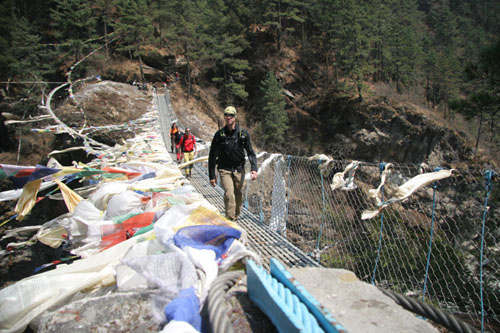
Nepal Trek photo 2.jpg

The author crossing a river on the trek

Though I was officially working — I was hired as the communications director for the first leg of Expedition Hanesbrands’ climb — the trip followed a similar trajectory that trekkers traditionally take to reach Base Camp, including a flight from Kathmandu to Lukla, and then eight days of hiking uphill village to village to acclimate to the increasingly thinner air en route to Base Camp.

Between my duties of blogging, posting videos, and shooting photos for the expedition’s web site, Climbwithus.com, I had time to do day hikes, climb an 18,600-foot peak near Base Camp, and hang out with local Sherpas in lodges and tents along the route. In mid-April, I stumbled into Mount Everest’s Base Camp, a slight altitude headache accompanying me to my tent in the middle of a sea of ice and jumbled stone.

Climbing Mount Everest is an obvious achievement. But just trekking to Base Camp is a feat that requires strong lungs, leg muscles that can go for hours uphill, and a physiology that will adapt to air that suffers a significant deficit in the oxygen department.
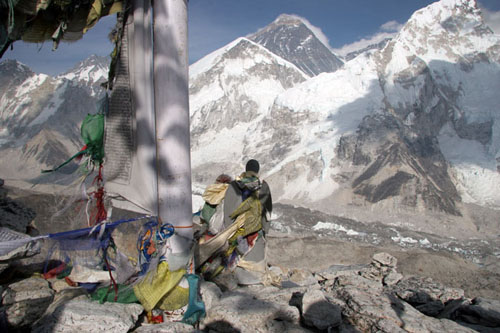
Nepal Trek photo 1.jpg

View of Mount Everest from Kala Patthar, an 18,600-foot satellite of the world’s highest peak

Altitude, not distance or terrain, was the main hurdle on my journey. The trek began at about 9,000 feet in the village of Lukla. It topped out at Base Camp with stops to sleep at 11,000 feet, 13,000 feet, 16,000 feet, and higher along the way.

Trekkers sweat and breathe hard on the trail, the thin air resulting in headaches and fatigue. You move slow. You stop often. In some villages, a planned rest day keeps you at the same lodge for two nights in a row.

The right equipment keeps you going. For gear, I used mainly common backpacking items, including a mid-size pack and trail-running shoes, not boots, most of the way. One thing I did not bring, a dust mask, is highly recommended. Trekkers, porters, and yaks kick up clouds of dust on the dry trail. Inhaling the particulate results in something known locally as the Khumbu cough.
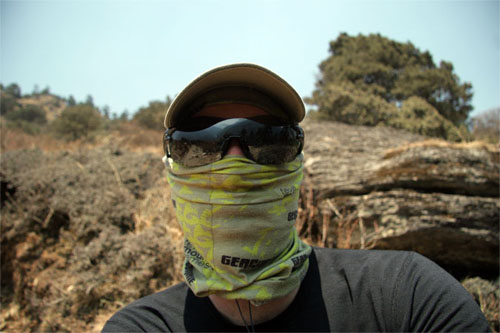
Nepal Trek photo 3.jpg

High-altitude sun and trail dust necessitated mouth and eye protection

Instead of a mask, I wore a Buff scarf pulled up over my face. The thin Buff fabric did a good job filtering dust, though it was often too warm and would fog my sunglasses if I breathed too much out of my nose.

continued on next page. . .

Shop the Gear Junkie store »
Commenting on post : Gear for Trekking Nepal
Posted by Alex - 06/11/2010 09:14 AM

I’d add one more small but essential piece of gear to your list for anyone trekking to base camp: lotion! With the dry air and the sniffles it causes, your hands and especially your nose get REALLY dry. At least mine did. Every evening I’d slather on the skin lotion. My trek-mates all had dry, cracked nostrils by the end of the trip. Mine were soft and supple… :)

Posted by Pat Smith - 06/16/2010 01:04 PM

Alcohol gel in a small bottle at the hip belt is important to help avoid gut bugs. It made a big difference for us after it was introduced compared to friends trekking the year before.

Posted by Scott - 06/16/2010 02:59 PM

Is that a Gear Junkie Buff?? I’m also curious as to which Duofold you used….

Posted by willy - 06/17/2010 12:58 AM

I went to Makalu base camp 18 years ago, one of the greatest trips of my life. No problem with dust. Like you, I should’ve left the boots at home (mine actually were stolen on the return and I walked 3 days through the mountains barefoot!). Two of us carried our own packs, 2 porters carried food, 1 cook carried the kitchen stuff and there was a guide carrying his own gear. Backpack weight was the biggest problem. I often wonder whether I could do it with a pair of barefoot-style shoes such as the Merrills you just wrote about, if I kept my overall load light. Maybe next time.

Posted by Stephen Regenold - 06/21/2010 09:31 AM

Scott — Yes, a GJ Buff! Re Duofold, we used the Varitherm wool hybrid base layers. Great tops/bottoms and good price (about $40, as compared to twice as much from other wool base-layer makers).

Posted by Nepal Treks Sanjib - 01/30/2012 05:16 AM

Recently we returned from a four-day trek with a friend in the Annapurna Himalayan range. Boasting spectacular scenery, rugged terrain and extremely welcoming locals, I’ve never visited another place on earth like Annapurna.
Helping us get the most out of our trek was our friendly and knowledgeable guide Sanjib Adhikari, a specialist trekking guide and expedition organizer based in Thamel, the bustling heart of Kathmandu. He skillfully guided us across treacherous mountain passes, pointed out the rich variety of flora we passed and, in the evening after hiking, served our meals and played cards with us.
Knowing that there are quite a few other less capable and experienced guides than Sanjib, I’d certainly recommend him to other trekkers. His website is: www.nepalguideinfo.com
www.hikehimalays.com
www.nepaltreckingguide.jimdo.com
sanjib-adhikari@hotmail.com

Read more: http://www.virtualtourist.com/travel/Asia/Nepal/Things_To_Do-Nepal-Trekking-BR-1.html#ixzz1kw1O2Y2D

Add Comment

  1. Add link by using "LinkText":http://google.com
« Back to the Blog