The 1Up Heavy Duty isn’t just another tray-style hitch bike rack: It’s a statement piece. For those of us who drive backroads like we rip a good downhill, we know getting to the trailhead isn’t always a Sunday drive. It usually involves bouncing along a dirt road filled with potholes. So, for riders who invest as much into their shuttle rig as they do their bike, a good bike rack is a make-or-break: It’ll be a daily driver or a full-on overland build.
Matching a daily driver rack to my F-150 Raptor, which is designed for rough roads, I needed a rack that could keep up — that I wouldn’t have to slow down with just to preserve my bike. After testing the 1Up Heavy Duty, I finally found that match.
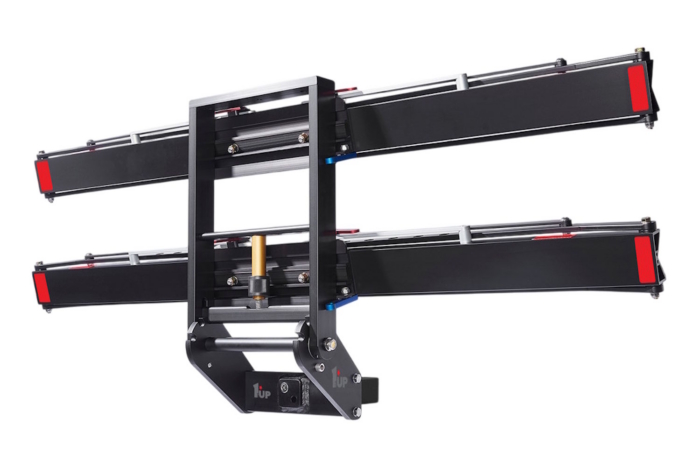
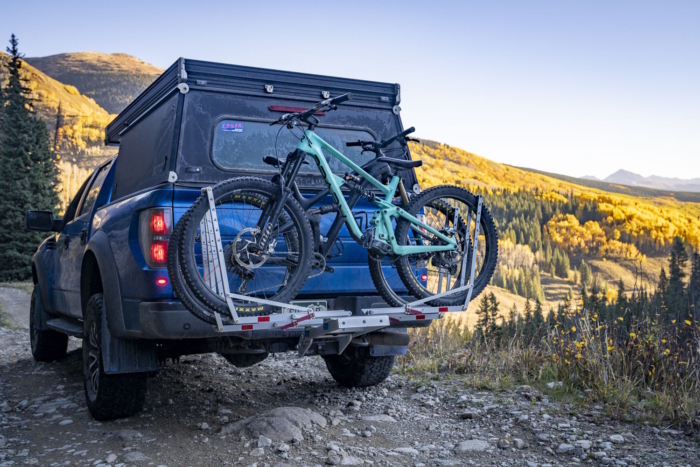
In short: The 1Up Heavy Duty ($750 for the two-bike model) is a purpose-built rack for riders who spend more time off pavement than on it. It’s tough, dependable, and rock-solid. With a few add-ons, it transforms into one of the most capable and customizable bike racks out there. It’s made for riders who regularly traverse dirt roads, washboards, stream crossings, and venture to remote trailheads.
Check out our other top picks in the Best Hitch Racks buyer’s guide.
-

-
(Photo/Eric Phillips)
-
(Photo/Eric Phillips)
-
(Photo/Eric Phillips)
Specifications
Pros & Cons
Pros
- High ground clearance for off-roading
- Highly durable materials
- Anti-wobble feature perfect for rough roads
- No assembly required — rack comes ready to go out of the box
Cons
- No integrated bike locks
- Rack-tilt bar can be hard to reach and pull when loaded
1Up Heavy Duty Rack Review
Bike Attachment System
The main job of any bike rack is simple: to hold your bike securely without chewing up your frame. The 1Up Heavy Duty nails that brief and then some.
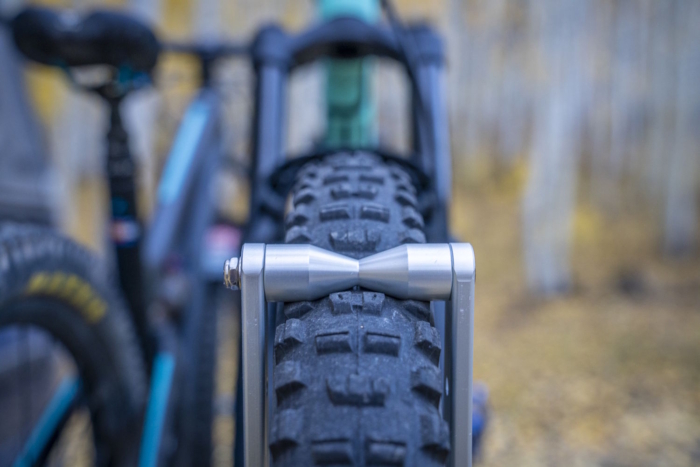
My entire fleet of bikes cinched in with the same confidence-inspiring clamp. Nothing rattled, nothing rubbed, nothing felt sketchy. That collection included my 20″ BMX to my 650B gravel bike, two mountain bikes (27.5″ and 29”), and even my 26″ fendered fat-tire commuter e-bike.

Instead of cradles or frame contacts, this 1Up uses two stout, anodized articulating arms on each tray that clamp directly onto the tires. It’s a clean, scratch-free system that feels almost overbuilt (very on-brand for 1Up). Operation is intuitive, too.
Easy-to-Use Release System
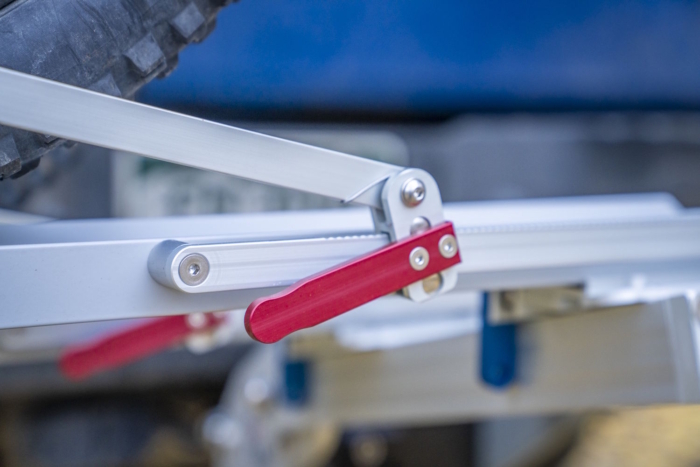
As someone who has worked with helicopters in search and rescue, red has always meant “release,” like the door latches on a CareFlight A-Star. The 1Up follows that logic: one red anodized lever cracks the ratchet open, and the whole mechanism feels industrial in the best way. The exposed aluminum ratchet is oddly satisfying to work with — like gear you trust, because you can literally see how it works.
For trips on pavement, a few pounds of pressure is enough to seat each arm. But when I headed for dirt roads, I’d give the arms an extra shove until I heard that last reassuring click. The bikes didn’t budge. When unloading, giving the arm a little push into the tire before pulling the lever made the release noticeably easier.

The standard arms swallow up to 3-inch tires. Though, with an additional fat bike spacer kit for $38, it will fit up to 5-inch tires. The only real gripe? Adjusting the wheel-size spool requires a ½-inch wrench, whereas racks like the Küat Piston ION let you dial adjustments tool-free. That said, the 1Up spool does offer seven positions for different tire sizes and fender options.
Lastly, each bike tray is rated up to 65 pounds, meaning it will hold pretty much your entire quiver, including light e-bikes. That rating drops to 45 pounds for trays 3 and 4, if you’re using the add-on trays. For those looking for a beefier e-bike rack, 1Up makes a Super Duty at 100 pounds per tray and Xtreme Duty at 150 pounds per tray.
Off-Road Features: Ready for Adventure

I can’t tell you the number of times that while driving through stream crossings, or on double-track while trying to find a remote camp spot, with bikes on the hitch rack, that I have heard the unpleasant sound of smashing my bike rack on the ground.
The best mountain bike trails often don’t come with paved parking lots — or even parking lots at all. As someone who drives a very capable overlanding truck, the last thing I want to do is limit my Ford Raptor’s off-road capabilities with a bike rack.
What really sets the 1Up Heavy Duty rack apart from other racks I have tested are some of the off-road–friendly features. First and foremost, that includes the ground clearance and departure angle.
Roomy Departure Angle
For those not familiar with off-roading, the departure angle is essentially a line from the bottom of your rear tires to the furthest part of your vehicle, or in this case, a bike rack. A larger angle means you can drive up a steeper angle without scraping the ground.
Even when taking the rack to Hartman Rocks Recreation Area and doing some moderate rock crawling, I wasn’t able to bottom out this rack. Despite this, the heavy-duty build quality gave me confidence that, in the event I did smack the rack on the ground or a rock, it would handle the impact without issues.
Anti-Wobble Design
Another key feature for off-roading with a bike rack is the ability to take the wobble out of the hitch. 1Up has solved this with a corner-expander ball in the front of the hitch. Simply insert the hitch into the receiver, and then tighten it into place, reducing the wobble. Eliminating the wobble of the hitch gave me extra confidence to power through washboards, bumpy roads, and anything else I could find on the way to the trailhead.
By the end of the season, I put over 100 miles on this rack on washboard and pothole dirt roads around Gunnison, Colo., where I was intentionally aiming for the potholes without slowing down. My goal was to shake the rack loose within my hitch. I wasn’t able to loosen the rack, though 1Up does recommend periodically tightening the anti-wobble feature, as well as removing it once every few weeks to avoid it seizing in the hitch.
Assembly: Easy

The Heavy Duty Rack came fully assembled in the shipping box. No assembly was required other than pulling a lever and moving the rack from a compact storage position to a fully open position. Installing the rack was a breeze thanks to the included locking hitch pin. Securing the sway was as easy as tightening the bottom of the rack into the hitch.
All in all, it took 5 minutes total from starting to unbox to fully bolted, into the hitch, and ready to load bikes. That makes this an easy-rated install. The overall assembly score is 8.5/10. Integrated bike locks and an easier-to-actuate tilt bar would make this a 9.5.
Assembly and Add-Ons: Critiques

One thing I love about the 1Up Heavy Duty: it shows up ready to roll. No assembly, no bolt bags, no afternoon spent translating IKEA-style diagrams.
The rack arrives in “storage mode,” which keeps the footprint tight right out of the box. Flip each tray open with the blue release lever, slide the rack into your hitch, lock it in place with the included hitch lock, crank down the anti-wobble system with the security wrench, and you’re loading bikes in minutes.
That said, “ready to go” doesn’t mean “fully featured.” A few things I consider essentials are notably absent. And while 1Up sells add-ons to fix every one of them, it does mean you’ll be spending more.
Missing Integrated Bike Locks
The biggest omission is integrated bike locks. For me, I’ve spent years rolling around with bikes that cost more than the truck carrying them: security isn’t optional.
I really wish 1Up had included a built-in locking system that was keyed the same as the hitch. Instead, you’ll need to add your own $52 cable lock or a far more confidence-inspiring $165 chain lock, both available from 1Up.
Room for Improvement: Tilt-Release Handle
My next gripe is the tilt-release handle. The small black lever works, but using it feels awkward. You have to reach under the rack, pull blindly, and hope you’re applying even pressure. Clearly, 1Up knows this isn’t the smoothest design because the company sells the “EZ Pull Handle” upgrade for $99. It fixes the issue, but again, it’s an upsell.
There’s also an optional Quik Slide ($49), which addresses the wheel-size spool adjustment quirk I mentioned earlier, plus a whole lineup of smart accessories: license plate brackets, swing arms, fat-tire spacer kits, and even expansion trays. In fact, the Heavy Duty can scale all the way up to a four-bike setup, which is a big win if your riding crew grows.
So yes, the rack is absolutely dialed from the factory. But if you want the full premium experience, expect to tack on a few upgrades. If anything, it highlights the Heavy Duty’s modular DNA: 1Up gives you a rock-solid platform and lets you build the rack your way or fix parts when they break.
Conclusion

As someone who treats their vehicle like a rolling project — always tweaking, upgrading, and dialing it in for the way I actually use it — the 1Up Heavy Duty fits right into that mindset. On my Raptor, it looks and feels like gear that belongs.
It’s all anodized aluminum, zero plastic fluff, and a design that’s meant to work hard, not just look pretty (though, it does look good). And it has performance that backs it up.
Whether you’re in a Subaru Outback hunting trailheads or a fully built Tacoma crawling toward a remote campsite, this rack’s ground clearance, rigidity, and off-road stability make it a legit choice for anyone who spends more time on dirt than pavement.
And if you’re willing to invest in a few add-ons, the Heavy Duty becomes an even more dialed system: secure, modular, and tailored to the exact way you ride. In a world full of hitch bike racks that feel like afterthoughts, the 1Up Heavy Duty feels like a real piece of kit that’s built to perform, built to last, and built for the way mountain bikers actually use their trucks.