Weirdly, the least interesting thing about the 2027 Polaris RZR Pro R Boost is that it makes 275 horsepower. Making 275 horsepower isn’t hard, especially with the RZR’s engine size. But if you think it’s an exercise in pointless marketing, you’re only half right. We’re currently in a golden age for side-by-sides. And the real excitement is downstream from all this power. Buckle up.
The first problem with the new RZR Pro R Boost is that my initial unfiltered reactions are pretty much unprintable, at least not without requiring a parental advisory sticker. It’s the most powerful production side-by-side ever made, and when you drive it hard, it inspires a lot of swearing.
The previous, naturally aspirated Polaris RZR Pro R was already amazing. When you floored it, it took off like a steer being branded. But because America, it wasn’t enough. There’s an unofficial horsepower war between Can-Am, Kawasaki, and Polaris.
The 2023 RZR Pro R had 225 horsepower. Then the 240-horsepower, turbocharged Can-Am Maverick R debuted in 2024. The supercharged, 250-horsepower Kawasaki Teryx H2 arrived in 2025, and suddenly the Pro R wasn’t the most powerful side-by-side. Or even the second-most powerful. But Polaris had plans for the RZR Pro R, and they were the side-by-side world’s worst-kept secret.
Polaris RZR Pro R Boost: More Than Just Horsepower
With Great Power Comes Great Upgrades
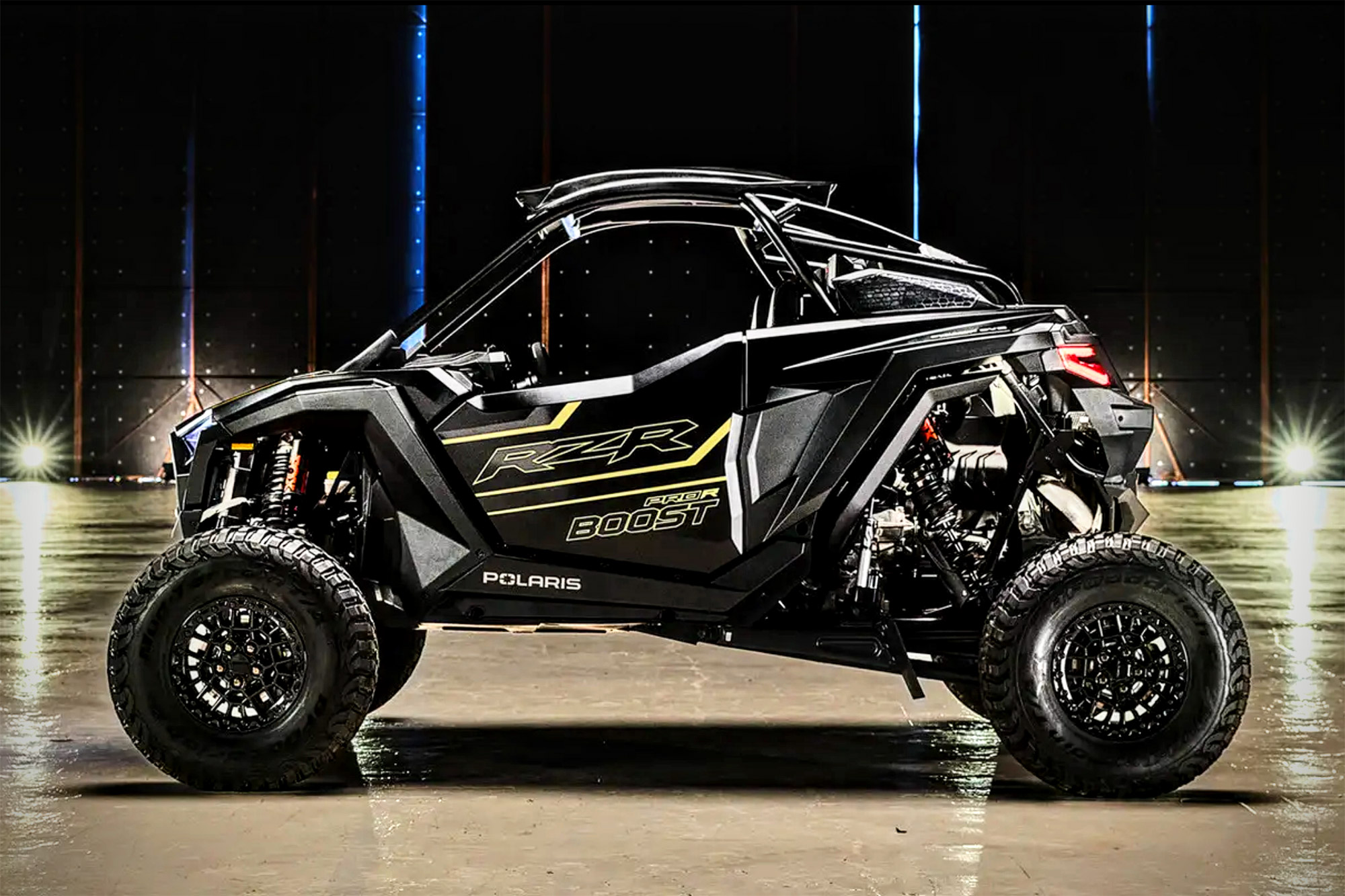
Adding power is straightforward engineering and some quick warranty math. The RZR Pro R Boost stands out because of everything that comes along with the ProStar Fury 2.0L, turbocharged inline-4 engine. It has improved cooling, so you don’t have to worry about overheating when thrashing the RZR in the desert.
There’s virtually no turbo lag, either. Unless you regularly compete at Baja, you’re unlikely to ever push it to its limits. The RZR Pro R Boost is desire and terror with a convenient key fob.
The RZR Pro R Boost isn’t really all brand new; it’s just better in all the ways that matter. Polaris made the cabin cooler by moving the engine radiator to the rear, like a racing UTV. It also used the roof as an open-air scoop to force more air to the rear radiators. Then the engineers kept the front radiator to cool the turbo and transmission.
They also gave the Pro R Boost a bigger, better-cooled CVT belt. There are no secret weapons here. Just smart, simple improvements that make for a faster, more reliable side-by-side.
It all hits the ground with 32-inch Pro Armor Trekker tires on 15-inch cast aluminum rims with beadlocks. These tires do everything well, but deep-sand enthusiasts will still want paddles. The Fox Live Valve X2 shocks get Polaris’s Dynamix active suspension, which actively controls compression and rebound independently in each strut over 200 times a second.
The RZR Pro R Boost Ultra (not the Ultimate) also gets the active sway bar stabilizer, plus upgraded 32-inch BFGoodrich tires. Both start life with dual A-arms up front and trailing arms in the rear. Usable suspension travel is claimed to be 27.0 inches up front and 29.0 inches in back. Four modes (Comfort, Rock, Track, Baja) are available. This is the best side-by-side suspension I’ve ever tested, and that’s saying something.
Boost Beyond Belief

To show off its latest technological terror, Polaris flew us out to Sand Hollow, Utah, and strapped us into a fleet of two- and four-door RZR Pro R Boost Ultimates and Ultras. The idea was to let us experience the Boost at full howl, while letting rock formations and shale walls reveal any turbo lag.
Our morning ride took us up the rock steps of Milt’s Mile to Sand Mountain, where we’d mat the throttle and let it ride. The boost response was impressive as hell.
Later in the ride, we hit endless sand whoops. Sand whoops form, in part, because most vehicle suspension is passive. Over time, thousands of vehicles create depressions after hitting each bump, subtly fulfilling a prophecy of worsening terrain. By sampling the terrain 200 times a second, the RZR Pro R Boost Ultra’s Dynamix suspension compensates by adjusting compression and rebound in real time.
On the RZR Pro R Boost Ultra, the active sway bar provides instant stability in corners or sudden articulation over rocks. You don’t need to stop, disconnect, or adjust the sway bar. It’s unlike anything you’ll experience on pavement. Just point the Pro R Boost at danger and hit the throttle.

Soon after passing processions of Jeeps, Sand Mountain’s 100-foot-tall dunes gave way to basalt steppes and rock faces that demanded low gear. That gave way to fast, single-track trails with huge dirt berms. Misjudging a corner only needed a blip of the throttle and 215 pound-feet of torque to rotate the chassis and correct it.
Weight is usually a bad thing in a high-performance vehicle, but the additional 162 pounds of curb weight added by all the new features is no problem. In fact, when combined with endless horsepower and torque, it adds stability, which is a welcome thing when blasting down a dirt trail at Mach Jesus.
The RZR Pro R Boost made all of us journalists look like geniuses on the trails — that is, until professional racers Brock Heger and Cayden MacCachren gave us rides at their usual Baja pace. Turns out abject terror makes me laugh uncontrollably.
Creature Comforts

Want to listen to something besides your own screaming? Polaris has you covered here, too. The 10.4-inch TFT LCD display, powered by the company’s Ride Command system, features Apple CarPlay, split-screen mapping, Group Ride comms, and visual suspension settings. A 4-inch color display is paired with traditional rotary gauges in the instrument binnacle.
Big, chunky, unmistakable steering wheel-mounted buttons for suspension settings join dedicated switches under the TFT for ride modes. The Rockford Fosgate Stage 4 audio system features a 10-inch subwoofer, which is nice. Hell, even the front seats are heated and cooled — this thing is borderline luxurious. Oh, and you can hose everything off with a pressure washer after your ride, which is handy for cleanup.
Last Obstacle? Price

The 2027 Polaris RZR Pro R Boost Ultimate starts at $49,999 MSRP, and the RZR Pro R Ultra starts at $52,999. Preorders are being taken, with delivery slated for November. That these UTVs cost as much as the average new car is a fact not lost on enthusiasts.
In 2016, the most powerful rig made 144 horsepower and cost $24,999. Do the math. Twice as much power begets a matching MSRP. It’s a tough pill for many folks to swallow, but UTVs now come with engineering, tech, and features once reserved for high-performance pickup trucks like Ford’s F-150 Raptor, so it’s easy to see where the money is going.
If you can write the check, you’re getting what you paid for. As for how I’d spec mine, I’d opt for the Ultra trim with active sway bars. It’s real tech that makes a real difference on wildly varying terrain. Besides, at that point, what’s another $3,000?