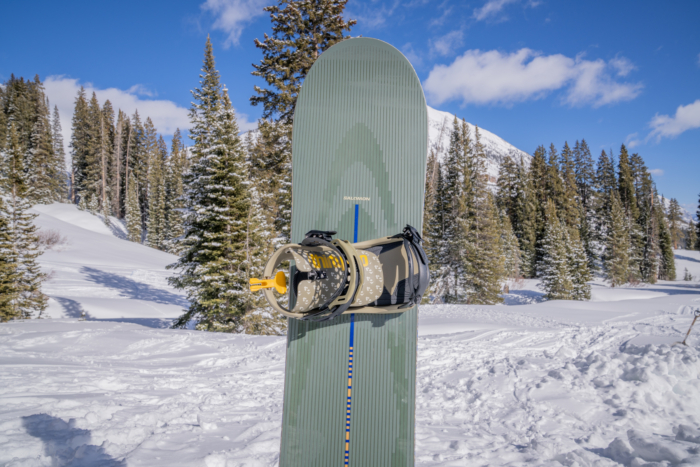
Strapping in at the top of 1,500 feet of untouched powder, my heart began to race. Below my feet was the 162W Salomon Highpath. Today was one of the rare days for me to be riding a solid board in the backcountry.
I was out in one of the few easier snowmobile-accessible areas in my area, having just been dropped off at the top. The line below me wasn’t the longest. The snow depth was only a few inches. But during one of the worst snowpacks on Colorado’s record, I was incredibly excited for those few inches of untouched fresh powder paired with the Highpath’s 267mm waist.
Dropping in, I started very slowly. Then quickly picked up speed as the slope steepened, rolling into an undulating 30-degree slope. My turns felt surfy, like riding a wave, as I traversed the fall line. I opened up, making large turns to contour the slope, even getting a few finger drags on my toe edge.
The wide open, untracked slope was the perfect place for the Highpath. My turns got longer, narrower, and flowier as I picked up speed. This board thrives on high-speed, drawn-out turns, and I consistently feel better the faster I ride.
Navigating to the top of a 10-foot cliff, I scouted to make sure there was a nicely filled-in landing. Then pointed the nose directly down the slope to the takeoff. I loaded the camber underfoot and released a pop, effortlessly floating over the rock band before sending the Highpath to the runout below.
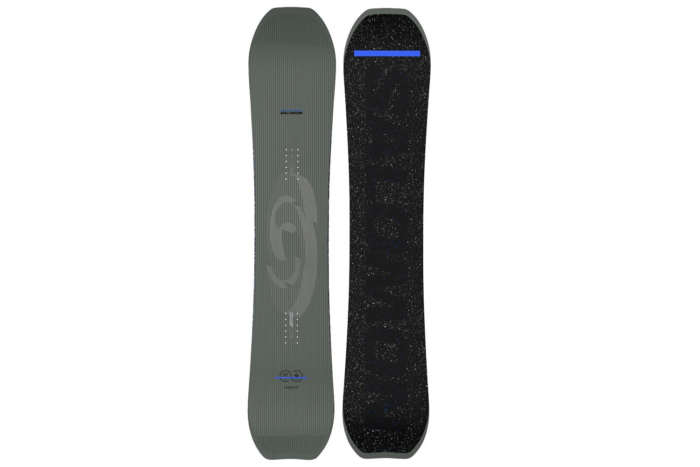
In short: The Salomon Highpath ($700) is an eco-friendly, all-mountain snowboard that loves deep carves on groomers as much as deep powder days. It’s relatively stable through chunder and damps uneven snow well. The board comes alive at mid to high speeds. It offers a smooth, stable, and even snappy ride for bombing groomers or powder fields.
I received the Highpath late in the winter ’25/’26 season, which, for my home mountain of Crested Butte Mountain Resort, was unseasonably warm and featured the lowest snowpack on record for February and March. As such, I didn’t get as much test data as I wanted across different conditions for the Highpath. Most of my test days were in spring conditions. The majority of the inbounds steep terrain was closed. So, I’ll revisit this review with more test data at the start of winter 2026.
Read about other top rides in our Best All-Mountain Snowboards guide.
Specifications
Pros & Cons
Pros
- Volume shifted so you can size down
- Extra width for float in powder
- One of the most sustainable snowboards
Cons
- Not good for beginner or park riders
- Can be catchy at slow speeds
- Feels best when ridden at speed
Salomon Highpath Snowboard Review: Profile, Shape, Flex

The Highpath is a directional board with a tapered nose and slightly swallow tail. It has a 20cm setback, which gives its great performance in pow, thanks to its large nose. The tail, though slightly swallow, is enough for both riding switch and landing switch, but it’s far from a true twin. It has Salomon’s “rock out camber,” meaning the profile has rockered tip and tail, camber underfoot, and is flat between the feet.
The rocker helps its float, and the camber gives it OK pop, but you really have to preload and put your energy in when approaching a jump or side hit. It doesn’t offer the best pop like a full-camber board would, and it requires extra effort to extract it. But the tradeoff comes with its stability.
The board is a solid 7 out of 10 in terms of flex profile. It’s stiff enough to handle most mountain terrain, but not so stiff that it becomes completely unforgiving. When riding the board at slower speeds, the stiffness can be borderline unforgiving, especially when making snappy movements or tight turns, but once you get some speed underneath your feet, all of that goes away.
All-Mountain Stability

Right off the bat, with this snowboard, I could feel it’s not a playful board, leaning more toward stable and damp than nimble and playful. At high speeds and in adverse snow conditions, the board provides a stable, smooth ride. Chunder proved no match for the damping capabilities.
At the end of the day, spring conditions with heavy snow, I was able to power through high-speed drawn-out turns across various slopes, easily blasting through piles of heavy slush. It let me easily take high-speed, uninterrupted turns down both groomed runs and double-black terrain. Perfect for straightlining a runout or high-speed traversing.
The board is just as stable on hardpack as it is in powder. Though I never got a bottomless day on the board, the 3-6 inches of powder I did have a chance to ride. It was very easy to float on top of and maintain speed. I would trust this on a much deeper day, both with its superior stability, rockered and tapered nose, and setback.
Sustainable Features

What sets the Highpath apart from other boards is its sustainability. Starting inside the construction, it uses a FSC-certified wood core, recycled ABS sidewalls, and 20% recycled edges.
Also, it’s built with a 50% recycled base. Instead of using traditional fiberglass, it uses a Bio-Based Resin and an ABC wrapper top sheet.
All of these sustainable materials aren’t just for show and come with the high performance you expect for a top-of-the-line snowboard.
Critiques

After spending some time on the Highpath, I figured out what I liked and what I didn’t.
This board feels best at speed. At low speeds, I did feel the nose was catchier on fast edge-to-edge transitions. Additionally, the board is sluggish at slower speeds and would be no good for a beginner rider. You need to get a moderate speed under the high path for it to feel better. The board feels best and most stable at higher speeds.
At slower speeds, like in tight trees or moguls, the board felt like it took extra effort, requiring me to keep my guard and legs flexed at all times. The board also wasn’t my favorite in the park.
It did OK at jumps, especially when able to take a relatively straight approach, but didn’t like last-second changes or speed checks, especially noticeable with my riding style when chasing side hits across the mountain. All this goes to say the board requires some speed and some effort to extract the high-quality riding it delivers, making it not an ideal board for someone just starting out.
Conclusion: Who Is This Board For?

Overall, I appreciated that this fast-charging, stiff, and stable snowboard is made with recycled materials. This board really shines in a few places: deep, drawn-out carves on groomed runs. At higher speeds. Floating on powder. And powering through adverse chunder.
I didn’t feel I had ideal test conditions during the winter 25/26 season in Colorado, and I will update this review in December 2026 after more time on the Highpath.
Ultimately, my first impression of the Highpath is that it’s best for intermediate to advanced riders who want a stable, smooth ride at speed.