I rolled off the chairlift at 12,130 feet as wind ripped over the ridgeline and snow mist pelted my jacket. I slid my right foot under the straps of the Nidecker LT Supermatic binding, mashed my heel, and heard it click. All set.
A nearby ski patroller watching advised me to “stay in the middle.” I nodded and then dropped into Pallavicini, a 1,329-vertical-foot, roughly 40-degree incline at Arapahoe Basin.
As I made sweeping turns across a gully, the binding straps hugged my ankles and toes, and the baseplate responded but didn’t chatter. I dodged rocks and drops before arriving back at the lift line. Then, I leaned over, pressed a lever with my thumb, and popped my right foot out of the binding.
Time for another.
Snowboard bindings this convenient don’t typically have this level of performance. But the Supermatic does. The Nidecker LT Supermatic’s step-in binding blends a high-spec build with the ease of fast entry, for riders who want to charge without interruption. Here’s how it performed through weeks of winter testing in Colorado.
In short: The Nidecker LT Supermatic ($480) is a fast-entry and -exit snowboard binding with the traditional feel of strap bindings. But the LT isn’t just about convenience; a responsive baseplate, a new highback, and revised straps make it a more high-performance variant of the OG. Though there’s room for improvement, it’s a binding that can handle most terrain and makes for easier days on the hill.
Check out our guide to the Best Snowboard Bindings.
-

-
(Photo/Mark Reif)
Specifications
Pros & Cons
Pros
- All-mountain versatility
- Seamless entry/exit
- Comfortable, supportive straps
- Sleek design
Cons
- Weight
- Cushioning
Nidecker LT Supermatic Snowboard Bindings Review

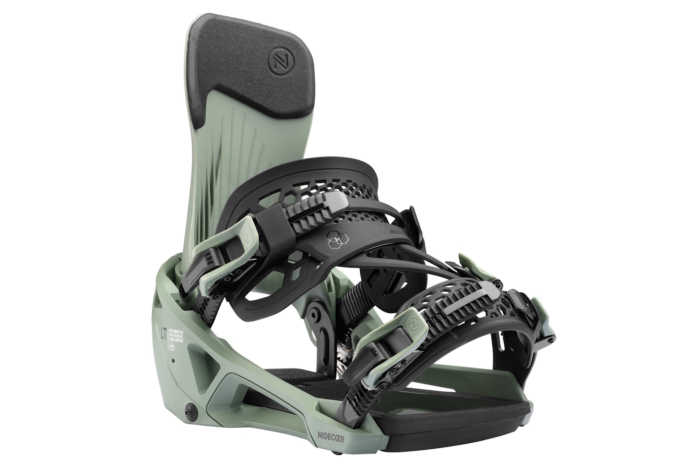
New for this season, the LT Supermatic builds on the success of the OG version, released in winter 23/24. Key to the design is Drop IN Tech, which allows entry and exit in about one second. The highback autoengages as you step into it with Drop IN Tech, and Active Strap tech automatically lifts the straps at release.
On its website, Nidecker describes the LT as “Leaner,” “Meaner,” “Powerful,” and “Aggressive.” Compared to the OG, the LT is stiffer, with a flex rating of 4/5 (OG is 3/5). Other upgrades include a highback designed for “englobement” of the lower leg, low-mass pro straps (with interchangeable toe straps for a customized fit), and an upgraded Slip-N-Grip pad to better catch the boot as it connects to the base.
The binding has a mid-stiff baseplate made from 30% glass fiber and 70% nylon. The LSR 2.0 Auto-Lock ratchets now lock in place, and the Nylon +S Ultraback has enhanced support.
Testing the LT Supermatic

I wanted to test the LT for convenience and performance across demanding terrain. Sure, the binding might allow easy ingress/egress. But performance is what makes or breaks a snowboard binding system.
So, I took the Supermatics on a freeride adventure around Colorado. Over 3 days at Arapahoe Basin, Copper, and Vail, I rode for over 13 hours and covered about 78K vertical feet.
At A-Basin, I slashed down Humbug’s natural gully. Copper’s Atlantic Cornice tested my big mountain chops, with a 25-degree incline and heavy leftover snow. On a powder day at Vail, I flowed down Baccarat’s open swaths, searching for stashes in the trees.
I’m 6’1”, 180 pounds, and rode size XL bindings, 11.5-sized thirtytwo Austen Sweeten BOA boots, and a Jones Howler 163W freeride snowboard.
Entry & Exit

My initial step into the LT Supermatic was delightful. My forefoot slid forward, and then there was a light click as the highback locked in place.
But getting there required a proper setup.
First, one must conventionally strap in and adjust the straps to a snug, not tight, setting. A middle strap, designed to hold the others in position, is set slightly loose. I found proper adjustment essential, as tight straps resulted in sticky entry and exit.
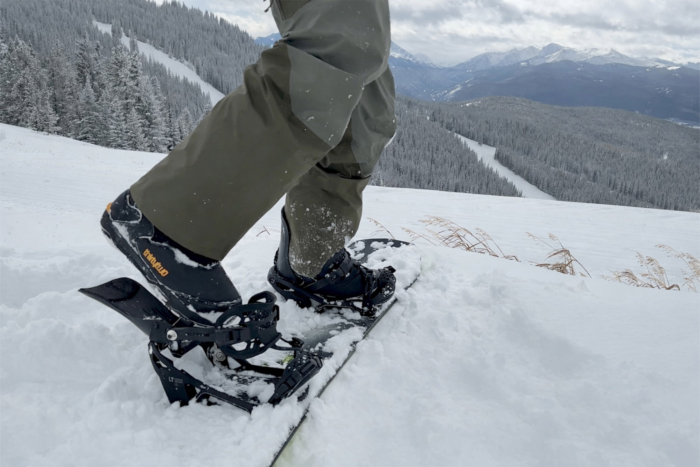
To enter, the rider slides their forefoot under the straps, where a roughly 3×5-inch, gloss-black panel on the baseplate eases entry. Vertical grooves on the highback then guide the heel onto a metal roller in the heelcup. From there, the rider presses down on a stirrup, which locks the highback in place. A quick press of a thumb lever releases the highback and boot.
These bindings are easiest to enter when on flat ground. I found it’s also important to clear snow from the baseplate before entry.
If you’re on an incline or in deep powder, you can still use the straps conventionally, too. The design leaves that option open to the rider.
Comfort Over Long Days

Until I tried fast entry/exit snowboard bindings, I never realized how tedious conventional strap bindings were. Imagine going on a run and having to retie one of your shoes at every mile. On the mountain, those repeated sit-downs, adjustments, and releases turn play into work.
A binding like the LT Supermatic changes that, with the foot gliding onto the baseplate, a quick kick, and it’s time to ride. Every time I exited a lift, like Pallavicini at A-Basin, I could better focus on the terrain and where to make my drop. Or, arriving at the liftline, quads burning, I could simply press a button and be on my way.
Performance Across Terrain
Aside from convenience, the Supermatic LTs proved themselves to be versatile, high-performance bindings. Key to that were its mid-stiff baseplate and web-like straps.
Some baseplates are too stiff, offering a responsive yet choppy ride. Nidecker found the right formula, as the LT relayed inputs, yet never chattered on uneven surfaces. Morning groomers were a delight, as I carved wide arcs on Copper’s Rhapsody, locking in the edge and powering across crusty corduroy.
I also loved the TPU toe and ankle straps, composed of a hexagonal web, which enclosed and hugged my feet. The material was at once rigid and flexible, offering the hold I needed in tricky situations.
Room for Improvement

Weight Compared to Other Bindings
When I unboxed these bindings, they felt a little heavy. So I took them to the local UPS store, along with competitors including the Jones Mercury FASE and the Burton Step On Genesis Re: Flex. The Nideckers were size XL, while the Jones and Burton’s were size L (weight includes discs, no screws).
- Nidecker LT Supermatic: 3 pounds, 2.2 ounces
- Jones Mercury FASE: 2 pounds, 3 ounces
- Burton Step On Genesis Re: Flex: 1 pound, 15 ounces
While the LTs had a weight penalty, it wasn’t that noticeable on snow. It was most apparent on hop turns on steeps or ollies off rollers.
But I also noticed some benefits. The extra heft imparted a damp, stable feel at high speeds, on chunked-up snow, or while blasting through powder mounds.
Limited Shock Absorption
The gloss-black, hard-plastic insert near the front of the baseplate helps the boot slide in and out. But it’s also an unforgiving surface, which I noticed on my initial runs. When popping ollies or jumping rollers, I landed harshly.
To help, I installed FP Gamechangers insoles in my boots, which mostly fixed the issue.
LT Supermatic vs. Step On

Before my test of the Supermatic LTs, I rode the Burton Step On Genesis Re: Flex for several weeks. The Genesis Re: Flex uses FullBED cushioning that covers the entire baseplate. That helps reduce some impact on landings and makes it feel like you’re floating over crud. As mentioned, the LT Supermatic baseplate insert created harsh landings, which cushioned insoles could remedy.
Compared to the Supermatic’s slide-in-and-click entry, the Step On allows the user to actually “step on” the binding. First, a mash of the heel, then a wiggle of the forefoot, engaging three connection points. The bindings release via the thumb lever on the outside of the heel.
Because of Step On’s mechanical connections, there’s precise board control, which allows increased edge angle through turns and energetic transitions in between. In contrast, the LT Supermatic offers a flowy, surfy experience, which some riders prefer. Nidecker doesn’t offer demos, but if you can try riding these bindings before you purchase, you should. The experience is different from both regular bindings and the Step Ons
Nidecker LT Supermatic Snowboard Bindings: A Legitimate All-Mountain Option

When the Nidecker Supermatic OG debuted a few years ago, I dismissed it as a gadget. While innovative, it seemed like a complex solution that, while convenient, wouldn’t offer much beyond that. I was wrong.
In Colorado, wherever I found myself, I knew the LTs were up to the occasion. Whether drops into Pallavicini, mach-speed groomers at Copper, or powdery glades at Vail, I had bindings that were responsive and comfortable. Besides that, their fast entry and exit reduced fatigue.
If you’re an advanced snowboarder searching for convenience and performance, the LT Supermatic is a top pick. You can ride anything on any mountain while saving time and energy.