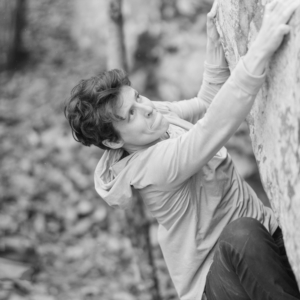
In the early 2000s, there was no climber more famous than Dean Potter. Nicknamed “the dark wizard,” Potter accomplished never-before-seen feats in Yosemite National Park. He embraced highlining and BASE jumping as an extension of the pursuit of his physical limits.
The legend died in a wingsuit accident in 2015, and the story of this mercurial visionary has never been fully told in a documentary — until now.

Famed documentary filmmakers Peter Mortimer and Nick Rosen decided to take on the challenge of delving into Potter’s life. Their new four-part series, The Dark Wizard: A Portrait of Climbing’s Most Enigmatic Figure, premieres on HBO on April 14.
With interviews with his friends, family, and rivals, the episodes provide an intimate glimpse at the psyche of this complex figure. GearJunkie spoke with Mortimer and Rosen about the series, their approach, and Potter’s legacy.
GearJunkie: Potter passed away in 2015. What made right now the right time to tell this story?
Peter Moritmer: A big part of the series are these really emotionally charged interviews with the people who spent really significant time with Dean and knew him best. And I feel like people were able to be so honest and vulnerable in those interviews. It feels like the right amount of time. Like, if it was too soon, I think, it would almost feel like Dean was still in the room a little bit. You need to kind of reflect about back on this with a little bit of distance.
And if you take too long, those memories become convoluted. A lot of guys would come into the interview and just start crying because they had so much unresolved, emotional, and relationship stuff with Dean and they’re never gonna be able to resolve it and it was almost like therapeutic for a lot of those guys to do this and to talk about it and even to see themselves talking about it and get a little perspective, just like get it out there.
Nick Rosen: I think it’s also cool that a lot of our characters, a lot of Dean’s friends, and the people who loved him, have reached this kind of very sort of adult stage in their life where they’re able to kind of look back on their youth with a new lens.
GJ: A major focus of the series is Potter’s mental health, his struggles, and how those shaped his climbing and his life. The series treats it with sensitivity without prescribing a diagnosis. Walk us through your approach to this complex subject.
NR: I mean, transparently, there was a temptation to do that [diagnose Dean with a specific illness] on my side. A lot of his friends really felt like they understood what was going on, like that they had language for it. Brad Lynch in the film says, we had something, we had an understanding because I was suffering from the same things that Dean was suffering from. And Brad has been able to kind of go through his mental health journey, and wanted to make sense of it all in a specific way.

Pete and others were right to kind of convince me to be restrained on the actual throwing out of diagnoses and stuff like that. And there’s this bigger question too, about whether Dean was inappropriately not treated for his mental health, or did he just treat himself for his mental health in a way that he could do best.
The series relies on Potter’s personal journals and voice memos as a major source of information. A friend in the series said that Potter would’ve hated people reading them. How did you wrestle with the ethics of sharing these incredibly intimate things from his life?
NR: Our guide for that and the person who was the keeper of the journals, and that part of the story was Elizabeth, his sister. And she has been incredible working with through this whole story. She obviously loved Dean. His legacy and memories are something she holds so dear, and yet she really wanted to do a nuanced and really honest approach to this project. She gave them all to us and trusted us.
She had read what was in there, and she understood that this was a layer of Dean’s psyche and Dean’s story that only these sort of written documents could tell, and that was really true.
A lot of the times in the interviews, Dean’s interviews, he is kind of putting on the Dean show a little bit and trying to kind of burnish his mystique or maybe steer away from the things that he feels most vulnerable about. These journals really sort of hit the kind of soft and molten core of his personality where he was addressing some of his biggest struggles.
There are certain things in there that we didn’t feel were appropriate. We left some stuff out, but also went pretty hard. Our watchword was … honesty.

PM: It’s funny because Dean always wanted to make the big movie. He was a performer, you know. He wanted the cameras rolling all the time, and we found this one voice memo that we just put in at the last minute, right at the end. And he’s like, “Maybe everyone out there, knowing that there’s this freak who’s struggling, who’s having a hard time, doing all this weird shit. Maybe that … that’ll make them feel more inspired.”
And so in some ways I feel like Dean, even though he wouldn’t want to share some of this stuff — I think it makes him so much more relatable and so much more vulnerable. And I think it is the story that he would want to tell, want to share. So I think while he might hate parts of it, I feel like he’s just oddly relatable in his struggles and his vulnerability and his self-doubt, and a lot of that does come from the journals.
NR: The egoistic, materialistic, human side of Dean would have had a lot of problems with what we were doing. But the spirit of Dean and the purity that he was striving for, and the honesty — he talked so much about honesty in his journals, being truthful, being honest. That part of him, his best side, you know, or at least the side that he was striving for, would have been like, “Yeah, OK, you guys took the right approach, the courageous approach.”
You’re both climbers and experts on the history of climbing. What do you think Potter represents in the history of the sport?
PM: He was broadening the vision of what climbers can do and, throughout his life, tying it in with highlining and wingsuit flying and BASE jumping. But also within climbing, [he had] these just big audacious ideas for solo linkups. A lot of those ideas, I think, were already in fruition and he just took them and had a really big. iconic vision about things, and sort of did these new things in this big, audacious way that just brought it into the consciousness in a way that they hadn’t been before.
He’s more of just like this amazing visionary and this leader of that generation. And climbing can get really analytical in terms of like the difficulty of feats and, you know, this person did this grade and that. I mean, he’s part of that history, for sure. But I think he’s more like this amazing visionary character who really made his mark for that whole generation in the climbing world. I mean, he’s the king of Yosemite for a decade and a half.

NR: The previous generation, the Stone Masters’ generation of Yosemite on the cultural side [had] just like really like strong culture and counterculture that kind of defined climbing in this kind of rebellious, iconoclastic way. And I think in the ’90s, that had sort of started to stray away, into media and sponsorships. And Dean was definitely a part of that: You can see in the series.
But at least from his intention and the things that he valued, he was really drawing back on that previous generation of sort of rebels and counter-culture dudes who kind of embraced him, and he kind of tried to revive that within Yosemite and took it to another level with illegal base jumping and stuff, where it was actually like explicitly forbidden in sports.
With its release on a large platform like HBO, plenty of non-climbers will watch the series. What do you hope that they get out of it?
PM: I think you can just look at Dean’s big iconic feats and these incredible things, like the moonwalk or flying off the top of the Eiger or whatever it is, and just, they’re almost like Instagram-worthy, like, “Whoa, humans are amazing.” But I think combining what he did and showing the struggle and the vulnerability and just all that stuff — one of my friends who’s an artist was like, “God, it’s so refreshing, like, that’s all the shit that I go through.”
And you end up with this beautiful piece of art, but that’s kind of like what the world has been diluted, dissolved down to. It’s just like, “Oh, here’s the art.” But the humanity that created that art, Dean just had that cranked up to like an 11 all the time, and like we said, the cameras were always always rolling. He was journaling about it.
NR: When he’s out on that high line, climbers and non-climbers alike can feel just the absolute visceral terror that is appropriate. When these things [Dean’s high lines or free solos] were first seen or whatever, he was like, “I went and did this incredible feat, and that’s amazing,” and he had some inspiring words about it.
This series is really about what happened before the cameras were turned on. And when you start to sort of see the context and the emotional environment and the sort of psychodrama that was occurring right up to the moment when he’s like, “Okay, I’m doing this,” and the camera starts rolling. The stakes are just higher, and they [the audience] start to realize that this guy doesn’t totally have it all locked down.