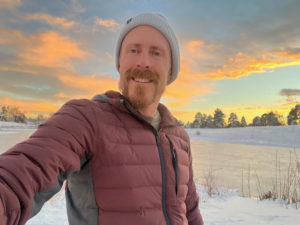
Long before adventures and adventuring were commoditized, sanitized, and commercialized, there were people like Ken Sleight. Ken loved a good adventure, and he loved sharing it with others, be it as a river guide, a pack outfitter out in the wilds, or a storyteller over a whiskey and a crackling fire. Moreover, he and his life were an adventure.
Ken Sleight died on October 2, 2026, at age 97. Raised in Paris, Idaho, before spending most of his life in Utah, he spent more than half a century as one of the Colorado Plateau’s most stubborn defenders. He was among the early guides to take paying clients through Glen Canyon before Lake Powell drowned it, and then spent the rest of his life as an advocate, columnist, and occasional human roadblock in the fights that followed.
From 1986 through the early 2000s, he ran Pack Creek Ranch beneath the La Sals with his wife Jane. To readers around the world, he’s Seldom Seen Smith. To those of us lucky enough to be his neighbors, he was a man who loved hearing about your adventures every bit as much as telling his own.
Inspiration for The Monkey Wrench Gang‘s Main Character
Outside a few esoteric circles, Sleight is best known as a caricature of himself as Seldom Seen Smith in Edward Abbey’s 1975 ecosabotage novel The Monkey Wrench Gang. And in broad strokes, Seldom Seen Smith paints well onto Sleight, with both being charismatic, eco-passionate, outdoorsmen. (I can’t speak to the accuracy of Smith’s collection of female companions, but I can imagine a younger Sleight as quite the charmer, as he remained one throughout his life.)
Abbey nailed his portrayal as the two were close friends and business partners from time to time. Years later, Sleight shared that he met Abbey at a river put-in on the Colorado River at Lees Ferry, Ariz., in 1967, where the latter was a ranger, and that their discussions that first evening sparked what later became The Monkey Wrench Gang.
While Abbey commanded worldwide attention as a writer, Sleight generally kept things much closer to home in southeastern Utah. He got folks outside and excited as one of the earlier river guides in the Colorado River basin, starting in the 1950s, a role that would get him inducted into the River Runners Hall of Fame in 2012. His trips through Glen Canyon and his reminiscences thereon helped to vividly keep alive what he considered a sacred space for many decades after its inundation by Lake Powell behind Glen Canyon Dam.
Sleight was a committed environmentalist for much of his life. In addition to being interviewed countless times on environmental issues, he long maintained a column in the Canyon Country Zephyr that mixed environmental advocacy with stories from a lifetime in canyon country. That said, Ken wouldn’t be satisfied with words alone.
He was party to at least one environmental lawsuit, influenced and supported younger generations of environmental activists like Tim DeChristopher, who famously bid on oil and gas leases he couldn’t pay for at a 2008 BLM auction, and would go so far as to put himself and his horse Knothead in the way of bulldozers that threatened to destroy local piñon and juniper forest on Amasa Back Mesa.
The Glen Canyon Institute awarded him the David R. Brower Conservation Award in 1999 for “his introduction of numerous people to the wonders of Glen Canyon on countless river trips, visionary efforts to halt the construction of Glen Canyon Dam, and passionate advocacy for the restoration of the Glen.”
A ‘Community of Impassioned Eccentrics’
Although best known as a riverman, Sleight led pack trips for decades from the depths of Grand Gulch to the heights of the La Sal Mountains. It was on the flanks of those La Sals where Sleight spent his longest tenure. In 1986, he and Jane Sleight — his second wife, who passed away this spring after 42 years of marriage — bought a couple of hundred acres with run-down buildings known as Pack Creek Ranch.
With much love and sweat, the two brought it up to snuff as a dude ranch that hosted thousands, including the likes of Stephen Hawking. It was a spot for readings and activism (from Abbey, for one) and, as they sold off some of the parcels surrounding the core of the ranch, a community of impassioned eccentrics.

It’s at Pack Creek Ranch that I first met Ken over the winter of 2010. While he and Jane had closed the dude ranch and its restaurant, they continued to live and entertain in the main lodge building that had served as its heart. Then, in his early 80s, he was as sharp and engaged as ever.
After moving to the ranch, I’d routinely end my runs in Ken’s office in a Quonset hut, where he’d be writing or researching his current cause with his dog Boy at his side and a coffee cup with whiskey on his desk. We’d chat about environmental issues, politics, and adventures past and present.
While Ken would get fired up about local environmental issues, what always stood out to me was the spark that would form in his eye when the topic of adventures came up. He had an astounding memory for detail for landscapes and the trails that crossed them. For any place I’d mention in southern Utah, he’d have a fascinating story that he’d excitedly share.
Admittedly, lots of outdoorsmen light up telling their own stories, but for someone with half a century of his own tales, he absolutely loved hearing your story. There was no hiding it. Whether you were still in the planning stages or returned with a mind full of memories, Ken wanted in. He was in. In retrospect, it’s amazing to have so deeply shared so many adventures with Ken despite never stepping onto a trail or into a raft with him.
Sleight left a legacy of conservation and community, and a blueprint of an admirable life for those who love special places. His individual spark may have finally gone out, but the fire it ignited decades ago will continue to burn through the magical places he adored and protected, and the community that sprouted around him.