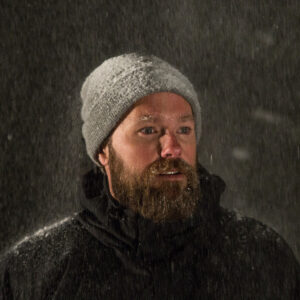
“You have the gear you have, and you like what you have. I had no idea what was on the market,” explained Karl Bushby, the British adventurer who just completed a 28-year circumnavigation of the globe. On foot.
Bushby’s implausible trek, which he dubbed the ‘Goliath Expedition’, began in 1998 and has captured attention at various times over the years — like when he was booted out of Russia for the first time in 2006. But his completion of the journey and return home to the UK on Nov. 2, 2026, has it at an all-time high.
Bushby, a former British paratrooper, left his family and homeland behind at age 29 and is freshly back in Hull, east of Manchester, after nearly 30 years on the road. Bushby estimates about 15 of those years were spent traveling while the other 13 were what he calls “static”. He paused for years at a time, navigating visas and geopolitical difficulties, but hiked roughly 31,000 miles through nearly every climate on four continents.
To survive the wildly different environments he encountered — from the Atacama Desert in South America to the Bering Strait — Bushby’s equipment changed drastically at times. But he nearly always was pushing a cart carrying around 100 pounds of gear.
Local, Free, and Cheap
I interviewed Bushby from his mother’s home in Hull about the clothing, footwear, food, and equipment he used on his journey, and he revealed a surprising indifference to most modern outdoor gear. Most gear lists from thru-hikers detail thousands of dollars’ worth of the latest ultralight gear. The lack of funds for much of Bushby’s trip necessitated relying on what he could find locally for free or cheap.
But even with intermittent sponsorships from brands such as The North Face and Mountain Hardwear, Bushby gravitated toward pedestrian apparel and military-issue equipment. “I wasn’t ever too excited about the latest gear. Just cotton T-shirts and fleeces,” he said. “Never been a gearhead.”
He and his sometime companion, French-American adventurer Dmitri Kieffer, did get serious about high-dollar expedition gear to make it from Alaska to Russia via the Bering Strait. But in milder climates, Bushby almost always kept things simple.
“I don’t need anything fancy. I never had that much money to spend anyway,” he said.

A ‘Beast’ of a Gear Hauler
Bushby started his journey in South America with a “bastardized golf cart” rather than a backpack. While backpacks are great for a weekend (or even a whole summer) on the trail, Bushby needed more supplies and better ergonomics.
“We were looking at many years on the road, and a backpack would eventually whittle away at your ankles, knees, and hips,” said Bushby. “Having been a British paratrooper running down hills with 40-50 pounds on my back for a decade, I understood just how much damage that can do.”
The first of Bushby’s carts, “The Beast”, was a modified golf trolley he brought to South America from Britain. The first Beast got him from Patagonia as far as northern Peru, but was abandoned for pack animals as he climbed into the Andes.
“I managed to get a donkey for literally a couple of dollars at a market in a small town,” said Bushby. “That turned out to be a mistake because this was a male donkey that hadn’t been [neutered], and the thing was just a rampant, mad animal that was not interested in walking.”
A horse proved a bit better, but Bushby ultimately pared down his kit, ditched the horse, and backpacked through Ecuador, Colombia, Panama, and Costa Rica. In Nicaragua, he found someone to custom-build “The Beast 2,” which stayed with him for the rest of his journey.
“It’s been to hell and back and just kept soldiering,” said Bushby.

Feeding the Goliath Expedition
For normal backpackers, food and water often make up the bulk of their pack weight and volume. It wasn’t much different for Bushby, though the early days of his journey were more opportunistic than planned. He also carried tools and spare parts for The Beast, but food and water were always top of mind.
“Latin America was mostly survival. There were some hungry days,” explained Bushby. “Literally eating trash, finding stuff growing along the side of the road. You’d be amazed at just how much stuff I could find per day in a 30-kilometer stretch along the road. Just discarded food, like half a packet of sandwiches or something, a bag of chips, half a bag of chips, half a bottle of Coke.” Chile, especially, had roadside grapes and berries to supplement scrounging.
By the time he reached the U.S.-Mexico border, Bushby had picked up sponsorships and a few hundred dollars a month, mostly used to buy food. There was also a lot more civilization to lean on, with roadside gas stations and restaurants far more common.
Further north into Canada and Alaska, food and water required more forethought.
“We were packing specialized rehydratable food, camping foods, and boxing that up and shipping it to waypoints, villages where you would meet them along the way,” said Bushby, “and you’re just carrying a lot of fuel to heat and melt snow and add water to the dehydrated food.” The purchases and logistics costs ate up most of his sponsorship money from Canada through to Russia.

Goliath Gear
By now, it should be clear that cotton-loving Bushby isn’t an evangelist for modern outdoor gear. “I’ve never been one for the best gear,” he said. “For a while there, we had some of the more Gucci gear, but I never really found it that practical because it’s kind of fashion stuff and doesn’t really work in the real world.”
Still, he does have favorites, and his time in the far North helped him appreciate extreme weather gear. Over the decades, his kit evolved with the climates, times, thefts, and chance, but certain pieces stood out.
Footwear
Early on Bushby secured a sponsorship from Italian mountaineering bootmaker Zamberlan and went through about 10 pairs of their boots while traversing South America. The alpine footwear wasn’t a perfect fit for the mostly desert route north, however.
“They were good hiking boots. A little heavy for what I needed, especially in the desert,” said Bushby. “We had to rip out the Gore-Tex and cut holes in them, but we really didn’t care that much in South America. We would have worn anything anyone gave us at that point.”
In the U.S., he stumbled upon Merrell’s Moab hiking boots. “Merrell just happened to have a boot that was a good wide fit,” he explained. “If you’re walking long distance, especially on roads, then you get boots that are two sizes too big for you, and that gives your feet a lot of room to breathe and expand.” He found the Moabs were widely available, and Merrell eventually signed on as a sponsor.
Once he reached Fairbanks, Alaska, Bushby realized he needed specialized gear and ultimately settled on Alaska Gear Company Bunny Boots, which he swears by for Arctic travel.

Sleeping
Bushby valued concealment on the road over ultralight designs and settled on the USMC 2-Person Tent for most of his journey. This 9-pound military surplus tent is durable and, most importantly, employed a camouflage rainfly that blocked light.
“I would sleep better if no one knew where I was sleeping,” he said. “So I would go through great lengths to get out of sight each and every night.”
His sleeping pad was a “three- to four-inch thick” monster inflatable, brand unknown. Similarly, he picked up a brand-unknown minus-40-degree down sleeping bag and used it for the entire northern portion of his trek. In warmer areas through Kazakhstan and Europe, he “used it like a duvet”, anticipating the trend toward quilt sleeping bags.
Apparel
Moisture-wicking tech tees and Merino wool baselayers weren’t part of Bushby’s kit. “ I just found comfortable clothing,” he said. “I mean, just t-shirts, just cotton t-shirts.” He also found that the cheapest secondhand jogging pants made the best walking pants, or shorts when the weather demanded it.
And fleece. “Fleece was the primary warm layer [outside of the Arctic]. Fleece and a windproof layer,” he said.
The Arctic called for more serious expedition-grade gear and was the one time Bushby expressed some reverence for the evolution of outdoor gear. “The Arctic was when you needed the really expensive stuff,” he explained. “900-Fill mountaineering suits. We spent a lot more time focused on equipment in those environments. Over the Bering Strait, we had to become Arctic marine sea mammals.”

How 28 Years on the Road Changes Your Relationship with ‘Stuff’
Mission complete after almost 30 years of being itinerant, Bushby isn’t sure he wants a house. But he definitely doesn’t want a big house.
“Don’t understand a big house. Something that requires so much effort and material to maintain,” he said. “I’d like to bastardize a shipping container. That is very appealing to me. Pick it up and move it with a truck when needed. But make it as efficient a living space as possible.”
Despite the carrying capacity of The Beast carts, Bushby collected hardly any souvenirs from his journey. The only item outside his body that made it the full 28 years was the 16th Air Assault Brigade patch he pulled off his British Army paratrooper jacket in 1998.
The second-longest-tenured item was a postcard given to him at the start of his expedition by a man in Chile for his friend in Austria. Bushby received the card in 1999 with $100 “postage” and hand-delivered it in 2026. “I like to say that one of the records that I broke was the slowest piece of hand-delivered mail in human history,” said Bushby.
He says the balancing of sparing utility with relative material comfort became second nature on the road. “You’re used to really preserving things like water, square sheets of toilet paper, anything,” he said. “You really learn it, and it becomes culture. I still have that. I’m probably going to live with that. “
“Most people look at me on the road and think I’m packing this enormous amount, but it is a balancing act, and I could live incredibly comfortably for long, long periods of time. And that’s kind of spilling over into how I look at life going forward.”