I had sort of a sideways introduction to Skallywag Tactical. While checking on new offerings from its partner brand, Toor Knives, I was offered the Scallywag Iron Jaw as a ready-to-go tester. While I waited for it to arrive, I did a little digging. Skallywag Tactical was founded by folks with real-world experience in the military, law enforcement, and skilled trades.
As such, Skallywag’s knives are designed for abuse in conditions where failure isn’t an option. Actual experience informs the work it’s doing.
In short: The Iron Jaw from Skallywag Tactical is a flipper-style folder that opens nearly as fast as an automatic. It’s aggressive in appearance, but not ridiculously so. The handle is slim and easy to grip, while the frame lock keeps the blade in position while you work. Even if the biggest threat you face is a pile of Amazon boxes you need to fit into a recycling can, the Iron Jaw is ready for action.
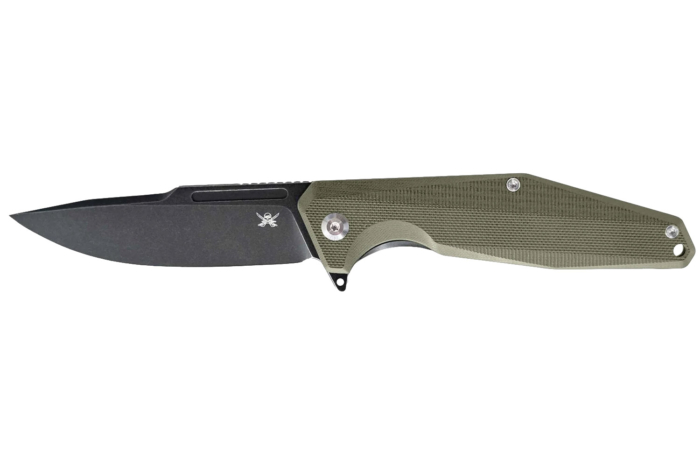
Specifications
Pros & Cons
Pros
- Contoured handle is very ergonomic
- Blade opens lightning fast
- Great size for EDC
Cons
- D2 steel requires patience to sharpen
Skallywag Tactical Iron Jaw Review
What’s in a Name?

According to Skallywag Tactical, the Iron Jaw’s namesake was originally called Captain Elias Krowe. A privateer-turned-pirate born in 1682, he lost his lower jaw to a cannonball during a fierce battle. As the story goes, he tied his beard into a knot to stem the flow of blood and continued fighting. When the battle was over, he commanded his men to forge a new jaw for him using iron from the cannon that had shot him.
After it was fitted to his face, he became Captain Iron Jaw. He spent the next several years striking terror into the hearts of all who traveled the high seas.
It’s a cool story, with undoubtedly at least some degree of flourish.
Materials and Design

The Iron Jaw is a medium-sized folding knife. It’s just shy of 8 inches long when opened, and it has a 3.4-inch blade. The brand went with D2 steel for the blade. That’s not a bad choice, but D2 can be troublesome to sharpen. However, once you get a keen edge on it, the steel holds that edge for a long time.
The blade is coated with black PVD. This is a thin film that’s been bonded to the steel and provides the knife with a degree of corrosion resistance and a cool look. There’s a small section of jimping along the spine, located exactly where your thumb naturally rests when you need to apply a little pressure.
There’s also a small fuller located on each side of the knife. Some folks mistakenly refer to these as blood grooves. That’s an old marketing term coined to make tactical knives sound cooler.
A fuller’s purpose has nothing to do with preventing the blade from getting stuck in a body. Instead, fullers help balance the knife’s weight by removing a small amount of steel from the blade without compromising its strength.
This is a flipper knife with a tab extending from the back of the handle when the knife is closed. Press that tab with your finger, and the blade flies into position very quickly. The tab turns into a finger guard when the blade is open. A frame lock secures the blade while you’re using it.

As a frame-lock knife, it has only one handle scale. The handle material is G10. I feel that G10 is second only to Micarta in durability. While I typically prefer the look of Micarta over G10, this isn’t an ugly knife by any means. And G10 is probably a bit more tactical-looking than Micarta. The material has been contoured with a nice finger choil. It also has some great texturing that provides a secure grip.
Opposite the G10 side is the frame lock. It’s very secure and engages quite a bit of the tang. At the same time, though, it isn’t a bear to disengage. That’s always appreciated, as you don’t want to struggle to open or close a knife.
A deep-carry pocket clip is attached to the frame-lock side of the handle. It’s set up for right-hand, tip-up carry. The pocket clip is not reversible, but it could be removed if desired.
Iron Jaw Performance

I’ve been carrying the Iron Jaw as my routine EDC off and on for a couple of months. It has tagged along on a few hikes and hung out around the house. I work from home, and there seems to be a never-ending list of chores to distract me from actually working.
I don’t live a tactical life, but like most of us, I use a knife on the regular for a variety of tasks. In my time with the Iron Jaw, I’ve used it to open packages, break down boxes, slice lengths of paracord, and do a bit of whittling, just for fun.
Early on, I found that the knife’s flipper-style open is almost as speedy as an automatic knife. The action is incredibly smooth. Lockup is very solid, too. You should always treat a knife’s lock with at least a small degree of caution, as failure is never impossible. That said, the Iron Jaw’s blade has zero wiggle or wobble. The lock solidly engages the tang, leaving little concern about the blade accidentally closing.

Once the lock is disengaged, the blade can fall closed easily. With just a little practice, you should be able to open and close the knife with one hand, no trouble at all.
The deep-carry pocket clip is pretty stiff and tight. That’s not a bad thing, but it does make it more difficult to remove the knife when it’s clipped into a pocket. Personally, I just dropped it into my pocket, rather than clipping it in place. As a general rule, I don’t carry much in my pockets, so the knife isn’t fighting for real estate.
Testing
After carrying and using it for several weeks, I put the Iron Jaw through a few specific tests. First up was a section of braided polypropylene rope. I started by looping the rope around the blade and then pulling the blade through, parting the rope easily. Then, I took the smaller sections and used push cuts on a board to nip them smaller and smaller. Hardly any effort was necessary, and I didn’t need to use any sawing to get through the material.

Next was feather sticking. This helps test the sharpness of the blade, as well as how it handles more delicate chores. The keen edge worked well, even though I’d not touched it up at all since it was unboxed. The wood shavings were thin and had I been in need of a fire, they’d have lit right up.
From there, I grabbed a large piece of cardboard and began slicing it up. Corrugated cardboard is nasty stuff for knives. It’s filled with rock-hard adhesive as well as dirt and debris from the factory where it was made. It is also one of the most common materials we cut with our knives. I sliced the cardboard into strips, then chopped some of them into smaller pieces using rocking push cuts. No muss, no fuss, this knife continued to impress.
The last testing medium was a piece of scrap leather. As with everything else, the Iron Jaw cut through it like a laser beam. I use long pulling slices as well as short push cuts, and the knife never got caught on the leather once. Every cut and slice was clean.
Even after all that, the edge was still sharp enough to easily slice paper. That’s pretty impressive.
What Does Tactical Really Mean?

The reality is that tactical is simply a marketing term. It’s largely meaningless in the grand scheme of things. It refers to a knife, pack, or other piece of gear that’s designed to look like it would be used by a member of the military or law enforcement.
There are common features to gear that’s been labeled tactical. It’s typically black or another dark, dull color. It might look rugged or dangerous in some way. A tactical knife, for example, often has sharp, angular lines.
But calling something tactical doesn’t automatically mean it’s high-quality and dependable. And it for darn sure doesn’t mean it’s being issued or used by military or police units.
Now, all of that said, the Iron Jaw is that rare combination of a knife that’s pretty clearly tactical-oriented and also lives up to its appearance.
Who Needs This Knife?

I like the Iron Jaw for a solid EDC option. It has the reach to handle just about anything you’ll need without being awkward to carry. It falls squarely into the tactical side of the knife world, but it isn’t ridiculously overbuilt.
I could see this being carried by workers in the trades as well as office drones. Whether your day-to-day involves hard labor or hard negotiation, the Iron Jaw will fit right in.
The Iron Jaw from Skallywag Tactical is available now. It retails for $150, and is available online at Blade HQ and similar outlets. The knife is available in OD Green, as shown here, as well as all black.