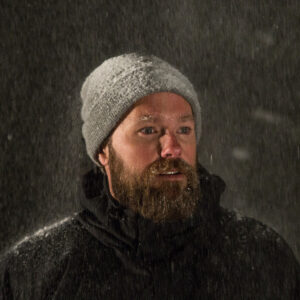
Colorado just got a new thru-hike, and it’s a daunting, bucket-list route filled with soaring peaks, iconic vistas, and a massive amount of vertical gain. The Great Colorado Route is a 2,000-mile loop that began as a personal “dream hike” for Donovan Rice, but has since become an ongoing passion project. He hopes others will literally follow in his footsteps and help build an alternative to the “Big 3” thru-hikes.f
Rice, a Colorado native, hiked the Continental Divide Trail from the Mexican border to Canada and, when passing through the Colorado portion, thought, “We’re missing so many really cool parts of the state.” The Great Colorado Route is a hikeable love letter to the state that aims to hit all those really cool parts from the Uncompahgre Plateau to the Gore Range to the Flat Tops Wilderness.
It’s also more technical than the Big 3 thru-hikes, incorporating 13 of the state’s 54 official 14,000-foot peaks and 47 of its 13ers. Part of the appeal of the Big 3 is their accessibility to a wide range of hikers. The Great Colorado Route uses many existing trails but also includes plenty of “cross-country” (read: non-trail) travel, so wayfinding skills are a prerequisite.
That’s why the still-new GCR is more of an ongoing project than a well-worn path to follow. It’s also why Rice hiked all 2,021 miles himself this summer. He’s hoping his efforts to document the route will draw more backpackers in to help build a knowledge base around it over time.
“The big question was, ‘Am I doing this just for myself, or do I want to share this with the world?'” said Rice. “Once I was sitting there with the map, I thought, ‘This is pretty cool, and I think that others would like to see it.’ And that’s when I designed the website to give people enough information where they could go ahead and do this, too.”

Mapping the Great Colorado Route
Anyone can open up CalTopo and draw a “really cool” route, and Rice spent two months doing just that. Using Gaia and the state of Colorado’s official maps app COTREX, Rice plotted his roughly 2000-mile course. The route maximizes “breadth, beauty, epicness—coolest route whenever possible.” And minimizes overlap with the CDT.
In the summer of 2026, he took the important first step of the next step, setting out on May 14 in the Black Canyon of the Gunnison to actually hike his Great Colorado Route. Rice stress-tested his track with trail runners on the ground, hiking 2,021 miles in 141 days. His trek exposed flaws, flagged alternates and bail-out points, and proved the GCR was a worthwhile thru-hike for the more ambitious backpacker.
“There were several setbacks,” Rice admitted. “Some research failure where I hit private property. I learned that Montezuma Wildlife Refuge doesn’t allow people to hike on their roads.”
Modern mapping apps such as COTrex and Caltopo were invaluable to planning and tracking his journey, but even the best maps today are still not the territory. “One of the things I found out in the field is that a lot of these dotted lines on the map aren’t actually trails in person,” said Rice.

What’s On the Great Colorado Route?
Rice is still updating the official routes on the GCR website to reflect his scouting, but the interactive map and downloadable GPX track files are still close. The GCR is a loop that can be started anywhere along the course or tackled in shorter sections, none longer than roughly a 5-day stretch. The segment breaks are at “resupply” points where backpackers can reconnect with roads and civilization.
The GCR currently has 29 segments, which Rice groups into five regions he’s named The Aspens, The Western Canyons, Pikes Path, Rocky Mountain Highs, and the San Juans. In addition to summits such as Lone Peak in Rocky Mountain National Park, the route hits lesser-known ranges such as the Gore Range and the Mount Zirkel Wilderness.
It also tours well-known highlights such as Maroon Lake outside Aspen and Pikes Peak, but makes a conscious effort to draw hikers into less-traveled parts of Colorado. “Maroon Lake is insanely popular, but everywhere else in that area I saw hardly anyone,” said Rice. “The Flat Tops Wilderness is another great example. One spot, the Devils Causeway, I saw lots of people, but everywhere else {in the Flat Tops Wilderness}, just nothing.”
Rice’s path tallied more than 360,000 feet of vertical gain, and Rice cautions that it’s unrealistic and likely dangerous to stick to the prescribed route at all times. “Weather in Colorado means it’s just not safe to stay exposed above treeline for days at a time with storms and lightning.” He’s currently in the process of updating his “Low Route” and adding recommended alternates and bail-out points.

Who’s the GCR For?
The Great Colorado Route is unapologetically more challenging than the Pacific Crest Trail, CDT, or Appalachian Trail. Still, Rice used guidelines to ensure it wasn’t out of reach for experienced backpackers. “No Class 5 climbs, no packrafting, no ropes. A helmet would be wise, and I brought one,” said Rice.
The route’s infancy, combined with the challenging terrain, means it won’t soon match the popularity of the PCT, which sees 2,000 to 3,000 hikers each summer. Rice said a handful of other thru-hikers plan to tackle the route in 2027, and others have already traced smaller segments. Even if no one follows in Rice’s footsteps, he’s planning to strategically revisit certain segments next spring to continue improving the route.
While the 2000-mile length puts the GCR in league with the Big 3 American thru-hikes, Rice sees the 29 section hikes as the draw for most. “I would love to see more thru-hikers; just send it and check it out. I hope people do. But I think that, as with most long trails, the main draw is just people doing sections of it,” said Rice.
“Whether it’s someone having a long-term section hiking project, or it’s just someone saying, ‘Hey, you know, I’ve never checked out the Gore Range’. This is a way to sample a piece of that,” said Rice. “Even if people don’t hike it, if I’m just inspiring people to go out and explore Colorado, that’s a win in my book.”
GCR Gear List
This is GearJunkie, so we had to ask. Here’s a partial list of the gear that helped Rice on his 141-day circumnavigation of Colorado.
- Pack: Nashville Cutaway 30 Ultralight Pack. Rice kept things light with this smaller pack by minimizing days between pit stops to stock up on food.
- Shelter: SplitWing Shelter Bundle. Rice called the SplitWing “bombproof for the weight” while camped above treeline.
- Bag: Katabatic Palisade 30 Quilt. “I wanted to use as much Colorado gear as possible,” said Rice on why he chose the Salida-based company.
- Sleeping Pad: Therm-a-Rest NeoAir Xtherm. Rice picked this up used while on the trail after his original pad failed.
- Footwear: Rice started with Norda trail runners but needed a wider toebox and switched to the Altra Experience Wild 3+. Smartwool socks.
- Food: Bowl & Kettle freeze-dried meals and Bud Power Protein Bars.
- Favorite “Non-Essential”: Hyperlite Essential Umbrella. The GCR includes several high-desert sections in the San Luis Valley and canyons outside Grand Junction. Check out our editors’ favorite “Eleventh Essentials” for more unnecessary luxuries.