The wind changed directions and clouds quickly blocked out the sun. A storm was descending on my Vail Pass backcountry zone as a partner and I approached an exceptionally windy ridgeline. I stopped and ripped out my hardshell — Stio’s Objective Pro Jacket.
A weird rain came next, followed by thick, fluffy snowflakes intermingled with blasts of wind. With the Objective Pro’s hood up, my layering system was impenetrable. I was warm despite what the weather was doing outside. I was able to stay out in the storm for lap after lap, harvesting the new fallen snow in relative comfort.
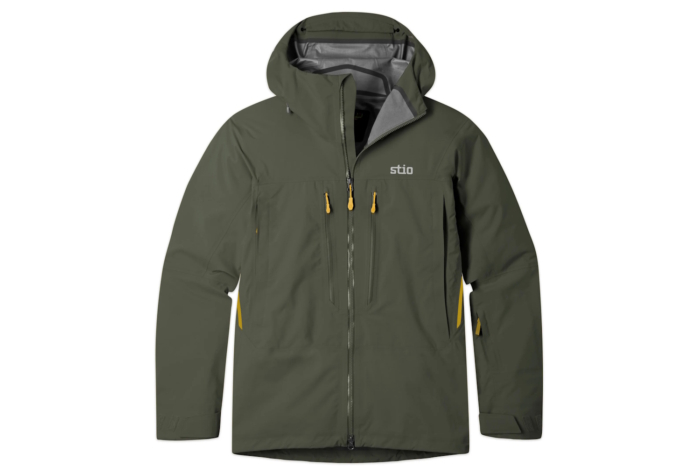
Stio’s Objective Pro Jacket is the brand’s top-shelf shell, utilizing high-end materials designed for waterproof performance and just enough breathability for the skin track. It pivoted easily to the ski resort the next day with a slight shift in midlayer strategy thanks to its accommodating fit and generous pocketing.
It’s the type of product whose simplicity and quality were immediately easy to get along with. But I dragged it through weeks of backcountry and resort shredding alike to sniff out any flaws for myself.
In short: I haven’t run into weather conditions that have stumped the Stio Objective Pro Jacket ($799). It’s a three-layer hardshell jacket built entirely from GORE-TEX Pro ePE. As promised, it kept the snow and rain outside. The high-end fabric also came with impressive breathability for a hardshell — plentiful for long days of resort skiing and just enough for short uphill jaunts in the backcountry with the proper layering strategy. The feature set is streamlined, making it a versatile companion for resort skiing and backcountry. The catch? The premium build comes with a premium price tag.
The Objective Pro Jacket is easily the most expensive jacket in GearJunkie’s guide to the Best Ski Jackets at $799. It’s more than double the price of other hardshell offerings. But if there’s one thing I’ve learned after testing a dozen of the brand’s products, it’s that they don’t skimp on quality or fit. Their high prices can be justified for the right skier.
See how this layer stacks up against other top ski jackets in the Best Ski Jackets buyer’s guide.
-

-
(Photo/Bergen Tjossem)
-
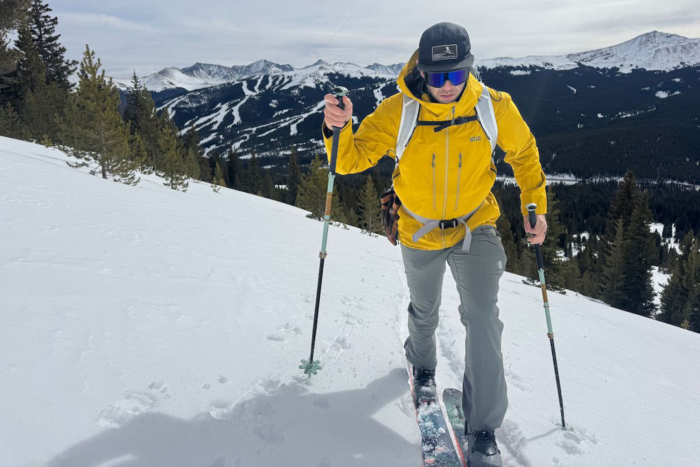
The Objective Pro Jacket boasts a nice, comfortable, and accommodating fit; (photo/Bergen Tjossem)
-
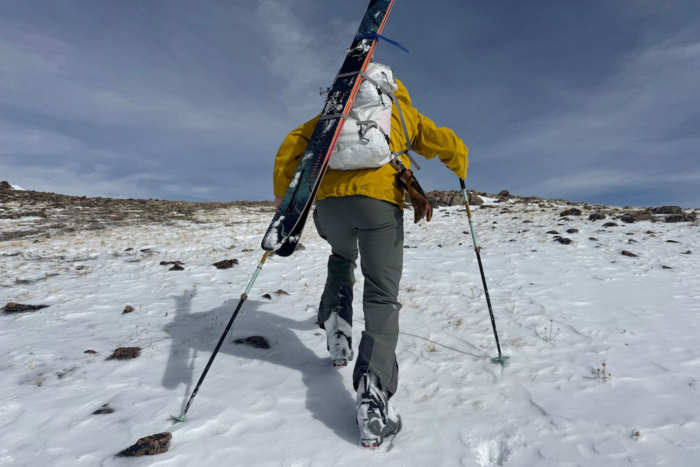
The weatherproofing of the jacket is at about 28,000mm; (photo/Bergen Tjossem)
Specifications
Pros & Cons
Pros
- Feature-rich
- Pass-through front chest pocket
- Burly fabric denier
Cons
- On the heavier end of the scales
- Chest pockets share volume
- Price
Stio Objective Pro Jacket Review

Field Tests: Where I Skied With the Objective Pro
I spent many days at the ski resort and another handful in the backcountry sheltered in the Objective Pro Jacket. Being an uninsulated shell, it’s exceptionally versatile inside or outside the resort boundary with the right base and midlayers.
It’s been a warm season in Colorado. Most days at the ski resort, I’ve been able to get away with Le Bent’s Featherweight wool base layer, a gridfleece midlayer like Patagonia’s R1, and then the Objective Pro Jacket on top. That setup had me covered to about the high 20s.
For the colder days, I’d swap the gridfleece for an active midlayer like Norrøna’s Møre Thermo60 Aero200 jacket. That kept me warm during the most frigid days this winter down to about 0F.
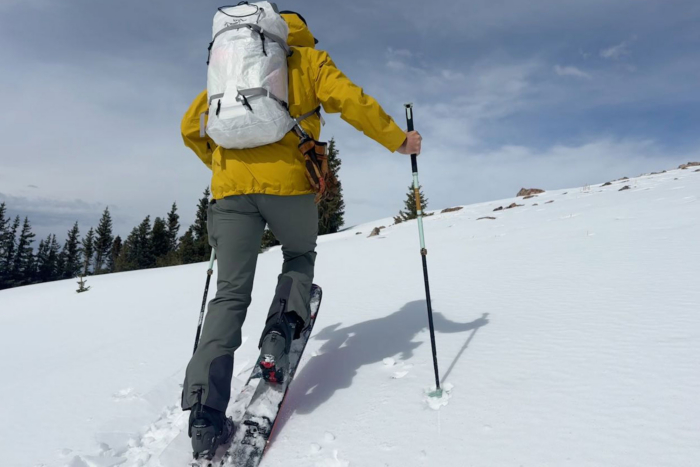
In the backcountry, I was usually able to take advantage of the heat I had generated on the skin track by tossing the Objective Pro over my base layer and calling it good — that setup had me covered for shorter backcountry laps. But when the wind really started whipping on a Vail Pass ridgeline, a proper midlayer under the Objective Pro was the better recipe.
The Objective Pro is competitively light for three-layer hardshell jackets at 577 g in size large. With a 70D face fabric and the relatively new ePE membrane, the entire jacket also packs down small for when I needed to stuff it in my pack. It’s a fabric and feature package slimmed down to the essentials precisely for this reason.

Fit and Sizing
The Objective Pro Jacket offers a nice, comfortable, and accommodating fit. At 6’1” and 195 pounds, I went for the large, and that landed on my upper body about perfectly. Stio lists the cut as “regular,” and I can’t disagree with it — that’s a fair descriptor all around.
It’s long and loose-fitting enough for a wide variety of layering setups, yet it offers a composed aesthetic without looking too baggy or bulky. The Objective Pro jacket is available in sizes Small through XXL for men and XS through XL for women. It’s a fit that the vast majority of skiers will get along great with.
Stio took the time to design long, articulated arms that fit my body great. I loved that I couldn’t feel any restrictions while reaching for a pole plant, bending at the waist, or while reaching overhead. That can be a weak spot in some hardshells, especially ones that don’t offer any stretch like the Objective Pro. It adds versatility to the mountaineering realms.
A big storm hood absolutely engulfed my resort skiing helmet and my mountaineering helmets. A pull tab at the back of the head cinches the whole thing down and requires only a single hand to operate. Once tightened, the hood did a great job of staying out of the way. It didn’t creep into my peripherals when I looked side to side, either. The whole thing moved well with my head and provided a welcome layer of storm protection.

Pockets: Plenty, Adequate
The Objective Pro really leans into chest pockets. You get two great vertically zippered pockets up front that parallel the jacket’s main zipper. They’re big, accommodating, and versatile. Big enough for a sandwich, phone, and the rest of the odds and ends required for a day of skiing. The wearer’s left pocket also includes a stretchy inner sleeve that’s big enough for a phone, which was a welcome respite from phone flop all too common in other jackets.
And then you get two more hand pockets underneath those two chest pockets — legitimately a pockets-on-pockets scenario. You access the secondary pockets more like you would side hand pockets on the sides of your torso. This pair of pockets are also quite large — plenty big enough for a pair of gloves and even a midlayer, and they work great for keeping your hands warm while you stand around waiting for your skin track partners.
Between these two layers of chest pockets, the Objective Pro jacket is accommodating. The catch is that the chest gets super bulky when the pockets are stacked like this — sort of like you’re wearing a small backpack on the front of your body. It’s just kinda bouncy and restricts your view of the ground. So, although the jacket has a big carrying capacity, I tended to cut down on the loadout while skiing.
The Objective Pro also comes with a ski pass wrist pocket, a stretchy drop-in pocket inside the jacket, and a small zippered pocket inside the left chest. I wasn’t short on places to carry all my things while skiing in the front country or backcountry.

Waterproofing: High-End, Sustainable
Stio endowed the Objective Pro with the highest-end waterproof membrane available in GORE-TEX Pro ePE. That’s the fabric package I’m seeking out for all my backcountry adventure outerwear. And it’s, of course, zipped together with a high-quality, two-way, water-resistant Aquaguard Vislon zipper at the front.
The weatherproofing is incredibly protective at roughly 28,000mm. There aren’t skiing scenarios that would warrant a higher waterproofing rating — the shell is just dang protective. I appreciated that during this strange Colorado winter, where the Objective Pro has protected me from snow, but also sleet and plain old rain. It’s not that complicated — the jacket’s wet-weather and wind protection is top tier.
But companies don’t spec top-shelf GORE-TEX Pro for the waterproofing alone, but rather for the combination of waterproofing and breathability. GORE-TEX Pro offers a breathability rating of up to 25,000 g/m²/24h. That’s about as high as you can get these days in waterproof hardshell material. And that’s also what’s bumping the price into luxury territory.

Breathability: Pros and Cons
The Objective Pro was plentifully breathable for downhill skiing. It was very rare that I overheated with this shell over appropriate-for-the-conditions midlayers. The generous underarm vents helped with temperature and moisture control, too. You can almost feel it (or at least imagine it) breathing, letting the moisture vapor escape through the membrane’s pores rather than building up and ultimately making you cold.
But in the backcountry, GORE-TEX Pro isn’t quite breathable enough for really aerobic, extended uphills. I could feel the moisture build up during one 15-minute climb between runs in my local backcountry zone. That’s not so much a knock on the Objective Pro; that’s just the reality of GORE-TEX Pro hardshell membranes.
It’s perfectly suited for the downhills. But the utility is limited on the skin track (unless the weather conditions are horrific). I’d routinely stuff it in my pack at the bottom of the skin track. Then I’d deploy it for the downhills or for chilly skin tracks above treeline and along windy ridges. It’s an indispensable tool in those scenarios.

Conclusion: Who Should Buy
Stio has a reputation for making high-quality outerwear that fits well, looks good, and performs in harsh weather. The Objective Pro Jacket doesn’t deviate from that trend. Like Stio’s best, the Objective Pro utilizes a top-notch fabric package in GORE-TEX Pro 3L ePE and pairs it with a slimmed-down feature set and a comfortable, aesthetic cut.
That combination made the jacket a top pick for just about any winter endeavor, from resort skiing to climbing and everything in between, when paired with the right base and midlayers. It’s protective enough for skiing in any weather conditions the sky might throw at you and breathable enough for long days in the backcountry.
At $799, nobody is calling the Objective Pro a bargain. Thankfully, the build quality, design, and materials are in line with top-shelf offerings from other brands at this price point. It’s a solid option for skiers and riders in the market for a great-looking hardshell jacket that boasts impressive protection and versatility.