When testing a mountaineering tent, you never expect your greatest setup trial to be at a rest stop in Oklahoma, or your coldest temps to be in Bentonville, Ark. Nevertheless, from winter backpacking in Tarptent’s own Tahoe backyard to MTB camping in Northwest Arkansas, I’ve taken Tarptent’s new ArcDome 1 across half a country.
Suffice it to say, Tarptent has built a name for itself upon long trail miles and attention to detail: smart reinforcements, multi-configurability, choosiness behind the fabric and coatings — the list goes on. The ArcDome is no exception. It’s the brand’s answer to “What if a Hilleburg Unna and Durston X-Mid had a child?” Pairing multiple swappable inners and pole options with a robust fly design, it’s as close to an all-occasions tent as any.
It might not be ideal for all conditions or users. But for campers who spend time in harsh, cold environments and who tend to abuse their gear, this tent has a lot to appreciate.
In short: The Tarptent ArcDome 1 ($449-509) is a lightweight single-person, four-season mountaineering tent. Made with high-tensile-strength materials like Dyneema and Silpoly, it can withstand alpine abuse. Sixteen guyout points offer rock-solid wind resistance. Uniquely, the arc-shaped door offers greater vestibule space for gear storage and cooking. For anyone looking for a highly durable, versatile tent that excels in cold weather, this tent is a finely tuned option.
Check out GearJunkie’s guide to the Best Backpacking Tents.
Specifications
Pros & Cons
Pros
- Multiple swappable inners
- One- or two-person
- Ultra-reinforced pole sleeve for fly
- Considerable snow load and wind resistance
- Numerous durable stake/guyouts
- Great compromise between interior and vestibule space
Cons
- No Ultra fabric fly option for the one person
- Poor ventilation for hot, humid conditions
- Stiff pole sleeves
- No ground-level pockets
- Can’t close vents from inside
Tarptent ArcDome 1 Review

My first look at the ArcDome 1, in Tarptent founder Henry Shire’s backyard, quickly turned into a masterclass. It’s what the Tarptent folks do best: obsess over the details. With the ArcDome, all the finer things add up to one bold package: a lightweight winter monster with serious four-season capabilities and an interesting floor design.
The ArcDome’s steep walls, crossed-poles arch, ultra-fabric sleeves, and ultra-high tenacity silpoly fly — designed chiefly to handle snow load and high winds — evoke the Hilleburg Unna. For added versatility, it’s compatible with multiple inners: a one-person solid wall tent, a one-person 50/50 solid/mesh inner, and a two-person 50/50 inner.
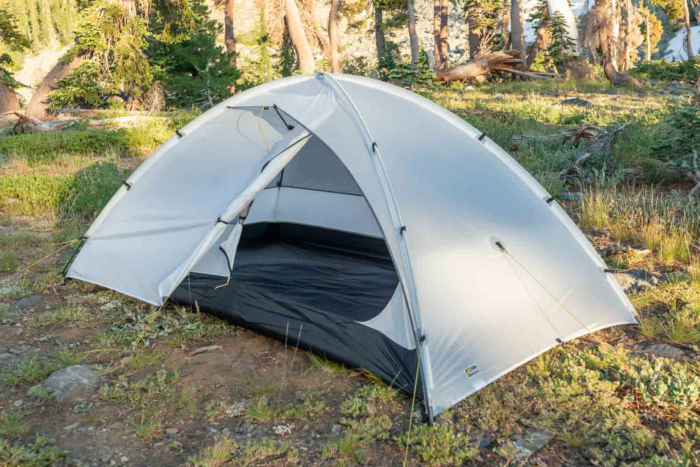
Its fat-ended, narrow-midsection design maximizes vestibule space. It’s similar to the Durston X-Mid’s angled floor, but with a more spacious floor plan. It’s dialed for vestibule cooking on stormy days in alpine environments.
The Arcdome 1 is well-reinforced anywhere you’d expect tension or rub. It’s a two-person inner that lets the one-person tent punch above its weight class for those willing to bring a tarp for gear. And the three- and four-season one-person inner offer year-round performance — with few caveats.
Fabrics

Tarptent is loud and proud about its particularly high-tenacity (think: tensile strength) silpoly. Its tensile strength and abrasion resistance are still lower than those of an equivalent nylon. Still, the folks at Tarptent prefer silpoly’s UV resistance, inherent water resistance, and low stretch. In the ArcDome 1, especially, this makes for a tauter pitch and quieter windy nights.
Likewise, “silpoly” can refer to polyester with any one of several types of silicon coatings (of various quality). Tarptent always insists on a 100% silicone coating on one side and PcU on the other.

The ArcDome’s pole sleeves are made of UltraTX70, a laminated polyester/UHWMPE composite with high-tensile and -abrasion strength. The poles’ intersection is further reinforced with Ultra 100X fabric. In fact, every pullout, stakeout, door tieback, zipper corner, and potentially high-abrasion seam edge is reinforced with some mix of Ultra 100X and Dyneema.
As for the inner, this tent features a 30D 6.6 double ripstop nylon floor, 15D polyester, and 15D nylon no-see-um mesh.
Hardware

The ArcDome 1’s hardware shares the same attention to quality. The zippers are all YKK. The included guylines are robust 2.3mm reflective UHMWPE cordage. The door tiebacks and inner/fly connection points all feature robust toggles.
While I’m a ride or die for MSR’s Groundhog stakes, I must begrudgingly admit that Tarptent’s included DAC J stakes are fantastic. At 7.88 inches, they offer plenty of holding power. Although given the ArcDome’s cold-weather inclinations, I wish Tarptent offered the option to bundle in dedicated snow stakes.

I opted for Syclone tent poles. These 9.3mm composite shafts have quickly become my favorite poles. They’re slightly lighter than aluminum and feel comparably stiff. However, they flex vastly farther without permanently bending, and aren’t as liable to fail catastrophically as carbon fiber.
Unfortunately, Tarptent recently stopped offering Syclone poles. However, they do offer 7.8mm carbon fiber for the most weight-conscious, 9.33mm DAC aluminum poles for all-around capability, and 10.65mm DAC poles for the worst weather
Setup

The Arcdome 1 is easy to set up in mild weather, but it has a break-in period. The Ultra 70X sleeves are stiff. They start off being difficult to push the poles through. Even fully loosened, it can take a little bit of force (and occasional glove removal) to get the 210D nylon webbing pockets over the ends of the tent poles.
Tarptent recommends staking out the tent before inserting poles. In calm weather, I found it unnecessary. In high winds, staking first is a must.
The ArcDome forgoes ground corner stakeouts. However, with 16 total potential stakeout points, the ArcDome easily pitches rock solid with just the main eight stakeout points.
The ArcDome opts for double-ended high/low guylines for midpanel pullouts. This distributes force well, but increases the load on those stakes. Although an incredibly minor nitpick, I found myself wishing that Tarptent had opted for linelocs on either end. That would make tensioning those pullouts even easier, as on the brand’s ProTrek tent.
Flying High

The fly’s stiff Ultra sleeves allow for fly-first setup in inclement weather and distribute both wind and snow load forces fantastically. I’ve personally put a backpack weighing over 30 pounds on top of my Arcdome 1. With 10.65mm DAC poles, I wouldn’t be surprised to find out that the arch can support well over 50 pounds.
I rarely enjoy tent sleeping in gales. However, with this tent, I’ve been bemoaning the fact that the highest winds I’ve slept through were 28 mph. Noisy nights are a given in high winds, but Tarptent’s rock-solid, silpoly design is less prone to cacophony.
The fly’s edges hug the ground, providing considerable storm protection, but leaving most of the ventilation to the single-door and dual vents. Fortunately, the fly can be tied back either halfway or fully. The vents on either side can’t be opened from inside, and in high winds, they may need to be tied shut. However, they’re easily deployed and well reinforced with a carbon pole.
The door is occasionally awkward. The zipper is well-protected by an overhang. However, this requires reaching up and under this overhang to fully unzip the door. Likewise, fully opening the door pulls enough slack out of the tent that I felt the need to retension the fly whenever I was leaving the door tied back for long periods of time.
The Inner Arc

As you can see in the image, the door of the ArcDome is, well, arced. It sweeps inward to allow more vestibule space for storing gear or cooking inside when conditions outside are nasty.
The ArcDome 1’s inners attach to the fly with buckles at the floor and toggles along the body. It’s a relatively easy process, but more difficult if the tent is staked out. (Once the tension of the floor is gone, the corners want to spring away from each other.) Personally, I preferred to flip the assembled fly upside down and attach the inner while standing — no crawling around necessary.
I wasn’t able to test the two-person inner, but the principle is simple. Trade your vestibule space for a three-season, two-person inner. Where would your gear go? Throw a tarp over it. In a market saturated with 1.5-person “two-person” tents, Tarptent calls a one-person spade a one-person spade — but still offers an inner that, at 90” x 50”, will fit two long, wide sleeping pads.

The 1-person inners I tested both featured 15D double-ripstop polyester, no-see-um mesh, a 30D double-ripstop nylon floor, quality construction, and a finicky two-hander door zipper. At 13.95 ounces and $189, and 14.15 ounces and $199, respectively, the partially and fully solid inners have a sub-quarter ounce weight differential and nearly identical prices.
The biggest difference is ultimately the choice between a dedicated winter tent (solid) and a shoulder-season tent (partially solid) that can flex into hot weather, provided some cool nights. Between them, the inners cover most solo and a decent range of duo backpacking needs.
The Arc Use Experience

Past the slightly fussy door is a surprisingly spacious interior. It’s tall enough for me, a hair under 6 feet, to sit upright near the center. The ArcDome 1 is also plenty long and wide. It will fit almost any long–wide pad to fit either straight or canted.
The inner’s inward curve shifts the natural landing area for your pack and not-allowed-inside gear to the left — out of the way of the door. With the door half deployed, I still had ample vestibule space to keep my 55L pack and boots out of the rain.

I wouldn’t mind some ground-level storage, but the inward arch does accentuate the door-side tent corners into shove-things-here catchalls. The overhead loft space was also plenty spacious. Although if I had to nitpick (and I do), I’d prefer another head-end loft pocket over a door-side loft pocket, which is unusable when said door is rolled back.
The loft pockets near the air vents are great for drying wet socks, but can dampen airflow if overstuffed. This is mostly an issue with the fully solid inner. It could lead to some condensation.
Sleeping in the ArcDome 1 was a dream. I have little doubt that it could withstand 50 mph winds less noisily than most. The full solid inner shone on the coldest, windiest nights — overing plenty of wind shielding and good condensation management. And the partial inner was plenty capable in warm, shoulder season, and mild winter weather. However, I’d hesitate to bring it on hot, humid backpacking conditions.
Who It’s For

As a wildland firefighter, my summer camping mostly consists of pitching at night while dog-tired, waking before dawn, and breaking camp in a rush. A fly-first setup tent that offers high marks in stormproofing, ease of deployment and breakdown, and will mostly be used over breezy mountain and cool desert nights, gets high marks from me.
As an early riser in Northern California, I’d be happy to run the ArcDome 1 with the partial liner any time outside of peak summer heat and winter storms. With the solid inner, I wouldn’t hesitate to hit wintry Sierra slopes.
For those looking to get expedition-grade tents for Everest and Antarctica, there are sturdier options. However, for those primarily solo adventurers tackling all but the most extreme high-elevation backpacking, mountaineering, and skiing, this tent is a fantastic pick.

It’s equally ideal for bikepacking and touring. The 16-inch poles are easily stowable, and the ArcDome is far more bombproof than most bikepacking-oriented tents. While I typically prefer larger tents or hammock systems for paddling, the ArcDome is also a dark horse here: a backup, small-footprint, quick-setup storm shelter.
The hardest limits will likely be temperature and weight. Ultralighters will likely scoff at a 56.65-ounce freestanding shelter. Those regularly sleeping in 75-degree, 70% humidity weather might regret a Sierra-minded tent. But for anyone who’s ever wished for a heavier-duty alternative to a Durston X-Dome, with more floor space, the ArcDome 1 is it.
Tarptent ArcDome 1: Conclusion

The silk-soft soil West of the Bonnevile Salt Flats, the sandstone of “Lake” Powell, the MTB trails of Northwest Arkansas — the ArcDome 1 has impressed me across half a country. Sadly, I’ve had fewer chances to run it in my and Tarptent’s Tahoe backyard. However, on the few days that either my Chevrolegs or rear-wheel 2Runner were able to get me out into the blanketed mountains, the ArcDome excelled there, too.
My worst night of sleep was the result of user error. It was a New Mexico truckstop at 2:30 a.m., whereupon, after pitching, the wind shifted, putting me downwind of latrines.

The ArcDome 1 is a bombproof, relatively modular, and solo-adventure-first platform in the underserved ground between dedicated expedition tents and lightweight backpacking shelters. It isn’t for everyone.
If you’re liable to reschedule a trip due to rain, have no interest in camping in the snow, or mostly camp in Louisiana-level humidity, perhaps a tent that sings of standing fast against snow load and squalling slope isn’t the best choice. GearJunkie has tons of lightweight options in our guide to the Best Backpacking Tents.
But the ArcDome’s song is catchy, and even for someone who rarely enjoys tent sleeping in high winds, I’m jonesing to take it out into some real storms. It’s a confidence inspired by real trail DNA and success that Tarptent continues to script into the small details.