The morning sun hits earlier at 10,000 feet. And those first rays were my cue. I rolled out of Big Agnes’ updated Tiger Wall UL2 Bikepack Tent into the crisp morning of Colorado’s Central Rockies. Before the water even boiled, I had the tent deconstructed into its basic elements.
I stuffed the fly and canopy into a bag and lashed the poles to my bike’s handlebar rack. And what’s this — room to spare? It’s unheard of in bikepacking where every square centimeter of pack space is spoken for.
Lightweight packability has been the promise of the semi-freestanding Tiger Wall tents since their inception. That design makes them a natural companion for long-distance backpacking and overnight adventures. This updated Tiger Wall UL2 is a small evolution of the platform rather than a ground-up overhaul.
Did it veer too far into ultralight territory or succumb to luxury? I hunkered down on the side of a mountain to find out.
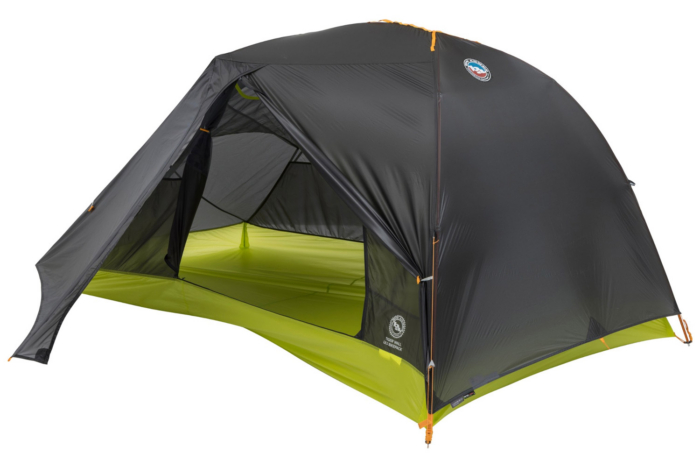
In short: You reach for the Big Agnes Tiger Wall UL2 ($550) when you want an ultralight solo shelter with occasional two-sleeper capability that’s ready to be carried deep into the backcountry. The 1.1kg tent has two big side doors and an entirely mesh canopy. It has an updated 15D Hyperbead rainfly and a lightweight semi-freestanding design. And it comes in a “Bikepack” version that uses shorter poles and a durable, highly strappable stuff sack.
Check out GearJunkie’s guide to the Best Backpacking Tents and the Best Ultralight Tents.
Specifications
Pros & Cons
Pros
- Super-lightweight and packable
- Short poles ideal for bikepacking
- Reliably waterproof
- Two big side doors
- Great internal storage options
Cons
- Poorly vented with door closed
- Semi-freestanding design flexes in the wind and rain
- Good stake placement required
Big Agnes Tiger Wall UL2 Bikepack Tent Review

Like its predecessor, the Big Agnes Tiger Wall UL2 is one of the lightest double-wall, double-door tents on the market at a svelte 1.1kg. It’s about as feathery as you can get in the category before you need to get into wonky setup configurations using trekking poles or a bike’s handlebars (pass). For reference, MEC’s similarly designed Spark UL 2 weighs in at 1.2kg, and MSR’s freestanding Hubba Hubba Bikepack 2-person tent lands at 1.4kg.
The tent’s 382g canopy is almost entirely mesh with a low bathtub-style floor of thin 15D Hyperbead material. That canopy is erected with two separate poles — one Y-shaped and one straight crossbar — totaling 341g. A feathery 369g rainfly provides full weather coverage, and nine included stakes (9g each) keep it stuck to the ground.
It’s a svelte package. And yet it still manages a 28 square foot floor area and a tall-enough 39 inches head height. Add an additional 16 square feet for matching vestibules over each door — it adds up to a tent with a solid space-to-weight ratio.
Sleeping Capacity

A palace for two sleepers? Definitely not. Although two sleepers can sit upright in the tent at the same time, the floor barely fits two normal sleeping pads side by side. I was repeatedly assured that my luxuriously wide Nemo Tensor sleeping pad takes up more than its fair share of floor space at 25 inches wide. That’s 52% of the tent’s 52-inch width.
Wide sleeping pads aren’t compatible with two sleepers in this tent. And because the foot box tapers, you can’t sleep cat-dog style to boost shoulder space. Lengthwise, the Tiger Wall is plentiful for this category — even my tallest friend Jake, at 6’6”, could lie comfortably inside, even if the 39-inch ceiling height was short when he sat upright.
Two doors are a luxury in this category, and there’s a small weight penalty over single-door models. But as soon as I crawled inside with a tentmate, I was glad we each had our own door. It means less crawling over each other during middle-of-the-night bathroom breaks. In addition to generous internal pockets, I also loved that we each had our own vestibule for gear storage and organization, given the tight squeeze — that’ll be well worth the extra weight for the vast majority of users.
So, the two-person designation is more like a maximum occupancy rather than a comfortable recommendation. I found it a perfect fit for me and all my gear, but then there’s the overkill issue — why would you need two doors if you’re going solo? Solo adventurers could drop weight and bulk by dropping down to the one-person version of this tent (with one door) or the brand’s 850g Fly Creek tent for even less weight and bulk.
Hyperbead Waterproof Fabric

The biggest change to the new iteration of the Tiger Wall UL2 Bikepack tent is the addition of Big Agnes’s proprietary Hyperbead fabric. The brand claims that it’s not only PFAS-free, but also 6% lighter and 25% more waterproof than the traditional ultralight fabrics than what is typically used in these tents.
The claimed list of advantages goes on — the fabric doesn’t require any kind of chemical waterproofing treatment, like DWR, to repel moisture. And Big Agnes says it’s 50–100% stronger as well.
In the hand? It’s light and silky, yet the tech is barely perceptible to the naked eye. But a few nights in wet weather revealed its secrets. I weathered two rain events in the Tiger Wall UL2 during an unsettled springtime in the Rockies. One a sprinkle, one a brief downpour with some hail, and yet neither did much to penetrate the Hyperbead fabric.
I even hosed it down at home for good measure; the fabric is reliably waterproof, and even a puddle under the tent’s floor (without a footprint attached) couldn’t soak through the thin Hyperbead fabric. Waterproof box checked.
Rainfly breathability is less critical, but still an important three-season tent element. In the drier regions of Colorado, condensation is a more common wetness threat than precipitation. Without any vents, the Tiger Wall UL2 gets wet inside after a full night of sleep with the vestibules closed.
The Hyperbead tech doesn’t solve that issue. With clear skies and nothing more than a light breeze, it was important to keep at least one of the rain fly’s doors open to improve the tent’s ventilation, or you’ll wake up damp.
Tent Setup

There’s a lot you can glean from the first time setting up a new tent. “Can I do it correctly without instructions on the first try?” is a low, but important indicator in my book for a tent’s intuitiveness — it shows that designers paid attention to how a user interacts with a tent at a foundational level.
The new Tiger Wall is very easy to pitch. Throw down the tent body and stake out the corners. Flip the Y-shaped pole out and let it click together, mostly on its own. Hook the three legs into the corner eyelets (barely any force required). Add the cross bar over the top of the tent’s spinal pole and attach it to eyelets above each door. Then snap the canopy’s hooks to the pole segments. The rain fly is similarly intuitive. That’s it — the tent is set up. It took about as long in real life as it did for you to read that paragraph.

My only qualm with the setup was that the door ties on each side are too low on the doors, so the rolled-up flaps inevitably unravel when stowed. It’s really annoying. One additional door tie higher up would solve the issue.
The Tiger Wall also comes with adjustable guylines around the outside of the rain fly to secure to trees, rocks, your bike, or additional stakes, depending on the campsite. On a calm night in the desert, I didn’t need them. But I was glad I staked them out during a much windier evening.
One of my favorite things about Big Agnes backpacking tents is the fast fly setup. You can leave the tent canopy at home and attach the poles directly to the footprint (sold separately) and attach the rainfly on top. It saves you 160g net and significant bulk if you don’t need the extra mesh and bathtub protection.
Bikepacking vs. Standard Tiger Wall UL 2

The new Tiger Wall UL2 is available in both a standard setup and a bikepacking-specific design (tested). The biggest detail that distinguishes the Tiger Wall UL 2 Bikepack tent as a legitimate bikepacking tent, other than the name, is the 12-inch Shortstick pole kit. Typical tents with aluminum poles land at about 16–18 inches .
Twelve-inch poles mean a much tighter package — they fit between my admittedly wide 19-inch gravel bars and more standard 16-inch road bars. And they easily fit on a pannier-style rack like Tailfin’s Journey Rack, and even within a frame’s front triangle or frame bag.
The other new bikepacking-specific feature is the tent’s stuff sack. It’s a waterproof, burly bag, with daisy chains and two included Voile-style ski straps. That means the whole package can essentially strap to your bike without needing its own bikepacking bag to carry it.

In practice, it’s easy to strap the whole tent to the handlebars, a fork leg, or to a pannier rack, but it’s best suited to the latter once you start riding. Without any real structure or a frame, the bag is super-bouncy on the handlebars unless you’re riding pavement, and it also cuts into real estate for your hands.
I much preferred stuffing the tent into a mounted handlebar bag or lashing it to a rack, like Tailfin’s Bar Cage system, which keeps the load steady and bounce-free. Still, for folks venturing into a bikepacking outing who don’t have specialized bikepacking equipment, the Tiger Wall’s stuff sack will do the job. And it’s a versatile feature since you can strap it onto basically anything — a car’s roof rack, a motorcycle, a raft, etc.
The last detail that distinguishes the Tiger Wall UL2 Bikepack tent is the daisy chain webbing stitched at the top of the canopy and rainfly for drying clothes and gear. For decades, I’ve been drying my nasty, wet clothes on top of the tent. But if there’s a lesson I’ve learned at least a dozen times, it’s that your clothes are going to blow off, sometimes never to be found again. The daisy chains finally solve that problem. I’m convinced that every tent should have them.
The difference between the bikepacking version of the Tiger Wall UL2 and the standard version is in the details. Skip the bikepacking features, and you can save 3 ounces and $50.
Tradeoffs

After several nights under the stars and one or two under a deep layer of spritzing clouds, I can honestly say there weren’t any glaring design quirks or quality issues. Of course, it requires careful handling, as do all ultralight tents. The fabric is a feathery 15-denier, remember?
But all semi-freestanding tents come with one distinct tradeoff — good stake placement is critical for setup. Rather than poles, stakes keep tension on the bottom corners. That means pitching on hard surfaces like rock, pavement, or even some dirt parking lots will leave the tent flappy. Be prepared for a loud night if you can’t find anything to tie those guylines to.
I found myself re-tensioning those foot stakes in soft ground at 2 a.m. to salvage that night’s sleep. Trying to pitch it in the sand without any rocks to loop will yield a similar result. You’re rewarded with a svelte weight and a tighter packing volume. That trade-off is usually worth it in my book, since tents are one of the bulkiest parts of an overnight kit.

The three-pole design is incredibly light, and I found it just protective enough. But like with other semi-freestanding tents with a long “backbone,” it’s not the most bombproof when a stiff wind blows through. It flexes and bends side to side and in and out.
It doesn’t lend itself to a good night’s sleep during a howling wind. Between the waterproof fabric and lightweight structure, the Tiger Wall UL2 handles three-season mountain weather confidently, but it’s not the one I’d intentionally choose for exposed alpine wind or sustained storm camping.
I didn’t encounter any glaring durability issues with the Tiger Wall Ul2 Bikepack during the test period, but I still wouldn’t call it a durable tent in the grand scheme of things. The floor feels about as thin as a coffee filter, even if it survived just fine after several nights on rocky terrain without the additional footprint, but it’s far from indestructible.
Despite the stronger Hyperbead fabric, this thing is feather-light. It’s not the kind of tent you should just toss into your roofbox for extended car camping — there are better tents for that purpose that cost less and will last longer in those scenarios. It’s an ultralight specialist, and the durability is on par with the leaders in that category. Don’t forget a pole repair kit, and definitely grab the matching footprint to extend the floor’s life.
Conclusion

Big Agnes had a good thing going with the OG Tiger Wall, confirmed by GearJunkie back in 2021 and in the Best Ultralight Tents of 2026. I can confidently report that the brand didn’t skimp on the update, nor did they veer very far from the previous design. And while $550 doesn’t exactly sound like a bargain, it’s actually competitive for its class.
Folks hauling a tent into the backcountry under their own power — be that on their backs or strapped to a bike — will be hard-pressed to find a better ultralight offering than the updated Tiger Wall UL2 Bikepack tent.
The new Tiger Wall UL2 doesn’t lead the category in weight or bombproofness, but it balances the two and brings the X factor: relative comfort, big vestibules, and lightning-fast setup, which can be the first things to go when designers are getting cutthroat about weight targets. And I sure loved rolling out the side door rather than crawling out of a tube-style door when my body was torched after a long day in the saddle. But be warned — the Tiger Wall UL2 works better for one person who occasionally brings a companion rather than the other way around.