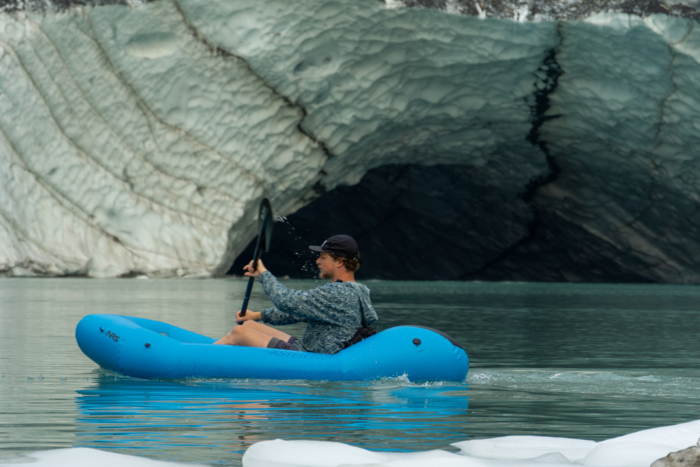
It’s wild where a little boat can take you. This summer, paddle in hand, I explored the great entrance of an ice cave at the terminus of one of the most impressive glaciers in the North Cascades. An icy blue-green lake forms at the base of this glacier, and by paddling across it, I could get as close as I dared to peek inside at some truly ancient ice.
The NRS Aster Packraft is, yes, a little boat, but it’s got big possibilities in it, and I found it to be the perfect fit for some of my adventures this summer. At $645, it’s also one of the best values in packrafting today. It’s not perfect, as I’ll explain below, but for what you’ll spend, I think it’s easy to work with and an excellent way to start paddling the wilderness.
In short: The NRS Aster is an excellent first packraft for casual lake exploration or simple river crossings. It’s a lightweight build that keeps it minimal in your pack, but it’s not so light as to need kid gloves when paddling. Whether it’s your entrance to packrafting or adding a lightweight option to your fleet, it’s a solid choice in packable watercraft.
Looking for a new packraft? Check out GearJunkie’s Best Packrafts Buyer’s Guide for more of our favorites.
-

-
(Photo/Nick Belcaster)
-
(Photo/Nick Belcaster)
-
(Photo/Nick Belcaster)
-
(Photo/Nick Belcaster)
-
(Photo/Nick Belcaster)
-
(Photo/Nick Belcaster)
Specifications
Pros & Cons
Pros
- Budget price
- Lightweight and portable
- Durable seams and double-TPU-coated materials
- Elevated seating
Cons
- Bravo valve is tougher to work with
- No self-bailing floor or skirt, so water stays inside

NRS Aster Packraft: Review
I took the Aster on three separate challenges this summer to see what it could do, and it impressed at every opportunity.
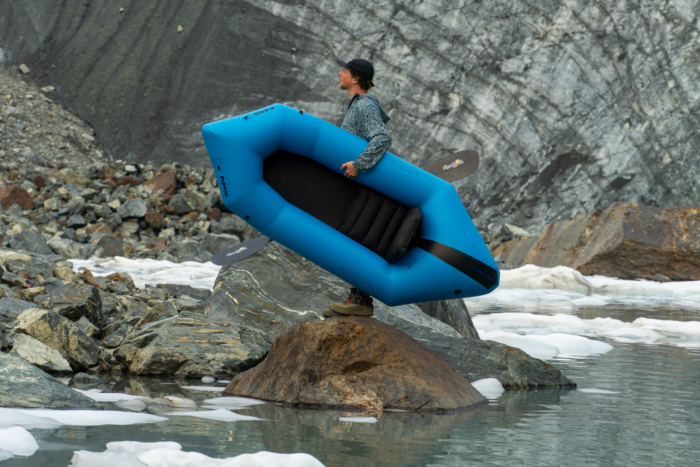
One trip was a bushwhack up to that glacial ice cave and lake, where the boat’s smaller stature meant it made the cut in a trim backpack. Another was a remote alpine fishing trip, where I relied on the Aster to get me out on the fish. Finally, I used the Aster to make river crossings when conditions allowed, and it excelled here as well.
If you’re after the classic idea of a packraft (compact and capable enough), I came away convinced that the NRS Aster wouldn’t be a bad choice at all.

Lightweight Build, Classic Design
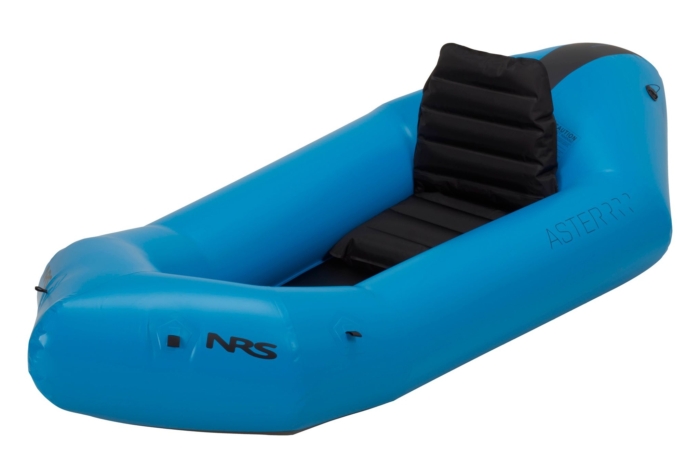
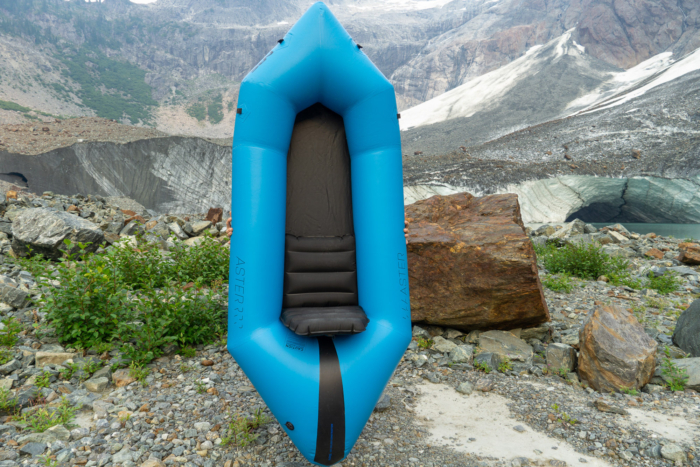
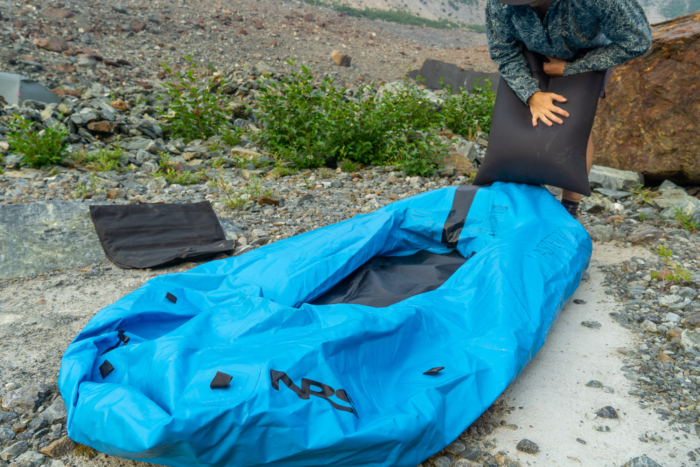
The design of the Aster is a classic bucket-boat packraft. Just some tubes, a slight taper from bow to stern, and a flat bottom with no drainage holes. This makes the design ideal for flatwater paddling and keeps bulk and weight down by avoiding excess features.
The tubes of the Aster are made from a 70-denier nylon, while the floor bumps up to a 210-denier weave. This material split is fairly common on lightweight packrafts like the Aster, with the Kokopelli Hornet-Lite being a notable comparison. That packraft weighs 4 pounds, 11 ounces to the 6 pounds, 2 ounces of the Aster (a ~1.5-pound difference).
The cause is the TPU coatings that each design uses. On the Kokopelli, the floor material is double-coated TPU, but the tubes are single-coated, making for a lighter (and slightly more packable) boat. For the Aster, it’s all double-coated material, with the goal being better long-term durability, but with a weight ding.
When I was paddling and launching from icebergs this summer, I was glad to have the slightly more durable floor on the Aster. After my summer of use, there are some rub marks on the bottom, but no actual abrasion that breaks through the TPU. That double-layered TPU does, however, make the boat tougher to pack up, and compared to a similarly specced boat with single-layer materials, it’s likely 20% larger when packed.

Sitting in the Cockpit
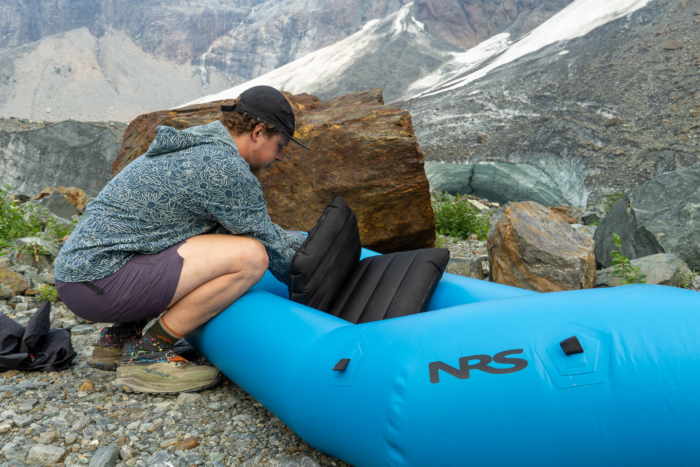
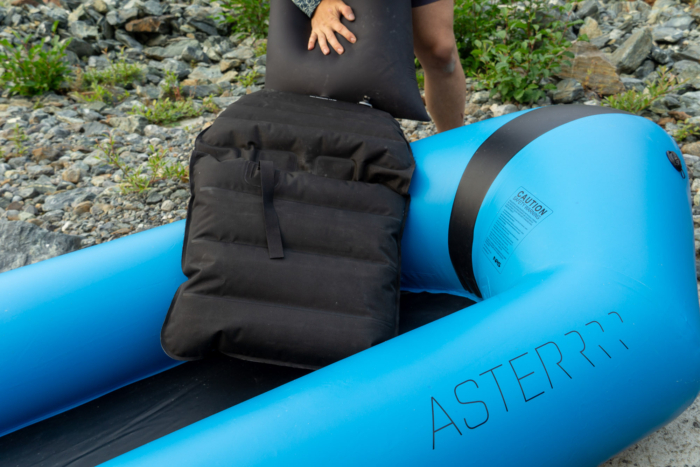
While I initially thought that the seat was going to be a compromise, it actually became one of my favorite parts about this little boat. My experiences with inflatable back-band designs haven’t been the greatest (they typically deform and are difficult to make supportive), but since the Aster combines the seat bottom and back panel together, it’s a different story.
Inflating the seat to full temper is quick, and once there, the seat becomes fairly firm and hoists you up a good handful of inches. The seat back lies against the stern of the packraft, and this is what you brace against while paddling. In this way, support is actually quite nice, and the paddling position in the Aster is well considered.
This is especially nice when using the packraft to fish from, as I did last August. The slightly elevated seat is nice enough to make casts from, but if you double the seat over on itself, it doubles in height and really gives you a platform to fish atop. I reeled in at least half a dozen trout across my trip while fishing out of the Aster, and it worked a treat.

The Rig
The set of four bow tie-off points on the Aster are simple webbing loops and are set up in a familiar pattern to affix things like a bow bag (or even your entire backpack). Surprisingly, even the $795 Alpacka Raft Scout lacks these bow tie-offs, and only sports one on the stern. While I didn’t make specific use of the bow loops during my testing, I did find a slightly better way to secure essentials.
Because the seat of the Aster is also secured by a webbing ladder-lock, this short tether becomes a solid spot to clip off a water bottle or small dry bag. Doing so tucks your kit down under the seat a bit, and so long as it isn’t too bulky, it’s a great spot to stash your stuff. This is what I did when using the Aster to cross the North Fork of the Nooksack River earlier this summer, when flows were high, and fording wasn’t feasible. Thankfully, it’s a secure spot.

The Bravo Mini Valves
All of the inflation of the packraft and the seat happens through a set of Bravo Mini valves, which are one of my only nitpicks with this packraft. While a solid interface and trustworthy seal when closed, I find the constriction of the small valve makes the inflation/deflation rate noticeably slow.
The issue doesn’t improve whether you use the included pump sack (which is an ample size and works well) or an electric pump, as the bottleneck is in the valve itself. It’s tough to ding a packraft too heavily for taking a little too long to inflate, but I will note that I was last to hit the water after my fishing partners had their boats inflated.
I’d love to see an update to the Aster that replaces these valves with something with a slightly better flow rate, like the New Short Halkey-Roberts Valve. The other packrafts in the NRS line use quality Leafield D7 valves, which, while bulkier, are noticeably quicker to pass air through. The pivot would both improve the inflation and deflation times and also move to a more widely used valve style, meaning different pump options could be used with the boat.

NRS Aster Packraft: Conclusion
At $645, the NRS Aster provides a practical combination of low pack weight, fabric durability, and river capability. By removing nonessentials and keeping the design light, NRS designed a streamlined raft that packs down to fit inside a standard multiday backpack without compromising on much flatwater capability. It suits both backpackers incorporating river segments into backcountry routes and paddlers who require a lightweight, packable boat for remote streams.
There are a few other boats out there to consider if you’re looking at the Aster, and the Kokopelli Hornet Lite and Alpacka Raft Scout should be on your short list. The Hornet is a bit less expensive and will pack up slightly smaller, but won’t be quite as durable (but it does still come with a Leafield D7 valve). The Scout is the splurge of the trio, but is a full pound lighter than the Hornet Lite, and is the most minimal of the bunch.
Between those two choices, I think the NRS Aster slides in as the perfect compromise. It’s certainly staying in my packraft rotation as my ticket to better access to alpine lakes and rivers. For the spend, I think it’s the one to go with.