While I’ve been actively involved with the knife community for years, I still don’t know every brand or maker out there (despite my best efforts). In hopes of finding some new-to-me sharp and shiny friends, I posted on social media asking for recommendations for pocket-carry fixed-blade knives.
One of the standout suggestions was the Slim Scout from Ice Age Blades, an artisan knife-maker under the Ice Age Crafts brand. The company sells materials like mammoth tusks and molars that it uses for handle scales and other projects. While I’m passingly familiar with mammoth molar knife handles, I was entirely unfamiliar with Ice Age Blades.
The Slim Scout is a great introduction to the brand. While this model doesn’t have mammoth DNA, it’s a solid option for EDC, whether your day involves chores around the house, hiking trails in the field, or working at a desk.
In short: The Slim Scout has everything you need in a fixed-blade EDC option, and nothing you don’t. Modeled after the classic bird and trout knife, it’s well-suited to many daily tasks you’re likely to encounter in your day-to-day, without being cumbersome or complicated. Just stop short of heavy-duty bushcraft chores.
Specifications
Pros & Cons
Pros
- Eye-catching design
- Perfect for pocket carry
- Good steel for general knife use
Cons
- Handle may be too thin for some users
Ice Age Blades Slim Scout Review

The Slim Scout is a take on the bird-and-trout–style knife. That happens to be one of my favorite types of fixed blade knives to EDC. The bird and trout is a style of knife that was expressly designed for processing fish, birds, and small game like squirrels. While the exact execution will vary from maker to maker, there are a few commonalities found among most, if not all, bird and trout knives. These include:
- A fairly short blade. Usually around 2 inches, but no more than 3 inches in length.
- The blade has a narrow profile, which is perfect for getting into the nooks and crannies of the game being processed.
- The handle will be comfortable and easy to grip, even if hands are wet.
The Slim Scout ticks all of those boxes, and then some. All of those features translate nicely to being an EDC-friendly knife, even if you rarely encounter birds or trout needing to be processed.
First Impressions

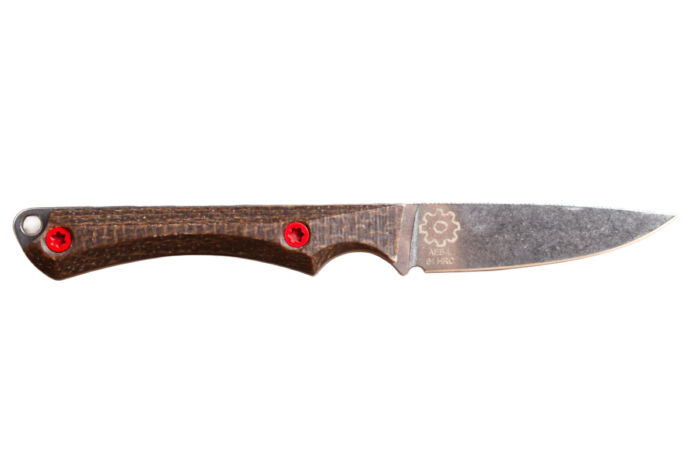
The Slim Scout is indeed a slim knife. It’s 6.75 inches long, with a 2.9-inch blade. From spine to edge, it’s only 0.75 inches. It tips the scales at a very modest 1.7 ounces.
While many knives have a section of jimping on the spine, this knife takes it to the next level and has jimping along the entire spine, all the way to the tip of the blade. This is the first knife I’ve had with that particular design, and I initially thought it was a little odd.
However, after using the knife for a bit, it makes perfect sense. When you’re carving or whittling, you often put a thumb on the spine for extra pressure and control. Having jimping at the base of the spine is great for traction.
Additionally, when you’re doing intricate or detailed work, you might put your index finger on the spine up near the tip. So, having jimping there is also beneficial. With just a 3-inch blade, you might as well just run the jimping end to end and be done with it.

The handle design is also unique. The scales have sort of a geometric quality to their shape, which provides excellent grip even in challenging conditions. I went with Burlap micarta scales, but they also included a set of textured micarta scales. The scales are easily swapped. They’re also interchangeable with their Slim Hunter model, which is a cool feature.
I wear L/XL gloves and sometimes struggle with smaller knives, as I prefer a full four-finger grip. I was concerned that my pinky would be hanging off the end of the handle of the Slim Scout. Once I had the knife in hand, any such worries were set aside. There’s enough real estate there for all four fingers.
The Slim Scout arrived shaving sharp, with no need for me to touch up the edge before putting the knife to use. This is always appreciated. Included is a Kydex sheath. It’s small and thin, perfect for pocket carry. There are also numerous attachment points on the sheath if you want to fasten it to a pack strap or affix some sort of aftermarket clip.
Field Use and Testing

I’ve had the Slim Scout for nearly a month. It’s been a regular companion on errand runs, in the kitchen, and around the house. My wife and I went camping last weekend, and I made sure the Slim Scout tagged along for that trip as well.
Something I noticed right away is how unnoticeable this knife can be. It didn’t matter if I was wearing cargo pants or basketball shorts. Once I dropped it into my right-hand pocket, it all but disappeared until it was needed. This is something I really look for in an EDC knife. I don’t need to be reminded it’s there every time I sit down.

The Kydex sheath holds the knife quite secure. No amount of shaking could dislodge the knife. In some environments or circumstances, I could easily see the Slim Scout being a neck knife, hanging from a lanyard looped through the sheath. That’s not my thing, but I try not to yuck someone else’s yum.
Carrying it in my pocket, I just got in the habit of popping the sheath off with my thumb, leaving the sheath behind as I pulled the knife out. Putting the knife back in the sheath was a two-handed process, though.
I used the Slim Scout for trimming some chicken breasts for dinner one night, and it really wasn’t a surprise how well it worked. That’s pretty much what it was designed to do. I also put it to work cutting paracord for a few projects, and it performed flawlessly. It broke down several boxes and opened more than a few Amazon packages.

While we were camping, I used it to slice up a couple of apples. It worked very well, despite the blade being shorter than the apples were wide. And just for the record, Honey Crisp apples might just be superior to Granny Smith for snacking, though it’s a close call. The Slim Scout also saw a bit of use trimming branches for the campfire, and it handled that chore easily.
Moving over to some more intentional testing, I grabbed a small sheet of rubber. A few years ago, I picked up a small bag of these specifically to use for knife tests. The Slim Scout sliced off bits and pieces without any effort. The blade didn’t even pull much at the material as it cut.
I mostly used long, dragging slices, focusing on the top third or so of the blade. This allowed me to make use of that jimping I mentioned earlier, as my index finger applied pressure to the blade as it cut.

Digging through my box of testing mediums, I came across a bag of fatwood. For those not familiar, this is dried pine that is rich with resin. It’s great for getting a fire going. These particular sticks came from a survival kit I bought ages ago.
I used the Slim Scout to carve off some shavings. What I wanted to see was how the knife handled with precision work. With sticks this small, every cut had to be short and exact. This sort of task posed no trouble for the knife.
All in all, I’m pretty happy with the Slim Scout. It ticks a lot of boxes on my checklist of EDC knife preferences. It handles well, keeps a sharp edge, and carries comfortably.
Recommendation

I’ll readily admit that I am absolutely the target audience for a knife like the Slim Scout. It’s just the right size for EDC without compromising actual utility. It’s just plain handy. And it also happens to look great, which is a bonus.
While I’d want something a little bigger and more robust for heavy-duty field use, the Slim Scout is great for routine chores around camp, such as slicing open food packets or, y’know, cleaning birds and trout.
On the flip side, if you’re working where there is a sidewalk in front of the building instead of a stand of oaks, the knife will still find plenty of use breaking down boxes or slicing up fruit and cheese at lunch.
The Slim Scout runs $215, so it isn’t exactly an inexpensive investment. But if you approach it with the “buy once, cry once” mindset, that can ease the sticker shock a bit. Is it worth the price tag? Absolutely.