
When you’re out in the backcountry, just about any meal tastes gourmet, but Jetboil’s new stove system, the TrailCook, turns that perception into reality. The TrailCook stove system takes all of Jetboil’s tried-and-true features and elevates them.
This stove system offers more control than ever in backcountry cooking, with its turn-and-click igniter and regulator, mirroring the functionality of a house gas stove. Its larger size provides greater stability, even in high-elevation winds, but it still breaks down to fit inside the pot. With the option to sauté and simmer, this stove system is for adventurers in larger groups who enjoy precision and don’t mind carrying more weight for greater reward.
In short: If you’re willing to add some weight to your pack, this stove system can transform your scrappy backcountry meals into a sustainable spread that lets you customize your meals and cooking preferences. I enjoyed a larger volume to work with, easily feeding my four-person crew of backcountry campers, cutting down on cooking time, allowing us to eat family-style on the trail. I experienced trouble with the knob-ignition at 7,840 feet of elevation and stronger winds, but when I retested the ignitor in a controlled environment, it started right back up.
-

-
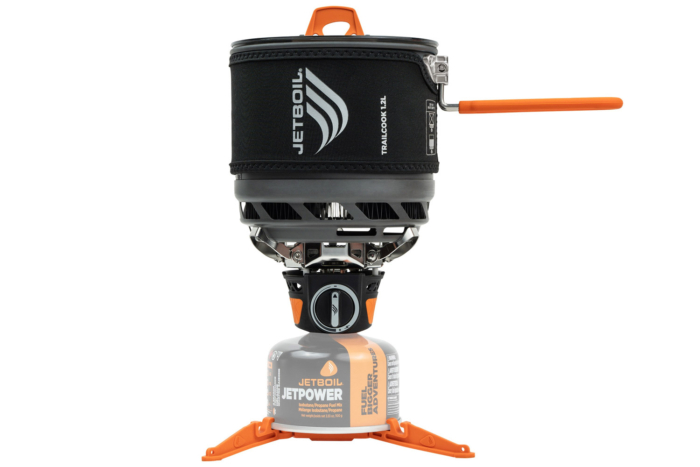
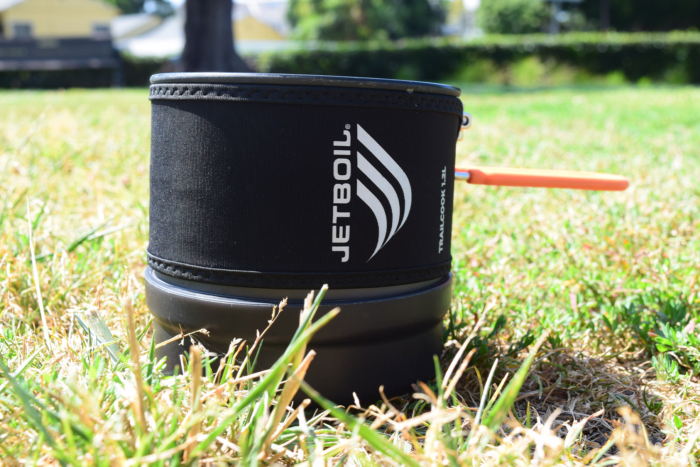
The TrailCook adds precise cooking control with a quick boil time; (photo/Teaghan Skulszki)
-
(Photo/Teaghan Skulszki)
-
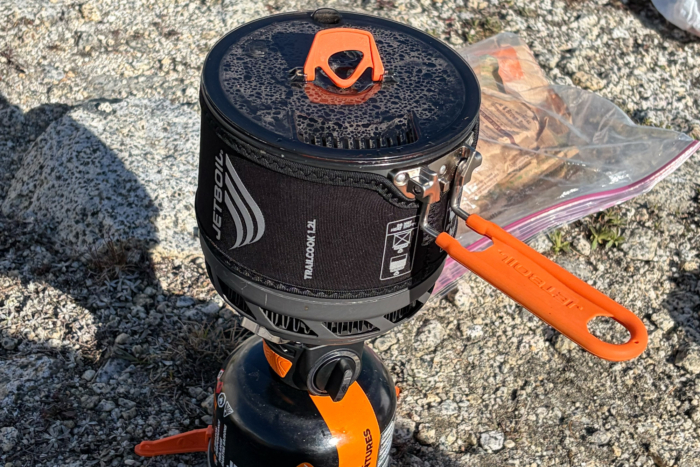
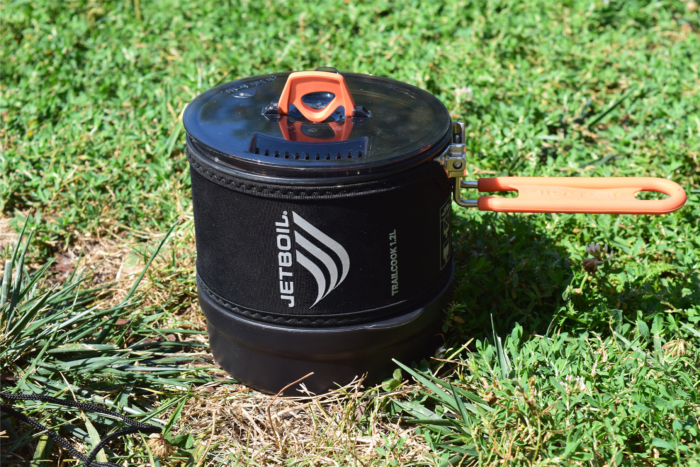
The TrailCook adds cooking function, but also extra weight; (photo/Teaghan Skulszki)
-
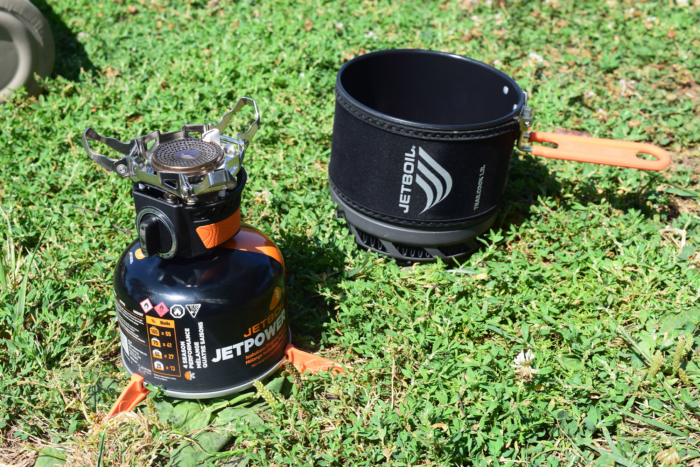
The TrailCook made it easier to cook and reheat meals outside; (photo/Teaghan Skulszki)
-
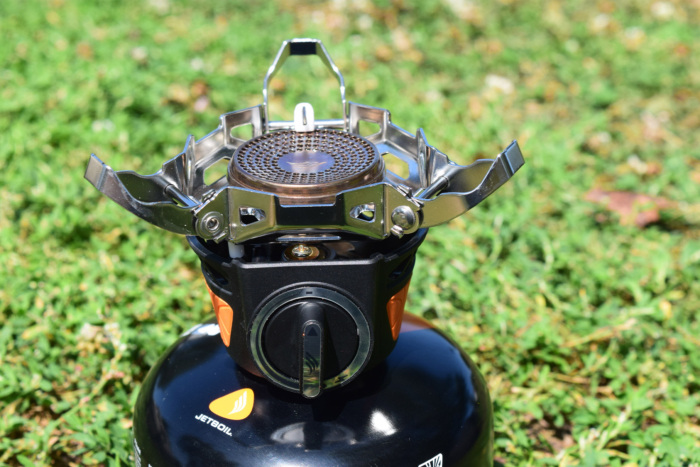
This stove system is built for adventurers who want better camp meals; (photo/Teaghan Skulszki)
Specifications
Pros & Cons
Pros
- Precise simmer and sauté control
- Quick boil time
- Easy reheating
- Packable all-in-one system
- Nonstick ceramic coating makes cleanup easy
- Foldable handle and smart lid improve usability
- Good for larger group sizes
Cons
- Heavier than traditional Jetboil systems
- Self-ignition is not durable
- Less appealing for ultralight backpackers
Jetboil TrailCook Stove System Review
I’ve used the Jetboil Flash on various trips in the backcountry, and more often than not, my trail menu ranged from ramen, ramen with more flavor, Mountain House pre-packaged meals, and black coffee with a side of oatmeal when I have extra pep in my step in the morning.
Because freeze-dried meals made me sick, I often opted for quick snacks more than meals, leaving me hungrier for meals that could support me for miles in the backcountry.

In search of more sustenance on the trail, I decided to switch back to a good old burner and metal pot, which added a few extra pounds to my pack weight. Obviously, I’d rather carry a lighter pack, but I’ll sacrifice saving weight for southern comfort and the ability to make N’awlins’ famous red beans and rice on the trail.
The haul was worth the reward, but my shoulders still ached. However, Jetboil’s new TrailCook proved to be a solution to my rumbling stomach. I took the TrailCook on a backpacking trip through the Enchantments in Washington to test its durability, weight, and, most importantly, its ability to elevate the simple trail meal.

Features
Jetboil centered the TrailCook system around heat control and precision cooking that’s more in line with the mechanics of home cooking. This accessibility does come at a very slight weight increase: 19.4 ounces (550 g) versus the 13.1 ounces (371 g) of the Flash 1.0L. If you’re obsessed with counting grams and cutting pack weight, you might want to go with a lighter option.
You’ll see improvements in all the qualities that make Jetboil a standout product, including a continuous quick boil (this one does it in 2 minutes, 15 seconds per 16 ounces), but there are new upgrades that set it apart from its sister stoves.
Re-Engineered Ignition & Flame Control

The re-engineered ignition makes this stove perfect for people who forget their lighters. (Guilty!) It has a valve control designed for faster ignition and greater control over your flame for fine-tuned cooking.
For the first three adventures I used the stove for, the self-ignition worked perfectly. However, as soon as I stuffed it into my pack, the self-ignition failed, and I had to use a lighter to start the stove. More on this below.
‘Smart’ Lid & Packable Design

The design also helps make your cooking process smoother. The new smart lid serves as both a spout and a strainer and comes with a foldable handle for easier packing. It locked into place and became storage for cooking ingredients in my pack.
Textured Grip & Self-Centering Pot

The textured grip zone on the burner base makes it easier to attach canisters, adjust the flame, or connect more cookware — so if you need to return your pot to the flame to reheat your food (like I did), you’ll be able to do it swiftly.
Along with that, the self-centering pot clicked smoothly into place while I was hastily trying to cook a quick dinner in ~10mph winds, without needing to add the stabilizing attachment.
Testing the TrailCook

I first took the TrailCook on a lunch date to test Backcountry chef Colin Yen’s famous Dan Dan noodles to see how nourishing a meal I could create with one piece of equipment. The boil system proved so quick, I hadn’t finished prepping my meal before the noodles were ready.
Once my meal cooled down, I threw it right back onto the stove to warm up and get some more sizzle on my garlic. The ability to reheat a meal once it cools down is standard in a traditional kitchen but a privilege in the backcountry. The TrailCook allows you that luxury.
The TrailCook also came backpacking with me through the Enchantments in Washington and accommodated my large group of friends, ensuring we could all eat our meals around the same time. Because the TrailCook has a larger circumference, we could make two meals at a time, doubling the traditional serving size and halving the time to feed everyone. This offered the added luxury of pairing hot coffee with a warm breakfast in the mornings.
In less-than-ideal weather conditions, the stove’s pot support held up against harsh winds without needing the fuel can stabilizer. This made for a quicker setup once we sauntered into camp a little too late. Once at camp, we managed to cook dinner for the entire group in less than 30 minutes.
In the morning, we tried out the fuel can stabilizer. We perched the stove on top of a boulder to test its balance and stability. Even with all of us coming back and forth to the pot with different needs, it was securely fastened with the stabilizer.
Where It Falls Short

The TrailCook’s biggest drawback is its weight. At 19.4 ounces, it’s noticeably heavier than more minimalist Jetboil systems like the Flash 1.0L. If you’re strictly focused on ultralight backpacking and counting every gram in your pack, this likely won’t be your first choice.
On my 21-mile trek, I opted for the extra weight and re-assessed my decision about 15 minutes up Asgard Pass. The added cooking functionality comes with added bulk, so whether the tradeoff is worth it depends on how much you value real cooking in the backcountry.
When it comes down to the functionality of the stove, I experienced one instance where the ignition knob did not spark a flame, and after multiple failed attempts and rumbling stomachs, we opted for the traditional lighter-to-gas method to get the heat rolling for our dinner.
I believe this mishap was due to user error and strong winds, as the ignition worked right away when I retested it in a more controlled environment with a lower elevation (4,000 feet versus 7,840 feet). However, it’s always important to pack an in-case-of-emergency lighter on the rare occasion that the ignitor is knocked out of place, causing it to not spark correctly. As of now, there have been no other reported incidents of the ignition knob not working.
Final Thoughts: Who Should Consider It

With an influx of newcomers stepping into the outdoor space and a desire for luxury in the mountains, this product caters to casual adventurers. From people trying to serve a larger crew on treks to skiers looking to make luxurious fondue at the top of a summit, the TrailCook is meant to elevate meals in the outdoors. If you’re planning to cook for a crew, consider sizing up to the TrailCook 2.0L, which serves two to four people and has a larger, Dutch-oven–style cook pot.

While it asks users to sacrifice some pack weight, the payoff is a stove system that brings precision cooking, larger serving sizes, reheating capability, and greater versatility to the outdoors.
For adventurers who prioritize better meals and a more comfortable camp experience, the TrailCook successfully bridges the gap between lightweight backpacking gear and a functional trail kitchen.


