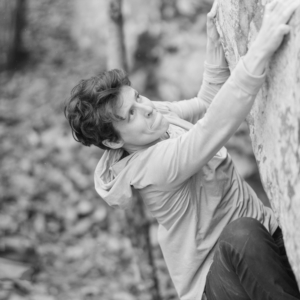
Before I tried Bedrock’s sandals, I was skeptical. People on Instagram say they can hike 20 miles in them; some people have even done the entire Pacific Crest Trail in these thong-type sandals. As someone who only wears sandals around camp, I balked at the idea of not wearing sturdy, closed-toed hiking shoes or trail runners. And yet, after spending an entire summer wearing the Bedrock Cairn Evo C PRO sandals ($145), I’m officially a convert.
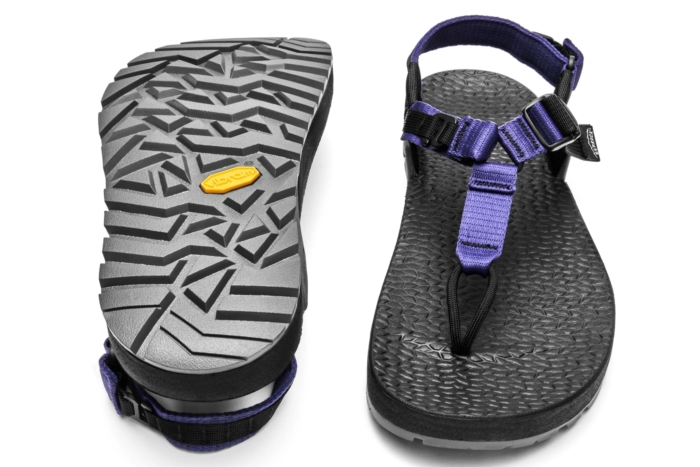
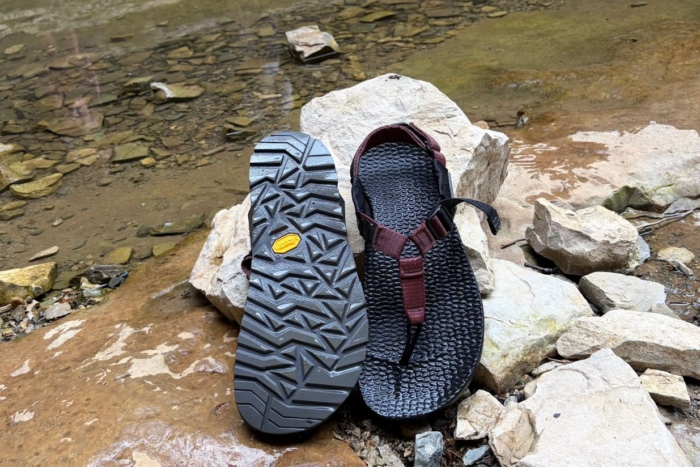
The brand says that this model has both the most cushion underfoot and the toughest heel strap of any of its footwear while requiring zero break-in. The Vibram Megagrip outsole is supposed to excel at slick and uneven terrain.
In short: The Cairn EVO C Pro aren’t the lightest or cheapest outdoor sandals, but I’ve never felt more stable and secure wearing sandals outdoors than I do with these. For multi-sport athletes looking for one sandal to do it all, Bedrocks are a top-tier choice.
-

-
(Photo/Mary Andino)
-
(Photo/Mary Andino)
-
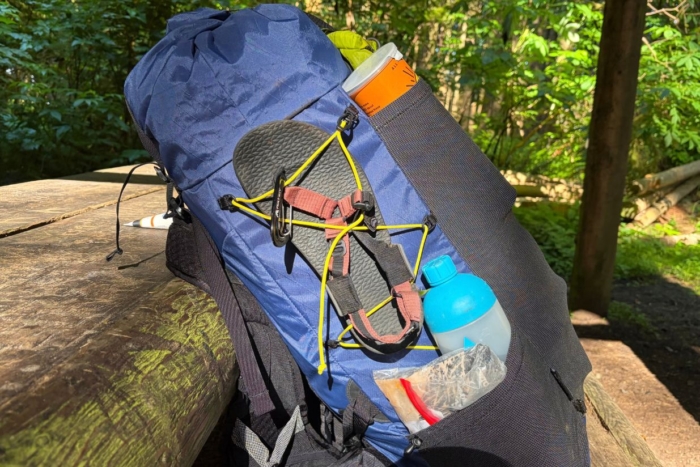
The Bedrocks were easy to attach to my pack; (photo/Mary Andino)
-
(Photo/Mary Andino)
-
(Photo/Mary Andino)
Specifications
Pros & Cons
Pros
- Highly adjustable
- Great traction
Cons
- Heavy
- Expensive

Bedrock Cairn Evo C PRO Sandals: Review
Design & Materials
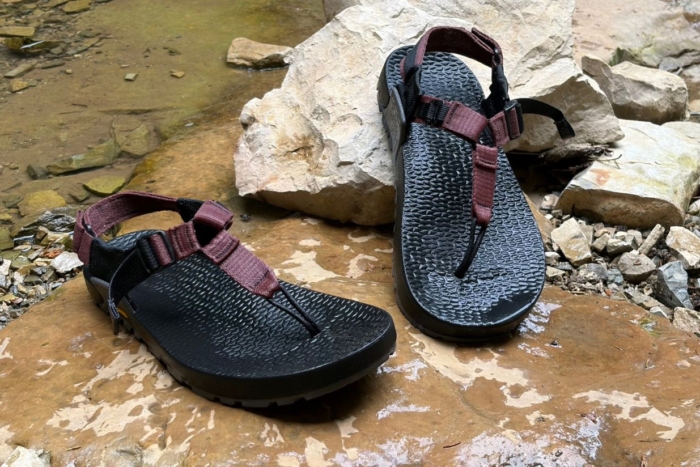
Bedrock sandals have three key components: strap system, footbed, and sole, and each is rigorously designed. The footbed on this model has EVA foam, a sturdy type of closed-cell foam that you’ll also find in gym mats, with 20 mm of cushioning. Vibram Megagrip makes up the sole, and the strap is made with polyester and nylon webbing.
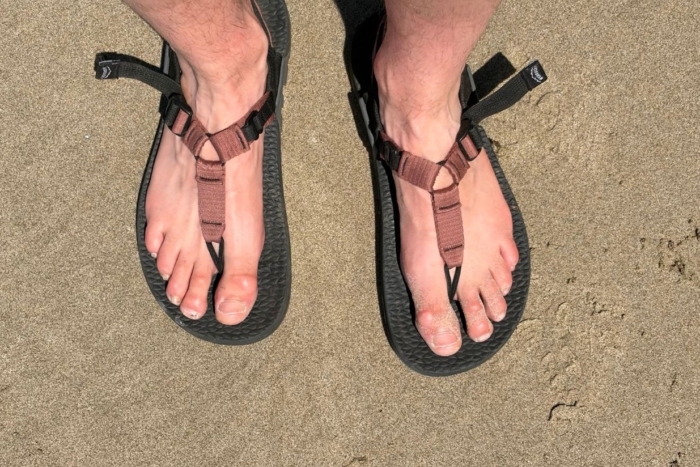
The strap has two points of adjustment. There’s a pull-strap on the front of the foot that you use for easy, quick on and off. On the heel, there’s a G-hook and loop system that you adjust when you first get the shoes. Bedrocks says that this closure is whitewater-grade and won’t slip off.

Testing & Durability
I essentially lived in my Bedrocks throughout the spring and summer. I took them on a paddling trip down the Buffalo National River in Arkansas and on a 96-mile backpacking trip on the Oregon Coast Trail.
During climbing season, I wore them as my approach and belaying shoe, as well as my camp shoe on overnight trips. I also wore them consistently in my everyday life, on walks with my dog in the park, trips to the botanical garden, and while working as a coach of my youth climbing team.
After months of use (and over 100 miles), the sandals are still in great condition. There is no fraying on the straps, and no significant damage to the tread. Bedrock also offers a Re-Soul program, where it’ll replace the footbed and outsole for $65, and any section of strap for $10.
Comfort
Bedrock says that these sandals don’t need any break-in time, and that’s only sort of true. While they felt fine right out of the box and didn’t cause any blisters, they definitely felt better after I had worn them a little bit, since the footbed molds to your foot over time, very similar to a pair of Birkenstocks.
The strap in between the toes definitely took a bit of adjustment. I typically wear Tevas outdoors, so I’m not used to having something stuck between my toes. It felt quite strange at first, but over time, I noticed it less and less.

The strap’s placement between the toes definitely provided better grip and control than my Tevas or Birkenstocks. My feet slid around less, and I could really dig in with my big toe if the ground was uneven.
The only real con to the flip-flop–like construction of the shoe is that it’s a little uncomfortable to wear socks with them. If I’m camping in a place with mosquitoes (which happens a lot as someone who lives in the Midwest), I’ll throw on a pair of socks under my Tevas to protect against bites. But unless you’re wearing toe socks, that approach doesn’t really work with the Bedrocks, since the toe thong pulls on the sock.
Bedrocks vs. Water
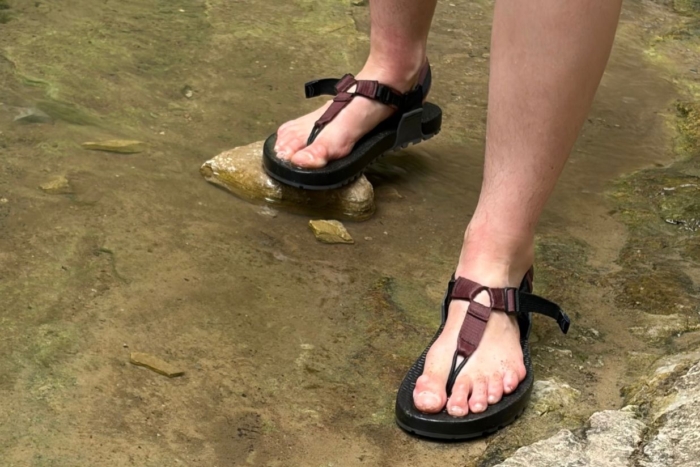
Bedrock advertises these shoes as perfect for river rats and whitewater rafting guides. I’m not either of those things, but I did wear them on an all-day paddle down the Buffalo National River in Arkansas. In a good test of the closure system, at one point, I hit a rock, tipped my kayak, and fell into the water. Even as I swam to my kayak, righted it, and hauled myself back in, my shoes didn’t budge an inch.
Later on in the day, at lunchtime, I went for a brief 2-mile hike to check out a waterfall. I was nervous about blisters, since typically moisture plus friction is a sure-fire equation for them. The hike had a series of gently rolling hills on uneven rocky terrain, and I felt confident about my footing and didn’t end up with any discomfort or blisters.

However, later on that summer, I had to ford a small inlet of the ocean in a bay on the Oregon Coast Trail. I took off my trail runners, slipped on my Bedrocks, and crossed the water at low tide. There was another mile to my campsite for that evening, so I figured I’d just keep my sandals on, which was a costly mistake. I ended up with the skin under the sandal straps on my midfoot totally rubbed raw, to the extent that I limped into my campsite.
Saltwater causes chafing more quickly than normal water, so I would point the blame there. Based on this experience, I do think the Bedrocks make for a great river/paddling shoe, but I would be cautious about relying on them as hiking footwear in saltwater environments.
Grip and Traction
Bedrock boasts that the Vibram Megagrip is “ultra grippy,” and I put that to a real test while at a crag in Missouri. While the climbs were dry, the ground was slick and covered in moss and algae.
If there’s one scenario where you really don’t want to have to worry about your footing, it’s belaying your climbing partner on their sport project. The intense tread on the bottom kept me stable as I moved around to give and take away slack.
I also wore them on an uneven approach trail through the woods for around 20 minutes while carrying a heavy pack of climbing stuff, and then wore them all day any time I wasn’t on the wall. They provided more support and protection from twigs, rocks, etc. than my usual Tevas did.
Two Drawbacks
There’s no easy way around it: Bedrocks aren’t cheap. At a price tag of $145, they cost as much as trail runners or hiking boots, and significantly more than other popular outdoor sandals like Chaco Z/1s ($95) or Teva Original Universals ($65). While they are certainly well-made and durable with quality materials, paying $145 for a pair of sandals may be a tough pill to swallow.

Compared to our other favorite camp shoes, the Bedrocks are also heavy. With a weight totaling a pound, they’re significantly heavier than the Rab Cirrus Hut Slippers (7.6 ounces per pair), Xero Shoes Pagosa Fireside (9.6 ounces), and Teva Original Universals (10.4 ounces).
Bringing them on as a camp shoe on a longer backpacking trip would be hard to justify when there are other lighter versions available. However, you can bring them as your only shoe on a trip and have them pull double-duty.
Conclusion: Bedrock Cairn Evo C PRO Sandals: Who Are They For?
For folks who like to paddle, hike, climb, and camp, the Bedrock Cairn Evo C PRO is an excellent choice. The well-made sandal can handle any outdoor activity you throw at it and transition seamlessly between them. It’s gradually replacing every other outdoor sandal in my arsenal, and its support and high cushion keep me reaching for it in my daily life.
Although this pricey sandal is certainly an investment, the durability and quality mean it should last for years. It allows you to take on the great outdoors with confidence while also letting your toes and feet feel free.