Blizzard has spent the better part of 2 decades building a reputation around powerful, directional skis. Those ski models that reward strong input, punish laziness, and feel happiest when driven hard.
That personality earned them a following. And diehard Blizzard fans have screamed as if mortally wounded by any previous attempts to “dumb down” beloved skis such as the now-discontinued Brahma and Bonafide.
But the brand’s sponsored athletes wanted something more adaptable to creative, modern freeride skiing. So the brand spent several years working with those athletes on what would become the new Canvas line.
The all-mountain headliner, the Canvas 100 ($700), will have the broadest appeal, but there are also fatter 108 and 118 widths. The skis are built with surprisingly little metal, and even the 118-width option comes in under 2,000 g per ski.
And they even have cool, artist-designed graphics! Some of the old-school Austrian racer types at Blizzard must have recoiled at the prospect of a lightweight freeride ski built to please the Americans, but the good news for those Americans is that Blizzard finally figured out what new-school skiers want.
In short: The Blizzard Canvas 100 skis are modern freeride all-mountain ski that takes Blizzard’s reputation for stiff power and softens it around the edges, expanding the capabilities of the ski and the pool of skiers who might enjoy it.
Check out GearJunkie’s guide to the Best All-Mountain Skis.
-

-
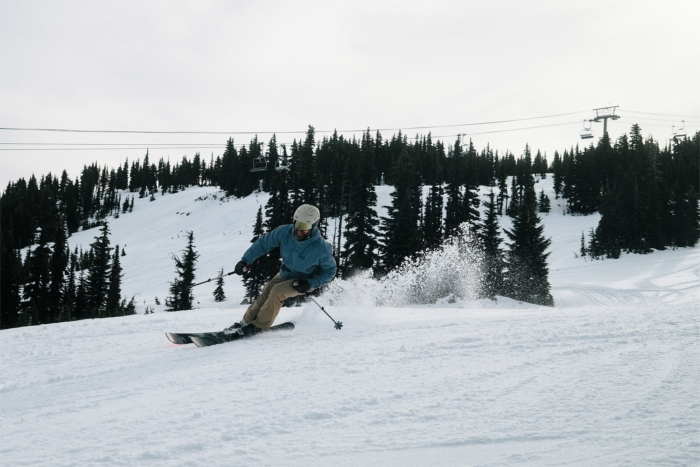
The Canvas 100 held an edge better than expected for a twin tip on groomed snow; (photo/Dawson Freisen)
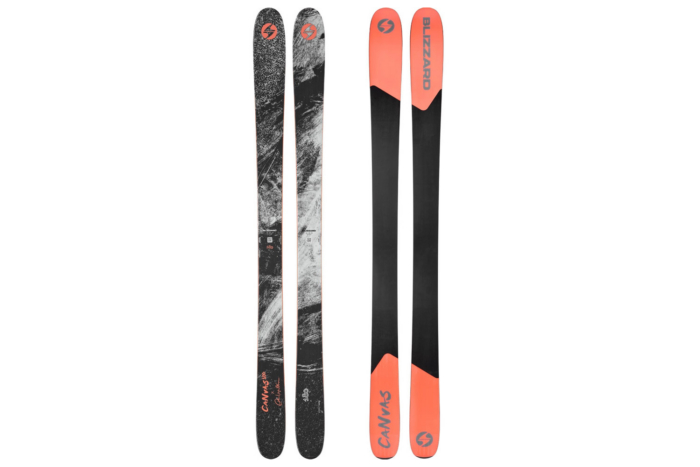
Specifications
Pros & Cons
Pros
- Strong underfoot in mixed conditions
- Playful without feeling flimsy
- Broad appeal for all-mountain skiers
Cons
- May disappoint Blizzard traditionalists
- Limited float in deeper snow
Blizzard Canvas 100 Review: My On-Snow Take

The Canvas 100 is Blizzard leaning hard into the “freestyle-meets-all-mountain” category. It’s a 100mm-waisted twin tip that prioritizes creativity — jibbing, slashing, pivoting — over trench-digging precision. Blizzard even markets it as a ski for “expression.” Cynics will say they just want a sliver of the Atomic Bent line’s sizable market share, gained with flexible, light, and fun skis with psychedelic graphics.
Compared to the brand’s current and historic lineup of race-minded skis (Bonafide, Cochise, Brahma, and the brand’s Anomaly line that replaces all three), the Canvas 100 is a radical departure in both intent and feel.
But they’re hardly just another Bent clone.
I’m a fairly heavy skier at 6’0” and 195 pounds, with a directional bias in my ski style. But even I found the classic Blizzard skis (and the newer Anomaly line) a bit much for all day. These are skis that demand you bite down on your mouthpiece and give them 100% focus, or they’ll punish you. And that’s what I grew to expect from the Austrian brand.
After 4 days of field testing the Canvas 100s in the 186cm length at Vail and Breckenridge early season, I’m relieved to confirm that these are something completely different.
The -6 cm mount point will feel centered for traditionalists, but is a compromised modern all-mountain positioning that loosens up the ski without feeling short. Similarly, Blizzard went easy on the metal, keeping the skis fairly light while retaining enough of the stiff-backed Blizzard personality to handle more aggressive moments.
On-Snow Performance
Groomers

The first surprise: this ski carves better than expected, given the weight and relative lack of damping metal. Despite its freestyle ambitions, the Canvas 100 has a fairly traditional camber pocket and a notably strong section underfoot. There’s real edge hold for a twin tip, and the skis won’t chatter if you keep your speed in check (and aren’t on the hardest of hardpacks).
The flex ramps up quickly from the tips into a stout midsection, which gives it composure when you tip it over and build speed. For casual carvers, there’s plenty here to do what you need to on the front side.
That said, it’s clearly not a frontside carving ski. That’s the whole point of this line. Compared to pretty much anything else in the Blizzard lineup, the Canvas is less precise and planted. It prefers a smeared entry rather than a locked-in arc. For the target audience for this ski, that’s going to be perfectly fine.
Trees, Bumps, and Tight Terrain
The moderate rocker lines and relatively centered mount point make it easy to pivot and release. It feels quick in tight spaces and much more forgiving than most Blizzard skis. You can ski it from a neutral stance without getting punished — something that absolutely cannot be said about most Blizzard skis.
The swing weight is much lower than older Blizzard designs, thanks to the lighter core materials and carbon reinforcement instead of sheets of metal. Heavy trench-digging Blizzard skis such as the Anomaly are brutal in tight spots, especially for lighter skiers. But the Canvas 100’s weight and centered stance make it more agile.
Powder and Soft Snow

At 100 mm underfoot, this isn’t a dedicated powder ski, but it punches above its width. During our midwinter testing period and a historically poor winter across the West, we didn’t get much opportunity to put the Canvas 100 through fields of powder across 5 days of resort riding at Vail, Breckenridge, and White Pass in Washington state.
The twin-tip shape and rocker profile gave it decent float in a few inches of damp PNW pow. And the skis planed in different depths and consistencies as the day warmed, despite fairly shallow rocker profiles. It’s happy to slash and surf, but I didn’t find it had a speed limit in soft snow. It encourages a playful style — side hits, quick direction changes, and butters — rather than straight-line charging or symmetrical arcs.
The -6 cm recommended mount point is centered for a Blizzard, but traditional enough that you won’t need to size up from your usual length to stay afloat in soft snow. Still, compared to wider skis in the Canvas lineup (like the 108 or 118) and other pow-first skis, it’s more of an all-mountain jack of all trades than a deep-day specialist.
Chop and Variable Conditions

Here’s where the Blizzard DNA shines through. Even though the Canvas 100 is marketed as playful, it retains a surprisingly strong and damp platform underfoot. That partial titanal layer and stiffer midsection give it stability when hitting skied-out junk at speed and differentiate the Canvas from skis like the Bent 100.
It’s not as planted or bulldozer-like as the Blizzard Anomaly 102 or even the Rustler 10 (see comparison below). But it holds together better than many skis in this freestyle-leaning category. It’s a playful ski that doesn’t fall apart when seas get choppy.
Freestyle Chops

The official description of the Canvas 100 says it’s designed to “jib, butter, and pivot,” and like basically no other Blizzard ski before it, it does! It has enough tail rocker and symmetry to ski switch comfortably, and it has a more centered stance than most Blizzard skis. It’s still not a full freestyle ski like the Armada ARV 100 you’d buy for dedicated park riding, but it pushes hard in that direction.
The Canvas 100 is not ultra-soft, so Blizzard traditionalists may whine. But compared to something like an Atomic Bent 100, it’s noticeably stiffer — especially underfoot and through the tail. Big mountain, high-speed freeride skiers will love that added support. Park rats will find it less forgiving for deep presses and butters.
Comparison: Canvas 100 vs. Rustler 10
To understand the Canvas 100, it’s worth comparing it to the Blizzard Rustler 10 Skis — one of the only previous Blizzard skis that partially broke the brand’s staid European mold.
- Rustler 10: Directional, still fairly heavy and charge-y, with metal shaping the ride
- Canvas 100: More centered, more playful, lighter
The Canvas is a bigger leap toward all-mountain accessibility. It moves further into freestyle territory, with a more balanced feel and less emphasis on driving the ski from the front while dialing back some of the Rustler’s top-end stability and precision.
The Rustler is playful for a directional ski, while the new Canvas line offers some directional stability for a freeride ski.
Bottom Line

The Canvas line is getting a lot of hype and with good reason. It’s one of the most ambitiously different skis Blizzard has released in years.
The move away from demanding, directional chargers toward the all-mountain-oriented Blizzard Canvas 100 gives skiers something accessible, creative, and fun. And yet, there’s still a backbone here, with a composed feel underfoot that keeps it from drifting into the overly soft, nervous territory of some freestyle skis.
For North American skiers who want one ski for everything from groomers to trees to side hits, the Canvas 100 has broader appeal than most of Blizzard’s historical lineup without totally abandoning its roots.