Twenty-five years of backpacking taught me the glory of cutthroat minimalism. More miles of deep backcountry become available when there’s less weight on your back. The shelters in my backcountry arsenal range from a small tarp to ultralight semi-freestanding tents that sometimes have enough interior space and often withstand the weather.
But as I lay awake during my 7-month-old-daughter’s first camping trip, pinned into the corner of a lightweight tent, my clingy 100-pound lab, Gus, cleaving me off of my sleeping pad, I cracked. The very next day, I called in Snow Peak’s Alpha Breeze tent ($550), a 22-pound glamping shelter that couldn’t be more opposite of the ultralight ethos I’d clung to for decades.
And after many subsequent nights of camping, I have to admit that the Alpha Breeze is a work of art both aesthetically and functionally. The type of tent that can transform family camping trips, as long as you aren’t trying to carry it on your back. While I’ll admit I’m deep in the liberating honeymoon phase of glamping after decades carrying ultralight shelters, I put the Alpha Breeze to the test in Colorado to sniff out its strengths and flaws.
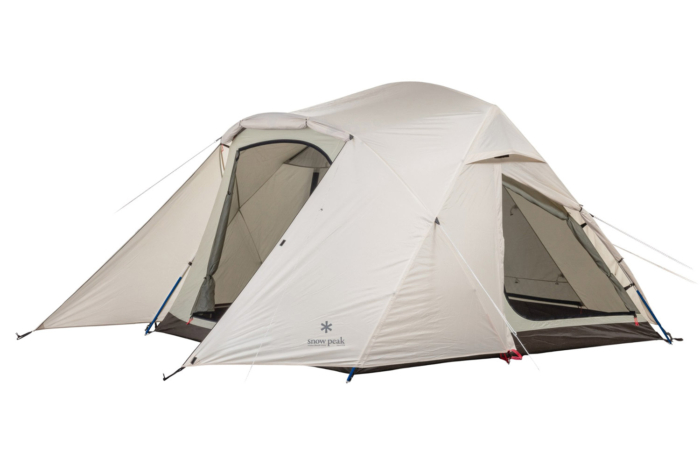
In short: Snow Peak’s updated Alpha Breeze tent is a four-person camping tent that leans into the glamping side of the camping experience. With enough ceiling height for adults to stand, enough floor space for the whole family, plenty of doors, and even a shade awning, this 22-pound tent adds a layer of comfort to the family camping experience. Given the weight and relatively large packed size, the three-season Alpha Breeze is a great option for campers accessing their site by car, donkey, or boat in any weather.
-

-
(Photo/Bergen Tjossem)
-
(Photo/Bergen Tjossem)
-
(Photo/Bergen Tjossem)
Specifications
Pros & Cons
Pros
- 4 big doors with mesh and weatherproof panels
- 77” ceiling height allows standing
- Excellent air circulation
- Solid construction and weatherproofing
Cons
- Heavy
- Moderately complicated to set up
- Pricey footprint sold separately
Snow Peak Alpha Breeze Tent Review

Snow Peak is a Japanese company that built a North American Headquarters in Portland in 2020, but has been distributing in the United States since 1999. What started as a mountaineering company born in 1958 from a Japanese outdoor adventure boom has grown into a high-end camping brand with a deep catalog of tents, camp furniture, and outdoor cookware.
The Alpha Breeze is positioned as the brand’s four- to five-person glamping tent, designed specifically for North American audiences. And while Snow Peak is not a brand I usually associate with affordability, the Alpha Breeze’s $550 price tag falls in the middle of the spectrum for tents this size. Gearjunkie’s guide to the best camping tents features tents of this general style, ranging from Coleman’s $200 Skydome Darkroom 6 to White Duck Outdoors’ $770 Regatta 13’, with several other options in the $500-650 range.
Tent Setup

As I unloaded the Forester one sunny September Saturday at a campsite outside of Eagle, Colo., I couldn’t help but feel perplexed by the sheer number of parts included in the Alpha Breeze’s duffel bag–like stuff sack, now scattered in the dirt in front of me.
Where I routinely intuit my way through first-time tent setups, I quickly and bashfully succumbed to the sturdy instruction booklet. And in retrospect, Snow Peak’s handy instructional video would have saved me at least 20 minutes during the first setup. Which way are the blue dots supposed to point??
Compared to most lightweight backpacking tents and even some big family tents, the Alpha Breeze takes a bit of thought to set up. I wouldn’t call it complicated per se, since the steps are all logical and the elements are mostly color-coded. It’s more so that there’s a sequence to setting it up that you should practice at least once before taking it out in the field.
This isn’t the kind of tent that you want to just “wing it” with in the dark after a beer or two while your family waits in the rain. And although it’s entirely feasible to set it up solo, a pair of experienced tent-pitchers speeds the process dramatically. I’d call it a 10-15–minute setup from stuff sack to stake once you get the process down.
Liveability

The payoff for all that setup time is space. Dare I say luxury? Or at least as close to luxury as you can get, sleeping next to a baby and a clingy 100-pound lab.
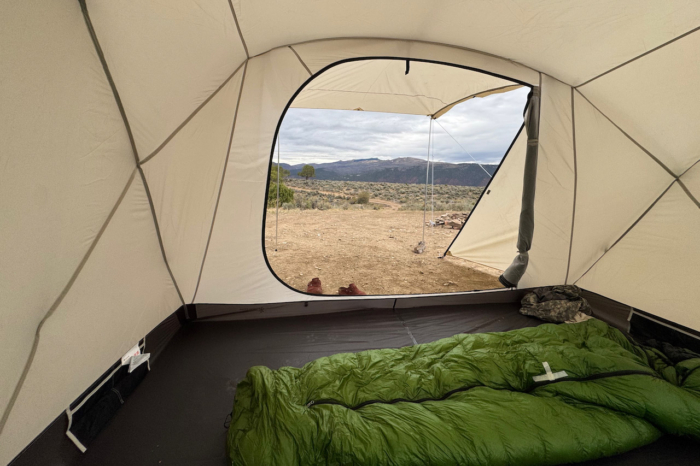
Aside from the big floor, the ceiling height is a whopping 77 inches. Even at 6’1”, I could stand up straight with a hat on inside the high point of the tent. That attribute alone is one of the Alpha Breeze’s strongest arguments, especially for parents who will spend a good portion of any camping trip attending to a baby and would like to do that in comfort.
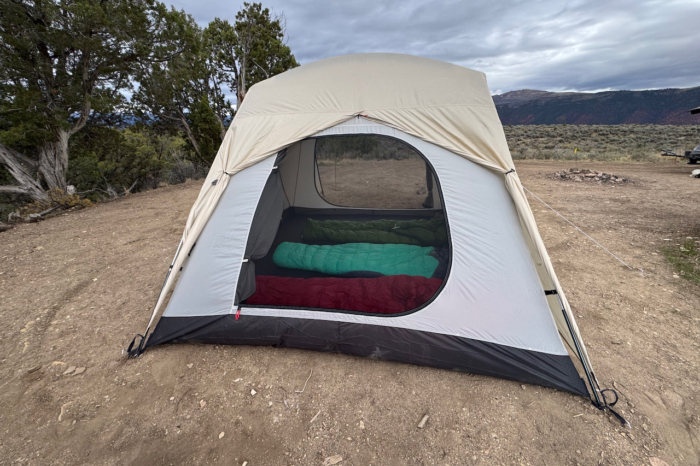
A 77 sq. ft. floor and 45 sq. ft. vestibule area make the Alpha Breeze feel massive, even when it’s all zipped up. It’s plenty big enough for a family of four and maybe even five.
In our case, a family of four meant my daughter in a pack-and-play, my wife and me on wide sleeping pads, and our dog, Gus, sprawled in whichever orientation felt right that hour. The rectangular floor plan meant that nobody was pushed into a corner or along the margin of a circular tent, which had been my role in our previous lightweight backpacking tent setup.

The sloped roof of the tent’s backside offers a unique aesthetic and silhouette, though it does cut down on some living space in the back half of the interior. Taller folks will find themselves lingering in the front half of the tent rather than crouching into the rear. But the nice thing about the Alpha Breeze’s floor is that sleepers can align in a few different configurations to find the most comfortable fit. Still, the sloped roof cuts down on an otherwise roomy interior.
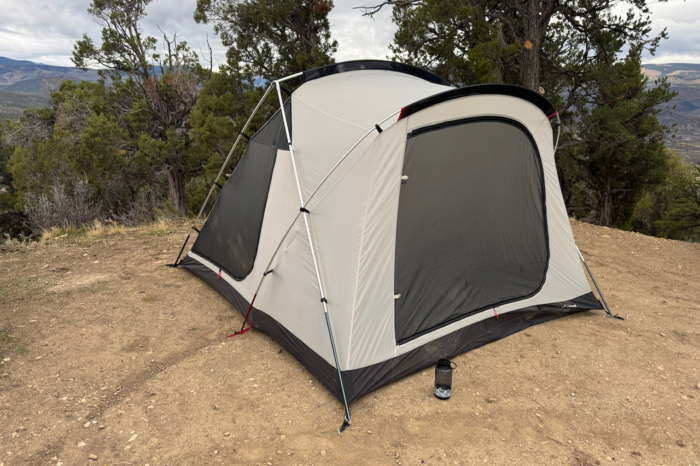
In addition to the generous dimensions, the Alpha Breeze comes with four doors. At first, I thought that was complete overkill, but I’ve since come around for a few reasons. There’s the obvious benefit of solving the midnight bathroom issue, where I’d typically find myself crawling over friends or family members while fumbling around for the exit door’s zipper. Now each person can have their own dedicated escape hatch, which means everyone else gets a better night’s sleep, too.

But the more important benefit is the impressive cross-breeze that can flow through the Alpha Breeze when the doors are open. We were able to enjoy the tent’s shade even during warmer parts of late summer thanks to that airflow, which we quickly learned as new parents is a critical element of a good naptime in the woods.
And this is where Snow Peak’s attention to detail really shone through with the Alpha Breeze. Each of the four doors has two layers and corresponding zippers — one a weatherproof shield, the other a fine mosquito mesh.
Perhaps more importantly, tiebacks will hold onto either or both of those layers when not in use. With all four doors in mesh mode and the two large rectangular vents open, a cooling breeze could pass easily through the tent, keeping its inhabitants comfortable. It’s an important feature when you need shade, and it’s not always a given with frontcountry- or backcountry-oriented tents.

The most recognizable feature of the Alpha Breeze tent is the front awning. It’s not a particularly new concept, but it’s well executed in the Alpha Breeze. Basically, the front door of the rainfly can unzip and be secured up by two included poles to provide an awning roughly 75” long x 71” wide and about 67” off the ground.
While it wasn’t overly protective from a sideways drizzle that blew through, the four of us could easily nestle underneath it for shade when the sun was at the right angle. It’s essentially a front patio, a covered spot for sitting and enjoying a campsite.
The one detail category the Alpha Breeze goes light on is internal storage. There are three modest flap pockets along the interior walls that are just big enough for the odds and ends — phone, headlamp, toiletries, etc., but that’s about it in terms of storage. That’s not a huge surprise or con given the generous dimensions of the tent itself, since there’s plenty of room for a few sleepers to bring their duffel bags inside.
Size and Weight

The price of all that space is weight. Coming from the 2.5-pound shelters that I could practically stuff into my Nalgene, the Snow Peak Alpha Breeze is a whopping 22 pounds and packs down to the size of a compact duffel bag. And that’s after dropping 2.2 pounds from the previous iteration of the Alpha Breeze.
Other four-person tents in Gearjunkie’s guide to best camping tents come in at half the weight or even less. The Nemo Aurora Highrise 4P, for example, clocks in at 16 pounds. The North Face’s Wawona 4 weighs just 13 pounds. The Best Budget Camping Tent pick, Kelty’s Late Start 4P, is just over 7 pounds.
But does weight really matter in this tent class? Not really, but it depends on your use case. 22 pounds is nothing if you’re simplifying carrying the tent from your trunk a few meters to a tent pad. It starts to matter when the campsite gets further than that. Don’t mistake the Alpha Breeze for a shelter you’re going to want to hike very far with.
Build and Durability

Where does all the weight come from? Well, for starters, the aluminum tent poles are much more robust than those you typically find in camping tents like these.
The collection of six A6061 aluminum alloy poles alone weighed just over 8.5 pounds and simultaneously gave me confidence that they wouldn’t require splinting in the field. And at no point during setup was I required to exert much force on any of them. They’re not a big failure risk in my mind.
The 75D silicone polyester ripstop canopy and rainfly are no welterweights either. Along with being sturdy to begin with, both elements are loaded with features, like doors, vents, tiebacks, and pockets.

The Alpha Breeze’s floor is a relatively sturdy 40D nylon ripstop that held up well to feet, paws, and a pack-and-play. But no tent floor is indestructible, and a footprint isn’t the worst idea for prolonging the tent floor’s life. The Alpha Breeze does not come with an additional footprint, but it can be purchased separately for a cool $286. I’ll stick with a $20 tarp from the hardware store.
Zippers can be a weak spot, but so far, the door zips are sliding smoothly and fast. And because the tent doesn’t put significant pressure on the canopy zippers, I’m predicting a long life if zipped with care, even if they aren’t as burly as something you’d find on a canvas tent.
Weather Protection

At first glance, the Alpha Breeze is a tall tent that looks more like a sail than a bomb shelter. It didn’t take long on an overlook campsite for a stiff cold front and 25mph gusts to test that observation.
The Alpha Breeze comes with seven thick guylines, a forked guyline for the awning, and an impressive 20 duralumin stakes. Pinning and tensioning all of it adds setup time, as Gus and I learned, but they earned their weight and bulk during that brief autumn blast.
With every line pinned and pulling tension on the sturdy poles, canopy, and rainfly, the Alpha Breeze was surprisingly formidable. Sure, there was the slightest bit of flap, but it pulls down into a taut structure. With the hatches battened down, rain simply wasn’t getting in, and at no point was I worried about the structure.

The main con of this tent’s design is that you need to collapse the awning and zip the flap into the vestibule for the best weatherproofing setup. But there’s no “quick release” way to get it down when you’re really in a rush. You need to pull out the stakes and guylines supporting the awning poles, toss those into the vestibule, and zip up both zippers. It felt like it took forever with the rain coming down (in reality, it was less than a minute).
The flip side of weather protection is breathability. With so much ventilation, condensation simply wasn’t an issue in the Alpha Breeze with two adults, a big dog, and a baby. “Breeze” earns its spot in the name.
Conclusion

Giving up on trying to cram my growing family into a lightweight backpacking tent was the best thing I could have done for our future as campers. Skipping the middle of the spectrum right to the glamping section, and to the Alpha Breeze specifically, was the next best decision I’ve made in a while.
I’m a big fan of this tent (and I think my baby and dog are, too). It makes sense that it was awarded “Best Glamping Tent” in GearJunkie’s Guide to the Best Camping Tents.
It’s not without a few distinct trade-offs that potential buyers should be aware of — it’s an absolute tank at 22 pounds, and the setup/takedown requires some patience and craftsmanship compared to tents that spring into form within seconds.
It’s not the best option for excursions where you’re moving campsites every day, but rather one that thrives in a basecamp scenario. Set it up and move in. Stay for a while.
Families or groups of two to four campers approaching campsites by vehicle, boat, or donkey will find an excellent camping shelter in the Alpha Breeze. Aside from just being a place to sleep, it offers a level of comfort and versatility that other big tents in this class don’t.
The awning and general layout has a way of attracting a group to gather, day and night, for a shady rest or a headlamp-lit game of cards. The way camping should be.