Most of the time, I carry my watercraft on my back. Which is, in fact, great fun, but paddling something like a packraft comes with trade-offs. Sometimes you want a little civility. This summer I kept my paddling strength up by doing laps in the Old Town Loon Kayak, and I came away convinced: heavy can be fun, too.
But the Loon isn’t really heavy; it’s just about perfect in nearly every metric I could drum up. A design that’s 30(!) years in the line now, and refined in that time to be an excellent recreational kayak. With easy paddling, nice storage space, and a super-adjustable seat, there’s little to see fit to change. After tallying up the mileage, I’m pretty confident that I’ve got 50+ miles of experience with this boat
In short: The Old Town Loon is a classic kayak, and one that’s worthy of your consideration if you need a single boat to do many things. It’s beginner-friendly in all the right ways, but feature-rich enough to keep you happy for years of paddling.
Looking for a new kayak? Check out GearJunkie’s Best Kayaks Buyer’s Guide for more of our favorites.
-

-
(Photo/Erika Courtney)
-
(Photo/Nick Belcaster)
Specifications
Pros & Cons
Pros
- Fine balance of stability and hull speed
- ACS2 seat is three-way adjustable and very comfortable
- Gel-coated interior adds impressive durability
- Deck bungee system tucks away when not in use
- Retractable carry handles
Cons
- A bit on the heavier side due to the overbuilt nature
- Storage hatch lid isn't the tightest fit

Old Town Loon Kayak: Review
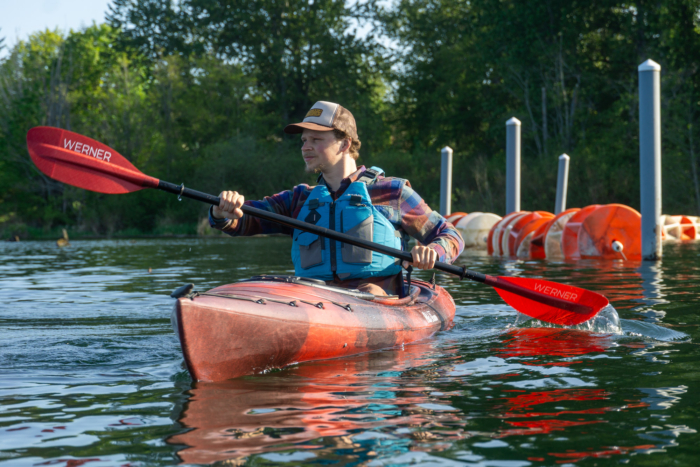
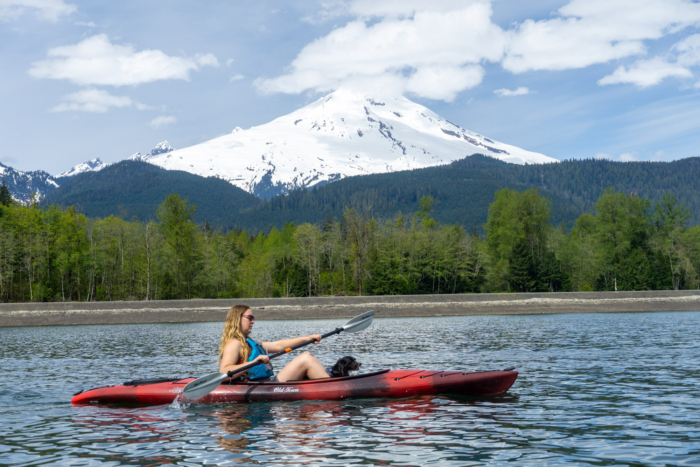
I’ve had the Loon in the 12-foot length for around three years now, and it’s been a treat. I’ve mostly paddled it in lakes, but it has found its way out into a river or bay here in western Washington. The hull shape gives it a bit more ability than your average rec kayak, and I could work up a good speed when paddling it all-out.
There are certain circumstances in which I might want a slightly more specialized kayak (say, a pedal-powered boat for long days of fishing or a true whitewater boat for rowdy water), but for most exploits, the Loon is just the ticket.
A Refined Hull Design
Some things you only really get a feel for by giving them a good whack, and thumping on the side of the Loon, you can tell it’s some quality plastic. Old Town says it’s a three-layer polyethylene, and the durability has been pretty impressive after testing.
Typically, plastic kayaks will do something called ‘oil-canning’ when you press on a larger panel (like the bottom), deflecting out of place and then quickly returning to place. Thinner kayaks do it more often, but with the Loon, it just doesn’t happen. The innermost layer of the kayak looks like gelcoat, and it’s smooth and certainly helps to make the boat rigid.
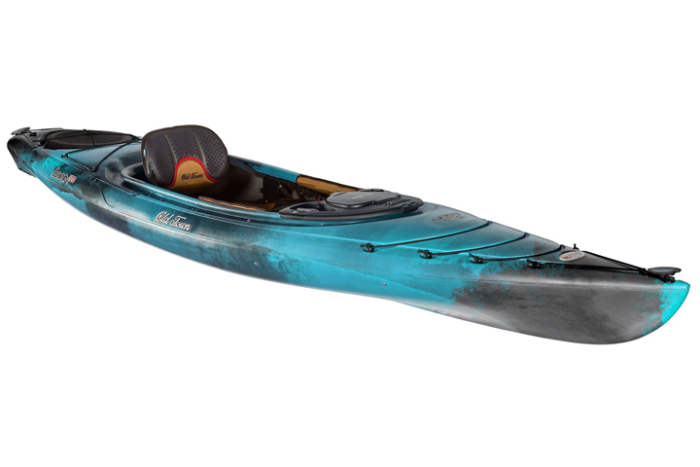
In the 12-foot length, the Loon gains a bit more waterline over the more commonly purchased 10’ kayaks, and the paddling speed and ease are noticeable. The bow and stern come up in some sharper chines than most recreational kayaks, and with a 30-inch width, the Loon 120 hits a sweet spot between the stability of 32-inch entry-level boats and the nimble (but tippy) ability of touring kayaks.
On bays in Puget Sound, that narrower beam and defined keel kept me tracking straight without fighting, though without a rudder or drop-down skeg, you still have to work your strokes to make tight turns on rivers. Secondary stability is equally predictable, and leaning the boat on edge feels controlled rather than tippy, giving newer paddlers room to grow their skills.

Time in the Saddle
There’s a lot to like about the Loon design, but honestly, the thing that impressed me the most might have been the seat. Many lower-end designs phone in the seat, but that isn’t the case here with the ‘ACS2’ seat (you know when it’s got a proprietary name, it means business).
The seat is adjustable in several different ways to dial in your fit, and is comfy from the get-go with breathable spacer-mesh padding. One of the highlights is the under-leg support, which ratchets up the leading edge of the seat to contact your legs braced against the foot braces. This takes a surprising load off your back and makes extended paddling painless.
The controls aren’t dainty, either. Heavily lugged ratchet straps adjust the seat tray angle, and the build quality of everything means it’ll stay adjustable into the future. The foot braces are also well-built, and even host a little contoured rubber padding that makes barefoot paddling possible.
The cockpit itself measures out at 56 by 22 inches, leaving plenty of wiggle room for taller paddlers or those who like to bring a dry bag between their knees. Old Town rates the Loon 120 for 323 pounds of usable capacity (375 pounds total), which easily handled my weight plus a full day’s kit without bogging down.

Room For Your Kit
Besides yourself, there’s also space to haul around some gear with you while you paddle. The first spot I tested was the series of bungee cords that span the deck of the kayak. There’s your typical crossed box of cordage behind the seat, but on the bow are three nested lines that are even more useful. This is where I parked a bulky backpacking chair on one trip, and a dry bag with toiletries on another. Note that this isn’t a splash-free zone, but for most paddling it’s not much of a worry.
The dry hatch behind the seat is where anything you’d rather not get wet goes. Typically, results can be mixed, depending on the quality of your hatch cover. Thankfully, the version on the Loon is excellent and has a chunky rubber lip that suction-fits over the opening. Across all my testing, this hatch stayed dry. The space here extends from the bulkhead behind the seat all the way to the stern, and is sized to fit nearly anything you could want for a lakeside picnic.
Finally, gotta-have-it items can be parked in the ‘Work Deck’, which is a plastic console that fits into the front of your cockpit. Here again, there’s a hatch (only water-resistant) that’s quick to access, along with some recesses for cups or other small items. A pass-through USB cord also lets you stash a portable battery bank inside and run a cable out to your phone on deck.
Just remember to remove the entire Work Deck before strapping the kayak to your roof rack — it snaps in securely for paddling, but you don’t want highway winds testing it.

Improvements?
Really, few and far between on the Loon. As a rotomolded kayak, you could make the comparison to 12’ ABS and composite boats like the Eddyline Caribbean 120 FS ($1,899) and note the ~10-pound difference between the two. The 55-pound Loon 120 isn’t overly heavy, but it’s an example of different materials making a difference (in weight and price). In this case, you’re paying $70 for every pound of weight you’re saving with the Eddyline.
Also, while the wide-open cockpit makes for easy entry and exit, it also allows in more paddle splash compared to more snug cockpits. The trade-off here makes good sense for a recreational shape like the Loon, but more experienced paddlers should consider the fact before jumping straight in.

Old Town Loon Kayak: Conclusion
If you’re after a daily-driver of a kayak, I’d start by looking at the Loon. The Old Town brand simply knows what they’re doing, and this design is proof of that.
I’d angle most paddlers toward the 12-foot Loon 120, as the extra waterline noticeably improves glide and tracking. However, if you’re under 5’6″, tight on garage space, or prioritize quick turns on narrow creeks, the Loon 106 (10’6″, 47 pounds) is easier to wrangle off the water. Conversely, paddlers over 6’2″ or anyone hauling heavy overnight loads should step up to the Loon 126 (12’6″, 60 pounds, 450-pound total capacity) for extra legroom and buoyancy.
At $1,200, the Loon hits a value-to-performance sweet spot that cheaper department-store boats can’t. Sure, you can pay nearly double for a lighter thermoformed composite hull, but you’ll be hard-pressed to find a plastic sit-inside kayak that balances hull rigidity, tracking performance, and all-day comfort as effortlessly as this one.