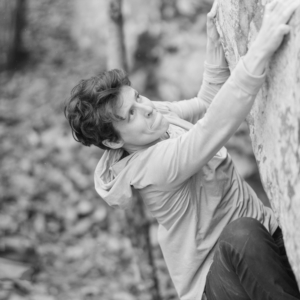
I have been backpacking for all of my adult life, and I’ve been single for most of my 20s and 30s as well. As I’ve traversed trails in Oregon, New Zealand, and California, I’ve been alone both on my hikes and in the larger, “lacking a life partner” kind of sense.
I’ve dated and had relationships here and there, but those were few and far between, and most didn’t last longer than the 6 months it would take to do the Pacific Crest Trail. I’ve never lived with anyone, and only one of my relationships (and a very dysfunctional one at that) has lasted longer than a year.
On a recent backpacking trip in Germany, as I spent hours alone in the woods, I came to a realization: My chronic singledom and my love of backpacking were actually connected. This outdoor pursuit served as a screening tool for men and helped weed out potential boyfriends. It also helped me present a hardened exterior and independent identity that kept even the good ones away.
The Big Question
When you first start dating someone, it’s so easy to get wrapped up in the butterflies. In the early days, everything the other person does is charming. You’re enchanted just by the way they make coffee or how they talk.
As someone who feels deeply and jumps into every relationship with both feet, I am especially guilty of donning rose-colored glasses with a new guy. By asking one question, I’m able to give myself a reality check. I ask myself: Would I consider spending multiple days on a backpacking trip with this person?

The guy doesn’t have to be a backpacking expert, or even know how to set up a tent. Not everyone has had the same opportunities for outdoor recreation, and the upfront cost of backpacking can be prohibitive. It’s more about his attitude and spirit, and how I think it would blend with mine.
If he is new to the activity, it’s important to me that he listens. If I think the guy would argue with me about directions when I’ve got the onX map and GPS pulled up on my phone, that’s a red flag. How a man behaves in a situation where a woman has more knowledge and authority says a lot about him. I’ve dated a few men who claim to support women, yet balk at the first sign of a woman asserting her opinion.
I also picture how he would respond if I were having a hard time. For all my backpacking experience, I still really struggle some days, whether it’s from blisters, an upset stomach, or just exhaustion from a bad night’s sleep.
When I did the Camino de Santiago with my best friend, we had a “no heroes” rule. Whenever one of us was tired or needed a break, we could say “no heroes,” and the other person would have to stop, zero questions asked. I would want my partner to respect the “no heroes” rule and be patient with me, as I would be with them.
Even the activity is a screening tool. My partner doesn’t need to love the outdoors or backpacking as much as me. But if they are entirely opposed to the idea of camping and hiking for a day or two occasionally, it’s probably not going to work out, since that is what I plan my life around.

Backpacking is like an extreme version of playing house. You’re out in the wilderness, entirely dependent on each other with no other resources or people.
I consider what I know about this person and our relationship, and try to imagine what it would be like to hike up a mountain with them. How much would they complain? If something went wrong or a piece of gear broke, how would they react?
Backpacking strips away all comfort and artifice, and really shows you how people behave when the shit hits the fan. I want to know how someone would respond to stress or discomfort.
It’s easy to be a wonderful, supportive boyfriend when everything is going right. I want to know if you can feel frustrated, tired, or upset — and backpacking will definitely cause all of those emotions — without taking it out on me, your partner. Going on a multiday backpacking trip is the ideal litmus test for so many qualities I look for in a partner: patience, humility, determination, compassion, and mental fortitude.
Some people, including my mother, would find my backpacking idea too high a bar. My mom would say I’m being too picky. I do all my backpacking alone now, and if I had a partner, she would say I could just continue to do so; my partner doesn’t have to come. But that’s not the life I want.
Last year, I was backpacking in New Zealand, and the vistas along the ocean were so stunning they made me cry. As I sat on the beach, I felt this profound melancholy as I thought how much more special this moment would be if I had someone to share it with.
The Problem of Persona
This summer, I went on three long backpacking trips alone in Oregon, California, and Germany, so I had plenty of time to think and reflect. I realized that my years of being perpetually single were perhaps a vicious cycle.
As someone who lives alone, in a city far away from any family, I have become hyper-independent. While I have a terrific community of friends, when the rubber meets the road, it’s all on me: the bills, health problems, the list goes on. All of my major life stepping stones — finishing my Ph.D., switching career fields, getting a job at GearJunkie — I did all on my own, often through sheer will, and it’s given me a bit of a chip on my shoulder.

And every backpacking trip reinforces just how capable I am alone. In Oregon, I backpacked 26 miles in 1 day with over 3,000 feet of elevation gain — one of the most physically and mentally difficult days I’ve ever had on trail.
I love how strong and confident solo backpacking makes me feel, but that may be part of the problem. Romantic partners like to feel needed by their significant other, and I have constructed a life and an outward persona that screams in neon lights, “I don’t need anyone.”
To survive as a woman both in my everyday life and in the woods by myself, I have adopted a “don’t fuck with me” attitude. While of course, in reality, I do need love, support, and affection like everyone else, my hardened exterior belies the opposite. My Instagram is just me backpacking by myself; I bristle when people tell me it’s not safe to do these things alone.
Backpacking alone has helped build up walls that keep people out. I don’t believe in changing myself to attract a man, but I could drop the mask and display a bit more vulnerability — I can allow two things to be true.
I love backpacking by myself, and I also have a softer side of myself that I can show other people. It doesn’t make me any less of an ardent feminist to admit I need things only a partner can provide. Vulnerability isn’t in opposition to strength — it’s part of it.
What’s Next
Unsurprisingly, I’ve never actually gone on a backpacking trip with a partner. Typically, just imagining that scenario tells me everything I need to know. If I can’t picture us being in the woods for 2 days without fighting, it’s not a great fit.
I’ve broken up with guys because they don’t respect my opinion or because they think my outdoor pursuits are a waste of time. And at the same time, guys have also dumped me because they feel expendable or not included, and I don’t blame them.
As independent as I may be, I’m not an island. When I’m on trail, I feel most like my true, authentic self, and I want to connect with another person on that level. And that means I have to be able to show that self to others. While I think of myself as a bold rockclimbing backpacker who dreams of solo hiking the PCT someday, I’m also a human in their mid-30s who doesn’t have it all figured out.

I have realized I need to practice patience and openness. Instead of doing everything on my own, I should let my boyfriend help, even if it takes a few extra minutes. Backpacking with a significant other won’t be the same experience as when I’m alone, but it could be better. I won’t know what that experience is like until I allow it to happen.
When I face an obstacle, instead of carrying on through sheer force with a brave face, I should admit to my partner that I’m struggling. So much of my success in the outdoors (and life) has come through a determined spirit; I can achieve a lot of things through white-knuckling and refusing to give up.
But relationships don’t work that way. My first response to a challenge can’t always be, “You think I can’t do it? Watch me.” When the day comes that I meet someone I would want to go on a backpacking adventure with, I hope to be an open, vulnerable person they can connect with.