When you’ve spent hours swinging a Pulaski or hauling chainsaws through the forests of the North Cascades, quality sleep isn’t a luxury. While leading backcountry trail work hitches requires packing light, running a front-country crew demands a different strategy. In those setups, weight doesn’t matter, but quality sleep does.
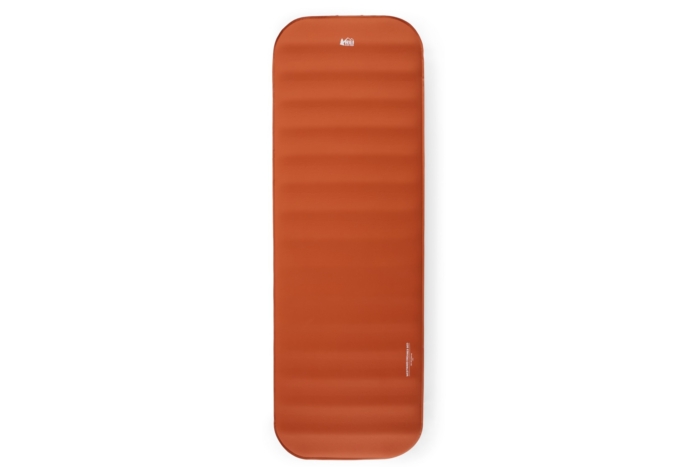
Over a full summer of testing, bouncing between extended work hitches and casual weekends, the REI Co-op Westward Dreamer Self-Inflating Bed became my go-to basecamp setup. At 4 inches thick, it provides the restorative sleep needed for working hard outdoors, and at $199, it’s affordable enough to snag on even a seasonal trail crew budget.
In short: The Westward Dreamer pad is one of the best camping mattresses for the money. After 3 months of rigorous testing, it proved both comfortable and easy to use, delivering similar results to pads that retail for $80-100 more.
Looking for a new camping mattress? See how the Westward Dreamer compares on GearJunkie’s Best Camping Mattresses Buyer’s Guide.
Specifications
Pros & Cons
Pros
- Budget pricing
- Plush 4" comfort
- Easy to use inflation and deflation valves
- Duffel-style stuff sack is easy to load
- Includes a patch kit
Cons
- Valves are basic
- Bulky packed size
REI Co-op Westward Dreamer Camp Bed: Review

The Westward Dreamer is the direct successor to the popular Camp Dreamer XL Mattress. REI made a few calculated tweaks to position this as a premier car-camping and basecamp pad, putting it in direct competition with premium heavyweights like the Therm-a-Rest MondoKing 3D and the EXPED MegaMat.
The pad itself hits all the important numbers: Its 4-inch cushion is supported by a cored foam construction, and is offered in a “Long Wide” (76” x 25”) and a “Long X-Wide” (76” x 32”). I tested the Long Wide and found it to be more than comfortable enough for my 5’3” frame, and friends up to 6’ tall agreed.
The R-value of 6.7 is also up there with more expensive mattresses, and puts the Westward Dreamer in the 4-season category. The coldest I slept on this pad was 41 degrees Fahrenheit, and it was more than warm enough for that. Here’s everything else I learned about the mattress from my 3 months of testing.
Field Testing: Work and Play

On the Clock
During early-season trail work on Washington’s San Juan Islands, temperatures regularly dropped into the low 40s. The pad’s toasty R-value kept the chill from creeping up from the ground, and the 4 inches of open-cell foam inside swallowed up uneven gravel and roots beneath the floor of the wall tent.
The 30-denier stretch polyester top fabric is notably quiet (no crinkling potato-chip sounds when you roll over) and feels reminiscent of the memory foam mattress I paid too much for at home. Plush enough that you almost don’t need a sheet, it’s also simple to clean, which is an important consideration when you’re 5 days out from your last shower.
In total, this camp mattress endured 18 overnights of work, which is no small feat, as my crew can be tough on equipment. It would certainly be too large to take on my backcountry work hitches, but when we have the extra cargo space, it’s my new go-to.
Off the Clock
When I wasn’t running a crew, this pad saw plenty of casual weekend abuse. Because the Long Wide model measures exactly 76 inches long, it slides perfectly into the back of many pickup trucks (something to keep in mind with other “Long” camping mattresses, which can often be 80 inches in length). After a long weekend picking morel mushrooms on the east side of the state, retreating to the truck bed to find this bed already inflated and waiting was phenomenal.
The 75-denier bottom fabric also easily handled being dragged across tailgates, truck beds, and rocky ground without a single puncture. And when the trip was over, it packed down small enough to chuck in the back of the truck.

Storage and Inflation
Wrestling a large camp mattress into a too-small storage sleeve is a huge bummer, and not something I’m trying to do on the eighth day of the hitch when I’m eager to get home. The carry bag included with the Westward is a large-mouth duffel type, and is oversized to fit even a hastily rolled pad without all of the air evacuated.
Inflation of the pad is also simple, and after the foam has done its decompression, the included pump sack snaps onto the one-way inflation valve, and I found that about three bagfuls of air will get the mattress topped off. Not bad! The valve used is common enough that I imagine that pump sack could also work on other mattresses out there.

Repairability
One of the most important improvements the Westward Dreamer makes on the previous Camp Dreamer XL model is small enough to fit in your pocket, and that’s a repair kit. While the previous version lacked a kit, the Westward comes fully equipped, meaning the value on this budget mattress can be stretched even further.
When testing the Camp Dreamer, an inquisitive cat ended up putting a few holes in the sleeping surface after testing the cushion himself. Because it lacked a patch kit, I had a cold night on a deflated mattress. To test the new patch kit effectively, I purposefully put a few pinholes in the new Westward. Good news: the patch is still holding to this day, and was simple to apply.
The inflation and deflation valves on the Westward Dreamer are simple flap versions, but this also makes them quite easy to repair if they ever should go bad. The internal rubber flaps on both valves are the same, and could even be field-replaced if you’ve got nimble enough fingers.
What Could Be Better?

As mentioned above, the inflation and deflation valves are fairly simple, which is great for use, but it does create one small issue: slow self-inflation. Because the inflation valve needs to overcome the valve to pull in air, it will only do so as long as the mattress has a large pressure difference. In real-world practice, this often means the pad will inflate about halfway over 30 minutes.
Thankfully, topping off the pad is easy enough with the inflation bag, but it’s still something to consider. Notably, more expensive camp mattresses like the Therm-a-Rest MondoKing 3D and EXPED MegaMat host inflation valves that open entirely, meaning they don’t suffer from the same bottleneck.
Who Is the REI Co-op Westward Dreamer Bed For?

Sure, you can get away with sleeping on just about anything (and I have), but if you’re working hard outside, you need the ZZZs to rest and restore yourself for the next day. At $199, the REI Co-op Westward Dreamer Bed doesn’t ask a huge price for the experience, and while it won’t be the most compact when packed (or host the most featured valves), it hits all the other high points I’m looking for in camp comfort.
If your work (or play!) takes you into the backcountry as much as the frontcounty, and you want a pad to do both, the Westward likely isn’t it. Instead, consider the Therm-a-Rest NeoLoft: an inflatable pad that still hits 4.6 inches thick and uses a cozy rectangular shape (we’ve even reviewed it as well).
For ultimate comfort, however, no matter the weight? The Westward Dreamer should be on your short list.