There was a time in my running journey when I almost exclusively wore Merrell shoes both on the trail and on the road, but the barefoot kind with minimal cushioning and a tight, narrow fit. Then I moved to shoes with more cushioning, a wider toe box, and a minimal drop. So when I had the chance to test the MTL SpeedArc Peaks, I was curious about the mid-level cushion, thick lugs, and, most notably, the split carbon plate.
These years-in-the-making shoes come out of the Merrell Test Lab, where numerous athletes help literally shape the shoe. The SpeedArcs were available to the public in July 2026, but have been worn and wrecked by Merrell athletes for the past 5 years, with 154 prototypes and more than 13,000 miles tested,
In short: The carbon-plated MTL SpeedArc Peak shoe by Merrell ($290, unisex) is a concerted effort to create a top-tier, athlete-endorsed, super-technical trail shoe that aims for perfect fit and accessible speed. Use this for mid- to high-mileage runs over moderately technical terrain. Lace them up for training runs on single track and your next long run, or save them for race day when you want that extra rebound.
Compare the Merrell MTL SpeedArc Peak with others in our guides to the best trail running shoes and best hiking shoes.
Specifications
Pros & Cons
Pros
- Winged carbon plate provides enough stability without being too pushy
- Well-balanced protection and support for long trail runs
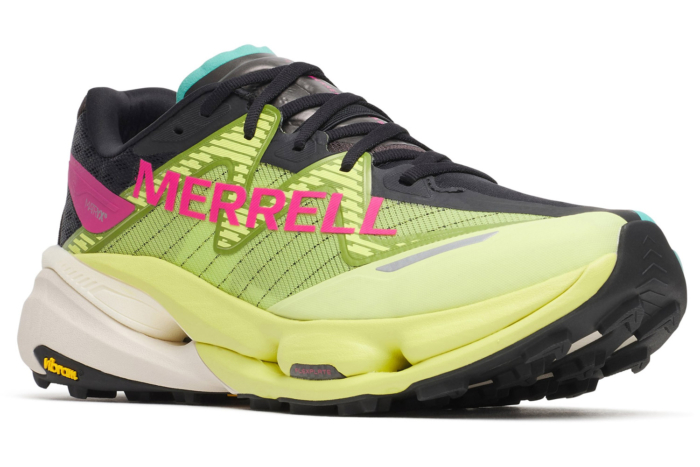
- Fun, vibrant colorway
- Durable Matryx upper
- Light and nimble on technical terrain
- Secure fit
Cons
- Pricey
- Can feel like a lot of shoe for shorter distances
- Slimmer toe box compared to other trail running shoes
Merrell MTL SpeedArc Peak Review
Comfort and Fit

I wore these on a dry run in Boulder right from the box and found myself not thinking about my feet at all. I’m used to running in shoes with a wider toe box; I didn’t find any issues with the narrower fit, as other shoes have left my baby toe feeling numb after a few miles.
My heel stayed in place with minimal movement thanks to secure lacing, a snug fit around the top of the shoe, and a padded collar. The tongue is secured over the top of the foot and is held in place on the sides with a minimal piece of stretchy fabric, which made for a very breathable upper, as no thick fabric blocked the mesh.
This is purposeful from Merrell, as the shoes are made with a Matryx upper that uses Kevlar threads to amp up durability and high-tenacity polyamide to maintain fit. That means the upper uses a single layer of fabric that lets your feet breathe during long, hot runs, but won’t snag, tear, or come apart from tricky trail elements.

Even without a full sleeve, the tongue didn’t move around. I was very happy with the no-sleeve option, as running in nearly 80-degree temperatures with high humidity can make for very hot feet, but I never found that to be the case with the MTL SpeedArc Peaks.
The only issues I had during the first few break-in runs were with the tongue, which dug into my ankle — even through my socks — on a 5-mile run, creating a small blister. Some of Merrell’s shoes, like the Agility Sky (debuting in 2027), have a split to the top of the tongue, which would ideally eliminate this issue. After the first run, I had no issues.
Midsole Foam With Split Carbon

The MTL SpeedArc Peak is Merrell’s first-ever shoe with a carbon plate. The midsole is a two-part, dual-density foam using FloatPro PEBA-based lightweight foam and FloatPro TPEE-based footbed sandwiching the Carbon FlexPlate. The bottom layer is cushioned yet supportive, without any sinking sensation, yet still responsive when you are making your way uphill.
The top layer of FloatPro PEBA is slightly softer to the touch. Both of these layers, paired with the carbon plate, made for a protective shoe against sharp rocks and pointy twigs, and it also felt poppy and responsive, even when I was dragging. On the side of the shoe, you can see all these elements, even the carbon plate, through a few cutouts.
The forked carbon plate isn’t always a staple in carbon shoes, especially road shoes, but the fork helps trail runners better navigate technical trails and allows both sides of the shoe to operate independently. Unlike some other shoes with carbon plates that feel like they will propel you off the trail as you bank around turns, the split plate in the SpeedArcs provided a much more subtle support system.

I wore these shoes during the 10K Forest Loop at the Beast of Big Creek race, part of Merrell’s Skyrunner World Series. The second half of the loop was all downhill, the kind where you wonder how much you can let go and just fly. The route was smooth singletrack with very few roots or rocks, and mostly wide curves with just a few tighter turns.
Knowing that I had the traction from the lugs and the flexible stability from the carbon plate and midsole, I felt confident pushing myself just a little faster as I continued downhill. I banked off turns with no slippage or a feeling like the outside of my foot went off-center as ferns whipped my ankles. My foot stayed centered over the midline of the shoe, and I felt that congruent positioning from my toes to my ankles to my calves.
Why the carbon plate in general? It’s a way to offer a lightweight chassis that adds support and rebound over highly responsive foams. Carbon plates have become common in many higher-performance shoes and are working their way into trail running.
Traction and Durability

The Vibram Megagrip Elite outsole features butterfly-shaped lugs on the bottom of the SpeedArcs and is said to be built for frequent changes in speed, direction, and vert. In action, the outsole and lug placement are prime examples of quality over quantity.
The lugs are 4mm high and are placed with the forefoot lugs facing the middle and the back lugs also facing the middle, so the grip that you need is working in the correct direction. Merrell rates these shoes at the highest trail rating of rugged (versus light or moderate), meaning they will keep you upright on technical trails with obstacles and debris.
On the trail and for race day, the Vibram Megagrip Elite outsole did its job. I wore these on humid, leaf-covered trails in Wisconsin; dry, rocky, and gravel trails in Boulder, Colo.; and on the misted single track in Hoodsport, Wash., with tight turns and various roots and rocks.
The grip was tacky on wet leaves and damp roots, so I could continue to propel myself downhill without worrying about slipping. The lugs also held superb traction on drier dirt as I was plodding uphill, so I was able to keep my footing on the singletrack or gravel paths without slipping out and face-planting. There are cutouts on the sides of the shoe and a few spots on the outsole that, while weight-saving, can catch pebbles as you go.

Design and Features
Other features that were an added bonus to aid in the shoe’s overall comfort were the padded collar, an elastic lace keeper to ensure those laces stayed tied, and a rad retro colorway that celebrates Merrell’s 45th anniversary.
Merrell MTL SpeedArc Peak: Who Is It For?

As professional runner Alexi Pappas describes the shoe, it’s a very accessible, friendly shoe that isn’t too extreme in either direction. She’s found it suitable for a variety of her running friends, and she’s used it for longer runs, shorter runs with more vert, and some gravel runs, too.
“I’d describe the MTL SpeedARC Peak as a race-ready shoe that delivers high-level performance without feeling overly specialized or intimidating,” Pappas said. “It’s definitely accessible, and when I run in it, I don’t notice it, which I love in a running shoe. It strikes a balance between speed, cushioning, and stability that makes it versatile enough for lots of different runners and terrain.”
I’m not an elite runner, by any means, but I’ve found myself choosing this shoe for my recent race and also for training days where I need just a little bit of that spring back in my step (literally) and extra enthusiasm.