Overseas knives have been on an upswing in the past 10 years. Reate and WE Knives have long been the frontrunners out of China, but a newer name, Kunwu, has been producing some very stylish, complex knives.
Until now, the company’s smallest offering fell into the “behemoth” size category, but a few new offerings have been reasonably for EDC. The Compadre was the most interesting these newer knives.
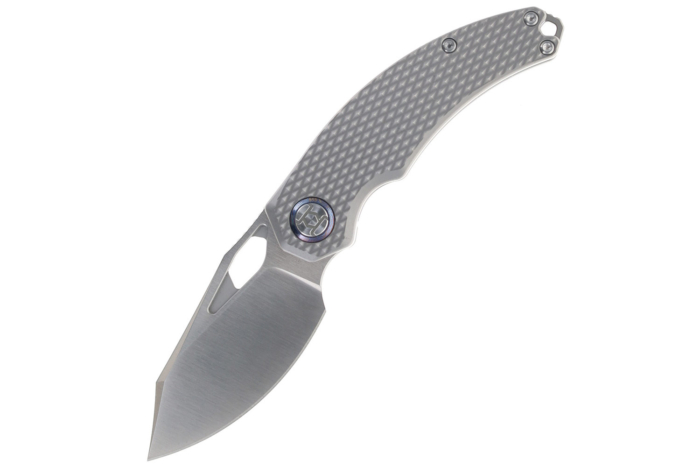
In short: The Compadre ($280) is a beautifully made, highly stylized knife with superior cutting performance. Its cuts and curves might look busy, but getting the knife in hand and using it will prove definitively that each element was thoughtfully considered. This is a fidget fiend’s friend, too! Its thumb hole and pivot allow quick deployment.
Compare the Compadre with the best pocket knives in our guide.
Specifications
Pros & Cons
Pros
- Lots of complex machining
- Superior fit and finish
- Bleeding edge materials
- Great in hand
- Snappy deployment
Cons
- May be a bit too stylized for some
Kunwu Compadre Review
First Impressions

Very few knives make as strong an impression as the Compadre does. Its evocative appearance looks like something out of a sci-fi pirate mash-up, but it still serves a functional purpose. With a huge arc to the handle and a good naked finger choil, this knife is great in-hand. The tall, thin blade and Vanax steel make it an elite cutter, falling short of only the very best knives in the world on this account.
Kunwu Compadre Review: Use and Carry

Arriving just after Christmas, the Kunwu Compadre got a lot of use. It did work post-Christmas processing boxes. This year, I decided to make some paper briquettes for the winter, and the Compadre helped me process a ton of material. I have also used it for food prep tasks — cutting and peeling apples, cutting cheese and cured meat, and finally, I used the Compadre around the workshop as a marking knife.
Don’t let the looks fool you — the Compadre, though a bit busy, is more Ferrari than Fiero. The steel and the blade height (which is possible due to the extreme, curvy design) make the Compadre one mean slicer.
Only something like the best traditional knives or the supernal Spyderco Spydiechef clearly outpace this exceptional performer. Its fit and finish match the level of design, from the ramped tail end of the clip to the lock-up; nothing has been given short shrift in the making of this knife.

Food Prep and Cutting Cardboard
Obviously, the knife did well opening packages and presents over the holidays. In food prep tasks, like cutting an apple, the Compadre sliced it rather than cleaving or popping it open. I liked the performance through sticky meats and cheeses. The knife also did well with strawberries and other fruits.
The stonewashed Vanax steel looked none the worse for wear even when I left sticky and acidic juice on it (like when cutting through an orange peel — oranges in stockings are a long-time Italian Christmas tradition). In general tasks and food prep, the Compadre did well. I had a Case Crossroads Barlow in for review at the same time, and it suffered a bit by comparison, but it was still better than most of the knives I was testing.
Making the paper briquettes was another great test. These briquettes are made by taking cardboard, paper, and sawdust and mixing it into a pulp by adding water and letting the mix set for a week or so. The pulp is pressed into cylinders that are left to dry. Once finished, they make hard, fist-sized fuel for fires in and outside.
With all of the boxes from Christmas, sawdust from the workshop, and a year of saved local newspapers (yep, we still have a printed paper), the Compadre faced a truly daunting cutting challenge. Cardboard tends to dull blades quickly, even with modern steels. The abrasive nature of the material is a good challenge for any knife, and slicing dozens of boxes into small strips for pulping up took a few 3- or 4-hour sessions.
Vanax Steel
After a while, the thicker blade stock on the Compadre held it back while the Crossroads Barlow kept going, but both cut for a very long time. Eventually, the cutting dulled the Compadre, and I stropped the edge and kept going.
Of the half-dozen or so knives I used (the Spyderco SpyNano, the Case Crossroads Barlow, the Victorinox Venture Pro, and Golden Designworks Nugget), the Compadre came in a very close second to the Barlow.
The results weren’t unexpected — the thinnest blades performed best, but I was impressed by the Vanax steel (this is my first knife with it). In every way, it reminded me of MagnaCut, a steel with a similar chemistry.

As a marking knife in the workshop, it wasn’t great. The Compadre is a very tall knife, and one of the projects I was working on is a detail-oriented Japanese toolbox.
The blade height made getting into corners tough, but the Spyderco SpyNano never dulled when marking walnut (moderately hard wood) or maple (hard wood). A smaller blade would work better here, since most marking knives are pretty slim.
Kunwu Compadre: Conclusion

The Kunwu Compadre is an excellent blade — a highly complex design that might put some in the minimalist mindset off. But don’t let the looks baffle you. This is a sweet knife that cuts for days. Vanax steel is among the best steels on the market, and the fit and finish here, as seen in the complex handle design, is top shelf. Reate and WE have a new rival, and Kunwu’s designs are unique and visually striking. The fact that they work so well should worry others.