Little else ruins a good backpacking trip like a midnight run for the bushes. I’ve been there, and I’m not keen on going back, which is why our experts have found the best backpacking water filters. Over the past 12 months, testers Mary Andino and Erika Courtney and I have taken five of 2026’s newest filters across 38 overnights in Washington state, Missouri, and beyond.
Our experts collectively tested a wide range of filters for the creation of this guide, from top-pick Platypus QuickDraw to the budget-conscious Lifestraw Peak Series Solo. I’ve been squeezing water through countless tubes and dropping tablets in Nalgenes each season to bring you the streamlined selection of 15 filters you see today.
Rest assured, I would trust every model in this guide to keep me safe and hydrated in the backcountry.
Editor’s Note: We updated our Backpacking Water Filters guide on August 24, 2026, to add the Katadyn BeFree AC Bottle and Epic Water Filters The Answer 2.0, along with a new comparison chart with updated functionality.
The Best Backpacking Water Filters of 2026


Platypus QuickDraw
-

-
(Photo/Erika Courtney)
-
(Photo/Mary Murphy)
-
(Photo/Mary Murphy)


Specifications
Pros & Cons
Pros
- Impressive 3 L per minute flow rate
- Filter interfaces with both Platypus reservoir and popular soft-drink threaded bottles
- O-ring sealed caps for both the inlet and output sides of the filter
- Integrity Check allows you to ensure your filter membrane is still safe to use
- O-ring in inlet side is indexed to not fall out
Cons
- 0.2 micron filter size isn't as fine as some filters out there
- Dirty water bag isn't immune from punctures or wear
Read Review: Water Filter Review: Small & Speedy Platypus QuickDraw Rivals Sawyer Squeeze
Bottom Line: A hollow-fiber filter with a 3L per minute flow rate and a dual-thread compatible design. The quick flow rate ranks it above most other filters, while the stated filter lifespan is on the lower end.
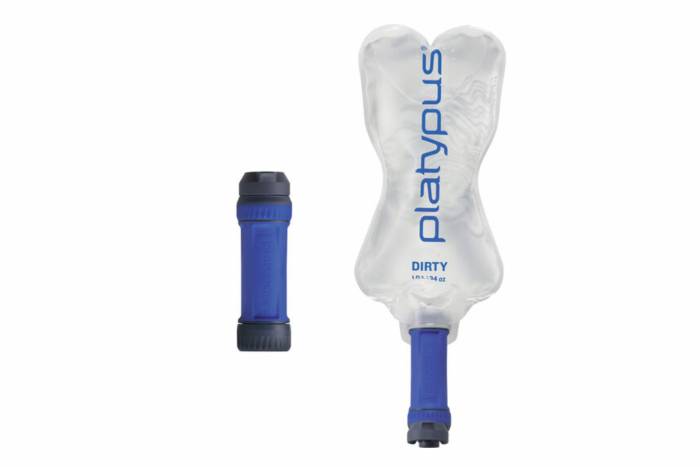
Now, after a few solid seasons of use, I can finally say that the Platypus QuickDraw ($80) is one of the best backpacking water filters out there. Eclipsing the trusted Sawyer Squeeze is tough, but the QuickDraw surpasses it in more than a few metrics, and it’s a dream to use day after day on the trail.
Like the Squeeze, the QuickDraw is also a hollow-fiber membrane filter, which passes water through a tangle of tubes inside the unit to filter it. The difference here is that the Platypus filter uses a 0.2-micron pore size, compared to the 0.1 on the Sawyer.
The difference in protection from particulates, bacteria, and protozoa is functionally null, but the flow rate on the Platypus is much better. I’ve run Squeeze filters until they could barely be filtered through, but the QuickDraw hasn’t slowed nearly as much over time.
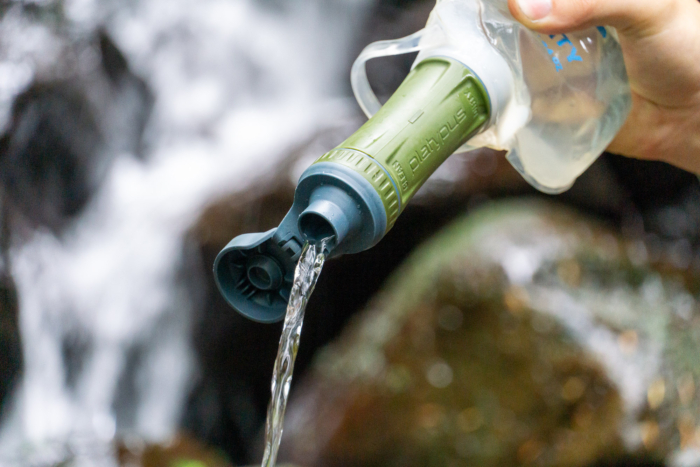
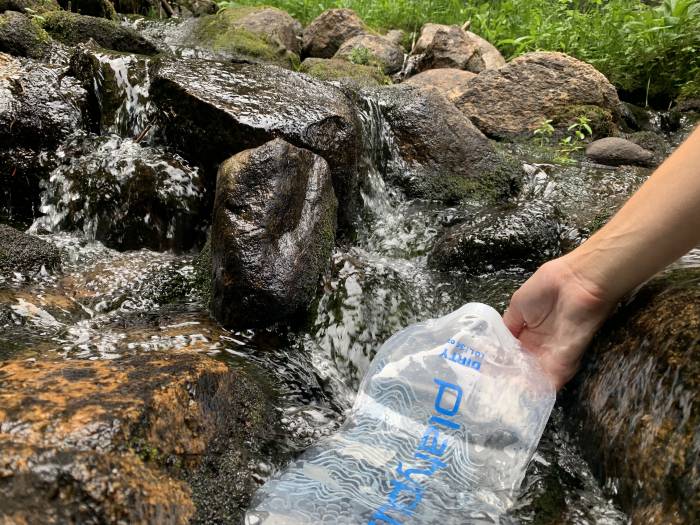
The 1L system comes with a tough tri-layer film reservoir that uses unique quarter-turn threads to interface with the filter. I found this much easier than screwing the Sawyer onto the smaller spouts on its bladders, and the filter itself also hosts fine threads internally, in case you want to use a water bottle.
I previously wished for a larger reservoir for the QuickDraw, and now there are 2L and 3L versions. I use the 1L system most often, and will note that the 3L reservoir has a known defect where the handle pop offs. Best to give the brand some time to fix before snagging that one.
The QuickDraw filter also helps assuage fears of filter compromise (which can happen to hollow-fiber membranes if they freeze or are dropped aggressively). It does this with an integrity test that gives you a solid yea or nay on whether or not your filter is no longer safe to use. The Sawyer filter doesn’t specify an integrity test, and I’ve binned filters before when I couldn’t say for sure if they froze or not.
I found the filter super easy to use and backflush, and experienced a good flow rate (I actually exclaimed when we used it for the first time — it’s quick). After testing the QuickDraw on everything from day hikes to river trips to sections of the PCT, I’m confident in it, and for most backpackers and hikers, this is the water filter you want.
LifeStraw Peak Series Solo Water Filter


Specifications
Pros & Cons
Pros
- Simple
- Small, light
- Good flow rate (better than previous LifeStraw)
Cons
- Hard to use without a disposable water bottle
- Best used with two water bottles (one dirty water, one clean)
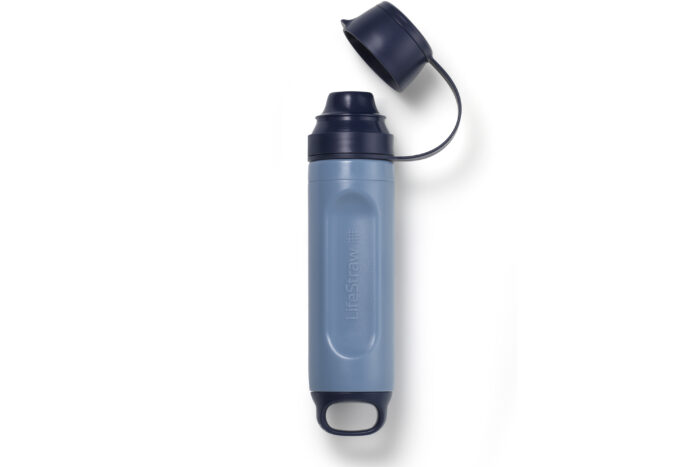
Bottom Line: A 1.7-ounce, pocket-sized filter with a 2,000L lifespan and 28mm threading for attachment to standard disposable bottles. You’ll need to provide your own dirty water vessel.
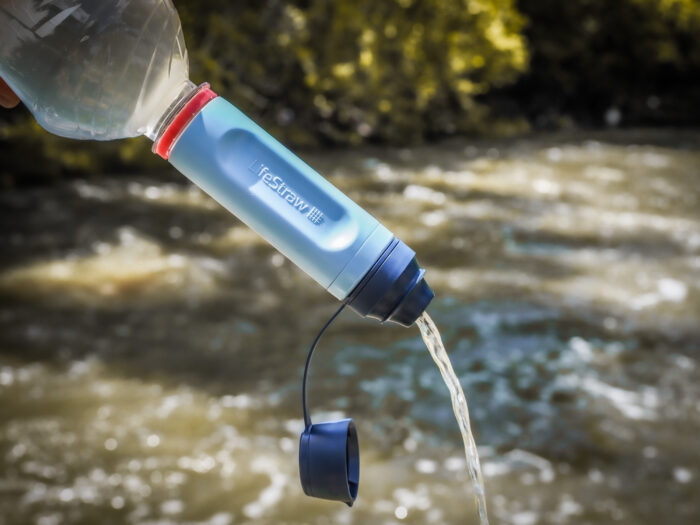
The LifeStraw Peak Series Solo ($30) marks a significant pivot for a brand historically defined by its “sip-from-the-stream” straw. In his field test, GearJunkie’s Sean McCoy found that while the Solo retains that legacy capability, its true value lies in its evolution into a high-performance squeeze filter. By adding standard 28mm threads, LifeStraw has finally created a direct competitor to the ubiquitous Sawyer Squeeze, allowing users to screw the 1.7-ounce device onto common disposable water bottles like Smartwater or soda bottles.
During testing in the murky, fast-moving waters of Denver’s Cherry Creek, McCoy’s primary impression was the Solo’s quick flow rate. Despite being half the size of the previous Peak Series Straw, the Solo hosts a less densely packed membrane. This design choice translates to a cleaner, faster stream; McCoy noted he could take full gulps rather than the labored “milkshake through a straw” experience common with older models. The brand claims a flow of 3 liters per minute, and field testing confirmed a low-restriction output when paired with a simple plastic bottle.
However, the review highlights critical trade-offs for the ultralight crowd. Because the device is physically short (~5 inches), McCoy found it difficult to use as a standalone straw without getting your face dangerously close to the mud and water. It is essentially a bottle-dependent tool. Furthermore, the 2,000L lifespan is exactly half that of the larger Peak Straw, a sacrifice made for its pocket-sized footprint.
If you want a 1.7-ounce Squeeze-style filter that offers one of the fastest flow rates on the market and fits standard bottle threads, the Peak Solo is a top-tier choice — and at a budget price. It’s ideal as a primary filter for solo hikers or a foolproof backup for hunters, provided you carry a compatible threaded bottle.
Sawyer Squeeze
-
-
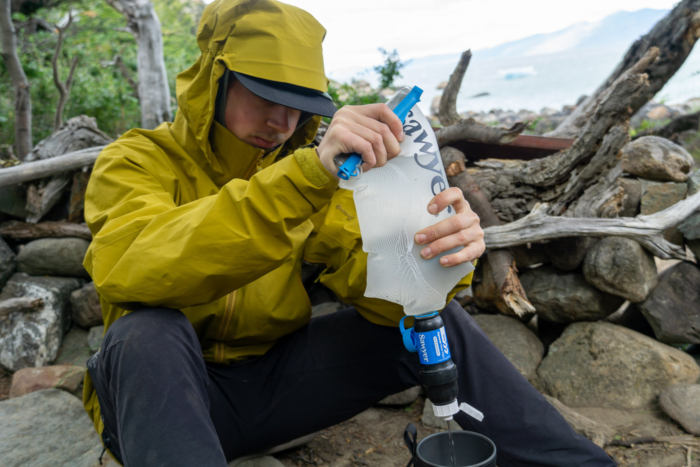
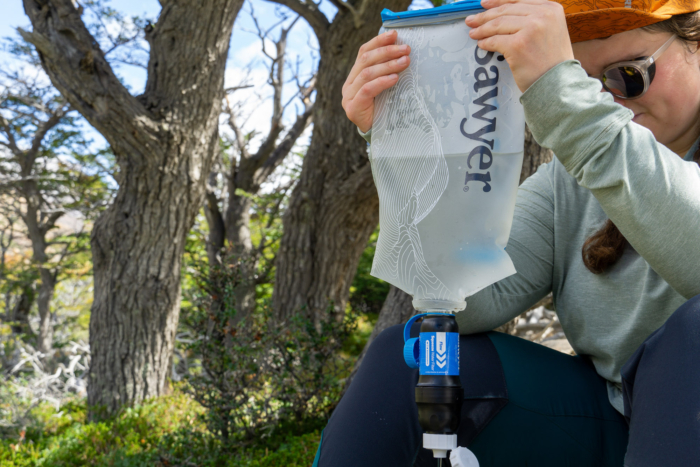
The new Sawyer Squeeze/CNOC water filter system in use in Patagonia; (photo/Erika Courtney)
-
(Photo/Erika Courtney)
-
(Photo/Nick Belcaster)
Specifications
Pros & Cons
Pros
- New CNOC bladders are much better than previous
- Simple-to-use design
- Lightweight at under 3 oz.
- Packable
- Integrated flip-cap keeps outlet clean (with extra gasket beneath)
Cons
- Inline filter setup isn't flawless
- No specified integrity test
- No cap on the dirty side
Bottom Line: A 0.1-micron filter that can be used as a squeeze, gravity, or inline system. The current 2026 kit includes a Cnoc Vecto reservoir, replacing previous bags with more durable, wide-mouth TPU bladders.
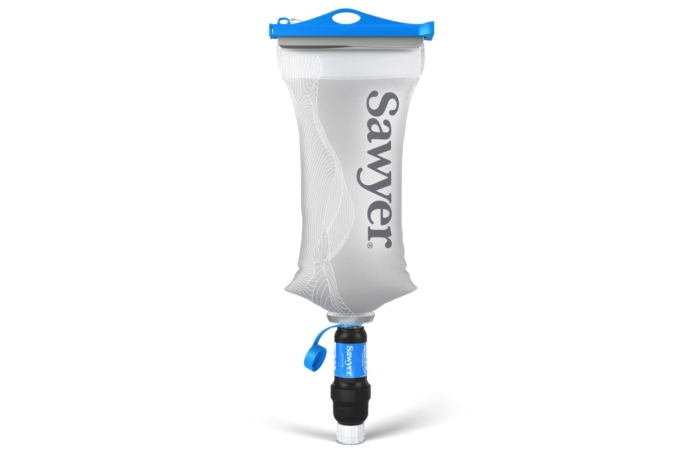
This Sawyer Squeeze ($65) is the gold standard for many thru-hikers and backpackers worldwide, and now updated with the addition of a Cnoc Vecto reservoir, I think it’s even better. Like our top pick, the Squeeze is another hollow-fiber filter that interfaces with a reservoir to filter from, but here you get a bit more versatility, along with a wild difference in recommended cartridge lifespan.
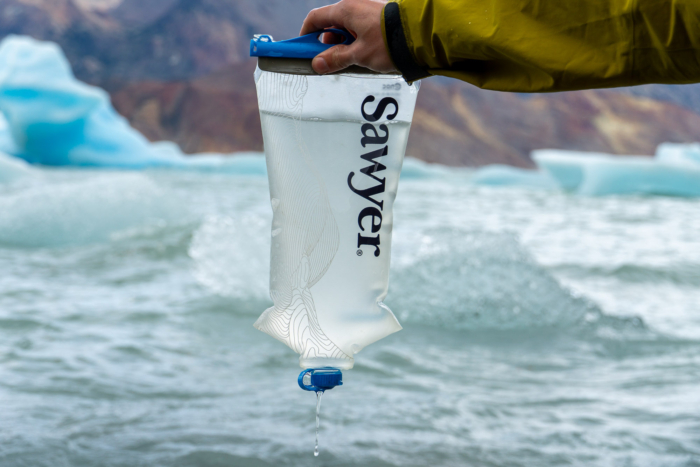
First, the new: The Cnoc Vecto bladder has been a very popular upgrade to use with the Sawyer Squeeze filter, so it’s natural to see the combo sold together. The TPU material is much more pliable and forgiving than the bags that the previous Sawyer bags (you’ll still see both sold; I think the Cnoc version is superior) used, and hosts a wide mouth end that makes scooping water far easier.
Given my bench-testing, the given flow rate of 1.7 L per minute seems accurate to us, though this number can be harder to recreate halfway through a thru-hike. I used the Squeeze as my primary filter on a Pacific Crest Trail thru hike, and it performed admirably. From high desert cisterns of unknown quality to sources in the Sierra that likely didn’t even need it, the Squeeze was dependable.
During this time, I sparingly backflushed the filter and, when needed, found a sports cap and Smartwater bottle combo to recreate the pressure provided by the syringe that comes with the Squeeze. For longer or more remote expeditions, the syringe is a nice addition to bring along.
I’ve also played around with the hydration pack inline set-up with the Squeeze, and while functional, I found it a bit finicky. Best to leave this filter mated up to a water bladder, or, straight from a soft drink-threaded bottle. Compared to the Platypus QuickDraw, I see the Squeeze pulling forward for those who will use that inline functionality or those who put a high value on longevity: The Sawyer is rated to last 100,000 gallons.
Most folks would be best served by the 2L version of the Cnoc filter system, but it’s also sold with a 1L bladder, which I found a little less useful, but still a solid option. It’s tough to go wrong with the Squeeze system.
Katadyn BeFree AC
-
-
(Photo/Nick Belcaster)
-
(Photo/Nick Belcaster)
-
(Photo/Nick Belcaster)
Specifications
Pros & Cons
Pros
- Easy to dip and go
- Can run the filter with or without the carbon filter
- Tough flip cap
- Available in a double-layer flask
Cons
- Carbon filter doubles your filter time
- Tough to get all the water to come out from flask
Bottom Line: An updated version of the original 0.1-micron collapsible flask filter that adds an activated carbon element to neutralize odors and chemicals. It maintains a 2L per minute flow rate, but only with the element removed.
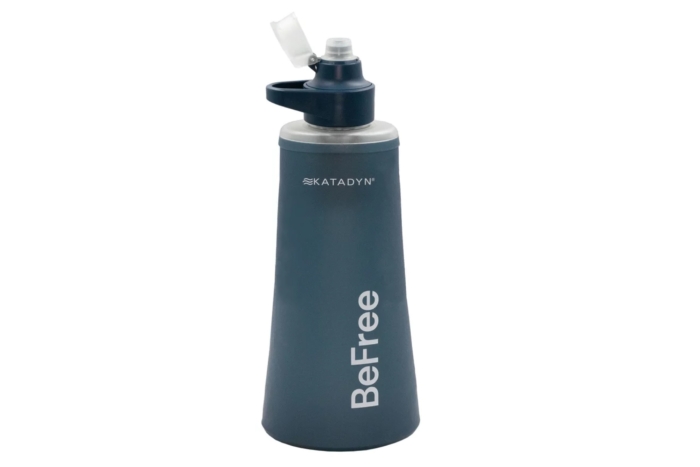
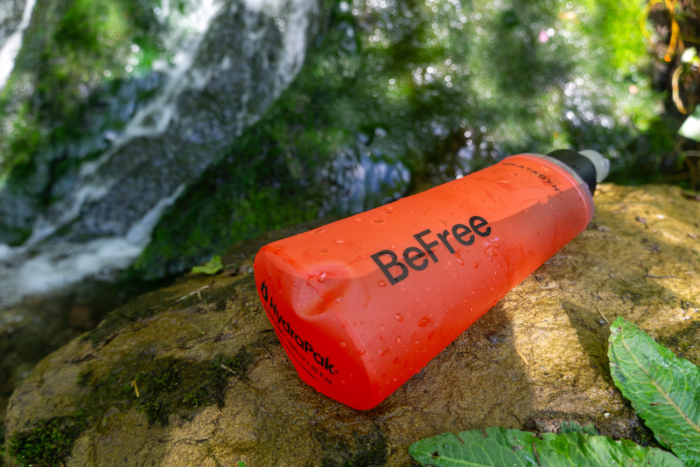
The recently updated Katydyn BeFree AC Filter ($53) gains a second stage of filtering by adding an activated carbon element to the trusted BeFree EZClean membrane. After comparing the new version with the old one, I’m sold on the update — this is one stellar trail running filter.
The new activated carbon prefilter is a small puck that fits beneath a screwtop and before the main filter. It pulls out the funky flavors of high mineralization or scummy water. This slows down your filter rate by about half, but I can attest that it does pull out weird tastes. After brewing up a grass clippings stew and filtering side by side with a Sawyer Squeeze, the BeFree AC had a decidedly less vegetal taste.
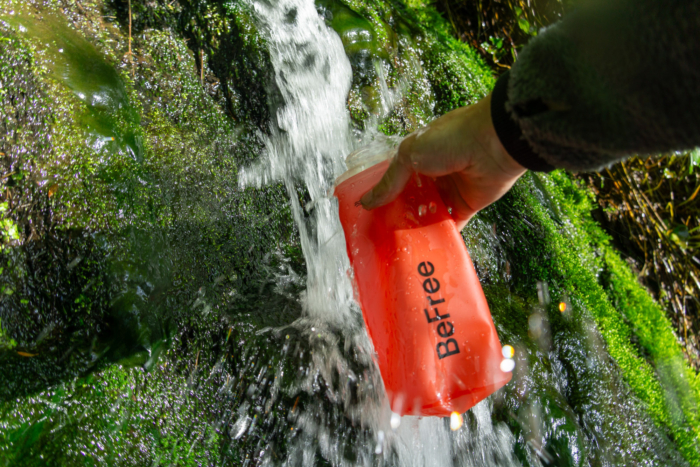
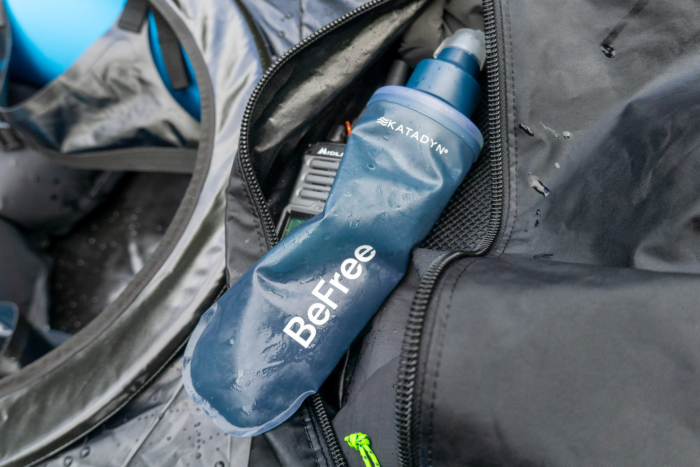
I tested all three versions of the new BeFree this summer, the 1.0L, 0.5L, and the double-layer flask, and found each had adventures it excelled at. The 0.5L BeFree is best for action where you’re in the water all day — think fishing or whitewater kayaking — and you don’t need to carry water around with you. Dipping directly into the river from the boat is a quick way to rehydrate, and this filter had me staying on top of my hydration needs.
The 1.0L is perfect for hiking, backpacking, and especially trail running, while the double-layer version would be best for high-stress use, such as entire thru-hikes or mountaineering. The weight difference between the two is negligible (2.7 vs. 3 ounces), and the price is the same, so decide what it’s worth to you.
There are a few instances where the new carbon filter would be crucial, and I would have killed for it on the PCT when getting water from desert cisterns and cow troughs. However, the ability to remove the AC filter is key, as there are times I just need water quickly or need high pressure (to rinse a mucky bike or irrigate a wound).
Overall, the updated BeFree AC is certainly an improvement on the trusted water filter, and I can wholeheartedly recommend it for trail runners.
Katadyn BeFree Gravity 3L
-
-
(Photo/Nate Mitka)
-
(Photo/Nate Mitka)
-
(Photo/Nate Mitka)


Specifications
Pros & Cons
Pros
- Requires no complicated backflushing
- High flow rate
- Easy to hang from a tree limb, etc.
Cons
- You’ll need a place to hang the filter
- Heavy
Read Review: Fast & Clean: Katadyn BeFree 3L Gravity Filter First Look
Bottom Line: A high-volume gravity system consisting of a 3L reservoir and a BeFree filter element. It provides hands-free filtration for groups or basecamps, but is larger and heavier than most systems.
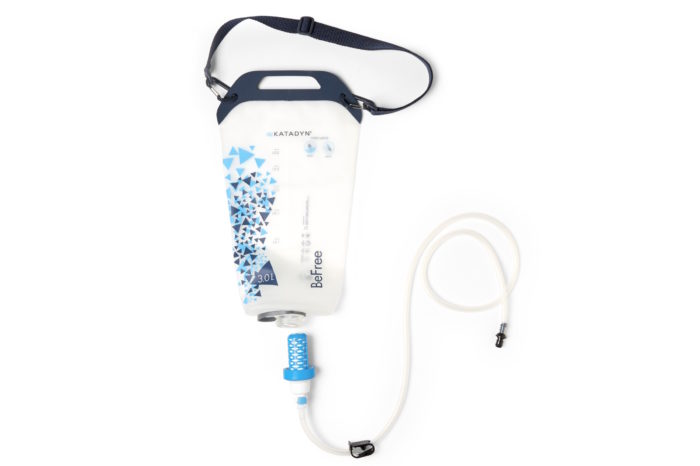
Gravity filters use the force of gravity to pull water through the filter. For that reason, they’re extremely user-friendly. Just fill it with dirty water, hang it, and come back in a few minutes to find filtered water waiting in another container. They work great for larger groups or when you want to filter a lot of water all at once. They’re also quite light, given the speed and ease of use.
At just 6.8 ounces, the Katadyn BeFree Gravity Filter ($80) is the lightest gravity filter on this list, beating out the Platypus GravityWorks by 5 ounces. Using the same filter element as the older handheld BeFree (note: not the new AC version), this setup filters 3 liters at a time and comes with a quick-connect output hose to easily fill multiple bottles, pots, or bladders. The wide-mouth port on the dirty-water bladder makes filling up quick, and a simple shutoff valve makes filling different vessels easy.
It also doesn’t require commonly involved filter maintenance like backflushing — since it clears itself with a vigorous shake of the filter. Similar to the Sawyer Squeeze, the flow rate is great, and because the bag rolls down, it’s fairly packable.
The expected filter lifespan of 1,000 L is likely on the conservative end, but it is a good bit lower than the 100,000 gallons (that’s 378,541 L) that the Squeeze claims. Our team’s testing has shown that the BeFree will last for at least an entire thru-hike.
Overall, it came in behind the Sawyer Squeeze in ranking, largely because it’s more expensive. However, for those who don’t mind spending a little more or are traveling as a bigger group in the backcountry, this is one of the best backpacking water filters available. It’s proven itself over many backpacking and hunting trips in the Rocky Mountains and beyond.
Grayl GeoPress Bottle
-
-
(Photo/Mary Murphy)
Specifications
Pros & Cons
Pros
- Convenient and great for travel
- Durable polypropylene bottle
- Activated carbon doesn’t just filter water, but purifies it as well
- One-way valve allows for drink mixes to be used
Cons
- More expensive option
- Inability to use filter separate from bottle housing
Read Review: GRAYL Geopress Purifier Gets an Ultralight Upgrade: Geopress vs. Ultrapress Review
Bottom Line: A purifier bottle that uses electroabsorption and activated carbon to remove viruses, bacteria, protozoa, and heavy metals. The large packed size keeps it from backpacking, and makes it better for day trips.
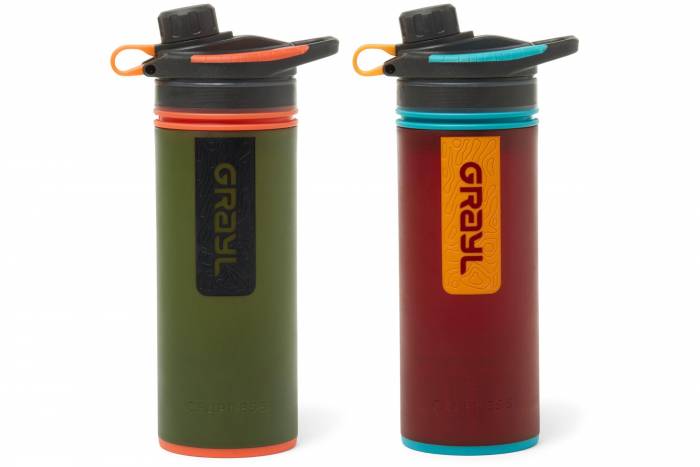
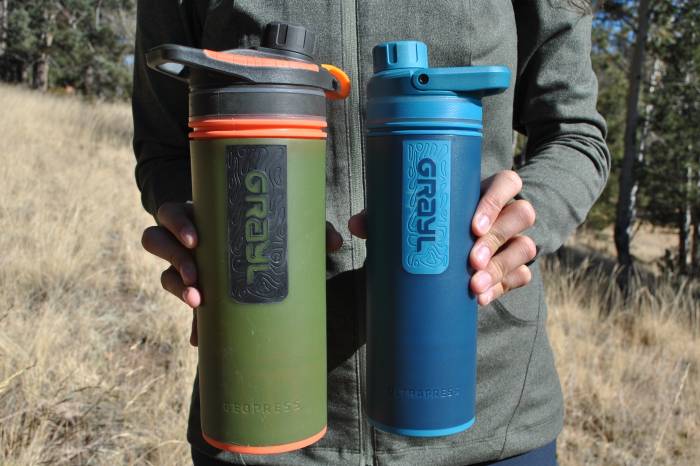
The Grayl GeoPress ($100) uses electroabsorption and activated carbon to purify water. Simply fill, press down, and drink. It is that fast. (And yes, the convenience, fast filter time, and quality of this filter make it worth the price.) Of the bottle filters available today, this is my favorite for international travel.
This is truly the best if you’re drinking from really sketchy, off-grid water sources or want a filter for backpacking that isn’t a bladder and hose system. The activated carbon filter medium goes a step beyond most other filters in protecting against heavy metals, chemicals, and viruses — in addition to common protozoa and bacteria.
We’ve tested this filter abroad and love it for far-flung travel. It’s ideal for filtering all tap water before drinking, and it works wonderfully as a constant companion to keep you hydrated on the go. We’ve also used it backpacking and thru-hiking on the Appalachian Trail. For one or two people, the GeoPress is an awesome purification method.
One of our biggest issues with other filter bottles, such as the LifeStraw Go, is the inability to add powdered drink mixes to our water on the go. Thanks to a recent design update, Grayl incorporated a one-way Drink Mix Valve into its filters, meaning you can load up the electrolytes without worrying about clogging your filter. Very slick.
We love the GeoPress’s fast flow rate of 5 L per minute (under 30 seconds to get clean water). The top complaint is its size (though it’s not any bulkier than a Nalgene). Also, the replacement cartridges are expensive at $30 and need to be replaced every 250 L. All that being said, however, this is an easy go-to for international travel, or shorter day trips where you won’t need to camel up on water.
Katadyn BeFree AC Bottle
-
-
(Photo/Nick Belcaster)
-
(Photo/Nick Belcaster)
-
(Photo/Nick Belcaster)
Specifications
Pros & Cons
Pros
- Very easy drinking with the bottle filter combo
- Nice flip-cap lid
- Fits bike bottle holders, etc.
Cons
- Charcoal filter puck slows flow rate considerably
- Low overall filter life
Bottom Line: One of the better in-bottle filters we’ve used in a long time. Good flow with the included charcoal taste filter (and quick without it). Total filter life in on the low end, however.
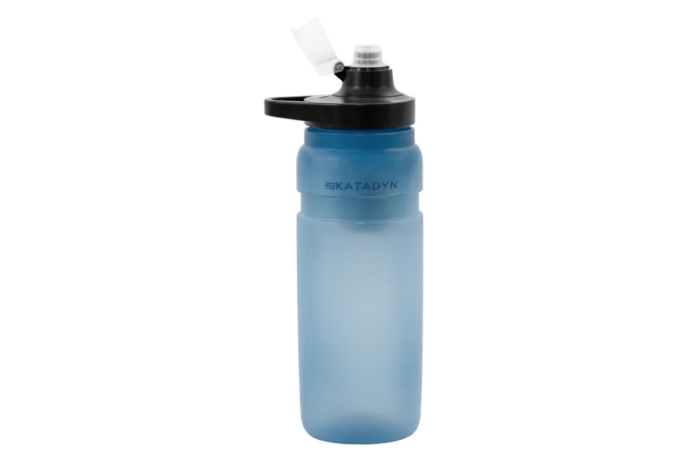
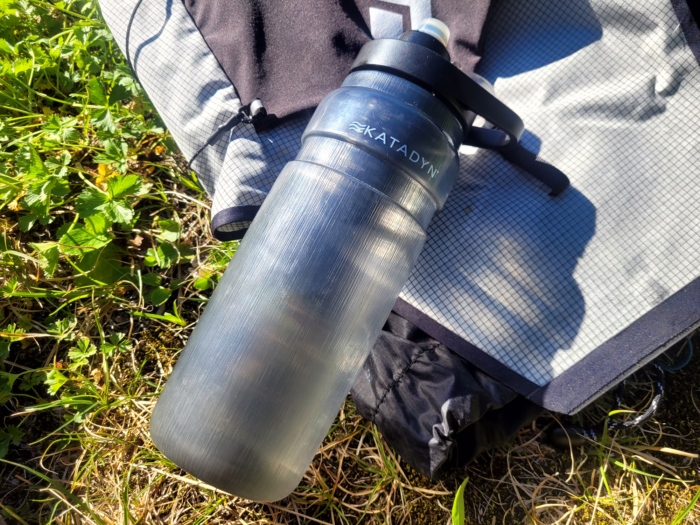
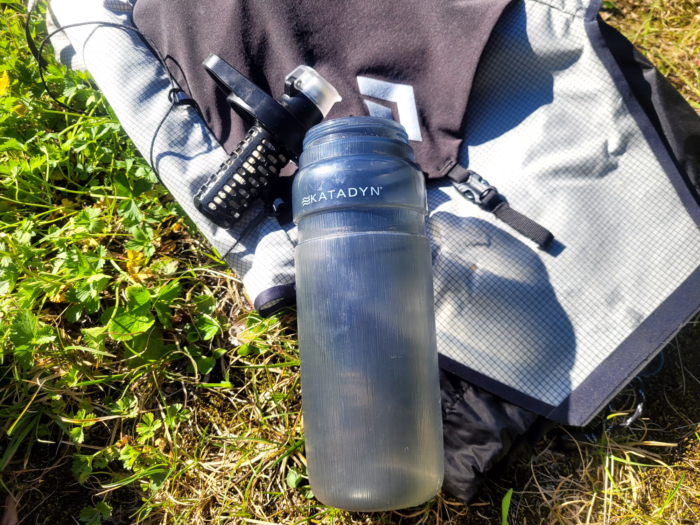
The Katadyn BeFree AC Bottle 0.7L ($50) solves two major trailside headaches: bad taste and annoying filter set ups. At 3.3 ounces, this system pairs a 0.1-micron BeFree hollow-fiber membrane with a replaceable activated carbon core. Housed in a semi-rigid, squeezable polypropylene bottle with a sturdy flip cap and carry loop, it easily spans trail runs, backcountry trips, and road trips.
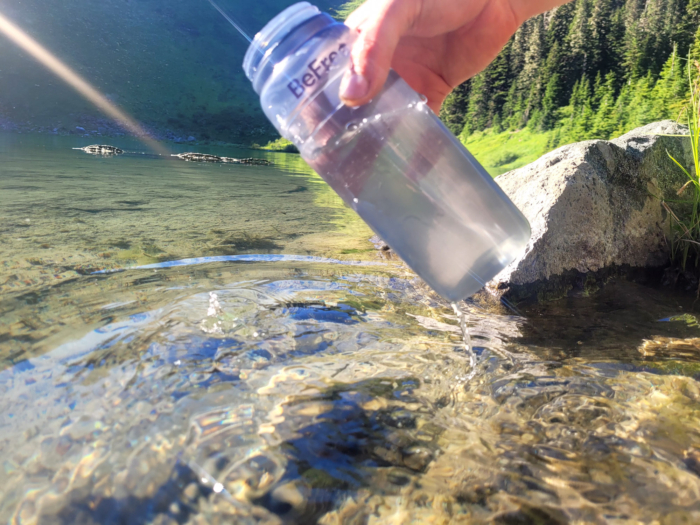
My testing in the Pacific Northwest ranged from dusty Cascade climbs to high-sulfur campground spigots. In the Alpine Lakes Wilderness, I scooped from tannin-heavy tarns; the carbon core stripped out the swampy odor and bitter taste, delivering clear water at a fast 2-liter-per-minute flow. When silt eventually slowed performance, a quick 10-second swish in the lake cleared the membrane (no backflushing syringe needed).
Compared to the original Katadyn BeFree soft flask, which could eventually be pinholed, the AC Bottle resists abrasion against rugged use and bike cages. Compared with standard microfilters like the Sawyer Squeeze, its wide 42mm mouth scoops shallow pools much faster while neutralizing foul tastes. In clean alpine streams where taste isn’t an issue, you can drop the carbon insert to maximize flow rate.
The primary membrane lasts 1,000 liters, but the carbon core exhausts after ~200 liters and needs periodic replacement. As a microfilter rather than a virus-spec purifier like the Grayl GeoPress, it won’t remove viruses in international travel or sewage-impacted settings. Still, for hikers and travelers wanting fast flow, bottle durability, and clean-tasting water, the BeFree AC Bottle earns a spot in my pack.
Other Water Filters We Trust
Clean water in the backcountry is essential, and the seven filters I’ve awarded above are just about the best of the lot. That doesn’t mean they’re the only options out there, and I’ve used plenty of other worthy filters on our travels. Check out the lineup below before making your choice.
-
-
(Photo/Mary Murphy)
-
(Photo/Xiaoling Keller)
-
(Photo/Xiaoling Keller)


Specifications
Pros & Cons
Pros
- Lightweight design
- Durable and sleek-looking
- Quick flow rate of 3 L per minute on the Squeeze filter
Cons
- On the heavier side
- Squeeze filter has a shorter filter life than some
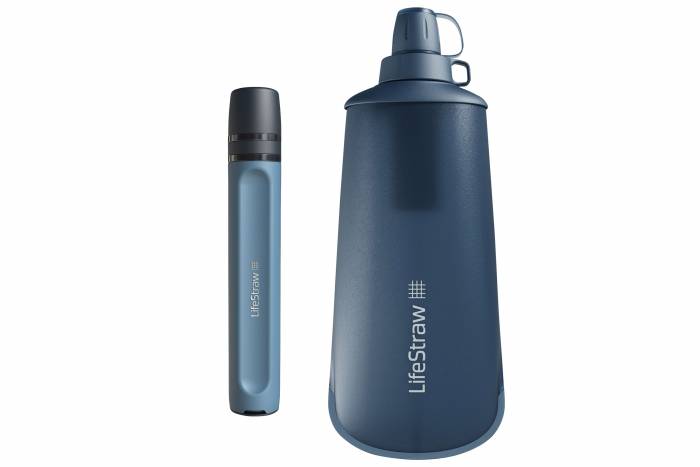
Bottom Line: A 1.7-ounce squeeze-style filter that offers one of the fastest flow rates on the market and fits standard bottle threads.
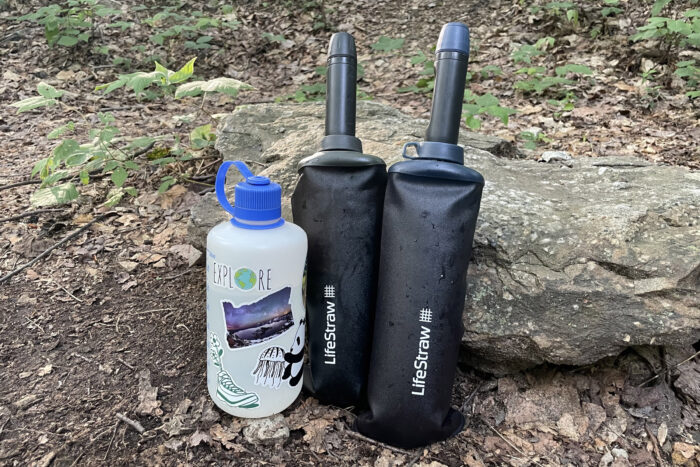
Thru hiker Xiaoling Keller put the new LifeStraw Peak Series — a personal straw filter, squeeze filter, and gravity filter — to the test this spring on the Appalachian Trail. The Peak Series Personal Straw Filter ($25) and Squeeze Filter ($44) turned out to work great for filtering water at various sources in the backcountry.
The personal Peak Series filter worked extremely well and had a good flow rate. After 20+ years of LifeStraw being on the market, it was nice to finally see a big upgrade in materials and design.
The new design is comfortable, easy to use, durable, and easy to clean and backflush. If you’ve used a LifeStraw filter before and are maybe looking to replace it, we definitely recommend the Peak Series version.
The LifeStraw Squeeze Filter also performed well in testing, though not as much as others on the list. It’s modular, so while it has the filter incorporated inside the squeeze pouch, you can also move it to the outside (and swap out the cap) if filling bottles or not drinking directly from the filter. Both are a great price.
Specifications
Pros & Cons
Pros
- Self-cleaning ability cuts down on maintenance time
- Super-long filter life of 10,000 L
- Faster flow rate than MiniWorks EX
Cons
- Heavy at more than a pound
- Expensive
Read Review: MSR Guardian Purifier — Last One You’ll Ever Need
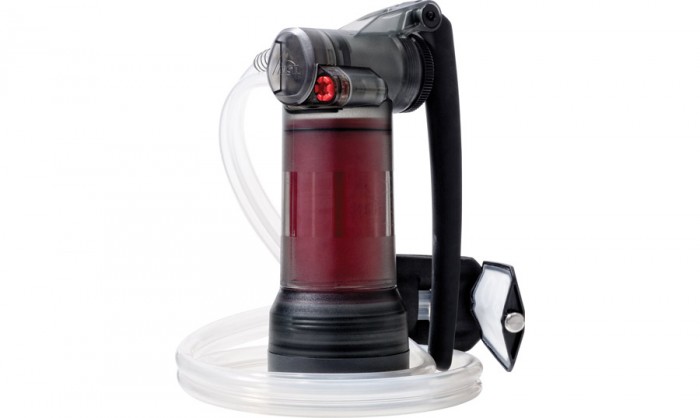
Bottom Line: A military-grade pump purifier that removes viruses and bacteria and self-cleans with every stroke. It is bulky and expensive, but one of the only options for high-turbidity water.
The MSR Guardian Purifier ($400) filters out nearly everything (including viruses), has an excellent flow rate, and even self-backflushes during use. For most people and places, however, it’s downright overkill. If you’re setting up for a serious adventure that requires filtering a lot of very sketchy water, however, you may want to consider forking over the cash.
The difference between this filter and the more affordable MiniWorks EX is both a higher flow rate (more than twice the capacity) and the pump’s self-backflushing ability. The pump accomplishes this by using 10% of the water it filters to clear the membrane and flush back into the source with the second tube. The unique uptake float keeps the supplies separate and means your time to clean this filter is near zero.
The Guardian physically removes viruses, bacteria, protozoa, and particulates, including hepatitis A, E. coli, giardia, cryptosporidium, and more. Just be ready to lug a large item that weighs in at over a pound.
The MSR Guardian is probably one of the best backpacking water filters on the market. So why didn’t it top the list? Well, in two words, price and weight. It costs a pretty penny at $400 and weighs considerably more than other filters. I find that most users will be better suited by the MiniWorks EX filter, which still accomplishes the same feats, just a bit slower and with some additional cleaning.
-
-
(Photo/Nick Belcaster)
-
(Photo/Nick Belcaster)
-
(Photo/Nick Belcaster)
Specifications
Pros & Cons
Pros
- Interfaces with bottles that you already own
- Straw attachment gets filter element down to the bottom
- Quick flow
- Complete kit works with many different set ups
Cons
- Easy to confuse the tap water and raw water filter elements
- Low filter lifespan of 75 gallons per
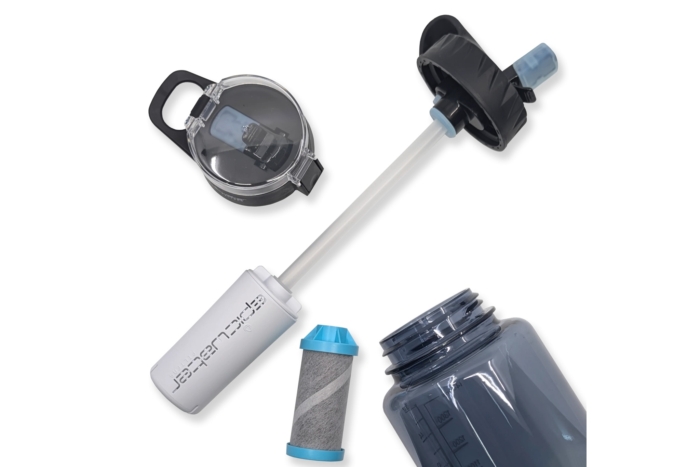
Bottom Line: A DIY solution for filtering water out of your trusty Nalgene bottle. Not the most versatile setup for backcountry use, however.
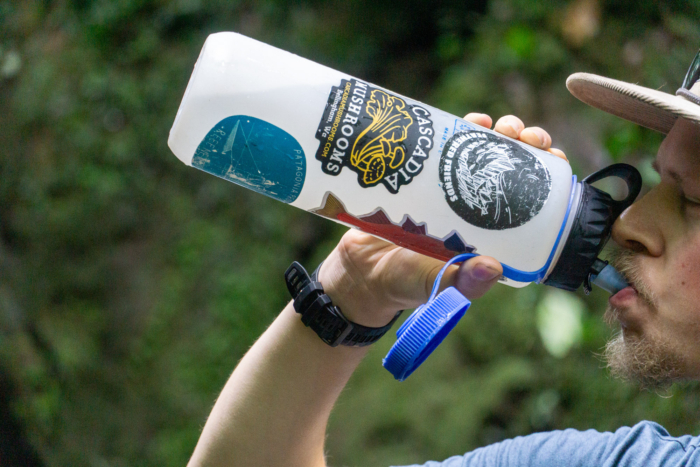
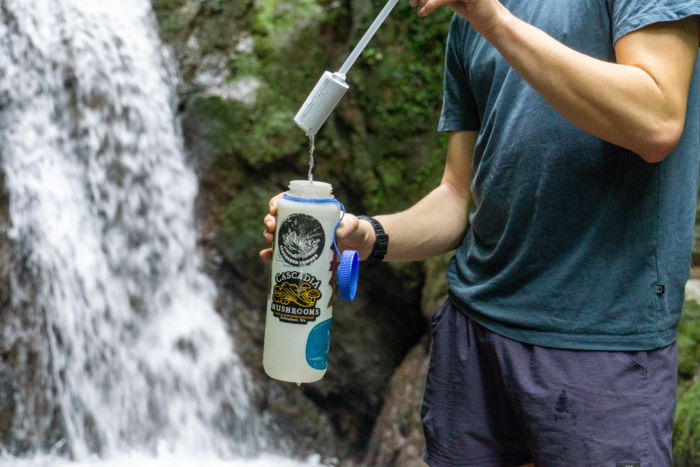
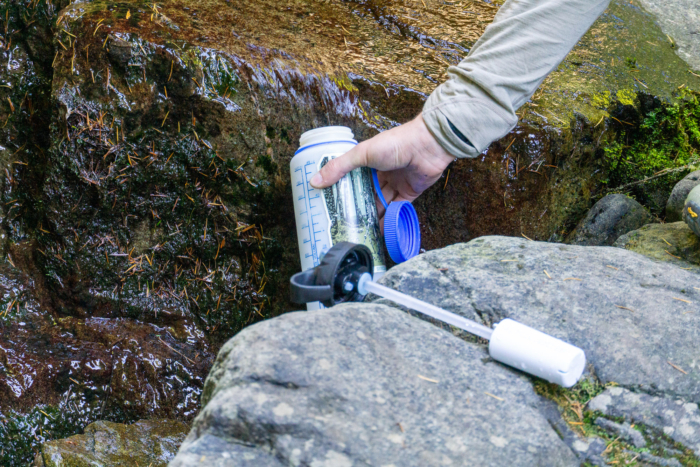
If you’re attached to your wide-mouth Nalgene or insulated Hydro Flask, Epic Water Filters The Answer 2.0 ($55) is a smart upgrade. At just 3.0 ounces, this lid-and-straw setup threads directly onto your vessel, pairing two swappable filters: the high-flow EveryTap for municipal water and the sub-micron Everywhere filter for raw trail sources.
On a muggy hike along Washington’s Hannegan Pass Trail, I filled my 32-ounce Nalgene from a tannin-heavy creek. The Everywhere cartridge trapped the silt and completely killed the swampy taste. While testing side-by-side with the Katadyn BeFree AC Bottle, both systems excelled at stripping out organic flavors thanks to their activated carbon media. However, where the Katadyn reliably provides a rapid 2 L/min flow rate, The Answer 2.0 uses a sip-thru straw that requires a bit more suction effort.
Traveling through Costa Rica, I found that swapping cartridges made jumping between cities and rural spots easy. The EveryTap filter knocked out heavy chlorine tastes in San José with practically zero resistance. Down on the Nicoya Peninsula, clicking in the Everywhere cartridge provided protection when drinking from jungle rivers. While the BeFree AC Bottle locks you into its proprietary 42mm bottle format, Epic lets you thread onto insulated double-wall bottles, and keeps purified water ice-cold for hours under the tropical sun.
Because it’s a sip-thru straw system, you can’t squeeze water out to fill camp pots or share with a partner, and it lacks virus protection for severe raw sewage risks. But for day hikers, road-trippers, and commuters who want to add taste-clearing filtration directly to their favorite wide-mouth bottle, it’s a slick, ultra-versatile pick.
Specifications
Pros & Cons
Pros
- Destroys bacteria, viruses, and protozoa including cryptosporidium
- Ultralight and easy to stash away
- Budget-friendly
Cons
- 4-hour wait time to fully clean water
- Expires after 5 years
- Slight odor/taste, as with most chemical treatments
Bottom Line: A simple backup purifier tablet that destroys viruses and leaves a minimal aftertaste. Though, there is a 4-hour delay before cryptosporidium is eradicated.
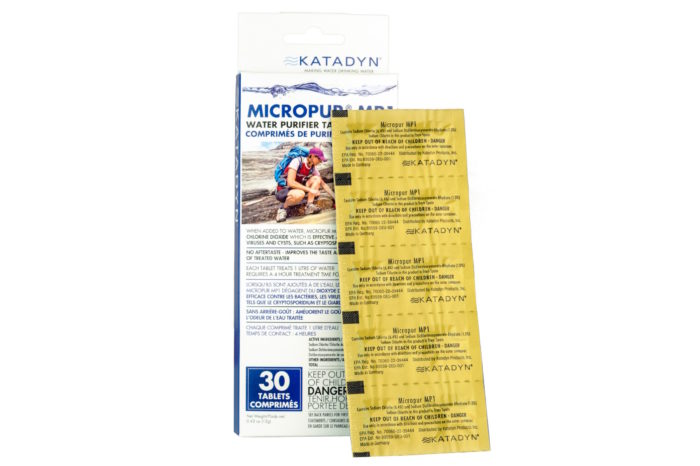
If you really don’t want to sacrifice weight for a filter — or are in an area that eats filters for breakfast — chemical treatment is a great option. Katadyn’s Micropur M1 Tablets ($18) have been a top choice over the years, thanks to their purifying powers and easy-to-use instructions.
My exploits have taken me to high-alpine outflows where every water source is heavily laden with glacial silt, and for quick filtration, chemical tablets do the trick (though I sometimes prefilter a bit with a bandana). Otherwise, these tabs ride along with me in my emergency kits, as they’re about the lightest option you’ll encounter, and less likely to spill than chemical drops like Aquamira.
Some claim there is a slight aftertaste, although I like these much better than other chemical treatments. I also agree that learning the wait times is important. The tablets destroy viruses and bacteria in 15 minutes, but it takes 4 hours to kill the pesky cryptosporidium parasite.
This is a good bit longer than my second choice in chemical treatment, Aquatabs (30 minutes to clean), but if you’re using chemical filtration, you’ve likely got some time to kill anyway and may as well kill everything.
For backpacking trips, you can use tablets in the evening to ensure that you have clean water for the next day. These are also great options for trips where you’re operating out of a backcountry base camp for side excursions. Most filters have the potential to fail, so having a few Micropur Tablets stashed away for emergencies is smart.
Specifications
Pros & Cons
Pros
- Easy to drink and go without any set-up required
- Small prefilter on tube keeps the main filter running quick
- Simple to field clean, and can be rebuilt with new filter element
- Small packed size
Cons
- Slower pump rate makes it tough to filter large amounts of water
- No dirty water vessel means you'll need another container to carry water in
- A bit pricey
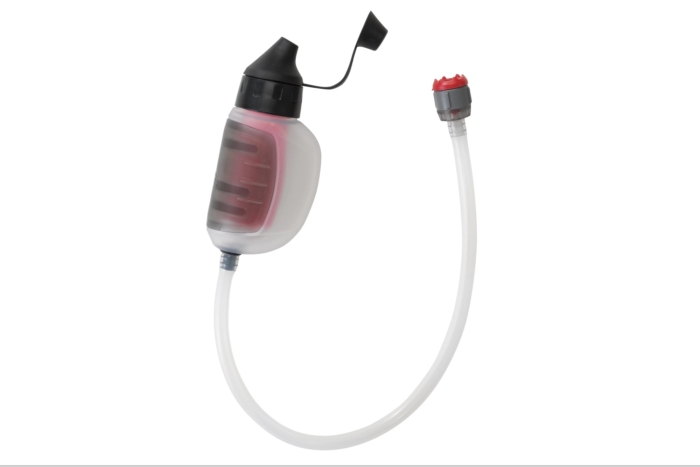
Bottom Line: A compact hand pump that allows for direct drinking. It weighs 5 ounces and can be cleaned in the field, but it isn’t ideal for long water carries.
The MSR TrailShot ($70) is a trail runner’s water filter, aimed at providing quick hydration on the go. Built around a hollow fiber membrane, this filter uses a different pumping style: a squeeze pump motion and a remote pickup tube.
This means there’s no setup involved when you come across a water source: simply grab the TrailShot from your running vest, dip the tube, and start drinking. Trail runner Ian Atkinson found this to be a simple way to keep hydrated as he trained for the Leadville 100 this summer.
The hollow fiber membrane on the TrailShot has a 0.2-micron pore size, meaning it will flow a bit quicker than 0.1-micron filters like the Sawyer Squeeze. The filter element is also replaceable and protected from sucking up gunk by a small prefilter on the pickup tube. A one-way valve in this pickup also prevents the filter from losing its prime.
The TrailShot packs small enough to fit in your fist, and using the small included band, you can wrangle the tube and stash the whole kit into a hip belt or vest pocket. Without an actual vessel to carry water around in, you’ll need some other way to carry your H20 (and won’t be able to count on your filter providing a little extra storage ability).
Pumping a volume of water is where the TrailShot tends to fall flat, as the flow rate simply isn’t that great for trying to fill something like a hydration bladder, and your hands may get tired before you’ve filled the entire thing. But for on-the-go water needs, like while trail running or mountain biking, the TrailShot can really limit the bulk you have to carry.
Specifications
Pros & Cons
Pros
- Easy-to-clean filter element
- Unique carbon/ceramic filter design cleans heavy metals and organic compounds
- Interfaces with MSR Dromedary bags or Nalgene bottles
- Uptake hosing uses a small float to pull from the cleanest water
Cons
- Pretty expensive
- Heavy at 1 pound
Bottom Line: A pump filter utilizing a ceramic element that can be scrubbed to maintain performance. It’s designed for long-term field use. That said, it’s heavy and bulky to pack.
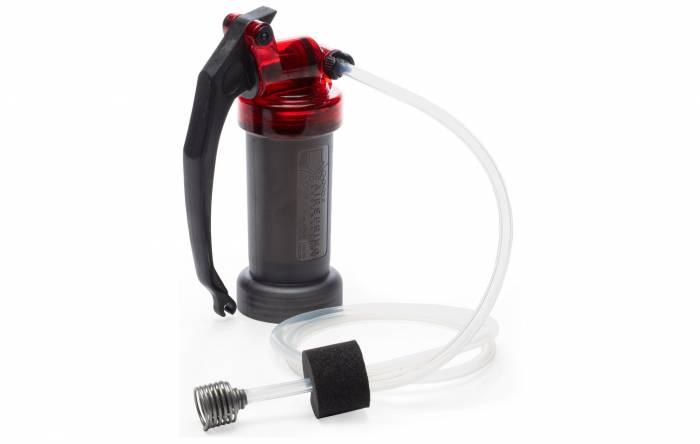
MSR makes a few pump filters, but this one is my favorite. The MSR MiniWorks EX ($130) protects against bacteria, protozoa, heavy chemicals, and particulates. One of my favorite features of this filter is the fact that it’s compatible with both MSR Dromedary Bags and Nalgene bottles, so you can easily attach and pump into your drinking vessel.
Pump filters aren’t as prevalent today as they once were, but that doesn’t mean they don’t have a place. Large groups are an excellent place to deploy a pump filter like the MiniWorks, where ease of use and not having to refill a dirty water bladder constantly can save time. It’s also pretty foolproof to stick into someone’s hands and educate them quickly: Stick this end in the water, and then pump.
The filter element is ceramic, meaning you clean it over time instead of replacing it (although you may need to replace the tubing). This field reparability is a pretty common theme among MSR kit — such as the brand’s expedition stoves — and it’s something those on long river trips will come to appreciate. The filter’s carbon core also does some heavier lifting than comparable filters, sucking up heavy metals and organic compounds.
During testing, we had a few users note an issue with pressure building up in the filter chamber, causing the flow rate to slow. We still found we could hit the rated 1 liter per minute, but only with some good arm muscle. MSR says that a tempo of around 70 to 80 pumps a minute is prime, and we’d agree. The $130 price is a bit on the high end for pump filters, but if you’re after the best, this is it.
The MiniWorks EX is the filter I’d reach for on a float down the Grand Canyon with friends, and that’s where it’ll excel. Pro tip: Using a ‘flocculant’ such as Water Wizard For River Runners before filtering super-sedimented water will condense large particles together, making for easier filtering.
Specifications
Pros & Cons
Pros
- Bags are clearly labeled "dirty" and "clean," so there's no confusion
- Flow rate is pretty great for a gravity filter
- Quick disconnect on dirty bladder side makes it easy to set up
- Large 4L capacity
Cons
- Can require an air flush to get full flow rate potential
- Dirty bag zip closure doesn't always stay closed
Bottom Line: A 4L gravity setup that provides a water tap experience for the entire basecamp. There are some occasional issues with airlocks, and the price is higher than most, but the performance is impressive.
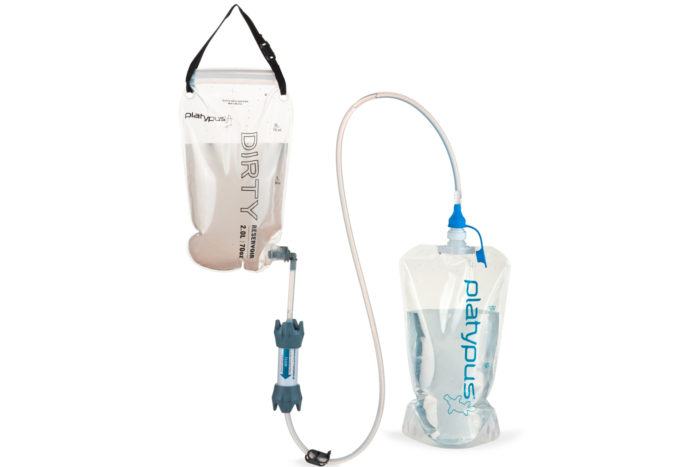
The Platypus GravityWorks 4L ($135) has won a spot on the list for another year in a row. Why? The Platypus is good for when you need water for more than just drinking (straw filters are great, but not for filtering several liters of water at a time).
So far as gravity filter systems go, GravityWorks is the full ticket, with other systems like the Katadyn BeFree Gravity Filter only providing a single dirty water bag. The Platypus option instead hooks it up with both dirty and clean 4L bladders, and tacks on a few other niceties that might lure you to this setup.
One of those perks was the quick-disconnect hose on the dirty bladder side, which meant that I could fill up without the need to bring the entire filter system down to the water source. This bladder’s wide-mouth opening is also nicer to use compared to the screw-top mouth of the BeFree Gravity, though we did find that it doesn’t always stay closed.
Filter rates are about on par between these two options, with the slight edge going to the BeFree. I did find that sometimes the GravityWorks could develop an airlock when first being set up — something that’s easy to remedy by elevating the clean side bladder for a minute to bleed out the air. Then, it’s smooth sailing.
Both gravity systems work great, and between the two, it’s tough to call either a clear winner. Those familiar with the BeFree system will find it an easy choice, but if you’re already plugged into the Platypus world with their hydration bladders, the GravityWorks 4L could be a great way to go for large group filtration.
Specifications
Pros & Cons
Pros
- Lightweight
- Easy to use
- Long lifetime
- Great option for those with gut issues
Cons
- Have to keep it charged
- Pricey
Bottom Line: A purifier that uses ultraviolet light to destroy 99.9% of bacteria, viruses, and protozoa. It requires clear water to function effectively and operates on two CR123 batteries.
UV filters are popular for many reasons. They don’t require pumping or filtering, and the wait time to kill bacteria and viruses is fairly short (between 60 and 90 seconds).
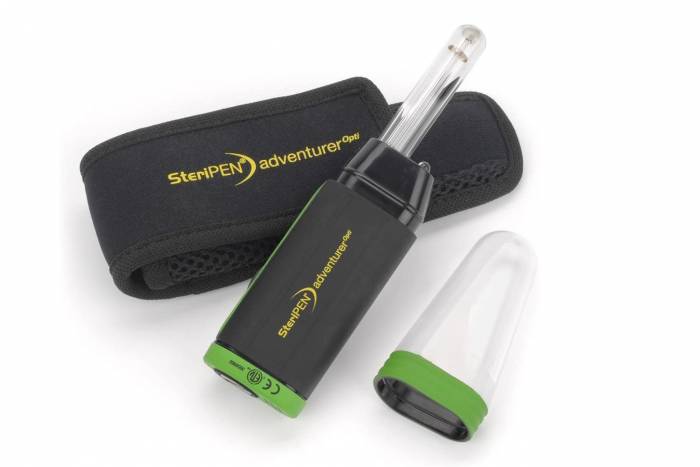
My first SteriPEN Adventurer ($125) recommendation came service of a mountain guide who had done the tango with suspect water one too many times and burnt out his gut flora, making the common chemical treatments alpinists use no longer an option. He praised the UV filter as being simple to use, long-lasting enough to get him through week-long mountaineering courses, and hard to break — an essential.
Using the Adventurer is pretty simple: just get your bottle of water ready (wide-mouth bottles are essential here), activate the UV light, and stir for a minute and a half. There are two options: 1 and 0.5 liters, but either way, once your time is up, everything nasty is sufficiently zapped.
This type of filtration will not remove particulates in your water, so take some advice from my mountain guide friend and filter through a bandana first.
At 3.6 ounces, the SteriPEN is a little bit heavier than other filter options like the Sawyer Squeeze or Platypus QuickDraw, but if your water is fairly clean to begin with, the speed at which you’re able to go from dirty to drinkable can’t be beaten by those filters. Longevity isn’t a problem, either, with 8,000 treatments being standard.
The rather inexplicable part about the Adventurer is that it runs on CR123 batteries and not a rechargeable internal battery. Most backpackers today carry some type of external battery pack, and recharging the SteriPEN would be simple to do. Bumping up to the SteriPEN Ultra ($130) will get you that USB charging ability, but in a bigger footprint.
Even still, for shorter trips where quick filtering is key (or you’ve been unkind to your gut biome), the SteriPEN Adventurer can be a key pickup toward getting your water quickly.
Backpacking Water Filters Comparison Chart
| Compare |
|
|
|
|
|
|
|
|
|
|
|
|
|
|
|
|---|---|---|---|---|---|---|---|---|---|---|---|---|---|---|---|
| Price |
$80
|
$30
|
$65
|
$53
|
$80
|
$100
|
$50
|
$25 or $44
|
$400
|
$55
|
$18
|
$70
|
$130
|
$135
|
$125
|
| Verified Weight |
3.3 oz.
|
1.7 oz.
|
2.5 oz.
|
3 oz.
|
6.8 oz.
|
15.9 oz.
|
3.3 oz.
|
Straw: 2.3 oz.; Squeeze Filter: 3.2 oz.
|
1 lb., 1.3 oz.
|
3.0 oz.
|
0.9 oz.
|
5 oz.
|
1 lb.
|
11.5 oz.
|
3.6 oz.
|
| Filter Type |
Bottle/inline filter
|
Bottle filter
|
Bottle/inline filter
|
Bottle filter
|
Gravity Filter
|
Bottle filter/purifier
|
Bottle
|
Straw: straw; Squeeze Filter: bottle/gravity filter
|
Pump filter/purifier
|
Bottle
|
Chemical purifier
|
Handheld
|
Pump filter
|
Gravity filter
|
UV purifier
|
| Filter Life |
1,000 L
|
2,000 L
|
378,541 L
|
1,000 L
|
1,000 L
|
250 L
|
1,000 L
|
Straw: 4,000 L ; Squeeze Filter: 2,000 L
|
10,000 L
|
285 L
|
1 L per tab
|
2,000 L
|
2,000 L
|
1,500 L
|
8,000 L
|
| Flow Rate |
3 L/min
|
2.5 L/min.
|
1.7 L/min.
|
2 L/min.
|
2 L/min
|
5 L/min.
|
2 L/min.
|
Straw: N/A ; Squeeze Filter: 3 L/min
|
2.5 L/min
|
N/A
|
1 L/4 hours
|
1 L/min.
|
1 L/min
|
1.75 L/min
|
1 L/90 sec.
|
| Filter Pore Size |
0.2 microns
|
0.2 microns
|
0.1 microns
|
0.1 microns
|
0.1 microns
|
N/A
|
0.1 micron
|
0.2 microns
|
0.2 microns
|
1 micron (Everywhere filter); 2-5 micron (EveryTap filter)
|
N/A
|
0.2 microns
|
0.2 microns
|
0.2 microns
|
N/A
|


How We Tested the Best Backpacking Water Filters
Whether hauling water out of stagnant desert potholes, filtering glacial flour in high alpine basins, or dipping a reservoir into a silty creek along the Appalachian Trail, reliable water filtration is non-negotiable in the backcountry. A failed filter can quickly derail a trip with waterborne pathogens or dangerous dehydration.
To build this guide, the GearJunkie team field-tested and lab-verified the most promising, functional water filters on the market, evaluating squeeze systems, gravity setups, hollow-fiber microfilters, and UV purifiers across thousands of trail miles.
Our Testing Process & Testing Grounds
Our evaluation process blends long-term field testing with controlled bench metrics. Field testing begins the moment we hit the trail, deploying filters side-by-side at primary water sources to evaluate real-world flow rates, setup friction, and cold-weather ergonomics under field conditions.
We test systems across diverse water sources (ranging from pristine mountain tarns to murky, tannin-heavy ponds) and evaluate performance for both solo fast-and-light pushes and high-volume group camps. Over years of continuous testing, our team has carried these filters along the entire lengths of the Appalachian Trail, Pacific Crest Trail, and Continental Divide Trail. Thru-hikes serve as the ultimate proving ground, exposing structural weaknesses, premature clogging, and connection failures that send lesser units straight to the hiker box.
To complement real-world trail use, we subject every filter to standardized bench tests in a controlled setting:
- Independent Weight & Packability Checks: We weigh every filter element, reservoir, hose, and storage sack on precision digital scales to verify manufacturer claims down to the fraction of an ounce, ensuring weight calculations are honest.
- Flow Rate Benchmarks: We time baseline flow rates using clean, room-temperature water to establish maximum potential throughput (L/min) outside of field variables.
- Turbidity & Clogging Torture Tests: To test filter grit, we run a standardized, highly turbid organic slurry through each system. This pushes the media near its clogging threshold, allowing us to evaluate both flow rate degradation and how easily the filter can be restored through field backflushing or field maintenance.

Our Expert Testers
GearJunkie’s testing team brings decades of backcountry experience to this guide, spanning long-distance thru-hiking, alpine climbing, bikepacking, and expedition paddling.
Guide author Mary Murphy curated our foundational testing pool of 14 filters back in 2020. Prolific backpacker and field tester Chris Carter took over testing in 2022, expanding our protocols while scouring testing grounds from the desert Southwest to high-alpine ranges. Today, our testing efforts are led by our senior editorial staff, including Editor Nick Belcaster, along with Staff Writer Mary Andino and a revolving team of contributors such as backcountry trail crew leader and thru-hiker Erika Courtney.
Our Water Filter Rating System
To provide transparent, side-by-side comparisons, we rate each filter across four core performance metrics:
- Treatment Time & Flow Rate: 30% weighted. We measure both raw filtration speed (liters per minute) and total operational setup time. A fast squeeze filter means little if it requires minutes of tedious hose assembly; we reward true gulp-and-go systems while setting 1 liter per minute as the baseline standard for acceptable flow.
- Ease of Use & Maintenance: 30% weighted. We evaluate operational simplicity for both novice backpackers and seasoned guides. This includes assessing the number of moving parts, the risk of losing small components (like O-rings), glove-friendly operation, and how intuitive it is to backflush or clean the filter in the field when flow slows down.
- Durability & System Integrity: 30% weighted. We test filters over full seasons of hard use, scrutinizing the longevity of hollow-fiber membranes, pump handles, threaded connections, and collapsible reservoirs. Systems that withstand trail drops, high-pressure squeezing, and repeated field maintenance score highest.
- Weight & Packed Volume: 30% weighted. Because ounces turn to pounds on multi-day treks, we reward ultralight, compact designs. Micro-squeeze and inline filters should weigh under 3 ounces to earn top marks, while full-capacity gravity or pump setups targeting group use should remain under 16 ounces.

Buyer’s Guide: How to Choose a Water Filter
Filters vs. Purifiers
Water filters and purifiers work in similar ways, but it’s helpful to know the difference when choosing. Filters protect against protozoa or parasites (such as cryptosporidium and giardia) as well as bacteria (like E. coli or salmonella), microplastics, dirt, and debris.
Bacteria are the main concern when drinking from unsafe water sources in the backcountry or remote areas, and any filter will sort out these nasty bugs. Popular filters include the Platypus QuickDraw and Sawyer Squeeze.
Purifiers go an extra step by protecting against and filtering out viruses. This is more of a concern when you’re traveling internationally or to rural places where clean water may not be accessible. Products like the MSR Guardian and Grayl GeoPress Bottle will purify your water while also filtering out larger debris, while purifiers like the SteriPEN Adventurer use UV light to purify water, but won’t clear the water of visible dirt and sediment. You can run the water through a bandana or T-shirt first to remove the biggest particles before using these purifiers.
For truly heinous, dirty/stagnant water, it can be wise to use several different methods to ensure you don’t get sick. Some will filter their water with something like the Platypus QuickDraw and then boil it, add a purification tablet like Katadyn’s Micropur M1 tablets, or add a couple of drops of bleach to ensure everything is killed. This can be time-consuming and make the water taste interesting, but it’s far better than catching a trip-ending sickness in the wilderness.
| System Type | Target Pathogens / Removes | Best For | Examples |
| Water Filters | Bacteria, protozoa (Giardia, Crypto), microplastics, sediment | North American backcountry & pristine trail sources | Sawyer Squeeze, Platypus QuickDraw |
| Water Purifiers | Bacteria, protozoa, microplastics, sediment, + viruses | International travel & heavily contaminated sources | Grayl GeoPress, MSR Guardian, SteriPEN |

Types of Water Filters
There are various types of backpacking water filters, and I cover a wide range of them in this guide. Each one has its place in the backcountry, and which type you choose will depend on how clear the water will be on your adventure, how lightweight you are trying to go, and if you are traveling internationally.
Gravity & Inline Filters
These filters use gravity to pull water from a dirty bag through a filter and into a clean bag or directly into your mouth. These are often the easiest filters to use as you simply hook it up to a tree branch or tent and wait. They are also usually heavier and take some time to set up, so aren’t the best options for fast and light missions. They tend to work best for large groups or to keep around a base camp.
Gravity filters allow you to keep a large amount of water handy, but they can be difficult to fill up in shallow water sources, so keep that in mind when choosing a campsite. I found the Katadyn BeFree Gravity filter to be one of the best options for large group trips.

Inline filters are often used in gravity systems, but they can also be paired with a hydration pouch or water bottle for quick use. Filters such as the ubiquitous Sawyer Squeeze or the Platypus QuickDraw can be used in this way.
These generally rely on the user sucking the water from a pouch or water bottle, through the filter, directly into their mouth. With the correct adapters, several models of inline filters can be used with a hydration pack you may already be carrying, offering easy filtration without adding much weight.
Straw Filters
While I don’t recommend them as your primary method of water filtration in the wild, straw filters are undeniably one of the easiest ways of procuring fresh water fast. My favorite budget filter, the LifeStraw Personal, fits this bill. These filters are great for trail running, mountain biking, or as a backup to your primary filter. They allow you to get down and dirty by a stream or lake and drink directly from the source by sipping the water through the filter like a straw.
The main downside to straw filters is that they don’t offer any way to carry filtered water with you, unless you can fit the straw into a water bottle of dirty water you are carrying with you, which can be really annoying. It can also get frustrating having to practically lie down on muddy or rocky banks to get a drink anytime you get thirsty. These filters suffice for day hikes, but you’ll probably want something different for any extended backpacking trip.

Pump Filters
Pump filters, such as the MSR MiniWorks EX, work great for pulling water out of shallow pools or creeks and can be a solid choice for small backpacking groups. They tend to run on the heavy side, take a little more effort to use, and can be quite complicated to clean. For these reasons, you don’t see as many pump filters in the backcountry as you used to, but they do still have their place.
In some cases, as with the MSR Guardian, pump filters do a better job of purifying truly nasty water by removing viruses, bacteria, and protozoa, such as E. coli, giardia, and cryptosporidium. This is something to consider a little more seriously while adventuring internationally.

Water Filter Bottles
Water filter bottles are handy for traveling, road-tripping, or light hiking, but they are often heavy for dedicated lightweight backpacking trips. Some of these bottles, like the LifeStraw Go Filter Bottle, filter water with a simple hollow-fiber straw that extends from the nozzle into the water, while others use fancier technology to deliver a pure, fresh swig.
The Grayl GeoPress uses electroabsorption and activated carbon to purify water by simply pressing it firmly on the ground. This isn’t your average Nalgene! If you want to nerd out a little more, check out our in-depth review of the GeoPress.
Chemical/UV Purifiers
Finally, purifying your water chemically or with UV light is another simple way to target viruses that may be present in a water source, as opposed to just bacteria and protozoa. Chemical purifiers use iodine or chlorine dioxide to deal with contaminated water, while UV purifiers employ ultraviolet rays.
Some backpackers will also use bleach to treat their water (two drops per liter, and then wait 30 minutes). This is a super simple solution but does leave your water tasting, well, somewhat like a pool.
We like Katadyn’s Micropur M1 tablets for chemical treatment, as they tend to leave a more subtle aftertaste compared to other brands. The SteriPEN Adventurer has been our go-to UV filter for its long lifespan and light weight.
This is a great way to purify your water more effectively, but since these don’t have filters with them, it’s important to use them with clear water that doesn’t have a lot of debris in it. Chemical or UV purifiers are lightweight and simple, but should probably not be used as your primary method of filtration on a backpacking trip.
It’s hard to get filtered water fast — they can leave an unsavory aftertaste and sometimes rely on batteries and electronics (in the case of UV purifiers). Since they are so light, however, it’s always a good idea to have them as a backup.

Filter Pore Size
Any filter that uses a membrane to separate the nasty bits from your water (note: not chemical or UV filters) will do so through pores in the membrane material. These pores are measured by their micron size, and they’re a good indicator of not only how effective your filter is but also how fast it will filter water.
For example, the Sawyer Squeeze filters down to 0.1 microns, which is just about the standard you’ll see. This is fine enough to catch particulates, bacteria, and protozoa, but not small enough to nab viruses. Alternatively, the Platypus QuickDraw uses a 0.2-micron membrane, which filters the same way but at a higher flow rate. On the trail, this means you can filter more water faster.
If you’re adventuring somewhere with especially sedimented water, such as rafting the Grand Canyon, an extra step is usually necessary to keep your filter elements from clogging prematurely. That is, unless you’re using the MSR Guardian, which backflushes the filter with every pump. For every other type of filtration system, use a flocculant such as alum powder (easy to snag in any grocery store), which will accumulate and settle the sediment for you.

Filter Time & Flow Rate
My picks for best water filters vary widely in terms of how quickly they can filter water, ranging from 30 seconds to 30 minutes to 4 hours (chemical treatments). Types of filters and methods of purifying will play a part, as will flow rate.
Flow rate is a unit that measures how quickly a certain amount of water can be filtered. Flow rates for gravity, pump, or squeeze filters listed here vary anywhere from 1L to 3L per minute. If you are encountering a slow flow rate with your filter, it may require priming or backflushing.
Similar to needing to prime a stove, some water filters require priming before initial use. Check the instructions (it varies by filter) on how to do this. Backflushing is a process where you need to clean water out of the filter system after use. This mainly applies to filters with pumps, tubes, or tubing, and it ensures that the inside of the filter stays dry and clean.
| Filter Type | Speed / Flow Rate | Key Considerations & Terrain | Examples |
| Press Bottles | Fast (8 sec/fill) | Instant setup; best for solo use and travel | Grayl GeoPress |
| Squeeze & Micro | Fast (1–3 L/min) | Requires backflushing; ideal for solo/pairs | Katadyn BeFree, Sawyer Squeeze |
| Gravity Systems | Fast (1–3 L/min) | Hands-free for groups; needs trees/elevation to hang | Platypus GravityWorks |
| Pump Filters | Moderate (1–2 L/min) | Needs priming & backflushing; pulls from shallow pools | Katadyn Hiker Pro |
| Chemicals | Slow (30 min–4 hrs) | Zero hardware; ideal ultralight or emergency backup | Katadyn Micropur |

Packed Size
This is an important point for ultralight setups and lightweight backpackers. You’ll want to choose a filter that works best for you and how much water you’ll need, but one that can also fit in your pack.
Filters like the Platypus QuickDraw and Katadyn BeFree AC are popular because the actual filter unit is so small and weighs close to nothing. The QuickDraw weighs just a couple of ounces, while the Katadyn weighs 6.8 ounces (but remember, it can filter up to 3 L of water at a time).
Filter systems that have water reservoirs and tubing also roll and pack down fairly small. My personal preference on group trips is a gravity filter system, whereas on solo trips (though they weigh slightly more) my preference is a water bottle filter/purifier, given that I always carry a 1L bottle anyway.

Durability & Longevity
A filter’s lifespan greatly depends on its filter method (cartridge, hollow membrane, chemical, or UV light). Backpacking water filters can last anywhere from 250 to 4,000 L. Cleaning your filter regularly using the methods that the manufacturer recommends will also help prolong its life.
Filters that use a cartridge tend to last anywhere from 200 to 500 L before you need to replace the cartridge. On the other hand, with other filters that last longer, you may need to replace the entire unit at the end of its life. The LifeStraw is an example of this; it can filter around 4,000 L, and then it will stop working and need to be replaced.
For UV methods like the SteriPEN, it’ll last forever as long as you charge or continue to replace the batteries (barring any damage, of course).
Filter Failure & Integrity Testing
Water filters with a filtration element aren’t bulletproof and can fail if allowed to freeze, causing the fragile membranes to break. If this happens, your filter won’t fully treat the water passed through it. Thankfully, the workaround is simple: when temperatures look like they’ll dip below freezing, toss your filter in your sleeping bag to keep warm.
If you’ve had a chilly night and forgotten your filter (it happens to the best of us) or potentially dropped it, an integrity test is in order. Filters like the Platypus QuickDraw instruct on how to do this, but the process will work for other hollow fiber filters as well, like the Sawyer Squeeze.
First, backflush a minimum of ½ L of water through the filter, and then empty the dirty water bag and reattach it to the filter. Introduce air into the filter by either squeezing the empty bag or, in gravity filters, by blowing air through the clean side. If air bubbles pass through the other side of the filter element, your filter is compromised and should be replaced.

Price & Value
There’s a bit of a spread when it comes to backcountry water filters, and without a little context, you might be led to believe that more money = more filtration. Instead, consider that there are a number of factors that go into just how much filter you might want to spring for: group size, water quality, and storage needs are just a few.
Budget
If you’re solo more often than not and find that day hikes are more your speed, it can be easy to jump into a budget filter that’s quick to deploy and drink straight from the source. Know that these types of ‘straw’ filters won’t give you any storage capacity for the long haul, but for out-and-back endeavors where water is plentiful, they can do the trick.
The LifeStraw Personal ($20) is an excellent example of this, and our fly fisherfolk on staff have come to lean on this filter as a go-to for quick and easy drinking while on the river. Chemical treatments such as Katadyn Micropur ($16) can be cheaper still, but we’d caution that this type of filtration is better suited to some specific use types — such as rivers with high glacial silt content.
Mid-Tier
Bumping up a bit in price nets you a great deal more in the world of backpacking filters. Even shelling out $40 to $100 can get you a hollow fiber filter that will last for 1,000+ L and move enough water to make personal trips to refill quick and easy. These filters often offer additional water bladders to filter from and backflushing syringes or hosing to connect to hydration systems.
Our top pick, the Platypus QuickDraw ($80), is a great value for the money. You’ll pay a bit extra for the large 2 or 3L bladders, but the flow rate and ease of use make it well worth it. This price range is also where you can get into some different styles, such as a gravity filter like the Katadyn BeFree Gravity 3L ($75) or Grayl GeoPress ($100) bottle filter.
Premium
Going with a premium filter option means that you’ve either got a lot of people to get water to, or are headed somewhere where the water is consistently challenging to filter. Anything north of $100 is likely to either be a pump filter or a complicated gravity system, and will use additional filter elements such as activated charcoal to strip out odors and heavy metals — improving taste.
The MSR Guardian ($400) is the mack daddy of pump filters, and, honestly, it’s a bit overkill for most of North America. That’s why we suggest the MSR MiniWorks EX ($125) as a better option for most folks. The MSR Guardian Gravity Purifier ($300) is similarly overbuilt compared to the pump version and builds on a charcoal filter and 10L (!) capacity to get an entire platoon watered.
Frequently Asked Questions
The best way to clean your water when backpacking is to use and find the cleanest water source possible. You’ll want to look for clear, running water — somewhere between a babbling brook and a rushing river.
Avoid stagnant ponds or areas where there might be runoff (from livestock, urban areas, etc.) or debris. You’ll also want to find a safe place to refill, pump, or hang your gravity filter.
With some filtering methods, like chemical filters and tablets, you’ll want to wait longer to ensure that the water is clean if it’s below a certain temperature (or cloudy).

Filters most commonly use a tube, pump, or gravity method of filtering. Purifiers use a combination of a tube or chamber with activated carbon or another chemical component to fight against one key difference: viruses.
All of the choices on this list protect against at least bacteria and protozoa, and many also protect against things like toxins, chemicals, and viruses. We recommend choosing the one that will work best based on your situation, budget, and preference.
The lifespan of a filter largely depends on the type of filter. Most hollow fiber or activated charcoal cartridges will need to be replaced every couple hundred uses, or after a certain number of liters have been filtered. Some filters, like the LifeStraw, can last for years, but when it’s run its course you’ll need to buy a new one.
There are also some filters and purifiers that just need new batteries or to be charged.

Yes! Purifiers like the Grayl GeoPress Purifier are built especially to filter and protect against everything you could encounter, whether in the backcountry or in a developing country.
As long as you are following the instructions on your filter or purifier, it will protect against whatever it’s rated for (usually something like 99.999999% of bacteria and 99.999% of parasites and microorganisms).
My top two considerations when buying gear like this are always: (1) how often we will be using it, and (2) price. Another important factor for many is how long a filter will last. If you backpack or hike 9-12 months out of the year, you probably want to drop more money on a filter that has a longer lifespan.
When all else fails, you can boil water to be safe. But let’s be honest, having a water filter on hand is much better.