I travel by plane quite often to go on backpacking trips, and there is one thing I simply refuse to do: check my pack. If the airline loses it or it gets damaged, my trip is ruined. I have fought for years with overhead bins to get my fully loaded pack inside, but on a recent trip to Oregon, for once, it was easy. The Swift X Pack from Six Moon Designs is so light, compact, and compressible that it can fit a surprising amount of gear in a small package.
I tested (and lived out of) the Swift X for 7 days and 96 miles along the Oregon Coast Trail. It experienced bushwhacking, rainstorms, and an ill-fated attempt to wade across an estuary.
While I enjoyed many things about this pack, the running vest-style harness was my absolute favorite. Imagine being able to keep everything you need right at your fingertips in a comfortable, lightweight, and ergonomic setup. That’s exactly what the Swift X delivers.
In short: If you’re looking to upgrade your pack or enter into the world of ultralight, the Swift X ($375) is an excellent choice. It’s durable, thoughtfully designed, and highly adaptable. The hip belt can’t quite deliver comfort with heavier loads, but it performs well for weekend trips.
Compare the Six Moon Designs Swift X Pack to other backpacks on GearJunkie’s guide to the Best Backpacking Backpacks and Best Ultralight Backpacks.
-

-
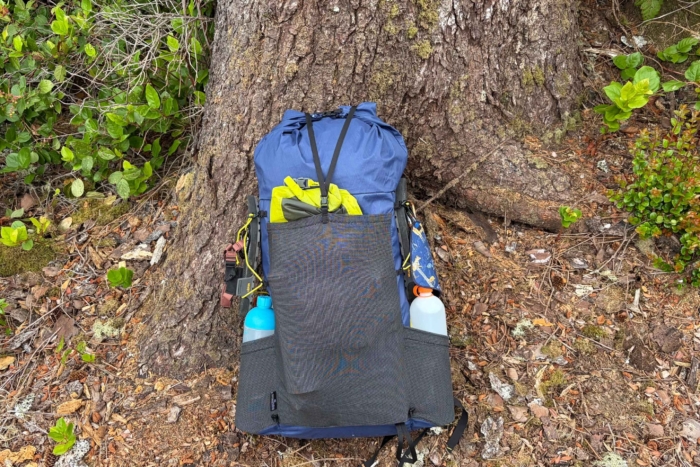
My fully stocked pack; (photo/Mary Andino)
-
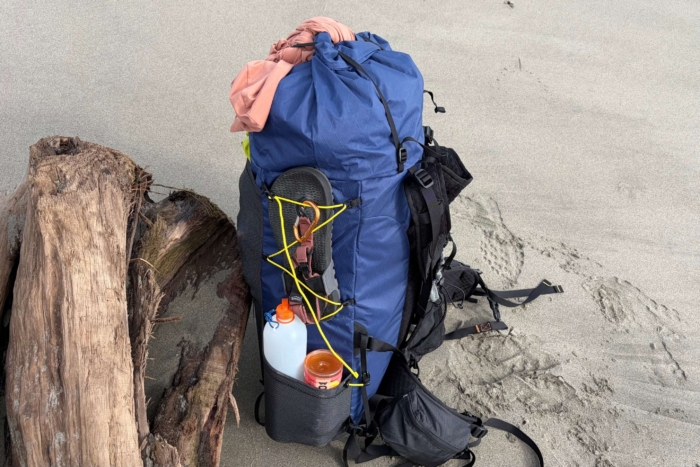
(Photo/Mary Andino)
-
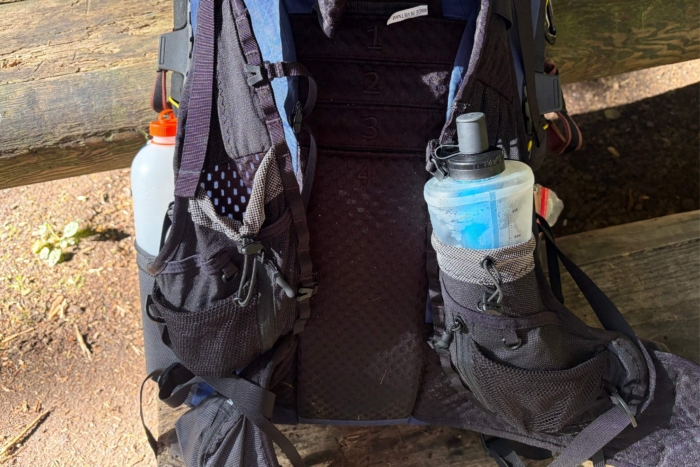
The running vest-style of the pack; (photo/Mary Andino)
-
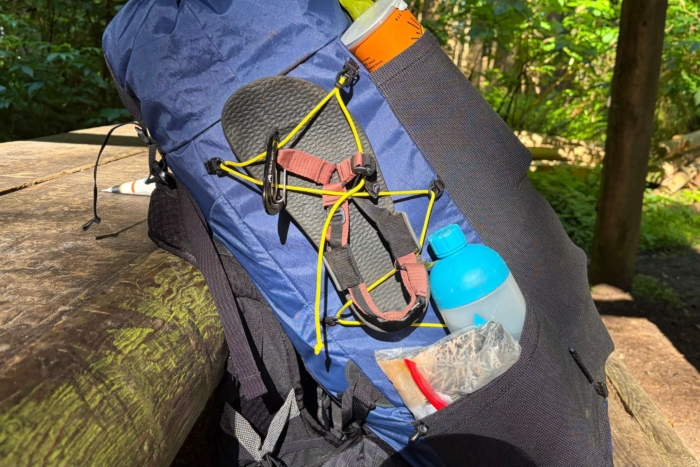
The criss-cross strap didn't feel too secure; (photo/Mary Andino)
Specifications
Pros & Cons
Pros
- Durable fabric
- External pockets hold large amount of gear
- Customizable
Cons
- Not comfortable with heavier loads
- Expensive
Six Moon Designs Swift X Pack Review
A Customized Design
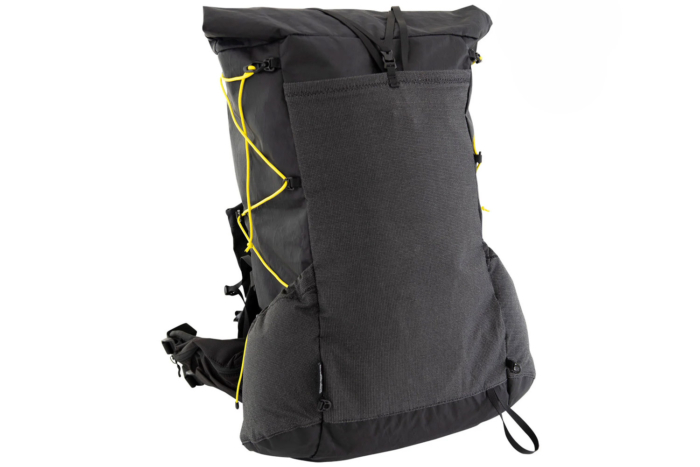
One of the cool aspects of the Swift X is your ability to customize when you order. Customers can choose what fabric they want for the body of the pack: The Ultra 200X is the most durable, but also the heaviest and most crinkly. The VX21 and LS21 are lighter, softer, and quieter.
You’ll also pick the kind of harness you’d like: the shoulder (a classic setup), the vest (the running-vest style), and the S-curve (designed for women and those with narrow shoulders and a larger chest). Each style comes in two sizes, and the hip belt comes in three sizes. I tried the VX21 with the vest harness in size large, and a small hip belt.

For a pack that isn’t custom-made, the Swift X offers a wide array of choices so you can get exactly what you want and what works for your body.
Inside the pack is a Delrin hoop frame stay, which the brand says helps with transferring load to the hip belt and making heavier loads more comfortable. It is removable, and taking it out decreases the pack’s weight by 3 ounces.
The bag has a roll-top closure with a buckle, with a Y-style strap that you bring over the top, buckle, and cinch down. It does a great job at compressing if you really yank on it. I filled the 50L capacity up to the brim, and got it to smoosh down enough to fit into the airplane’s overhead bin.
UL Fabric Choices
The largest external pocket is the mesh front pocket. I ripped the mesh on the front pocket of my Gossamer Gear Mariposa 60 pack the first time I used it. The fabric on the Swift X isn’t as stretchy, but it’s far more durable. Instead of typical mesh, Six Moon Designs uses Challenge Outdoor’s Sailcloth Ultra Stretch mesh. The company says it’s a four-way stretch fabric made for performance and longevity.

Initially, I was worried that this large pocket wouldn’t expand enough to hold everything I wanted to keep accessible (first-aid kit, rain jacket, snacks, charger, etc.), but I stuffed more in than I thought I would be able to. And the mesh is far and away a massive improvement over the typical kind you’d find on backpacks. Quite often, the trail was overgrown, and I had to fight my way through bushes and thorns, and the fabric held up well.
The body of my pack was made from VX21, a 60:40 nylon–polyester blend. While the fabric is waterproof, the pack itself is not watertight. I experienced around 36 hours of straight rain on trail, and the inside of the pack did get damp. I don’t think it’s fair to expect anything to stay 100% dry in the face of that much rain. While it is weather-resistant, I would still bring a rain cover with me for the Swift X or use a pack liner.

Smart Storage
The main body of the pack can fit up to 50 L. There isn’t any internal storage, except for one flimsy pocket made out of nylon that can’t hold much more than a wallet. I was testing a bunch of different gear for GearJunkie on this trip, so I needed all 50 L. The pack fit everything I needed for a week (including food and fuel), but if I had to fit a bear can, that would have been a bit of a struggle. The external fabric of the pack isn’t the stretchiest, so it doesn’t expand that much.
In addition to the main external pocket on the front of the pack, there is a water bottle pocket on each side. Each pocket can fit two 1L bottles similar to Smartwater bottles. I used the CNOC Outdoor Bottle and Mazama M!GO Bottles. They fit nice and snug, and if there were two on each side, I didn’t worry about them falling out. Even with two bottles in a pocket, there was still room to shove small items like my sunscreen.
On each side, above the water bottle pocket, is a criss-crossing nylon strap you can cinch down. I used that to attach my trail sandals. I wish the straps were more like bungee material and stretchy, so they felt more secure holding items. They could also work for trekking poles and other items that you want to put on your pack, but are dirty, and you don’t want to put inside with your clothes and sleeping bag.

The hip belt has a pocket on each side. Unfortunately, like almost every other pack I’ve tried, they’re not big enough to hold an iPhone or other similar smartphone. They are handy for keeping items like hand sanitizer, bars, and power banks readily accessible.
The running vest, however, is truly where the storage shines. I don’t like to carry my phone in my pocket while backpacking since it isn’t the most secure, and it doesn’t fit in the hip belt pockets. In the past, I’ve used the Hyperlite shoulder pocket ($60). It attaches to a shoulder strap and fits my phone.
With the Swift X, you can save yourself $60 because each shoulder strap has a large pocket with a bungee cord closure. It fit my phone easily, and when I was crossing rivers or in areas where I really wouldn’t want it to fall out, I just cinched the closure.
The bungee pocket also solved one of the most annoying issues I have with packs. I don’t like to use water bladders (I once had one break and leak all over my sleeping bag), but the pockets on other packs are so far behind me that I can’t reach them. In this setup, I have to stop and take my pack off whenever I want to drink water.
The bungee pocket, however, was big enough to hold a 750mL soft flask from HydraPak securely. I could sip water without taking my hands off my trekking poles or taking my pack off. Whenever I’d stop to go to the bathroom or have a break, I’d refill the soft flask with water from my bottles. This setup worked really well, and I was probably the most well-hydrated I’ve ever been on a backpacking trip.

Additionally, below this pocket, there is another zippered pocket, which I used for my wallet and Garmin inReach, and a small external mesh pocket I put my electrolyte tablets in. Six Moon Designs says that if you include the capacity of all of these pockets, the pack’s actual carrying max goes from 50L to 56L.
As a whole, the running vest harness held way more gear than a pack harness typically would. I know some people hike with fanny packs on for this reason, but the Swift X’s setup is more comfortable, streamlined, and simple. I had so many items I needed all within easy reach.
Comfort and Fit
Six Moon Designs says the max weight capacity of the pack is 35 pounds with the frame and 25 pounds without. I definitely pushed that 35-pound limit; all the gear I was testing for GearJunkie was, in total, quite heavy. As a result, the hip belt dug into my sides and caused pain and bruising.
By the last day, every time I buckled the hip belt, I cringed. It has the least amount of padding on the hips compared to all the other packs I’ve tried from Osprey, Gregory, and Gossamer Gear. More so than other packs, you need to be cautious about your total weight with this one.
Additionally, unlike other packs, which usually have one buckle for the hip belt, this one has two, with a strap for each. While I could see this allowing you to customize fit, in reality, it made it harder to get the pack to sit where I wanted it to on my body. There were now four toggles I had to adjust, instead of two.
For me, the ultimate test of a backpack is how my upper back and shoulders feel after several days of wearing it. Unfortunately, by day three, I felt extreme tightness and mild pain between my shoulder blades. No matter how I adjusted the fit of the pack (and it has multiple points of adjustment, including four levels on the back), this nagging ache stayed around. This could be just my body and not a universal experience (or it could be due to the heavy load I was carrying).
I will give the Swift X props for breathability. At one point, I was on a 3,000-foot ascent in direct sunlight, and my lower back only got slightly sweaty, impressive given the conditions.
Durability
After 96 miles in Oregon, I feel confident in saying I put this pack through hell. One day, the trail I was following, unbeknownst to me, had been destroyed by a landslide a few months prior. I got lost, and had to bushwhack through a literal rainforest before I made it back to the road. I was scraping against dead trees, rocks, and bushes.

On another day, I had to cross up and over a rocky outcropping by the ocean. It was a big step up, and I couldn’t do it with the pack on. I took the pack off, chucked it over the outcropping, and then jumped up and followed suit. Through all of that, the Swift X showed no visible damage. After my trip, I rest assured that VX21 fabric is tough enough to handle whatever I throw at it.
A Note on Weight and Price
Six Moon Designs says the Swift X is a pack for ultralighters and thru-hikers, so let’s see if that’s the case. The full setup (with frame included) weighs 38.8 ounces. Our overall pick for best ultralight pack, Hyperlite’s Southwest 55, weighs 31 ounces, and our best ultralight pack for thru-hikers, the Durston Kakwa 55, weighs 30.3 ounces.
Looking at the ultralight category as a whole, the Swift X is definitely on the heavier end. It’s still way lighter than traditional packs from brands like Osprey and Gregory (which easily go over 3 pounds), but if you’re a die-hard ultra-lighter, the Swift X probably isn’t for you. I’m someone who will happily add a few ounces for some extra features, and the convenience of the running vest is worth a bit of extra weight.
The Swift X in the VX21 or LS21 fabrics costs $375, while the Ultra 200X fabric version costs $430. Looking at the version I used, $375 is on the higher end of the ultralight pack category, but still within range. The Gossamer Gear Mariposa 60 costs $315, while the Hyperlite Southwest 55 is $420. Our pick for best budget ultralight pack — the Outdoor Vitals Shadow Light 60 — is $300.
In comparison to all of these other packs, the Swift X’s $375 price tag is within reason. Unfortunately, as a whole, the category of “ultralight” cuts ounces but does tend to add dollars. Spending around $300 on an ultralight pack is about what you can expect across the board.
Six Moon Designs Swift X Backpack Review: Conclusions
As an experienced backpacker, I really appreciated the smart design touches of the Swift X. Small utilitarian elements (like the bungee cord pockets) solved some of my most common headaches on the trail. While $375 isn’t cheap, the rugged durability makes this pack a good value.

If you are going on a weekend or short trip, the Swift X will be plenty comfortable. With longer distances and heavier loads, I’d worry about the ability of the hip belt to keep me supported and pain-free.
Ultimately, if you’ve got a pack from a big-name brand like Osprey and Gregory and want to upgrade without going full ultralight, the Swift X is an excellent choice. It cuts weight, but without stripping away all the handy features those packs have. It’s a great choice for the in-betweeners like me who want both utility and a slightly lighter pack.