Believe it or not, there once was a time when taking your smartphone with you on an outdoor adventure was frowned upon. The idea was to escape the hustle and bustle of everyday life by leaving your devices behind. But as our phones have become more integrated into our lives, we now recognize how valuable they can be even when traveling in the backcountry.
Thanks to the vast libraries of apps at our disposal, smartphones have become as versatile and useful as a Swiss Army Knife. They can serve as our cameras and GPS navigation devices. They provide entertainment in the form of music, videos, and podcasts or share our adventures on social media. And, they can even serve as a flashlight in a pinch.
Perhaps most importantly, our mobile devices can function as a communications tool, helping us stay in touch with loved ones back home or reach out for help in an emergency. These apps offer services and features that are potentially lifesaving, assisting search and rescue teams in locating lost hikers, backpackers, and skiers.
There are a lot of emergency alert smartphone apps out there on app stores for iOS and Android devices. Here’s a handful of apps that have been built with backcountry users in mind. They all work slightly differently. But, they all provide the same safety net should you stumble into trouble when you go off the grid.
The Best Emergency Alert Apps for Your Smartphone
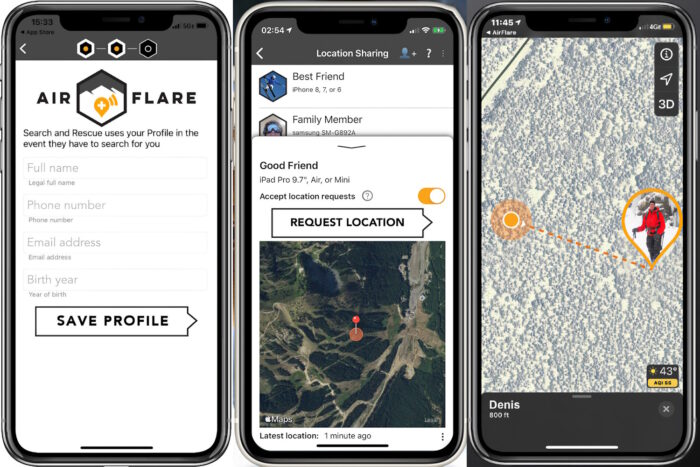
AirFlare is an app that turns your phone into a personal locator beacon. It transmits your location to friends and family, allowing them to keep tabs on your current whereabouts at all times. This can be helpful when hiking, mountain biking, or skiing with a group, keeping everyone connected throughout the day. But more importantly, this app can prove invaluable should an emergency situation arise.
The app contains a database of emergency contact numbers throughout the country. It will display the best options based on your current location. It can even tell you if local first responders can be alerted via text, which saves time by sharing the user’s exact GPS coordinates. AirFlare users can even call or text directly from within the app, saving even more valuable time.
Of course, other apps offer similar features. But, most only work reliably when the phone is connected to a data network. But the AirFlare team has developed proprietary tracking equipment that can detect a user’s location even when their smartphone doesn’t have any connection. This extends the app’s usefulness in the backcountry, dramatically improving safety.
Other valuable features include the ability to use your phone’s camera flash as an SOS signal and the option to tune your device’s performance to optimize battery life. The service requires a subscription, but it is very affordable at $4.99 per year.
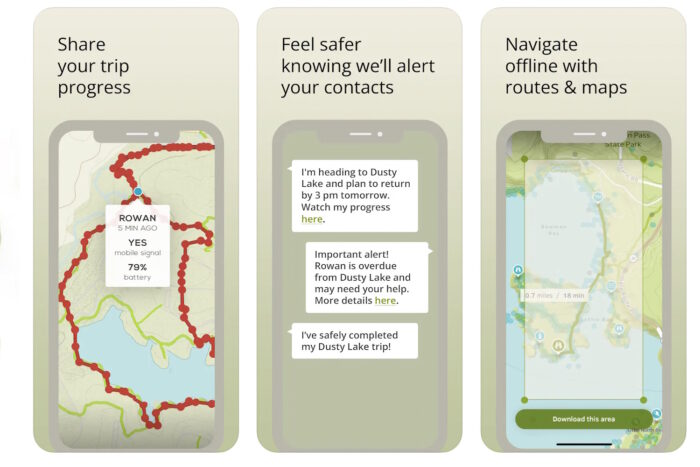
Thanks to its excellent backcountry maps and database of hiking trails from around the world, Cairn is a well-known app in the outdoor space. But, the software also offers several excellent features that can help you stay safer in the backcountry beyond just assisting with navigation.
For instance, it can monitor your hiking pace, the difficulty of your current route, and the distance remaining. Using that data, it will provide an ETA for when you’ll finish, which is very handy for letting friends and family know when you’ll be returning. Cairn can even send a message should you be overdue for a check-in.
The emergency alert app also offers real-time location tracking, allowing you to share your progress and current coordinates with others. This is especially helpful when traveling alone, giving friends and family the option to see where you’re at and that you’re still on the move. Cairn even indicates where hikers are most likely to have cell service along a given trail, making it easier to stay in contact or reach out for assistance should the need arise.
Cairn users will also appreciate the ability to download maps to their devices for use offline. They can also adjust the frequency of GPS pings to help maximize battery life, and the services can all be adjusted based on activity, including hiking, skiing, mountain biking, trail running, and more. The app is free to use, but to get the most out of it, a subscription is required. Pricing starts at $4.99 per month or $26.99 per year.
If an emergency presents itself, you want to be able to respond as quickly and easily as possible. That’s the premise behind Backcountry SOS, an app that understands that sometimes accidents happen and that time can be of the essence when it comes to getting help.
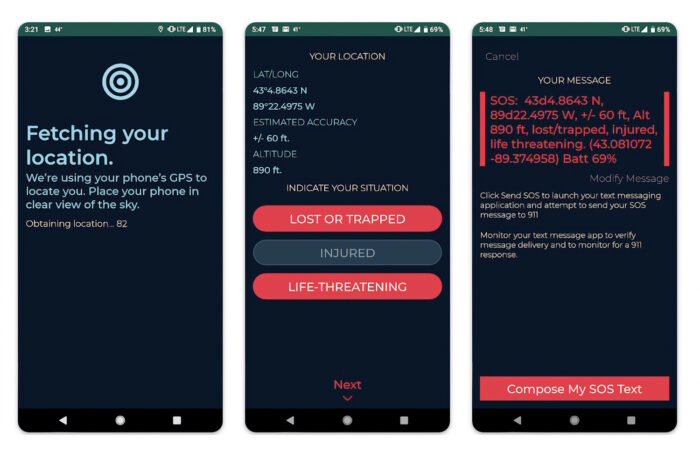
The app’s interface is about as simple and straightforward as it gets. When launched, Backcountry SOS activates your phone’s GPS chip to determine your current location. That information is copied into a text message, along with the current altitude and an estimate of the accuracy of the readings.
The user can then select from several preset messages to send to first responders, indicating whether they are lost, injured, or in a life-threatening situation. All of that info is then sent to 911 dispatch via text.
For Backcountry SOS to work, the phone requires a connection to a cell network and be in a location where text-to-911 service is available. With more than 1,500 counties nationwide now supporting that service, that is increasingly becoming a more viable way to reach out for emergency assistance. Some Wyoming, Montana, Idaho, and Utah locations even monitor this app directly.
One other nice feature of Backcountry SOS is that it doesn’t require the user to create an account or pay for a membership of any kind. The software is available for free and works without charge, thanks to the generous support of the Teton County Search and Rescue Foundation. The app developers recommend contributing to that organization as a show of gratitude.
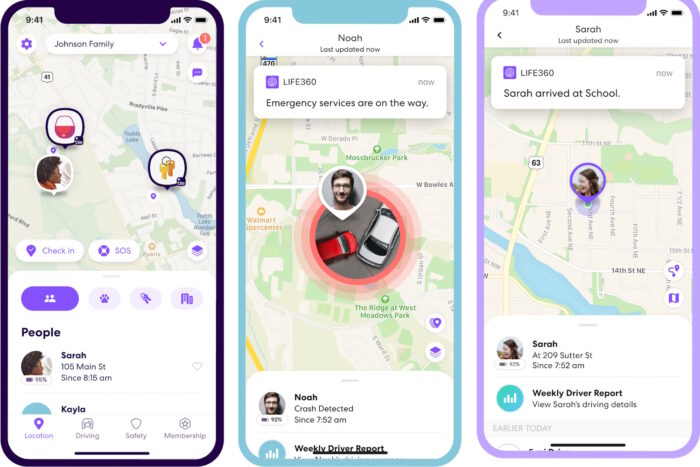
This app isn’t as outdoor-focused as the others on this list, but it still offers plenty of valuable features both on and off the trail. For instance, it allows users to track the location of family members via GPS and provide alerts when they arrive at — or depart from — specific places. It also has the ability to send SOS messages to friends, emergency contacts, or first responders.
Life360 also works with Tile tracking tags, which can be placed in a backpack, on keychains, or attached to other equipment to independently track those items too. This functionality could prove helpful if someone becomes incapacitated in some way, rendering them unable to send a request for help. But if they have a Tile device with them, it would still be possible to find their location and track them down.
Membership is required to use Life360, although the bottom tier of the service is free. That includes limited tracking capabilities and the ability to send SOS messages, while the Gold ($14.99 per month) and Platinum ($24.99 per month) versions add more robust tracking with detailed histories, unlimited place alerts, automatic crash detection, 24/7 roadside assistance, and much more. A connection to a cellphone network is also needed.
Apple Emergency SOS via Satellite
(Images/Apple)
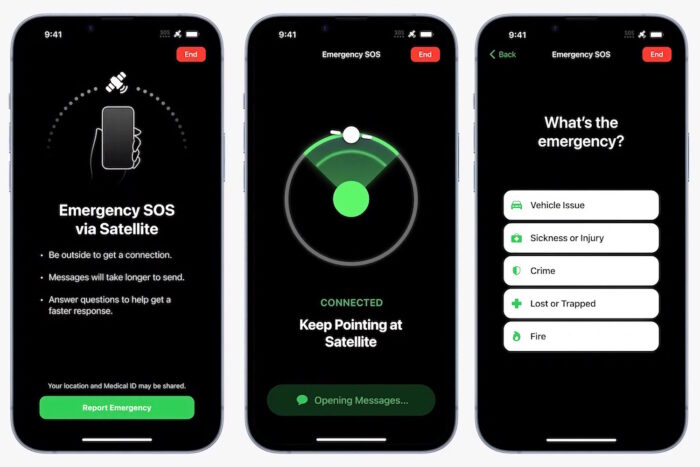
If you own an iPhone 14 or newer, your device has a built-in system for sending emergency messages even when traveling in remote places. The service is called Emergency SOS via Satellite, and it uses proprietary technology to send text messages to first responders using satellites in low-Earth orbit. Those texts include the user’s GPS coordinates and a brief pre-canned explanation of their current situation.
In true Apple fashion, the service is very easy to use. It automatically activates when a user attempts to send a text message from a location that doesn’t have reliable cell service. The iPhone will prompt the user to initiate an SOS via satellite message if no network connection is detected. It will then walk them through the process of connecting to a satellite overhead and sending a message that is then automatically routed to the closest 911 dispatch center.
Since its launch in late 2022, Apple’s emergency satellite service has proven useful. There have been numerous accounts of individuals getting lost in the backcountry or finding themselves in an emergency situation, only to have their iPhones aid in their rescue. Future versions of the system may even allow users to send more detailed text messages, potentially even to friends and family and not just emergency services.
Don’t use an iPhone? Never fear, Android users; several manufacturers are already working on bringing a similar service to that mobile operating system. Those phones should begin hitting the market in the fall of 2023, helping more of us to stay safer in the backcountry.
Satellite Messenger Companion Apps

Satellite messengers — like the Garmin inReach, SPOT X, or ZOLEO communicator — are excellent devices to carry on our backcountry adventures. These gadgets allow others to track our progress and view our current location. They also allow us to send an SOS alert should an emergency occur. But to get the most from these gadgets, you’ll want to install a companion app that unlocks additional functionality.
The smartphone apps that work with a satellite messenger allow users to connect the two devices so they can work in tandem. This allows the smartphone to send and receive text messages using a satellite connection and get updated weather reports. That’s a significant upgrade over previous-generation satellite communicators, which typically only allowed for one-way texts, often consisting of preset messages.
If you own a Garmin inReach device, you’ll want to install the Garmin Messenger app. That app works with the company’s entire line of satellite communicators. For the SPOT X, be sure to install the companion app for iOS or Android. ZOLEO users can find the ZOLEO app on the Apple App Store and Google Play Store, as well. Without this additional software, you’re not getting the most out of these potentially lifesaving gadgets.
These are our picks for the best and most reliable emergency comms apps to have on your smartphone while traveling in the backcountry. Each delivers essential features and functionality to keep us safer while pursuing our outdoor passions. Install one or two of these apps for those “just-in-case” moments. Doing so could save your life or someone else’s.