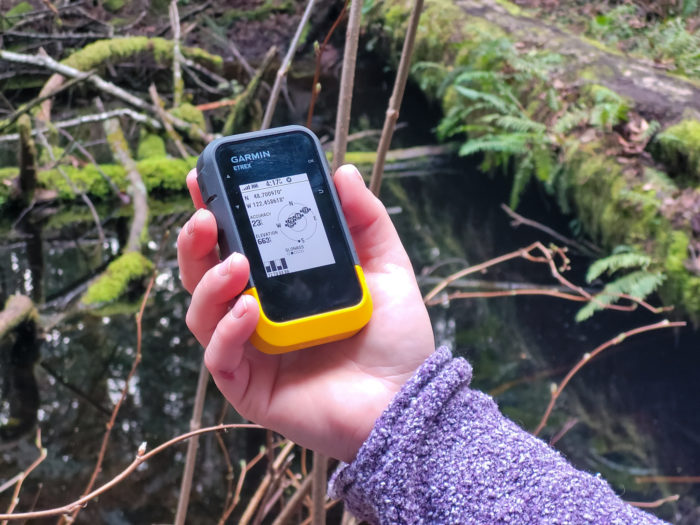
I was waist-deep in devil’s club and slide-alder, off-trail and trying to pick a line through the old-growth. Simple pursuits call for simple trim, and the Garmin eTrex SE is your grandfather’s type of GPS device: dang easy to use, no fluff, and doesn’t cost an arm and a leg. On these types of trips, you really only need a heading, and with a quick down look at the SE, I leaned back into the green.
While most modern outdoor tech keeps adding smartphone-style screens and endless menus, the eTrex SE goes the other way. It strips navigation down to basic tracks and waypoints, stretching battery life to a wild 168 hours on just two standard AA batteries.
After weeks of off-trail thrashing and route-finding around the Pacific Northwest, here’s how this bare-bones handheld performs off the grid.
In short: The eTrex SE is a revamped version of the classic, but retains all the same feel (and friendly price tag). There’s certainly fancier tech on the market, but sometimes less is more.
Looking for a new GPS device? Check out GearJunkie’s Best Handheld GPS Buyer’s Guide for more of our top picks.
-

-
(Photo/Nick Belcaster)
-
(Photo/Nick Belcaster)
-
(Photo/Nick Belcaster)

Specifications
Pros & Cons
Pros
- Impressive battery life
- Connectivity with the Garmin Explore app
- Multi-GNSS support
- Digital compass
- Supports real-time weather forecasting
Cons
- Black-and-white screen
- AA battery supply may not be for everyone

Garmin eTrex SE: Review
The Garmin eTrex SE is the least expensive version of a trio of updated devices for the eTrex line. It was the first to hit the market in 2023, and offered as the most approachable option for those who simply need a quality GPS (with some modern tweaks).
I’ve been testing the SE for 3 years now, folding it into my off-trail travels and marking cache locations in the backcountry with it. We’ve tested all three versions of the new eTrex here at GearJunkie (including the Solar and Touch versions), and here’s why I think the least expensive one is worthy of consideration.

GNSS (Global Navigation Satellite System) Reception
Typically, one of the areas that budget GPS units save on is satellite reception. While using only the GPS constellation is good enough to get you a latitude and longitude, combining location data from different systems has always been the way to ensure fidelity (and costs more to produce).
The eTrex 22x and 32x both exemplify this. Offered as the budget options of yesteryear (but still being produced), these units only receive on the GPS and GLONASS systems. This can mean that not only is location data not the most refined, but it can also take longer to get a location lock as your device searches for good satellites to connect with.
On the eTrex SE, the number of GNSS antennas is bumped up to five, with GPS, GLONASS, Galileo, QZSS, and BeiDou all being available. You won’t have access to Garmin’s Multi-Band technology on the SE version, and you’ll need to bump up to the eTrex Solar or Touch versions for that.
But with those additional satellite systems comes a much faster and better location signal. This makes the eTrex SE a more worldly device, as different systems are dialed in for different parts of the globe.

Menus and User Interface
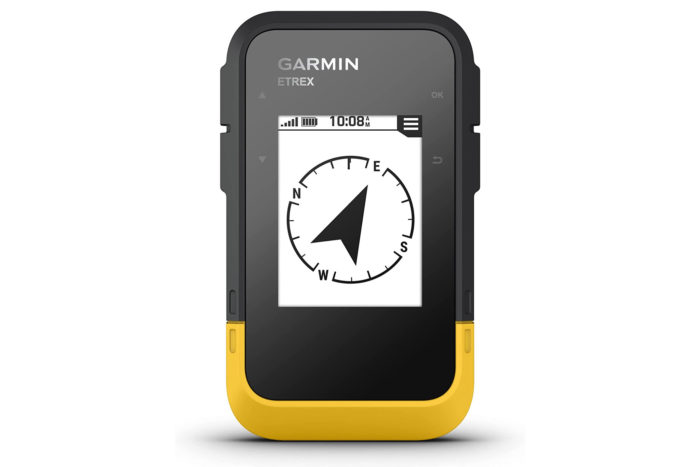
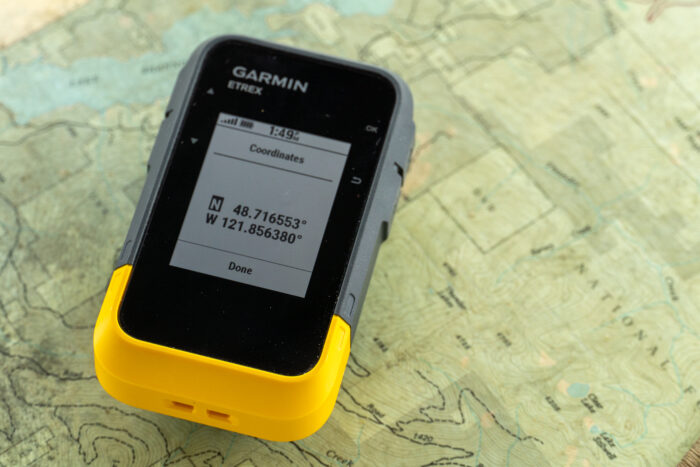
Don’t fret, legacy eTrex users, the user experience on the SE version is still delightfully lo-fi. The 2.15-inch diagonal screen is black-and-white only and is made up of chunky text and simple-to-recognize symbols. There are a few user interface spruces, however, and my favorite is the quick-action menus that can be summoned with a long press of a button, and the “Glances” page.
These glances are quick takes on the info you’re probably most interested in knowing. A quick compass direction, when the sunset is going to be tonight (or even a future date), or what the moon is going to do tonight and if it’ll be good stargazing or not. All are pretty handy, and it’s a modern touch that makes the SE feel like a modern device.
The on-device navigation feels familiar and simple, and is laid out on a breadcrumb-style grid that can be panned around and zoomed in and out. Don’t expect much, but just enough to give you some spatial awareness and a line to follow. It’s old-school GPS in the best way possible.

Garmin Explore App Integration
If anything, let this feature be the reason you upgrade from your old eTrex 22 to the SE version: the Explore app. This companion app is uncharacteristically good and densely featured, with the ability to build routes and port them over to your device, as well as maintain a stash of offline maps (with satellite imagery).
This creates a versatile duo of the SE and your phone, where the GPS can be your daily driver for navigating on the ground, and your phone the detailed map maker while you’re at camp. The SE uses Bluetooth to pair up with your phone
If you’re app-averse, fear not, as Garmin also tucked away a USB-C port on the interior of the device’s battery hatch, which can be used to connect the GPS with your desktop and the Garmin Explore website. This allows you to do everything the app does, just a little less mobile. If you’re trying to leave your phone behind and go lo-fi outdoors with the eTrex, this is a great option.

What Are You Missing Out On?
The eTrex SE is the least expensive GPS handheld that Garmin makes currently (even undercutting the $199 eTrex 22x). And since that device has relatively less horsepower in almost every way, it must be the color screen that does it. Color really only becomes important on a GPS device when it comes to viewing maps, and since the experience on the SE is a simple breadcrumb one, it’s not missed.
The benefits of sticking with a monochrome MIP (memory-in-pixel) screen are actually significant. The battery life difference between the old 22x and the SE is huge: 25 hours on the original, while the new version will do 168 hours on the same set of AA batteries. The difference in screen doesn’t account for all of that (simple map rendering and modern chipsets are also doing lifting here), but it does make a big difference.
None of the newer eTrex line hosts an Iridium antenna, meaning they won’t be able to act as a satellite messenger — something very popular in more expensive devices (like the GPSMAP or Montana series). This means you may end up owning two devices if you want the sat texting ability. Doing so would cost at least $450 (an eTrex SE + inReach Messenger), while the inReach-equipped Montana 710i is going to run you $800.

Garmin eTrex SE: Conclusion
For $150, the Garmin eTrex SE feels like a steal. It’s the bottom of the shelf in the Garmin line, yes, but that also means that it benefits from high-tech trickle-down. Modern chipsets and reception of five satellite systems make the SE feel sharp, even with its fewer features and simple mapping.
The rest of the new eTrex line ratchets up in price to $250 for the Solar version (not a bad pivot for the added battery life) and $450 for the Touch (one of the best GPS units for most people, in my opinion). The SE version strikes me as the best entry-level GPS (or even backup unit) of the bunch, but consider your needs before going with any of them.
If you just need a dead-simple, weather-resistant navigation anchor that turns on every single time and lasts for weeks on a couple of AA batteries, the eTrex SE is hard to beat. It cuts out the tech bloat, doubles down on backcountry reliability, and easily earns its keep on any shoulder strap.