On paper, the Nodus Nomad sounds like a practical field watch at a good price. With dual time, compass functionality, a reliable Seiko movement, and 100 m of water resistance, I was intrigued. But the shimmering, sand-colored dial is what really drew me in. I connected with Nodus to arrange a demo.
Before I ever got one in my hands, the Nodus Nomad GMT watch underwent extreme testing. At least that’s what the brand claimed, noting that 15 explorers wore prototype Nomads across two weeks along remote terrain, “enduring 124°F heat, violent sandstorms, and wet desert conditions with no logistical support.”
I didn’t have that kind of heat or sandstorms at hand. But I did have lots of mountains, fickle springtime weather, and a lot of hiking to get done. I strapped on the Nodus and hit the trail.
In short: The Nodus Nomad ($575) is a handsome automatic watch with a lot of utility for a very reasonable price. With a cool backstory and unique appearance, it’s a fun, functional piece for those who love tool watches.
Compare the Nodus Nomad with the best field watches.
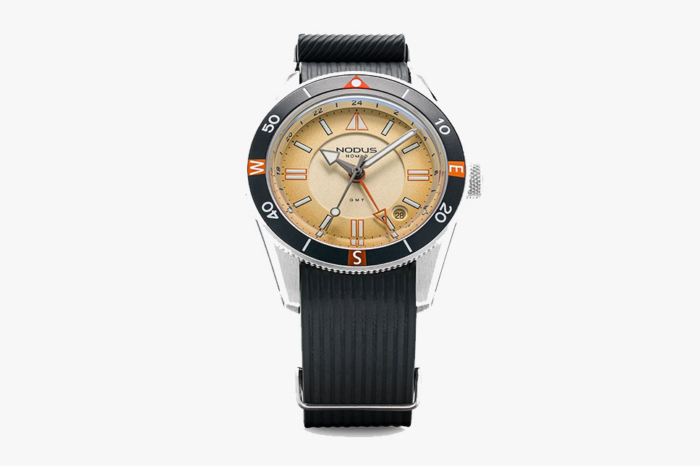
(Photo/Nodus)
Specifications
Pros & Cons
Pros
- Attractive dial
- Dual time zone tracking
- Functional bezel (compass, timer)
Cons
- Modest power reserve
- The date window is difficult to read
Nodus Nomad Review
Born from a 2-week retracing of Roy Chapman Andrews’ early 20th-century Gobi Desert expedition, Nodus designed the Nomad tool watch for extreme conditions.

Cutting through the marketing chaff, Nodus did build a practical, affordable field watch with some nice bonus utility. I received a demo model of the Nomad about 6 weeks ago. I’ve pressed it into some tough duty since then, strapping it on for downhill and cross-country skiing, turkey hunting, camping, and trail running. After some rough weather and even a few drops onto hard surfaces, the Nomad is still going strong.
To be clear, that’s a low bar. But it’s one that a good field watch needs to leap over with zero issues. Fortunately, the Nodus Nomad cleared it easily.
Timing has been reliable. When wearing the Nomad for two to three days at a time, I haven’t noticed any time deviation. As I’ve been jumping between a lot of tasks this spring, I often removed it for days at a time, revealing one of its downsides — a 41-hour power reserve. It isn’t long enough to get through two full days of downtime without needing to be reset.
To be fair to the Nodus Nomad, a 41-hour reserve is pretty standard, especially at the $575 price range. It’s a product of the reliable, yet affordable Japanese TMI NH34 movement.
Nodus Nomad: On the Wrist

The Nodus Nomad ships on a ribbed pass-through FKM rubber strap by StrapHabit. Testing this watch is the first time I’ve tested the style, and I’m conflicted about the design.
This strap has a secondary pass-through linkage that extends past the clasp. When you put the watch on, you first pass it through that linkage, then into the clasp, and then through two standard pass-through loops. The result is that the band snugs down more precisely than with a standard watch band.

I find this both good and bad. On the good side, I found a really good, comfortable fit once it was dialed. On the bad side, the watch was clumsy to put on and take off. When hustling out of my house, I’d stand there for an extra minute or two fumbling with the band.
Once on, though, the rubber strap was quite comfortable. The 38mm case has an oversized 40mm bezel, which allows it to feel smaller than it is on the wrist. Essentially, the bezel overhangs the case a little, so it is larger on the top than against the wrist.
I found the design quite pleasant for daily wear. Do be aware, it’s a little chunky and barely fits under a button-down cuff on an average flannel. While a field watch in use, it tends to fit a little more like a dive watch at 11.7mm thick.
GMT, Bezel Functions
The Nomad is a GMT watch, meaning it has a fourth hand that tracks a 24-hour clock by circling the face once every 24 hours. It sets easily and independently of the main timekeeping hands. This lets you set a second time zone to track while traveling, or while managing far-flung employees or loved ones as they travel.

This style, called the “caller” GMT, is most useful for those monitoring other locations. While still useful for travelers, it’s not as seamless as a “traveler” GMT, which lets the wearer quickly adjust the local 12-hour hand for time zone changes.
Using the GMT feature is quick and easy through the first crown position. Turning it one way adjusts the GMT hand, turning it the other way adjusts the date in the (really tiny) date window. More on this later.
The Nomad is also equipped with a bi-directional bezel. Emblazoned with cardinal directions and a “10, 20, 40, and 50” numeral, it allows you to use the watch as a compass or timer. Both are rudimentary tools, but functional with some basic skills.
To navigate with the bezel in the Northern Hemisphere, lay it flat and point the hour hand at the sun. In the Northern Hemisphere, south is the halfway point between the hour hand and 12 o’clock. This watch takes it a step further, allowing the user to pivot the bezel to point to north and south, somewhat simplifying navigation.
Nice Dial, Good Legibility
I was initially very attracted to the appearance of the Nodus Nomad dial. Its lusterous golden hue recalls sand dunes and sunshine. And while wearing the watch, I continued to enjoy its handsome appearance. But I did find myself increasingly critical of the legibility of the dial.

First, the date window is incredibly small. I can read it, but only with great effort and in bright light. Yes, I’m old enough to have slightly reduced near vision, but I can still tie a fly line without reading glasses. The window is legitimately tiny. I think the watch could lose this complication and possibly be improved, although the date is nice for international travel.
With a tringle at the 12 o’clock position, double batons at 3, 6, and 9 o’clock, and single batons at the rest of the hours, it’s relatively easy to read. It takes more time than numerals, but is easy to decipher. I do think the watch is a little cluttered-looking with the mix of batons on the dial, cardinal directions, and numerals on the bezel. There’s a lot going on, especially with each position using a different color.
The watch uses Swiss Super-LumiNova BGW9 Grade A for low-light visibility. It really pops in the dark, especially during the first few hours after exposure to daylight.
Nodus Nomad: Who Should Buy It?
The Nodus Nomad is a really cool watch. It has a lot of utility that travelers and explorers will appreciate. And it has a great backstory.
Tested on camelback through sandstorms and heat, the production model was refined by the explorers themselves. It has a handsome dial, a comfortable fit, and a bi-directional compass bezel. Each individually numbered piece comes with a StrapHabit ribbed strap, which offers a great fit once strapped on.
People who value utility, good timekeeping, and a unique timepiece with a cool backstory should consider the Nodus Nomad. It’s rugged, reliable, and has a unique, adventurous appearance. I think it has room for improvement, particularly in the date window and slightly busy appearance, but at the price range, it’s a compelling watch that the adventurous will enjoy.