If there’s ever been a time for me to test remote power solutions, it’s been this summer. Since the middle of June, debilitating storms have touched down once a week and wiped out power, sometimes for days. The kids and I have also been on the road quite a bit, and having a solar-powered power station with us has made all the difference.
I’ve been using Goal Zero products on the road and at home for nearly 20 years. Back in 2007, I was at the Teva Mountain Games — now the GoPro Mountain Games — in Vail, where the entire event village was powered by Goal Zero’s solar panels, power stations, and lighting accessories.
Impressed and eager, I had Goal Zero’s panels mounted to my work truck to power my engineering gear just a few weeks later. This setup also allowed me to keep my house running when the power went out. I was also able to illuminate numerous campsites and tailgating festivities across New England.
Over the years, I’ve had my ups and downs with the brand. Fifteen or so years ago, I had to throw one of its power stations out into my yard as the battery swelled, smoked, and sputtered to a glorious death. About 10 years ago, while camping in a cabin, miles from nowhere, I had a battery die without warning or reason.
While these incidents are worth noting, I have dozens of other situations where I had to rely on its power banks and power stations — and everything functioned without flaw. If it didn’t, I wouldn’t be taking the time to write about one of its latest power stations, the newly upgraded Yeti 1500.
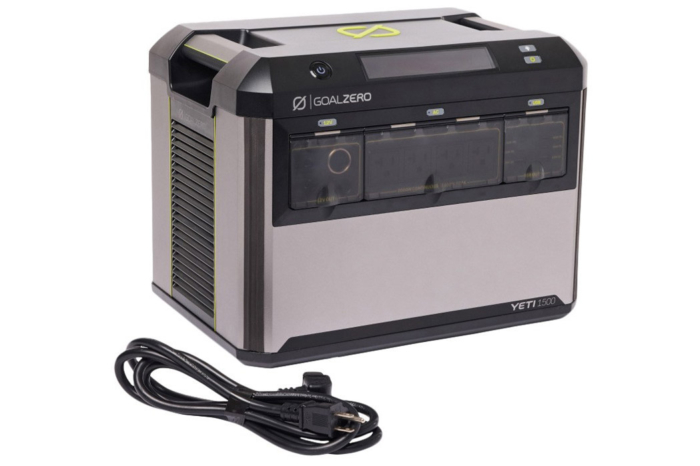
In short: If you’re looking for a feature-packed, easy-to-use power station for backup power at home or your main source of power for prolonged periods on the road, the sixth generation of Goal Zero’s Yeti 1500 will offer you some of the best balance on the market today.
Specifications
Pros & Cons
Pros
- LiFePO4 battery for reliability and longevity
- Input and output port assortment
- Durability and IPX4 rating for outdoor use
- Wide variety of solar panels and accessories
Cons
- It is heavier than some comparable models from competitors
- It's more expensive than some of the competition
Goal Zero Yeti 1500 Review
What’s New

For its sixth generation, Goal Zero has completely revamped the Yeti 1500. Weather-rated and faster-charging, this version of its mid-sized powerhouse has one goal in mind: keeping you powered up in the outdoors. Featuring a rugged, IPX4-rated case, this updated model is built to be bopped around, in and out of the elements. Along with these capabilities comes the upgrade to a Lithium Iron Phosphate (LiFePO4) battery.
Originally found in the Yeti PRO 4000, LiFePO4 batteries increase reliability tenfold and promise 4,000 cycles, or roughly 10 years of average use. They’re also smaller and lighter than the historically popular Lithium-ion and AGM batteries. This helps increase the mobility and adaptability of the products they are found in.
If none of this has convinced you that this is the best version of the Yeti 1500 yet, maybe remote monitoring, device management, and remote power optimization will? Not sure. Either way, relying on this power station has been a breeze during a year where we’ve traveled more, and the weather has been completely unpredictable.
Life on the Road and in the Woods

Living in New England, a lot of the places we go camping are in the woods. There’s not a lot of direct sunlight out there, which can impact the efficiency of a solar panel. However, even with a power station with the capacity of the Yeti 1500, you should probably still bring a solar panel like the Nomad 100 or Boulder 100 with you.
Whether you’re camping or overlanding, this power station can recharge something small, like a laptop, 25 times or power something large, like a pellet grill, for an entire day. If you’re bringing a portable fridge along, you can expect to keep it running for more than a week. It does this through a 2,000W inverter that can surge to 3,600 W. So, feel free to bring your favorite, most comfortable air mattress as well.
Additionally, if you do run into a jam where you need additional power, you can always find a sunny spot to use a solar panel or find someone with an RV, cozy up to them, and borrow a wall plug for an hour (yes, it’s that fast).
Addressing My Needs

When people think about power stations like the Yeti 1500, they think about camping, van life, and power outages. However, for me, it’s primarily a means to power my workshop.
My house was originally built to house the Army Corps of Engineers in the 1950s. It was completely upgraded and remodeled in the 1990s, and two outbuildings (big ol’ sheds) were added to the yard. Both are wired for power, and both of them were wired wrong. One of them is my base of operations for housework, yardwork, and displaying cool beer cans.
With the Yeti 1500, I can bypass the bigger project of rewiring everything out there. In fact, it has revolutionized how I function out there altogether. I have lights and the ability to charge the batteries for my power tools and yardwork equipment. In fact, we recently set up our screen and projector outside, and the kids were able to run around while we had movies playing, while the bats chased mosquitoes in the sky above us. There were dragonflies and fireworks, too.
But — but — the most important part of this for me is that it’s mobile. I can unplug a couple of plugs and take the Yeti 1500 and its Nomad 100 solar panel out on the road with us. For me, that justifies the expense and makes it more of a necessity than a want.
You see, something like this changes how you approach things. At home, I don’t need to bring in batteries and chargers and plug them in around the house. On the road, we can bring some of our modern amenities along with us. In the event of a storm, it sits on the floor, out of the way, keeping the lights on and our fridge cold.
Additionally, this generation of the 1500 highlights mobile monitoring and operation. Through Goal Zero’s Power App, I can turn the Yeti on or off, track power usage, and select which ports are powered. It also allows me to set up alerts to let me know when the things I am charging are fully charged, or if the 1500 itself is fully charged or running low. This all makes the 1500 a useful power solution that keeps things simple in any situation.
Fast Charging & Balance

Whether you’re using the Yeti 1500 on the road, at home, or anywhere else that requires power, the amount of time it takes to charge your devices is important. It’s also important that the things you need to supply constant power with are able to share bandwidth with those items.
This generation of the Yeti 1500 has the intelligence baked in to do both, so you don’t need to constantly switch between what you’re charging and what you’re powering. That said, with the app, you can remotely monitor what’s being powered, turn off outlets if need be, and pretty much anything else you need to keep this power station running like a top.
However, it’s the fast charging that’s got me smitten like a kitten.
Aside from my lawnmower, all my yard-related power tools run off a 40W Ryobi battery. These batteries are a BEAR to charge in a timely manner — taking about an hour to charge off a standard wall outlet. And, as fate would have it, I’m used to finding myself in a place where I need a battery charged, and it isn’t. This was mostly due to my shed not having power, which meant I had to bring the batteries into the house to charge them, and I never remembered to do it.
Charging these batteries from dead to full on the Yeti 1500 takes about 20 minutes, nearly a third of the time it would if I did it inside my house. Additionally, charging two of those 40W monsters takes only 8-10% of the stored battery capacity.
Solar Panel Pairing

For portability and convenience, GZ recommends using either the Nomad 100 or Boulder 100 solar panels to charge the Yeti 1500. These panels can be chained together to create up to 900W of input for faster charging. This would equate to nine panels being chained together, or quite the impressive solar farm at your campsite or out in a field.
In testing and use, I used both the Nomad 100 folding panel ($400) and the Boulder 100 Briefcase ($400). The Nomad is thinner and more portable than the Boulder 100, allowing it to be hung or placed on the hood or roof of your vehicle.
The Boulder 100 Briefcase is built with tempered glass and an aluminum frame. This makes it bulkier and heavier than the Nomad 100 (26 pounds versus 10 pounds), but more durable overall. I plan to mount the Boulder 100 Briefcase to the outside of my workshop for stationary use and use the Nomad 100 for travel.
For those of you who are looking for the best of both worlds, I would recommend either the Nomad 200 folding panel ($600) or the Ranger 300 Briefcase ($800). The Nomad 200 panel doubles the capacity of the Nomad 100 and Boulder 100 Briefcase panels while still being lighter than the Boulder 100 Briefcase. It also takes up less space when stored.
In terms of durability, the Ranger 300 Briefcase features a thinner aluminum frame than the Boulder 100 Briefcase, but it does swap out glass for a PET polymer shield over the panels. This is an upgrade in durability over the Nomad’s monocrystalline panels.
The Ranger 300 weighs 38 pounds, but considering it’s 3x the power of the Boulder 100 (26 pounds), it offers the best balance between weight, power, and cost.
In choosing which panel is right for you, consider where you’re using it and how fast you need it to recharge the 1500:
- Do you need something durable?
- Do you need something that can be adapted to surfaces and locations?
- Do you need something that takes up the least amount of space?
- Do you need something that recharges the battery the fastest?
Keep in mind, on the road, it’s going to take a lot for you to drain the battery on this bugger. Everyone considers speed to be the most important factor, but in traveling, space and adaptability should be your main focus.
Price

Overall cost is always a consideration when investing in something like this. It’s not just the power station you’re buying — you need solar panels and cables as well. Goal Zero has never been the most expensive option out there, but it certainly isn’t the cheapest.
Jackery is a brand that has gained popularity because its offerings have high rankings in portability and are generally affordable. Its comparable Explorer 1500 Ultra is $300 less than the Yeti 1500 and is 11 pounds lighter. It also has a higher IP rating. However, it has fewer inputs and outputs, and the brand has a limited offering of solar panels, cables, and accessories.
Flip of the coin, Dark Energy, another admirable portable power solutions brand, has just entered the portable power station market with its Recon 2000. More comparable to the Jackery Explorer 1500 Ultra in terms of IP rating and input/output offering, this unit is actually 20 pounds more than Goal Zero’s Yeti 1500 and $500 more.
The Numbers
- Goal Zero 6th Gen Yeti 1500 + Nomad 200 Solar Panel = $1,900
- Jackery Explorer 1500 Ultra + 2x Solar Saga 100W Solar Panels = $1,419
- Dark Energy Recon + Spectre 200W Solar Panel = $2,000
(Note: these are all bundled prices that you can get when you buy the power station with the panels. They’re all a few hundo more when you buy them on their own.)
Big Picture
We’re not going to solve the question of “is this worth my money” in the context of this article. However, the elephant in the room here is whether these companies are being honest in regard to what their LiFePO4 batteries can do.
Both Goal Zero and Jackery claim you’ll get 4,000 cycles. However, Dark Energy claims you’ll only get 2,000 on a similarly sized battery. Who’s right? Who’s wrong? I’ll get back to you on that between 2031 and 2036.
Overall

When Goal Zero first introduced the world to portable power stations that were reliable and easy to use at the end of the aughts, they were the only ones doing what they were doing. Since then, a handful of other brands like Jackery, Anker, and EcoFlow have not only made a name for themselves, but they’ve also done so by being more advanced than Goal Zero.
Where I do believe in brand loyalty, it’s based on experience and not logos or hot marketing. I have seen Goal Zero take a bit of a back seat to those aforementioned brands, but I have always been willing to give them a shot. Why? Because in the end, they’ve come through.
Seeing them power the entire village of Vail, Colo., has had a lasting impression on me, but I’ve also had to rely on its products during some of the shittiest times, so my admiration for these folks is warranted.
That said, I’ve only got a couple of months of use with this latest take on its Yeti 1500. However, at that time, this shifted from me testing the product to my daughters and me relying on it. As I said, this power station also powers my workshop. It’s a staple for the way we function out here.
I’m not writing this to champion the brand; I am writing this because I’ve had to rely on its products. At some point, the gear tester in me stopped paying attention, and the homeowner, adventurer, and father took over.
If you’re chasing the latest and greatest in mid-sized portable power stations, you can stop right here and invest in a product you’ll rely on for at least a decade.