Five years ago, I left the Rocky Mountain West and set up shop in Middle Tennessee. Having spent my entire life in the West, it was a huge adjustment in every way imaginable. One of the adjustments was shifting from spot-and-stalk hunting elk and mule deer to becoming a whitetail guy.
It’s a different world, for sure, but I’ve been having an absolute blast learning how to be successful at new tactics, for a new animal, on a new landscape. However, it hasn’t been without its problems. Like finding the right pack.
For reasons I’ll get into later, I haven’t been able to find a hunting backpack that works for every one of my hunts over the course of the season. I’ve cycled through six different options, none of which were a perfect answer. But fortunately, I was given the opportunity to test the Latitude Praxis pack this year, and let me tell you, it solves pretty much all my problems.
I’m going to go out on a limb and say that for the dynamic whitetail hunter, this is the best hunting backpack out there, which is why it’s taking the award as the best whitetail hunting backpack in GearJunkie’s “Best Backpacks for Big Game Hunting” Buyer’s Guide. Let’s dig into what makes this such a phenomenal pack.
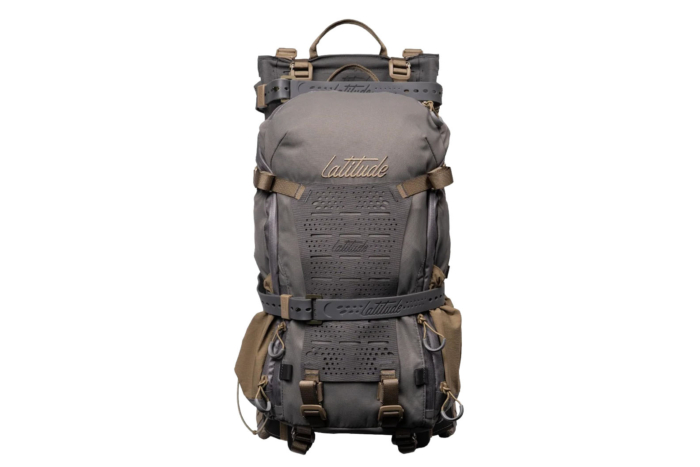
In short: No matter where you hunt, how you hunt, or the season you hunt, the Latitude Praxis ($450) will perform exactly how you need it to. Modularity and customization are the name of the game. Yes, the price is absolutely ridiculous. And yes, the customization means it takes time to dial it in for your specific needs. But in my opinion, the effort and price are worth it for serious whitetail hunters.
Latitude Praxis Backpack Review
-

-
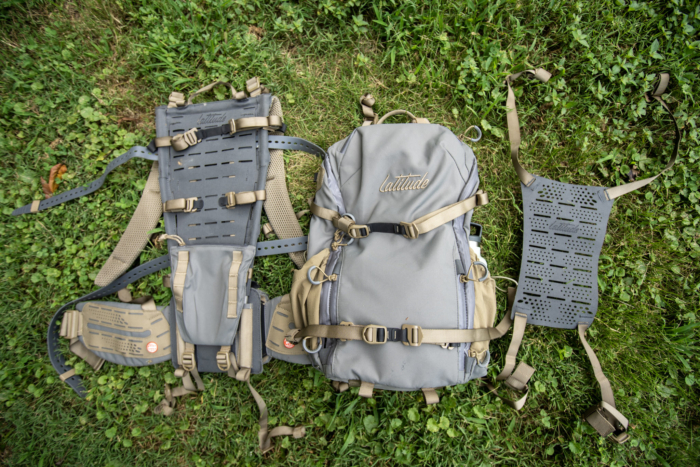
The customization of the Latitude Praxis lies in its ability to be disassembled and reconfigured in multiple ways; (photo/ Morgan Nowels)
-
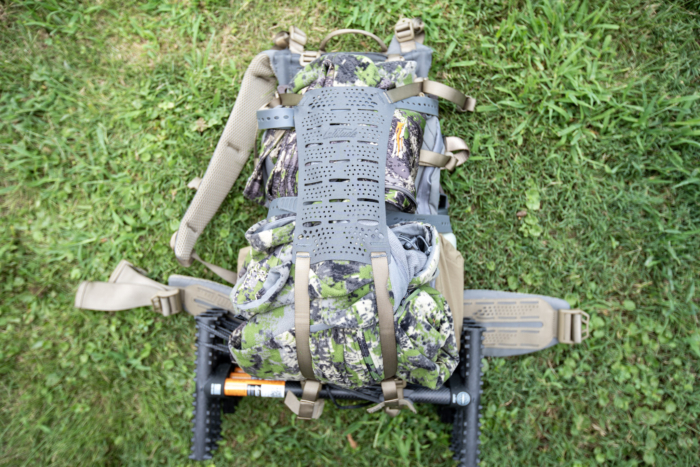
Thanks to the exterior webbing system, I can attach layers to the outside of the pack, keeping the interior organized and keeping overall pack size down; (photo/Morgan Nowels)
-
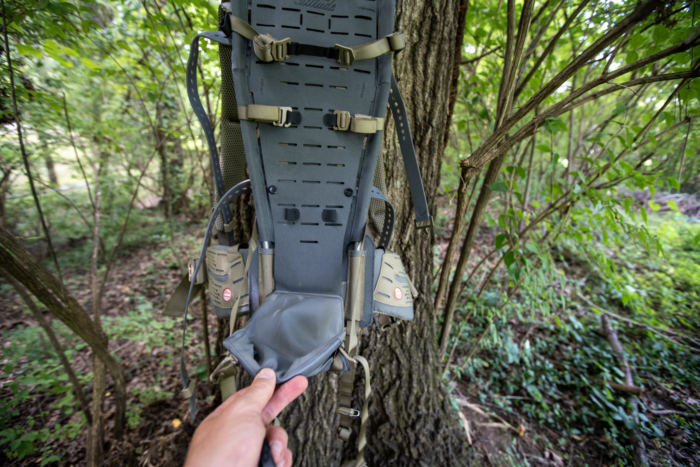
The Praxis frame has a meat shelf, allowing you to pack out a deer in far flung deer stands; (photo/Morgan Nowels)
Specifications
Pros & Cons
Pros
- Highly customizable
- One of the best packs for carrying climbing sticks, platforms, or stands
- Integrated meat shelf
- Excellent layout for tree stands
- Keeps things tidy and contained
- Surprising capacity
Cons
- Price
- No hydration bladder port
- Learning curve for set up
Deer Hunting Backpacks: The Struggle Is Real

I’m going to outright come out and say it: Most whitetail hunting packs suck. They’re so specialized that they lose functionality. For whatever reason, the hunting industry acts as if the only place anyone hunts whitetail deer is on prime AG land in the Midwest.
But seeing how whitetails are the most distributed big game animal in North America, such specialization and focus is, well, problematic. In my region alone, I’ve hunted steep mountain country, classic AG land, and even some urban neighborhoods. Our seasons are long as well, and I hunt from August to January.
Every landscape and every season requires different demands from a pack. Sure, if I’m hunting a farm with pre-set stands in October, a small, specialized tree-stand backpack may be perfect.
But what happens when I’m hiking miles back into the mountains in November? I may need to pack a bunch of layers and carry a stand in. What if I need to quarter a deer out and pack it out? Most whitetail packs have no way to do that. Likewise, packs that are capable in such situations are often too much in most classic whitetail hunting scenarios.
Enter the Praxis, the first whitetail deer backpack that combines an external frame with a classic whitetail backpack vibe. The result? A pack with the capacity to carry all of the gear under the sun, the ability to pack meat out of the hills, while still staying small and compact for the stand on the farm.
How the Latitude Praxis Solves My Deer Hunting Problems
On the face of it, the Latitude Praxis looks like a confusing wad of straps and buckles. Honestly, it’s a bit chaotic. I generally like things pretty simple, and at first, I didn’t like it. It seemed confusing.
However, after spending half an hour familiarizing myself with it, I started to really dig it. The straps and the modularity are exactly what make it so great. Depending on the situation I’m hunting in, I can alter the pack to fit exactly what I need. Here are a few ways I have mine set up.
No Matter What I Need to Carry, the Praxis Delivers
Saddle Hunting

I’ll admit, I’ve turned into a basic bro whitetail hunter. I’ve fallen madly in love with saddle hunting. Nowadays, I’m hiking in somewhat far and hunting out of a saddle 80% of the time.
Seeing how Latitude manufactures saddles, this pack was designed specifically with saddle hunters in mind. It is quite literally perfect for it. I set my Praxis up by strapping my platform to the frame of the pack and clipping the pouch to the frame over top of it. It’s tucked away and secured, but is easily accessed when I need to pull it out up in a tree.
I strap my sticks vertically to the pack using the torque straps, and they’re completely out of the way. I ditch the front webbing system entirely in this configuration.
When hiking through the woods, I couldn’t even tell that my sticks and platform were there. Everything is in a tiny, neat, light package. If I wanted to go ultra-minimalist (which I don’t), I could even set the pack up the same way on only the frame and ditch the main pouch entirely.
Late Season: The Praxis Is Small, but Big

A whitetail backpack being small and compact isn’t that unique. But the real beauty of this hunting backpack is that, while small and compact, it can expand out to carry everything but the kitchen sink.
While I haven’t had this pack out in the late season yet, I set it up as if I were. In the late season, I don’t want to hike in wearing all of my layers and get coated in sweat, so I need to store them in my bag.
I also tend to do all-day sits starting in November, so I also need to pack in breakfast, lunch, and plenty of snacks. Of course, I’m also going to toss in a few energy drinks, a grunt tube, a rangefinder, a knife, rattling antlers, and an extra water bottle. That’s a lot to fit into a little whitetail backpack. It’s not an option for most.
That’s where I’ll be utilizing the webbing system. I can shift my climbing sticks to the bottom of the pack because, of course, there are straps there too, and secure thick bibs and a jacket to the exterior of the pack.
The rubberized straps are a genius touch. They lock my layers to the bag, and they don’t shift around and fall off while hiking like they would with cloth straps. If needed, I could stuff even more layers between the pack and frame as well.
That leaves the pouch itself to hold all of my odds and ends. At the stand, I can throw my layers on and am back to an organized, tiny pack in the tree. It’s brilliant.
Carrying Traditional Tree Stands

Just because this backpack is manufactured by a saddle hunting company doesn’t mean it’s only for saddle hunters. Fortunately, its modularity makes it an excellent choice for hunters utilizing classic lock-on stands.
I’ve shifted away from lock-ons because I can’t stand packing them in the woods. Most affordable options, like the XOP stand I use, have backpack straps on the platform to carry because they’re so large and clunky. That means you’ve got to find a way to jerry-rig it, carrying it over the top of your current backpack, or hike the stand in, leave it there, and come back in later. You lose mobility that way, though.
Fortunately, while setting up a deer lease this summer, I found the strap system on the front is more than capable of holding a lock-on stand. And, just like my sticks, it seems to disappear on my back. The rubber straps keep it from shifting annoyingly while hiking. It makes carrying a full stand surprisingly comfortable.
I now use my lock-on as a semi-permanent stand and was able to hike the stand deeper into the property than I normally would, all while still carrying a trail camera, water, and sticks in a compact, comfortable-to-carry package. I carried an electric limb saw in my hands, and I could build an entire season-long stand setup in one trip, solo. Absolutely glorious.
Other Small Details Hunters Will Appreciate

My love for the Latitude Praxis doesn’t stop at its modularity. There are so many little details on this bag that I simply cannot go over all of them. This review would be a mile long. So, I’m going to shortchange its adjustability in the shoulder and hip straps, and how comfortably it carries loads. The whole load-bearing system is great.
But there are a few details that I think are worth diving into a bit more.
Meat Shelf

Latitude knows that not everyone can pull up to their deer with a side-by-side and drive it back to the barn for processing. There are many spots I’ve hunted in the last few years where dragging a deer doesn’t make sense. It’s best to quarter them out and get to packing, just like the boys out West.
The frame itself is designed for such situations. The bottom pocket quickly converts into a meat shelf. The pocket keeps it supported, and you can cinch the load close to your back with the handy torque straps. You can haul meat just like that, or throw the backpack portion over the front of the meat.
Now, I’ve done my fair share of hauling and will say, you’re not fitting an entire deer on this pack in one load. It’s not big enough. But, depending on the size of the deer, you could get it knocked out in two trips.
Either way, it’s nice to have an easy way to get meat out when you’re back in the sticks.
Treestand Shelf and Organization Pockets
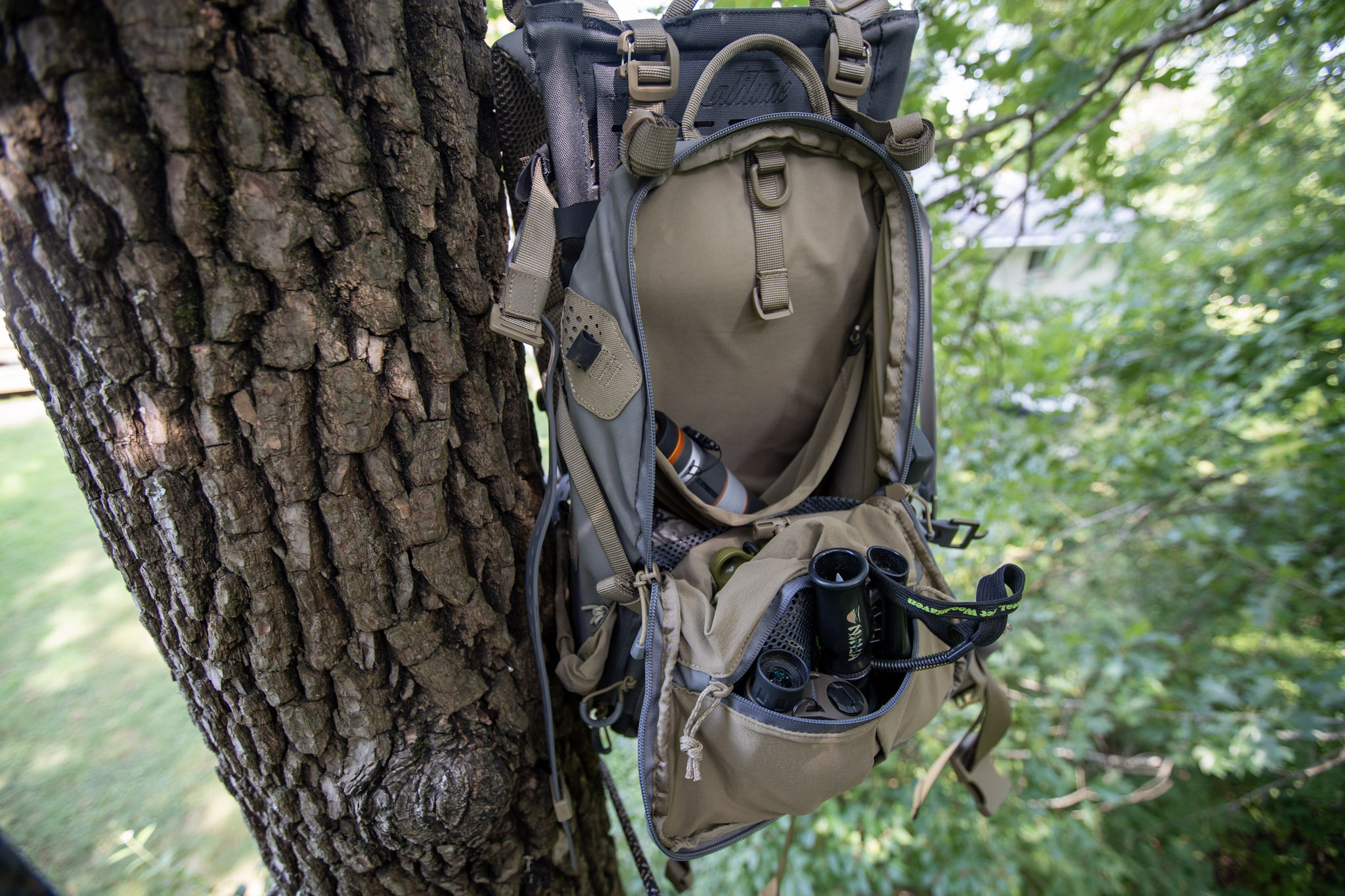
Now, onto the backpack pouch itself. There’s one main pouch that extends all the way down the sides of the pack, so you can access the sides and bottom without having to undo the entire thing.
Additionally, that allows the top to flip open when hanging in the tree stand, creating what Latitude calls a shelf. There’s one main zippered pocket there to keep things you need at a moment’s notice. I leave a grunt tube and a rangefinder there. Additionally, there’s a second open pouch behind that one to store snacks, gloves, or whatever else you may want quickly without having to dig around. It keeps me very organized in the tree.
On the interior, there’s also a large pouch (more on that later) that can be used for further interior organization. Oh, and that meat shelf flap? That just so happens to be a small pocket as well. I don’t foresee myself ever using it, but it’s a nice touch.
Lastly, on the exterior, there is an additional small zippered pocket at the top. Both the smaller top pocket and the main pocket have high-quality, water-resistant zippers. They’re smooth and obviously well-made. I have yet to get in a fight with a zipper on this pack.
MOLLE, Rubber Straps, and Silent Metal Clips

If that’s not enough pockets for you, you’re in luck. Dang near the entire pack is covered in MOLLE, including the waist belt, ready for you to add any of the ridiculous number of accessory pouches you want from Latitude. The sky is the limit.
I also like how any strap on this pack is designed to lash things to the exterior that has some sort of rubber built into it. The entire torque straps are rubber, but the other straps for lashing feature a “rubber belt” that metal clips hook onto.
Why is that good? Well, have you ever strapped something to your pack with cloth straps and had it shift around or fall out? The little bit of rubber on the Praxis’s straps stops that from happening.
The clips are awesome as well. There are no buckles, and the entire system is dead silent. There’s also no plastic, a touch I really love. I can’t tell you how many plastic pack fasteners and clips I’ve busted by stepping on them in the dark. These metal ones are indestructible.

Problems With the Latitude Praxis Backpack
I’ve been singing praises for Latitude on this pack, and here’s where I’m going to knock it down a rung or two. Very few things, if any, are perfect, and this pack is no exception (although it’s close).
A Small Rant on Pricing
First off, the price. $450 for what amounts to a day pack is asinine. That understandably makes it an automatic no-go for a lot of hunters.
Pricing is really starting to grind my gears. And I will admit, Latitude is kind of catching some strays here, but the price of this pack means it’s not totally misdirected.
I get it: if you want premium offerings, it’s going to cost you more. That’s fair. But every single damn thing in the hunting world costs $400 now, and I’m asking the industry: when will it stop? A jacket? Four bills. Bibs? Four bills. Climbing sticks? Fork it over, folks. Heck, socks are getting out of hand. So I’m just going to start calling brands out on what I think is approaching price-gouging status.
I think this pack at $375 would be a premium, albeit fair, price. But it’s $450. That’s a deal breaker for you, or it isn’t. I at least have to respect readers enough to acknowledge it and call it for what it is. Sorry, Latitude, just doin’ my job.
Hydration Bladder–Compatible… Sort Of
The only other true flaw is glaring, but solvable. Latitude says the giant pouch on the interior of the pack is for a hydration bladder. There’s even a little clip at the top to hang it from.
The issue? There’s no port to run the hose through to the exterior of the pack. That means I have to leave a gap in the zipper for the hose that will inevitably inch open into a gaping hole as I hike, and I’ll scatter the contents of my pack through the woods like a magical woodland fairy.
Fortunately, the two water bottle holders on the sides of the backpack are massive, can support the largest water bottles I own, and cinch down tight. With two massive water bottles on the exterior, I don’t need to use a hydration pack. So, despite failing to cross the finish line on the hydration bladder thing, water storage isn’t an issue with the Praxis.
Final Thoughts: Should You Buy the Latitude Praxis Pack?

After my old man rant on pricing, the question remains: Should you buy the Latitude Praxis?
To be honest, it’s not for everyone, strictly because of the price. At the end of the day, it’s a backpack. If you plan solely on hunting your grandpa’s farm or only heading out to a weekend deer camp during rifle opener, it’s probably not worth it. For casual hunters or those on a tight budget, any old backpack will do. Don’t get yourself into financial trouble for silly hunting gear.
But if you are the type of person who wants the best of the best, no matter the price, the answer is yes. Buy it without reservation.
Of all the backpacks I’ve tried, this is the most functional pack I’ve used for a wide variety of whitetail hunting scenarios. If you’re like me and spend every waking moment you can in the woods come fall, you’ll appreciate the versatility it offers. No matter where you hunt, how you hunt, or what you need to take in or out of the woods, the Latitude Praxis can handle it.