I’m someone who does a lot of backpacking and car camping, but I’ve always leaned more into sleeping pads designed for backpacking. I want my gear to be able to do both activities, and only a lightweight pad is coming with me to the backcountry.
This past summer, however, I broke from my usual approach and tried a pad made for car camping, and I now finally know what I’ve been missing. On multiple camping trips using the plush, supportive EXPED MegaMat Ultra ($250), I enjoyed some of the best nights’ sleep that I’ve ever had outside.
EXPED is well-known for its giant, thick sleeping pads, and the MegaMat delivers that comfort in a more compact package. You can have a luxurious pad without it taking up half your backseat.
In short: The EXPED MegaMat Ultra is soft and supportive, while also being easy to use and space-saving. If you’re looking for a middle ground between a backpacking pad and an air mattress, this pad is the ticket.
Looking for a new camping mattress? Check out how the EXPED MegaMat Ultra compares to the rest of the options out there in GearJunkie’s Best Camping Mattress buyer’s guide.
-

-

The EXPED MegaMat Ultra is an air-only version of the brand's super-comfortable camp pads for adventures further-afield; (photo/Elina Osborne)
-

(Photo/Mary Andino)
-

(Photo/Mary Andino)
-

(Photo/Elina Osborne)
-

The packed up pad is compact; (photo/Mary Andino)
-

(Photo/Elina Osborne)
-

(Photo/Elina Osborne)
Specifications
Pros & Cons
Pros
- Lightweight and compact
- Good value
- Integrated handles
- Pump sack is well-sized for inflation
Cons
- Not suitable for all seasons/conditions
- Thinner than the most luxurious camp pads
EXPED MegaMat Ultra: Review
I used this sleeping pad on two big camping trips this summer in Sequoia and Kings Canyon National Parks and a week of camping in the Black Forest in Germany on the Wolf Trail. I slept on uneven dirt and rock, and with nightly temperatures dipping into the 40s.
The MegaMat Ultra comes in three sizes, and to really see what a spacious pad was like, I tested the largest size, the LXW ($270). It measured 77.6 x 30.3 inches of sleeping area at a weight of 2 pounds, 11.5 ounces. The other sizes are as follows:
- MW: 72.0 x 25.6 inches sleeping area; 2 pounds, 4.5 ounces; $250
- LW: 77.6 x 25.6 inches sleeping area; 2 pounds, 5.5 ounces; $260

Design & Materials
Most inflatable sleeping pads these days are made out of polyester, and the MegaMat Ultra is no different. The outer layer uses polyester and TPU (a durable, flexible plastic), and the pad has 200 g/m³ Texpedloft microfiber (a lightweight, synthetic material) for insulation.
On its website, EXPED plugs the sustainable nature of this pad. The insulation is Bluesign-certified, and the polyester is recycled. It is also free from PFAS.
The pad has stripes for its baffles. “Vertical sidewalls allow the top to extend edge-to-edge without tapering, maximizing the available sleep surface,” EXPED explains. There are two valves (one for in, one for out), and they have small plastic coverings inside the valve.
What’s It Like to Sleep On?
One of my pet peeves about sleeping outside is that I often wake up in the middle of the night because my hips are so tight it hurts. I always suspected this had something to do with trying to fit myself on a narrow backpacking sleeping pad, and after sleeping on the MegaMat Ultra, I can confirm this is the case.
I am a combo side-stomach sleeper and often sleep with one of my legs up at a 90-degree angle at the knee. With the LXW size of this pad, I could sleep normally, starfish, and stretch out. I never woke up in the middle of the night with aching hips.
The LXW isn’t big enough to fit two people comfortably, but it was truly spacious for me as a 5’6″ person. I could fully extend my legs and not have my feet hang off the end of the mat. I could toss and turn in the night without falling off the pad.
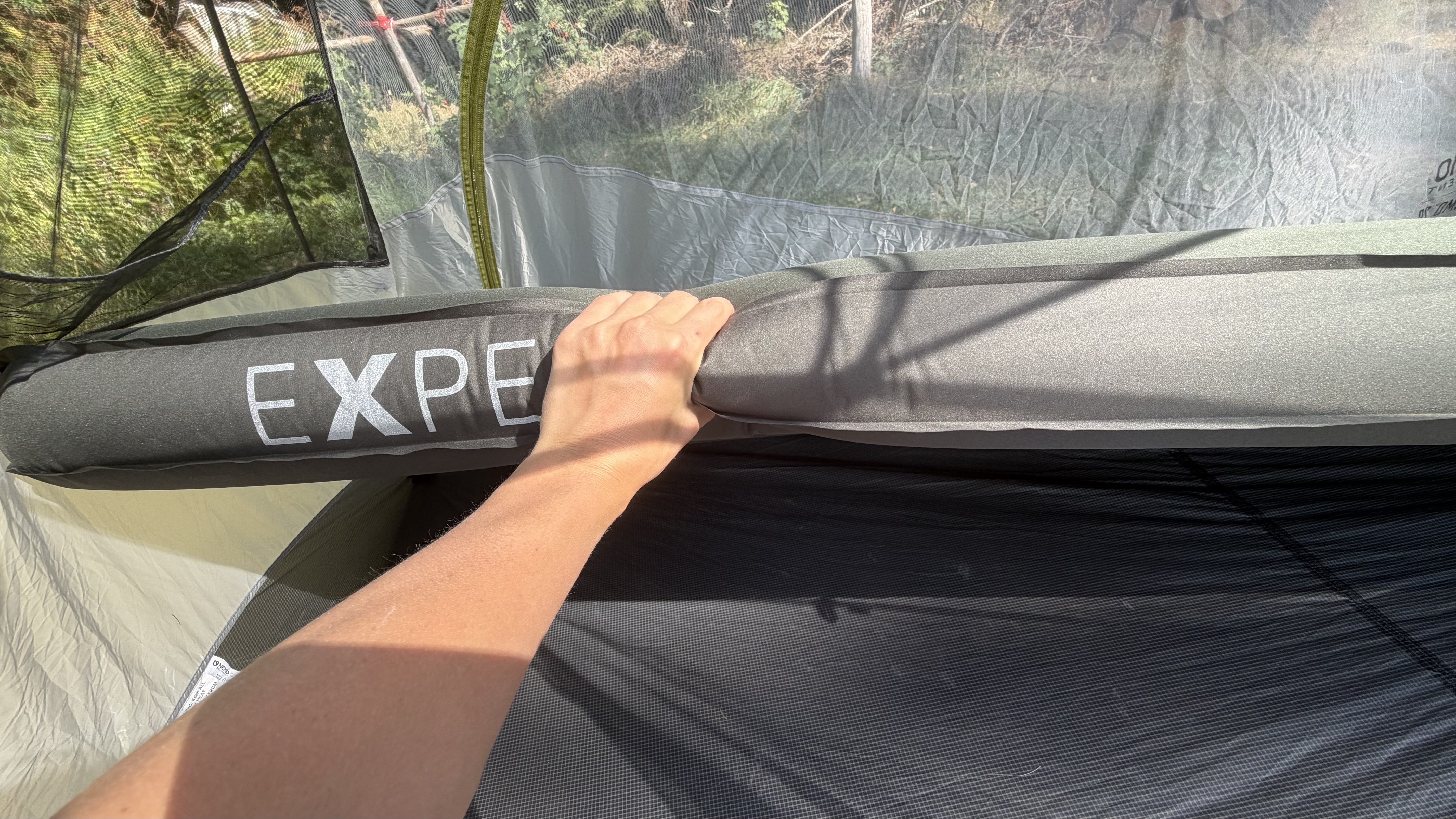
The Megmat Ultra had just the right level of firmness for me. At home, I sleep on a firm mattress with a thick memory foam topper, and this pad echoes that feeling. My body didn’t sink or collapse into the pad, but it also wasn’t as hard as a rock. I felt cradled and supported while sleeping on uneven rocky terrain.
The top of the pad is soft and doesn’t feel like plastic. I’ve tried some pads where my sweaty skin will stick to the plastic pad on hot nights, but this didn’t happen with this pad. I don’t use a pillow when I camp outside (I’m weird, I know), and I put my bare face on the pad, which was comfortable and not at all scratchy.

Inflating and Packing
For such a large pad, the MegaMat Ultra didn’t take long to inflate. I tried using both the provided stuff sack and a mini pump from EXPED, and neither took more than 3 minutes. For either method, however, to get the last little bit of the pad inflated, I did need to actually blow up the pad.

The separate in and out valves have a small plastic piece inside. When inflating the pad, this means that all the air doesn’t immediately rush out, which is handy. I wish they would’ve gotten rid of this on the out valve, however, since it makes it hard to push air out of the pad. To deflate and pack up the pad, I stuck my finger in the valve to open the plastic cover, and then sat on the pad to force air out.
Some pads require you to roll them up with a kind of military-level precision to get them to fit back in the provided stuff sack, but not the MegaMat. Once I deflated it, I folded it in three parts accordion-style and rolled it up, pushing out excess air as I went. It then fit with plenty of room back in the bag.
For such a large pad, it takes up very little space, comparable to a small bag of groceries. When I flew to Germany, I had to fit all of my backpacking stuff for a week in a carry-on suitcase and a small backpack. The packed-up pad only took up about a quarter of my 44L suitcase.

I used to go on climbing trips with a friend where we had to fit four bouldering pads, plus all our camping stuff and food in the hatchback of my RAV-4 (the back seat was reserved for my dogs). Space was so tight that I could never bring a big air mattress, but the MegaMat would have definitely fit. For how much surface area it delivers, it takes up remarkably little space, even less than my three-person tent.
Not for Every Season
Compared to our other favorite camping sleeping pads, the R-value of the MegaMat Ultra is on the low side. Most of our other top picks, like the Therm-a-Rest MondoKing 3D or EXPED’s own LuxeMat, have ones that exceed 7. With an R-value of just 4.4, the MegaMat is solidly only a three-season pad. To bring a pad winter camping, you’d want it to exceed 5.5.
A Note on Price
Depending on the size, the MegaMat Ultra runs $250-270. I think the value of the LXW size is a steal. For an extra $20, you’re getting nearly 6 additional inches of length and 5 inches of width to sleep on.
Compared to other single-person mattresses, this pad is a reasonable price. Our top picks from Therm-a-Rest, NEMO, and Sea to Summit range from $240 to $280.
Larger, two-person mattresses from brands like LUNO, HEST, and EXPED range from $350 to $630. As someone who does all of their camping solo, I appreciate having a quality, affordable option for just one person.

Could You Bring the MegaMat Ultra Backpacking?
One aspect of the MegaMat Ultra truly stands out. The MW size is only 2 pounds, 4.5 ounces, which is barely more than a pound heavier than many of our favorite backpacking sleeping pads. One could conceivably use this pad as their sleeping pad for backpacking trips; it’s not hard to find another area of your pack where you could shave off a bit of weight to accommodate the heavier MegaMat.
And imagine how good it would feel to sleep on. Even my go-to backpacking sleeping pad, the Therm-a-Rest NeoAir XLite NXT, doesn’t equate to a great night’s sleep. After a long, hard day on the trail, it would be such a mental boost to relax on a pad as comfy and large as the MegaMat Ultra. If I were planning a short weekend trip and hiking less than 10 miles, I would seriously consider taking the EXPED as my pad.
Conclusion: Who Is the EXPED MegaMat Ultra For?
There are plenty of luxurious car camping mattresses on the market, but they can easily cost over $400, making the affordability of the MegaMat Ultra a major point in its favor. It also won’t take up much room in your car, suitcase, or closet.
For outdoorsy folks who mainly car camp but occasionally dabble in backpacking, this pad is a solid buy. It is light and compact enough for casual backpackers to bring on a weekend trip.
For people like me who are three-season campers, the insulation of the MegaMat Ultra is plenty. If you live in cold climates or winter camp, you’ll want to choose a pad with a higher R-value.
Sleep is truly one of the make-or-break factors of a camping trip. Nothing ruins a vacation like a crappy night’s sleep, and you’ll be sure to have sweet dreams with this pad. In Germany, I was dealing with debilitating jet lag. I lay down on the EXPED MegaMat Ultra and immediately fell asleep for the next 9 hours. If that isn’t a winning commendation, I’m not sure what is.