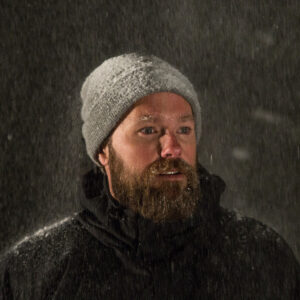
“So I’m a professional foiler,” said Edo Tanas, who is actually one of the best at his admittedly very new and niche sport: stand-up paddleboard downwind hydrofoiling. In fact, he won the last three world championships, so it’s probably safe to say he’s the best.
If you’re not sure how impressed to be, that’s understandable. Downwind SUP foiling is only about a decade old and not nearly as commonplace as stand-up paddleboarding, a distant relative. Downwind SUP foiling uses the paddle to get the board up to speed (like paddling a regular surfboard into a wave), and then physics takes over, allowing riders to reach speeds over 20 mph using the energy of the water and the wind.
It’s hard to explain, and videos of the seemingly physics-defying sport don’t help much. Tanas loves his sport and partnered with the creative team for one of his sponsors, the watersports footwear brand OluKai, to produce a new film, Crossings, that documents his three-day trip from one end of the Hawaiian Islands to the other on his foil.
270 miles in three segments over three days. Back-to-back-to-back. Imagine trying to do that on a regular SUP, and you start to grasp how different these sports really are.
That such a thing is even possible on an 8-foot carbon-fiber board with no motor seems ludicrous. It’s this capability that Tanas hopes the film will drive home to audiences and spread the good word about downwind foiling worldwide.
Crossings premieres Oct. 25 at the Hawaii International Film Festival and then goes live on YouTube on Dec. 30th, following a slate of other live screenings. The trailer for the film isn’t live yet, but you can get a taste for the sport via Tanas’ Instagram.
Edo Tanas Interview
I spoke to Tanas about his sport and the film from his home on Oahu. This interview has been lightly edited for clarity and length.

Justin Park: Let’s start with the basics since many people won’t know your sport. What is downwind foiling?
Edo Tanas: Foiling is really new. Before, I was just into wind sports, like wind surfing and surfing and stuff like that. There’s wing foiling, kite foiling, surf foiling, all kinds of different foiling.
But downwind foiling, I would say is the black belt of foiling. It’s definitely the hardest one to do, but it’s also the most fascinating because the foil itself is a very efficient way to capture the ocean’s energy. Just like planes travel through the air efficiently and go really fast and cover long distances. It’s like a underwater plane.
I would say it’s the latest and greatest of water sports. Downwind foiling basically means having the wind at your back and being in the middle of the ocean or a body of water where there’s a lot of wind and all those little ripples turn into waves that you can actually ride.
And by riding those, you can make your way downwind. And it’s not strictly straight line downwind. You can ride it down the line and kind of make your own path.
I love downwind foiling. I’m all for it.
And I won the last three world championships. So I’m kind of at the forefront of the sport and really wanted to showcase the sport with this film because most people don’t even know what it is.
They think it’s electric. They have no idea how crazy of a tool it can actually be.
Most people would think you would need a sail or like a battery to be able to go from one island to the other with a foil. But downwind foiling is literally surfing these waves for super long distances and traveling that way. And it started in Hawaii.

JP: Where did the idea for this film come from?
ET: I’m the three-time world champion. I’m living in Hawaii. I’m looking at the whole Hawaiian island chain and the trade winds just blow straight downwind from the top Big Island all the way to the bottom of the island chain in Kauai. So I’m looking at this and I’m like, I want to do some crazy challenge.
I really it’s all about the challenge with foiling, like even just going from one island to the other and connecting through a channel and foiling just without a sail, without anything. It feels like a really pure form of traveling and voyaging. And you’re having so much fun doing it because you’re just surfing it.
So I just wanted to showcase and push myself being at the forefront of the sport, what it’s capable of. And there’s definitely people around the world that have done long distances, kind of going down coastal runs, you know, just going down a really long beach.
But in Hawaii, it’s so cool because you can go from one island to the other and connect those all downwind. So I was looking at the Hawaiian island chain and thought that’s definitely something I want to do in my lifetime. And I’m young right now. But it’s definitely a really big challenge logistically to do it safely.
I met up with Matt Lindauer, the creative director at OluKai and told him about this project. When I told him about it, I was like, “Oh, I can do it for sure. Let’s just set up a date and go and film it and and and make a video of it.” But there was really no structure of what we were going to do. It’s not like it was planned. I think he had no idea what this was going to look like.
The most distance I’d ever done was 80 miles on a foil. This was 270 miles and two of those crossings were more than 100 miles. So I was shooting for the stars. But I thought that was the only way of getting someone on board for this project. And I obviously believed that it was possible.
We found boats to escort me through these channels. And there was honestly so much that had to line up because we had to plan ahead. The wind has to be in the right direction. The weather has to be good enough. There’s just so many things that could go wrong. But I just wanted to jump in.
JP: Describe what that environment is like for people that maybe have never even been offshore in a boat.
ET: You can really see the full force of the ocean in rough water conditions where the wind is just creating these huge swells that are breaking like mountains of water, and it just keeps surging and breaking over and over again. And even with a boat close to you, you see it and then it disappears and then you see it. It’s just really chaotic. It just seems super lively and powerful and you feel so small out there, not just because of the conditions throwing you around where you have no control, but also like the marine life that you see around you.
It’s really scary to be out there for sure. You’re just a little speck in this huge, vast blue ocean that’s going crazy with waves and surging and currents and wind. It’s just really uncomfortable.
But if you can embrace it, it’s one of the most beautiful things to see ever.
JP: And you’re just on, basically, a stand-up paddleboard that hovers above the water?
ET: It’s generally about an eight foot board. So just big enough.
The purpose of the board is for it to just be just big enough for you to float on it and be able to paddle it. And once you paddle it really quickly, and you get enough speed, the foil engages like an airplane underwater. And you start hovering about two to three feet over the water.
And once you start hovering, that’s when the efficiency really kicks in. And you can just be gliding and picking up little bits of energy in the ocean. So really, the purpose of the board is to float you and to get you flying.
There’s no real safety features. You’ve got to stay super light and you’re just standing on a flying surfboard holding a paddle and just like a water pack on your back. And you’re connecting distances that most people take planes for on a little surfboard.
JP: There’s a long history of crossings and interisland paddling in Hawaii, right?
ET: {Downwind foiling} is actually pretty big in Hawaii because it’s where it started and they call it the modern day voyaging. Polynesians and the Hawaiians would travel island to island with these canoes and essentially paddle downwind. And when they’re going downwind, they’re catching the swells with the canoe and pretty much steering and using the ocean’s energy to push them forward. You’re able to do the same thing and connect the islands, but at just much higher speeds.
I’m pretty sure on a canoe you could get up to like 10 miles an hour. Whereas on a foil it’s about 20 miles an hour on average. And that’s all just like catching the swells of the ocean.
No other propulsion. Just the efficiency of the foil doing something that the Polynesians have been doing for so many years in about a third of the time.
JP: What do you want people to come away from the film with?
ET: I look at old surf films, and to me, this is like the start of a new era. I think most people aren’t aware of the capabilities of foiling, and I just want to share it with the world.
The more people get eyes on it and they start wrapping their head around how it works, it’s going to keep growing as a sport from there on. We’re already super stoked on the initial selection at the Hawaiian International Film Festival.
The goal is just to show the capabilities of this new craft and for people to just see it for themselves.