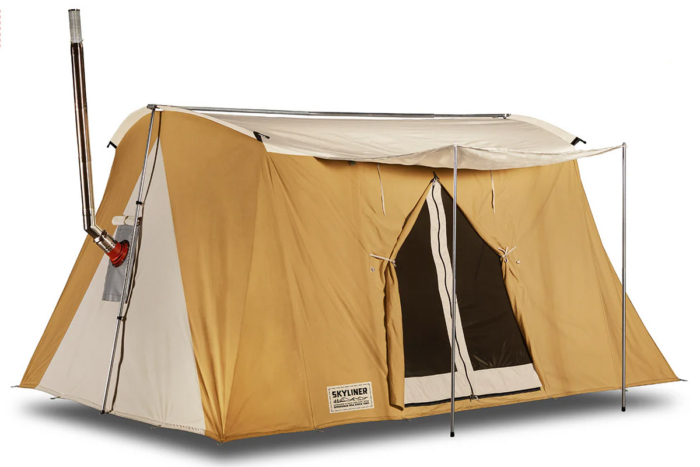
This was the first time I’ve ever felt like I needed more furniture in a tent. The cool vinyl floor of the Springbar Skyliner begged for folding chairs at one end, a large air mattress at the other, a rug and card table at the center, with a lounge area out front beneath the awning.
Between the breathable canvas walls and the wood stove, I was also as unworried about moisture as I’ve ever been in a tent — for now. When I pack this castle up tomorrow and store it away at home, that might be a different story.
Springbar has been quietly manufacturing some of the best canvas camping goods on the market since 1944. Their “If you know, you know” status wasn’t born from marketing. It’s decades of word of mouth among Boy Scouts, river guides, horse packers, hunters, dedicated car campers, and overlanders, built upon a rock-solid design.
The brand’s ethos: extremely well-made canvas goods, meant to be seriously used, repaired, and to last a lifetime.
Springbar’s massive Skyliner tent is a great example of what they do. It is the most comfortable backwoods basecamp I’ve ever had. However, the maximalist freestanding shelter has to compete against the growing popularity of quicker, simpler, similarly priced rooftop tents and lighter hot tents. I wanted to test how it stood up.
In short: The Springbar Skyliner ($2,349) offers 140 square feet of living space with standing height. It weighs 94 pounds, but sets up with one person and comfortably sleeps four to six. It includes a removable stove jack and window insert for versatility across seasons, environments, and conditions. As with most canvas hot tents, it’s heavy, durable, and well-ventilated. It might not be for everyone, but for those river runners, hunters, campers, glampers, and anyone who can afford it, it’s a luxurious basecamp.
Check out GearJunkie’s guide to the Best Camping Tents and the Best Backpacking Tents.
Specifications
Pros & Cons
Pros
- Excellent high-wind performance
- Reinforced stress points and stitching
- Breathable
- Impressive customizability
- Relatively compact for the internal volume
- Stays cool in the heat and retains warmth in the cold
Cons
- Expensive
- Flat roof makes it less snow load-resistant
- Massive footprint can complicate setup
- Takes a while to warm up
- Heavy
Springbar Skyliner Review

Back in 1944, Springbar was known as AAA Tent & Awning shop. Founded by Jack Kirkman Sr., the company made a name for itself on all manner of well-made canvas goods: tarps, awnings, blankets, and, of course, the occasional tent. As camping continued to grow in popularity, Jack started designing the first Rue Springbar tents, starting with the 10’ x 10’ Traveler that the company has been selling since 1961.
Springbar now has a plethora of tents; two are hot tents. It expanded its overseas budget line. However, 82 years, a father-to-son torch passing, and four shops later, most Springbars are still made right in Salt Lake City, where the brand began.
A Quick Detour to Springbar HQ

Generally, I try not to show up to meetings 2 hours late and needing help. Fortunately, the first fender cracking and falling on the wheels of my trailer while leaving a Bonneville Salt Flats photoshoot only put me an hour behind. The second fender falling off had me pulling up to Springbar HQ with a hot mess held together by ratchet straps.
A few miles out, I got a call from CEO Pace Measom: If I needed any help, no worries. They had a full fabrication shop. He’d be happy to help fix my disaster. Dignity and professionalism gone, I was forced to appreciate the warm, helpful attitude of the Springbar folks.
Walking through the door, visitors are greeted by a small museum of historical artifacts and sepia photos of Springbar camps past. There’s swag aplenty, too.

Beyond the front desk, teams of sewists ran specialized lap-felling sewing machines on the production floor. An inspector winched a fully assembled Skyliner to the ceiling and went over it with a fine-toothed comb. And several Springbars, sent in for repair after decades of use, sat in a room full of cubbies.
The production floor isn’t normally a public showcase. However, Springbar does maintain a garden out back, populated with nearly every model, Skyliner included. Any curious customers can see and test various models.
The people, the shop, the garden — it all felt like heritage, education, and personality, over marketing and fast consumption.
Skyliner Construction

You might have seen some Skyliner lookalikes. They started appearing when some of Springbar’s patents expired. But not all canvas tents are created with equal attention to detail, and not all canvas is the same.
The Skyliner, like all Springbar’s USA-made tents, features the gold standard in waterproof, breathable canvas for tents and awnings: Sunforger. It’s a pre-shrunk, mildew-resistant, 100% cotton duck canvas with a long-lasting, wax-based, water-resistant coating.
High-tension areas feature double or triple-needle–stitched lap-felled seams. It’s a highly durable, finished, and fully enclosed seam that resembles two hands in an S-grip, most commonly associated with the inseam of well-made jeans.

The floor is all heavy-duty 12-ounce vinyl. On its outer rim, canvas wraps a thick rope cord that distributes the tension of heavy steel-gauge stakeouts — better than more delicate grommets. The windows and doors are all lined with 40D military-grade no-see-um mesh, with solid panels that can be shut with massive YKK zippers or tied back.
At 14 feet long, the Skyliner has a three-section roof pole. Otherwise, it’s the same classic Springbar: The roof pole, through a ball-and-socket joint, pushes out against widthwise tension bars, tensioning a roof held aloft by vertical supports.
Setup & Breakdown

At 94 pounds (without the stove), this tent is heavy to lug around. Do not expect to take it anywhere you can’t drive, fly, or float to. And don’t try to set up camp too far from where you park.
The Skyliner’s biggest setup pain doesn’t have to do with its weight, though. It’s finding a stakeable 10 x 14-foot site. In Sedona, I buried half the stakes, only to pull and reset at the behest of buried boulders. In Bentonville, Ark., I had to work around tree roots at a campsite where, clearly, no one anticipated someone erecting a veritable cabin.
The actual process is straightforward. Stake it out with moderate tension. Insert the tension rods into the roof sleeves. Anchor them into the central crossbar. Push that third section of the cross pole in place. Slide the metal sleeve over the joint. Then elevate either side with the support poles and guy out the awnings as desired.

Elevating the tent takes a modicum of technique and strength. You need to brace the bottom of the support poles with your foot as you raise the roof, and lift the poles up as you extend them. With so many adjustment points — a crossbar whose tension can be adjusted with a screw, awning and support poles with a myriad of height settings, and simple rope-and-toggle tieouts — the Skyliner is just intuitive.
Ditto for the breakdown. (Just take a moment to walk trapped air out before you roll, and it stows unexpectedly seamlessly into its bag.)
Nearly daily setup and breakdown on a cross-country road trip did get old. However, the inconvenience came from setting up and breaking down a full hot-tent camp solo. It’s doable, but far more time-consuming that it would have been with one or two extra sets of hands. For group trips, base camps, and regular camping, this tent would be easy to pitch and pack.
Features Galore

Three massive windows with both mesh screens and zippable solid panels offer a wide range of ventilation and storm protection. For those going sans stove, the stove jack can be replaced with a panel that offers either ventilating mesh or a stormworthy solid panel.
The double doors also feature two layers. There are outer solid panels with dual top/bottom zips, and mesh doors with the same, plus bottom horizontal zips. Both have their own tiebacks and overlap the floor’s lip. They offer everything from a breezy open door to a draftless battened hatch.
Inside, a massive mesh skyloft has ample storage space in the warmest part of the tent. It’s particularly ideal for drying clothes with a wood stove. Two multi-configurable wall organizers offer additional storage, and a small pass-through hole provides a port for electrical cables.

Like all Springbar’s USA-made tents, the support poles are aluminum — lighter and more corrosion-resistant than steel. Included are four awning poles. Upright, they offer a taller (up to 7’) and more spacious entryway. Angled outwards, they shed wind and rain better.
However, the Skyliner has places for extra support poles. There is room for a third pole on each awning: one in the middle of the rear panel, and a space on either side of the front doors. This means that in stormy weather, one can set up the awnings with three poles, tie them back, and use the poles to buttress the front and rear panels, or a combination of the two.
The Skyliner, by itself, is a tank. It happily handles gale-force winds. The Skyliner’s large sides and flatter roof don’t shed wind, and particularly snow load, like Bell-style tents. Springbar notes on its website that Skyliner users need to manage snow loads to relieve stress on the frame.
Springbar’s heavy-duty waterproof polyester Stormfly levels up the already impressive stormworthiness and slopes the roof further. It also allows you to open windows in a storm.
The Straight Skyliner Experience

The Skyliner is more like a spacious canvas cottage than a standard tent. When camping solo, I felt small inside. I could fit my cooler within for a place to sit, set up a cot, and pile my bags or luggage in the corner.
If you aren’t solo, the Skyliner can house up to eight, but the sweet spot is two to six people. For that many, words like “tent” and “shelter” don’t do it justice. “Sanctuary” feels more apt.

The canvas breathes, but is highly water-resistant. I once let puddles form on the laid-out Skyliner. It held water for 2 days, with little noticeable soak-in, before I hung it out to dry.
Through Northwest Arkansas’ misty mornings, Sierra Nevada snow, and rainy days at high-elevation lakes, the Skyliner not only never soaked through, it never formed hoarfrost or condensation. With a little daylight, it dried quickly. Conversely, in the deserts of Utah and Arizona, the Skyliner stayed cool and ventilated far longer into the morning than synthetic tents I’ve used.
However, being canvas, the Skyliner does need to be thoroughly dried before storage, to avoid mildew. For those with a backyard and relatively sunny climates, this is as easy as laying it out in the yard for a few hours. For someone in an apartment in Seattle who primarily camps in temperate rainforests, this could be a genuine challenge.
Springbar offers in-house repairs if you manage to damage your tent. Just fill out a warranty repair form and ship your tent to the Salt Lake City HQ. If it’s a manufacturing defect, the brand will repair it free of charge. Otherwise, there might be fees involved.
The Hot Tent Experience

Springbar partners with one of the most trusted names in camping wood stoves: Winnerwell. The Skyliner is specifically meant to pair with Winnerwell’s large wood stoves, as well as their accessories, such as stovetop ovens and water tanks.
The hot tenting experience is meant to be seamless. So, I threw Springbar a curveball. I wanted to test Winnerwell’s Large Nomad External Air Stove and Secondary Combustion Burner. The stove is new and draws fresh air directly from outside, without drawing from inside air. The chamber burns off uncombusted wood gas to produce more and cleaner heat.

Combos of new gear tend to come with hiccups. This one would’ve too — if the Springbar folks hadn’t tested this combo themselves and recommended adding a short stovepipe section to make it all work seamlessly.
Being massive, the Skyliner can take a while to warm up. More than once, I found myself wishing I had a small fan I could hang from the lantern straps to better circulate the heat.
Fortunately, Winnerwell’s stoves are massive. They easily accept gas station bundle-length logs. Loaded up with compressed logs, I was able to get burn times of 4-5 hours before fuel got low. The thick canvas also loses heat far more slowly than synthetic designs.

I had no problem getting temps (in the middle of the tent) 40-50 degrees above outside — especially in low winds and with the secondary burner churning out extra heat. Throughout the night, with only one or two feedings, the stove kept the inside 10-20 degrees warmer. Likewise, the mesh lofts near the ceiling made drying out damp clothes incredibly easy.
Two small steel cables and a robust jack keep the stovepipe secure in high winds. The stoves themselves are extremely well-built, offering long burn times, high heat output, and plenty of customization options.
It’s all efficient and seamless, but I’d be remiss if I didn’t note two things. Firstly, hot tenting easily doubles the setup and breakdown time of a Springbar camp.
Secondly, the Skyliner’s breathability, especially with regard to carbon monoxide, also makes it safe to use with simpler, quicker, and cheaper (at least, initially) propane heaters. However, propane combustion also produces water. So, in the long run, a wood stove system is better for keeping gear dry.
Springbar Skyliner Canvas Hot Tent: Who It’s For

At $2,349, the Skyliner costs a pretty penny. Throw in a wood stove, and you’re easily creeping north of $3,000. There are cheaper canvas tents and comparably priced rooftop tents that are easier and more mobile. There are ultralight hot tents that can sleep four people and weigh less than the Springbar’s poles. It begs the question: Who is the Skyliner for?
Let’s start with who it isn’t for. I set up and broke down the Skyliner plenty, solo, along a 5,000-mile road trip. If you’re eating miles every day on solo trips, it’s a pain. The Skyliner may be simple, but it tempts you into the kind of maximalist camp that takes forever to build and break. Solo campers might benefit from a less cumbersome setup.
This hot tent is impressively waterproof. Even so, needing to thoroughly dry it for long-term storage is a tough sell for apartment-bound adventurers — especially those in wet areas.

However, the Skyliner packs down well for its considerable interior space — courtesy of less sloping sidewalls than most other canvas tents. Its build quality, attention to detail, and robustness are all next-level. It’s a luxury tank.
The Skyliner is portable enough to be good for group road, canoe, and raft trips where you’re moving every day — provided you can find large enough campsites. This tent would also shine for overlanders, hunters, anglers, photographers, and paddlers looking to set up shop for a few days at a time. It could be an amazing shelter (if a little overkill) for glampers.
As a base camp for hiking and photography in Sedona, fishing in the Uintas, paddling the Boundary Waters, or mountain biking around Northwest Arkansas, it would be a welcome sanctuary.

It’s also ideal for winter campers. The Skyliner is a fortress — but a breathable one. This makes the condensation of more budget-friendly propane heaters less of an issue. For those willing to go in on a wood stove, the Skyliner works seamlessly with the most bombproof and feature-rich stoves on the market.
The Skyliner’s footprint is cumbersome, but it was never meant to move fast. In all things, from the setup and breakdown to the myriad features, the Springbar is intuitive and designed for the actual work and joy of outdoor living.
It begs you to stay in place for a bit, to tend not just a stove but a hearth, and to call it not just a tent or campsite, but a sanctuary — a canvas cottage, at home in any wild, made by the sort of folks who’d help you fix a busted trailer just because.