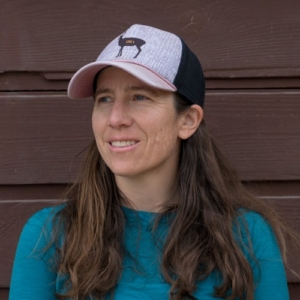
Megan Eckert wasn’t shy about her ambitions while heading to the 2026 EMU-GOMU 6-Day World Championships in Balatonfüred, Hungary, last week. She wanted to break both her own 6-day world record as well as the overall American record, held by Joe Fejes.
And that’s exactly what she did.
A week after that proclamation — and following 144 hours of racing around a 0.55-mile (0.89 km) loop — Eckert reached both of her goals. She ran an incredible 636 miles (1,024 km), setting a 6-day world record for the second time in her career. This broke her 2025 world record of 603 miles by 33 miles. It also broke Fejes’ 2015 American record of 606.2 miles by 30.2 miles.
To achieve this distance, Eckert maintained an average pace of 4.4 miles per hour (7.1 kph) for 6 days straight. That includes all her stops to sleep, eat, and handle logistics. What was perhaps so impressive about Eckert’s run — aside from the sheer distance of it — was her consistent pacing. While most runs of this duration slow significantly after about 108 hours, Eckert largely maintained her pace in the closing days and hours of her effort.
This was the 15th edition of this race, which served as the Global Organization of Multi-Day Ultramarathoners (GOMU) world championships. The event holds an International Association of Ultrarunners (IAU) Gold Label and has been the site of several past official world records. The loop is fully paved and flat.
As is usual for world records of this type, it is pending ratification by the IAU.
The original version of this article appeared on iRunFar.

A Pro at Multiday Races
Eckert has made a name for herself in the past few years in the multiday racing world.
In addition to her 6-day world record in 2025, Eckert set the women’s backyard ultra world record at the 2024 Big Dog’s Backyard Ultra. She ran an impressive 362 miles (583 km). In 2024, at her first try at 6-day racing, she ran 526 miles (846km) at the 2024 Six Days in the Dome and won the event outright.
This year, she placed third at the Cocodona 250 Mile and won the Vermont 100 Mile.
Eckert, a middle school special education and math teacher in Santa Fe, N.M., is known for her consistency and well-executed races. For this race, she was supported by her husband, Joe Eckert, and Mike Dobies, who is well known for his pacing insights. Dobies also crewed for Fejes during his 2015 record-setting run at the same venue, but on a different course.

Wasting No Time
In the scheme of 6-day racing, Eckert wasted no time getting ahead of her own world record pace after only 6 hours. She was ahead of Fejes’ overall American record pace with about 30 hours elapsed. Over the next 20 hours, she increased her lead on both records by significant margins.
With 72 hours on the clock, Eckert had run 342.14 miles. While the 72-hour world record isn’t recognized by the IAU, GOMU does recognize the mark, and Eckert just barely exceeded Camille Herron’s old record of 342.09 miles from 2024.
Less than a day later, with 90 hours elapsed, Eckert had covered 414 miles and was ahead of the overall American record by 29 miles. Three-quarters of the way through the race, at 108 hours, Eckert had covered 495 miles.

Maintaining Pace Until the End
In the final quarter of the race, Eckert remained consistent despite the daytime heat.
With 123 hours elapsed (and 21 hours to go), she’d run 550 miles (884 km) and increased her gap on both her old world record and the overall American record. Even after 5 days of running, observers reported that she was still moving strongly and smoothly. Her 2-hour sleeps, 15-minute naps, and otherwise minimal stops appeared to be enough to keep her moving forward and coherent.
In the closing hours of the event, Eckert blew past her old world record with 135 hours and 38 minutes elapsed — with still over 8 hours left to run. She then broke Fejes’ overall American record with 136 hours and 10 minutes on the clock. Then, Eckert became the first woman to run past the 1,000km mark (621 miles), which she did in 139 hours, 55 minutes, and 46 seconds. And she still had hours left to run.
In the end, when the clock struck 6 days and the race ended, Eckert had completed a little more than 1,140 laps of the course and 636.482 miles. She set a new women’s 6-day world record and a new overall American record, cementing her as one of the best multiday racers of all time.