As an avid backpacker, I really want to be someone who hikes in trail runners. Traditional boots are far too heavy, and brands promise trail runners will make you feel light and speedy. And yet, almost every time I’ve tried a pair, I end up with extreme foot pain.
And I’m not talking about blisters. I’m talking constant, nagging, aching pain across my arch, ball, and front foot. No matter what the model is, after a few days on trail, that same biting discomfort appears.
With a busy summer backpacking season planned, I wanted a pair of shoes that were breathable, nimble, and supportive. After 150 miles trekking over the last few months, it’s safe to say I’ve found that holy trinity with The North Face’s Offtrail Ultra Trail-Running Shoes ($190).
The North Face (TNF) worked with its athletes to design a shoe for rugged trail conditions, with a built-in sock-like gaiter that keeps out dirt and debris. The Surface CTRL outsole promises superior grip at a low weight.
In short: The Offtrail Ultra Trail-Running Shoes have a learning curve when it comes to lacing, but ultimately provide excellent support and cushion, and the gaiter is the pièce de résistance. All in all, it’s a fantastic shoe for long miles — if you can stomach the price.
See how the TNF Offtrail Ultra Trail-Running Shoes lined up in our buyer’s guide for the Best Trail Running Shoes for Women.
Specifications
Pros & Cons
Pros
- Lightweight
- Good cushioning
Cons
- Expensive
- Gaiter will break down
Testing
I wore these shoes on two major outdoor trips this summer. I hiked and backpacked about 90 miles in Yosemite, Sequoia, and Kings Canyon national parks in July, and then backpacked 60 miles through Germany’s Black Forest in August.
I wore them in temperatures above 90 degrees, and carried packs ranging from 10 to 30 pounds. I backpacked in these shoes across loose talus and rock in descents as great as 1,000 feet in Yosemite, and on days as long as 17 miles in Germany.

I typically wear a 9.5/size 41 in women’s shoes, and tried both a 9.5 and 10 in the Offtrails. I preferred the 10 for the extra toe room. I have a narrow foot, so I typically avoid the wide toe box–style shoes from brands like Altra. In women’s, the Offtrails are available in sizes ranging from 6 to 11, and from 8 to 13 in the men’s.
Design & Materials
There are several key components to the shoe. First, there’s the outsole, which TNF says includes its signature “SURFACE CTRL” design — basically a unique lug pattern and a “THINWEB technology” for improved grip and reduced weight.
Next, there’s the dual-density DREAMBOUND nitrogen superfoam midsoles. This pairs a firmer outer bottom layer for durability with a softer inner layer for comfort and rebound.

The body of the shoe includes sections of TPU (a kind of flexible plastic) for greater durability. On the rear quarter of the shoe, there is hydrophobic (or water-resistant) ripstop fabric. Finally, the built-in gaiter is made from a stretchy nylon and extends to slightly above the ankle.
A pair of the shoes weighs 1 pound (8 ounces per shoe). That is around 1–2 ounces lighter than the rest of our best-reviewed trail running shoes, including the HOKA Speedgoat 7, Scarpa Ribelle Run 2, and TNF’s own Altamesa 500 V2. Most people aren’t going to really notice an ounce here or there, but if you are prioritizing a shoe that won’t weigh you down, this is a stat worth noting.
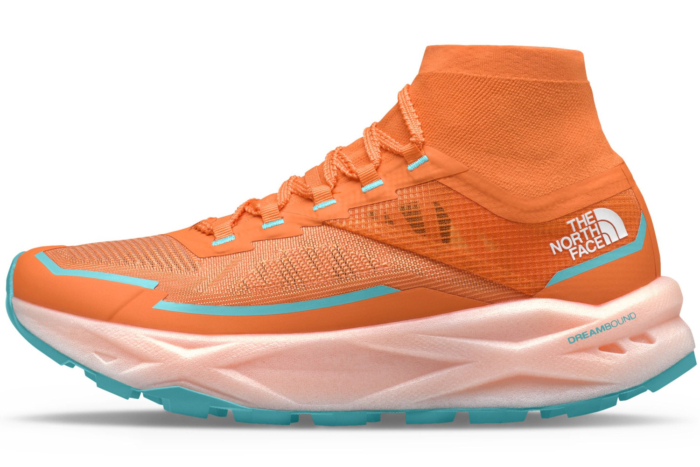
In the women’s version, they come in two color options: a pink/purple combo (which I tested) and an orange/light blue combo. This is purely cosmetic, but I didn’t love either of the options. The orange is almost obnoxiously loud, and I don’t love pink. (Why does all women’s outdoor gear need to be pink?) The black/white combo that the men’s comes in is much more my speed.
Comfort
There was a learning curve in tying these shoes correctly. If I laced them tight (my usual M.O.), I’d get pain on the front of my foot where the laces rested. If I made them too loose, I obviously felt insecure on downhills. Eventually, after trial and error, I came up with a method that worked well: tighter at the base where the laces started, and then looser up where I tied the knot.
The mileage I put on these included a decent amount of road walking, the kind of terrain most likely to lead to sore and tired feet. Even with a good chunk of time on the road, I was surprised that my feet felt pretty fresh at the end of 10-mile–plus days. I’ve tested shoes, like Scarpa’s Golden Gate LT, where I felt ready to chop my foot off at the end of the day because the ball of my foot was in so much pain. The nitrogen superfoam provided enough cushion and support to allow me to hit 60 miles in just 4 days.
I only got two blisters in these shoes over the course of 150 miles, which is not bad. One was a small one on my middle toe, and the other was a playing card-sized one on my left heel. I thought my foot just hurt from the shoes; I reached down to scratch an itch on my heel, and accidentally popped the blister. The blisters could’ve been due to a few reasons: I was hiking in 90-degree temps, I was trying out new socks, and I could’ve laced the shoes too loosely.
Traction & Performance
On a 32-mile backpacking trip in Yosemite, I traversed some seriously precarious descents down steep sections of loose rock and stones. With the help of my trekking poles, I felt quite stable on this insecure footing.
While I use trail runners more for hiking than actual running, I did jog with my pack in 10- to 20-minute chunks on trail. I felt bouncy and spry in the shoes, and the dual-density did a good job of absorbing the impact. My knees didn’t feel sore or twinge after.
With miles and miles logged in these shoes, I can happily report that the built-in gaiter really performs. I never got any kind of noticeable rock or dirt in the shoe. When I took my socks off at the end of the day, there would be a small amount of fine dirt dust on my skin, but that was it.
If you’re the kind of person who is constantly stopping to dig rocks or twigs out of your trail runners, this is the shoe for you. Of course, plenty of brands sell gaiters you can attach to your shoes, but the ones on the Offtrail are more secure and foolproof than those will ever be. There is literally no space for any material to get in.

The top of the gaiter has an elastic that is snug without being overly tight. I was concerned that the gaiter on top of my Smartwool socks would be too constricting or warm, but the gaiter is thin enough that that wasn’t an issue. It is a flexible, lightweight fabric that really moves with you.
The laces were not classic shoe laces. Rather, they had a corrugated, textured design, which I think helped them stay tied. On all of my travels, the shoes never became untied.

The shoes aren’t waterproof, but are very well-vented and dry rather quickly. I accidentally stepped into a stream, got my feet decently wet, and the shoes were relatively dry within 2 hours. During light rainstorms that lasted 10 to 20 minutes, my socks stayed dry.
Durability
After 150 miles, the shoes are only showing mild signs of wear. There is slight degradation of the foam where it meets the outsole, but nothing super-serious. There is almost a hole on the gaiter, but I think that is more due to how I hike.
For some reason, I walk pigeon-toed and frequently accidentally kick myself in the ankle. Normally, that translates to getting mud and dirt on my sock or lower calf; the gaiter of the Offtrail Ultras unfortunately took the brunt of my inability to walk normally. I think the gaiter will last about another 100 miles before it gets an actual hole in it.

Note on Price
The Offtrail Ultras cost $190, and that is on the higher end of the scale. Many popular trail runners from big-name brands like HOKA, Altra, and Topo Designs fall somewhere in the $150-170 range. Only high-performance racing models of trail runners — like HOKA’s Tecton X 3 or Scarpa’s Alien SKY LE — cost more than $200.
If you factor in the expense of buying gaiters, which cost $25-50, the price of the Offtrail Ultras seems reasonable. For $190, you’re getting a shoe with a gaiter that’s guaranteed to keep out dirt, rocks, and debris, without any fuss.
Conclusion: Who’s the Offtrail Ultra For?
Testing the Offtrail Ultras reminded me of a backpacking trip a few years ago in Joshua Tree National Park. In this rocky desert terrain, I had to stop every few miles to dump out tiny rocks from my shoes. If I were to do that trip again, I’d absolutely bring the Offtrail Ultras. For folks who do a lot of outdoor activity in terrain with gravel or scree, these shoes would be an excellent choice.
I’m someone who is more likely to use trail runners for long-distance hiking than for an actual trail run. I can’t say how these shoes will fare hurtling full speed down a mountain. However, I can say these shoes excel over the course of many miles on long days with a heavy pack.
If you do a lot of road walking or are prone to foot pain, the support of the Offtrail Ultras will serve you well. I’m thinking about doing a section of New Zealand’s thru-hike — the Te Araroa— which is infamous for a lot of road walking. If that trip comes to fruition, I’ll wear these trail runners.
The North Face’s Offtrail Ultras are comfortable, durable, and breathable. They’re not the cheapest or most high-performance–oriented shoes on the market, but they deliver in every category that counts.