After two straight days of driving, I found myself on a ridge top in the Western U.S. at sunrise, glassing a herd of elk with my brother. I was tired; my back, already aching from being in the truck for so long, was heavy with the Kings Camo XKG Summit 5200 backpack, and the morning had been, well, fairly uneventful. Bugling was minimal, and all the elk we saw were miles away on private land. They might as well be on the moon.
Within 3 hours of hunting, I resigned myself to the harsh reality that I would likely have to spend multiple weeks in the mountains to fill my tag. But boy, it didn’t take long for that to change. Quite literally, 2 seconds after that thought crossed my mind, a bugle pierced through the morning air, well within striking distance.
My brother and I popped up, made a game plan, and got scootin’. The bull, which we eventually spotted three-quarters of a mile away, was more than happy to play our calling game. Each bugle he ripped cut the distance to us in half. Before I knew it, he was screaming in my face at 31 yards.
It was the last thing he did. Time to put my new backpack to work, tired back and all.
In short: At a reasonable price of $550, the Kings Camo XKG Summit 5200 is a capable big-game hunting backpack. The meat shelf and solid support system make packing out the soul-crushing weight of an elk as painless as the task can be. It also has a streamlined, simple design that works for day hunts or multi-night excursions. It’s not perfect, or the best you can find, but it gives western hunters everything they need at a fair price.
Kings Camo XKG Summit 5200 Backpack Review
-

-
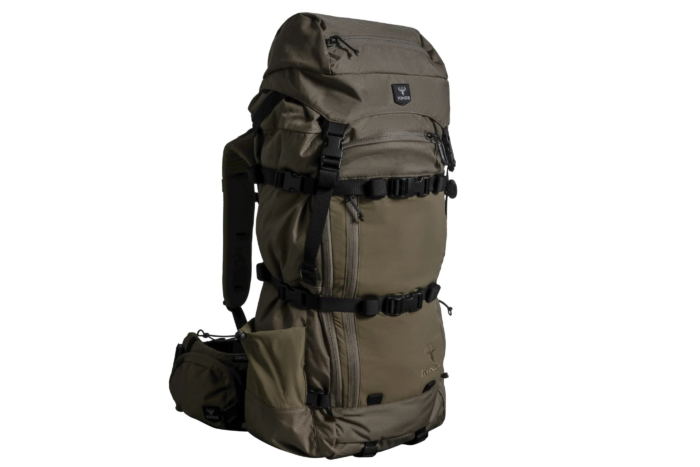
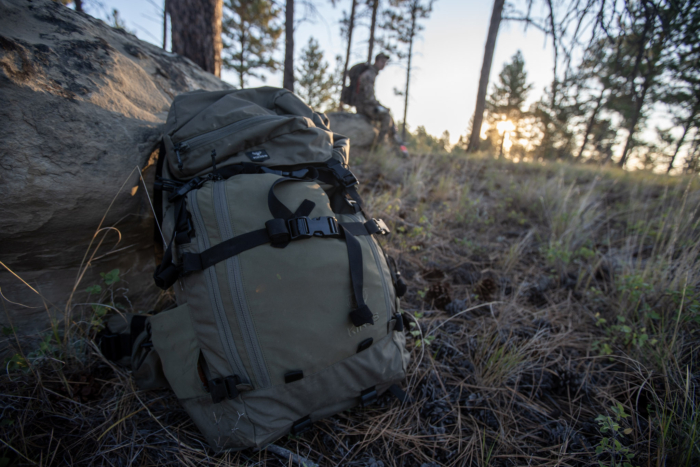
The Summit 5200 is streamlined; (photo/Morgan Nowels)
-
-
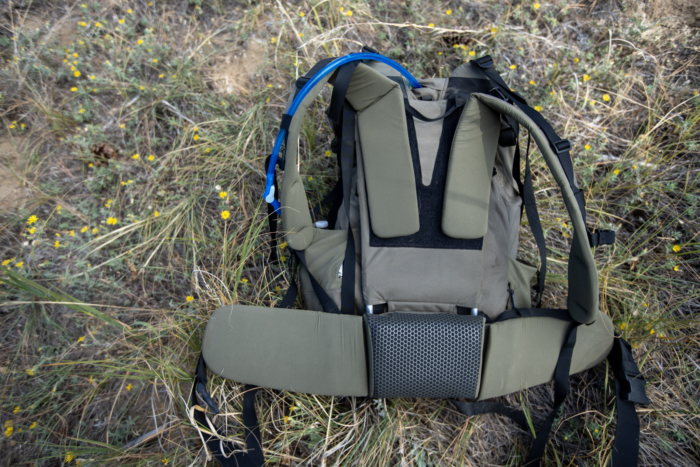
The velcro adjustment system can creak and make noise; (photo/Morgan Nowels)
-
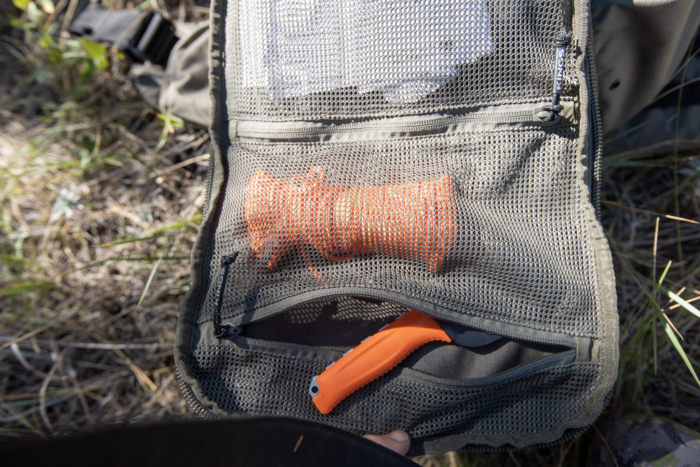
The zippered pockets on the front flap are a great place to keep essential items like tags, knives, and other odds and ends; (photo/Morgan Nowels)
-
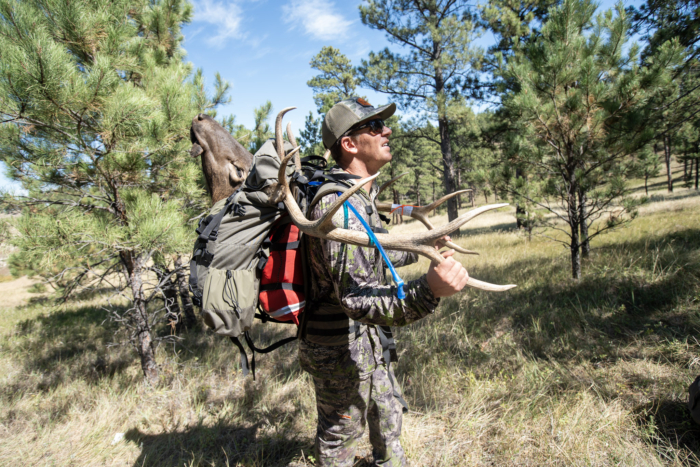
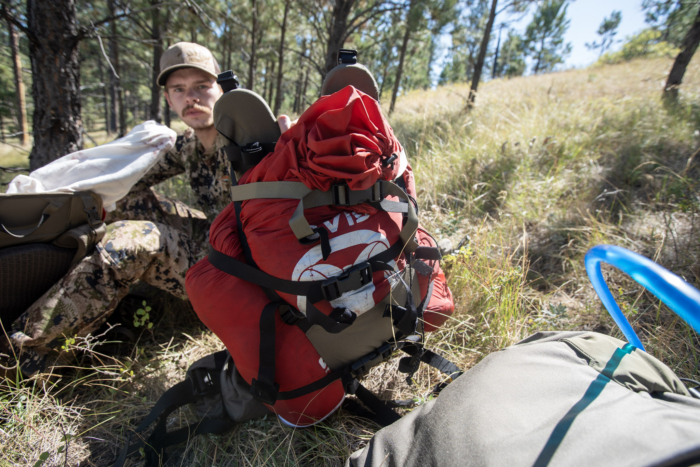
The meat shelf, while not the easiest to set up, keeps things cinched tight; (photo/Morgan Nowels)
Specifications
Pros & Cons
Pros
- Streamlined design
- Excellent capacity for multiday hunts or use as a daypack
- Comfortable under heavy loads
- Easy organization and access
- External hydration bladder storage
Cons
- Velcro on shoulder straps adjustment can be noisy
- Bottom portion of meat shelf could be improved
This Story Starts at the End: Hauling Meat With the XKG Summit 5200

You may be asking: if you only hunted for 3 hours with this backpack, how on earth could you write a legitimate review of it? That would be a fair question.
Before embarking on a cross-country hunt, I informed my wife that in the event I harvested an elk in the first 3 days, I would stay out with my brother and help fill his tag. Since I filled my tag on the first day, that’s exactly what I did. I spent a total of 10 days packing the Summit 5200 around the mountains.
But since my hunt began with packing meat, that’s where this review is going to start.
Frame and Pack Separation

After breaking down the bull, it was time to load it up and get packing. We did the pack-out in two trips, which allowed me to use the meat shelf in two different configurations.
To access the pack frame, you only need to undo a couple of straps, and the entire bag folds out to separate from the frame. Store meat there, fold the bag back up, and restrap it to the frame. As a side note, you can also remove the 5200 bag entirely and replace it with the 2700 bag for a smaller pack for shorter trips.
I found the meat shelf easier and quicker to get to than other packs I’ve used. All you have to do is undo the load lifter straps and the side straps, and pull two straps from the bag off the frame. It takes 30 seconds.
Strapping Meat to the Kings XKG Summit 5200

You can pack meat in this backpack in a few ways, which take a bit of explaining. You can use the frame by itself, or haul it with the bag attached. If you use the frame alone, a small flap runs halfway down it. Hunters can detach that and use it as the bottom “shelf” to support the load, and cinch it tight to the frame with the cross straps.
If you use the frame and bag together, you can store meat the same way and simply fold the bag back over the frame. Unfortunately, that configuration doesn’t quite work with a huge elk quarter. In that configuration, the quarter sticks out too far on the top, since the flap on the frame runs only halfway down. It makes it nearly impossible to reattach the bag to the frame.
Fortunately, a third way to carry meat solves that problem. Two straps run along the bottom of the bag and attach to the frame. You can loosen those and rest an elk quarter on them, and then tighten them to form a meat shelf of sorts.
Which Configuration Is Best? It Depends
In the field, using the straps on the bottom of the pack as a shelf proved necessary, but most difficult. It definitely took me longer to set up correctly. If you don’t retighten the straps on the bottom of the pack as tightly as possible, the meat can slip through. That sucks.
That happened to me on try number one. I had to drop the pack and start over, making sure I cinched everything down tighter than I thought possible. It worked, but you’ll need to take your time making sure everything is set up perfectly. I wish there were a secondary fold-out shelf at the bottom, too, to solve that problem.
On trip two, I carried the backstraps and spare meat in a game bag, along with the head and hide. Since I didn’t have a giant leg sticking out of the top, I was able to use the fold-out shelf halfway up the frame. It was fantastic, and definitely the easiest way to set up.
Overall, thanks to the abundant cross straps that stay hidden and out of the way while not in use, the meat stays tight and secure to your back. When cinched down properly, I found no slippage with heavy loads, and the weight stays centered and remains seamlessly supported by the 5200’s support system.
Support and Adjustability Make for a Comfortable Carry

This hunting backpack has a huge range of adjustability. You can choose from two frame sizes, regular for hunters 5’10” and shorter, and large for hunters 5’11” and up.
Each size offers 5.5 inches of torso adjustability via the shoulder straps. The hip belt adjusts 7 inches, not including the adjustability of the waist strap buckle itself. Before the hunt, that allowed me to custom-fit and fine-tune the suspension system to my own body. The pack will fit most, if not all, hunters.
In terms of support while packing out my elk, I loved the extra-padded, rubber-coated lumbar support. It is much thicker than the lumbar supports on other hunting backpacks, and it made a noticeable difference to me on the pack-out. Overall, my back held up fairly well. The rubberized grip kept the Summit 5700 pinned to my back, and the pack didn’t shift around my body at all while side-hilling or working my way up hills.
The shoulder straps and the hip straps have just the right amount of padding. It’s enough to keep the load comfortable without being overly bulky. It felt like the padding contoured to my body, rather than just resting on it.
Additional Features of the XKG Summit 5200
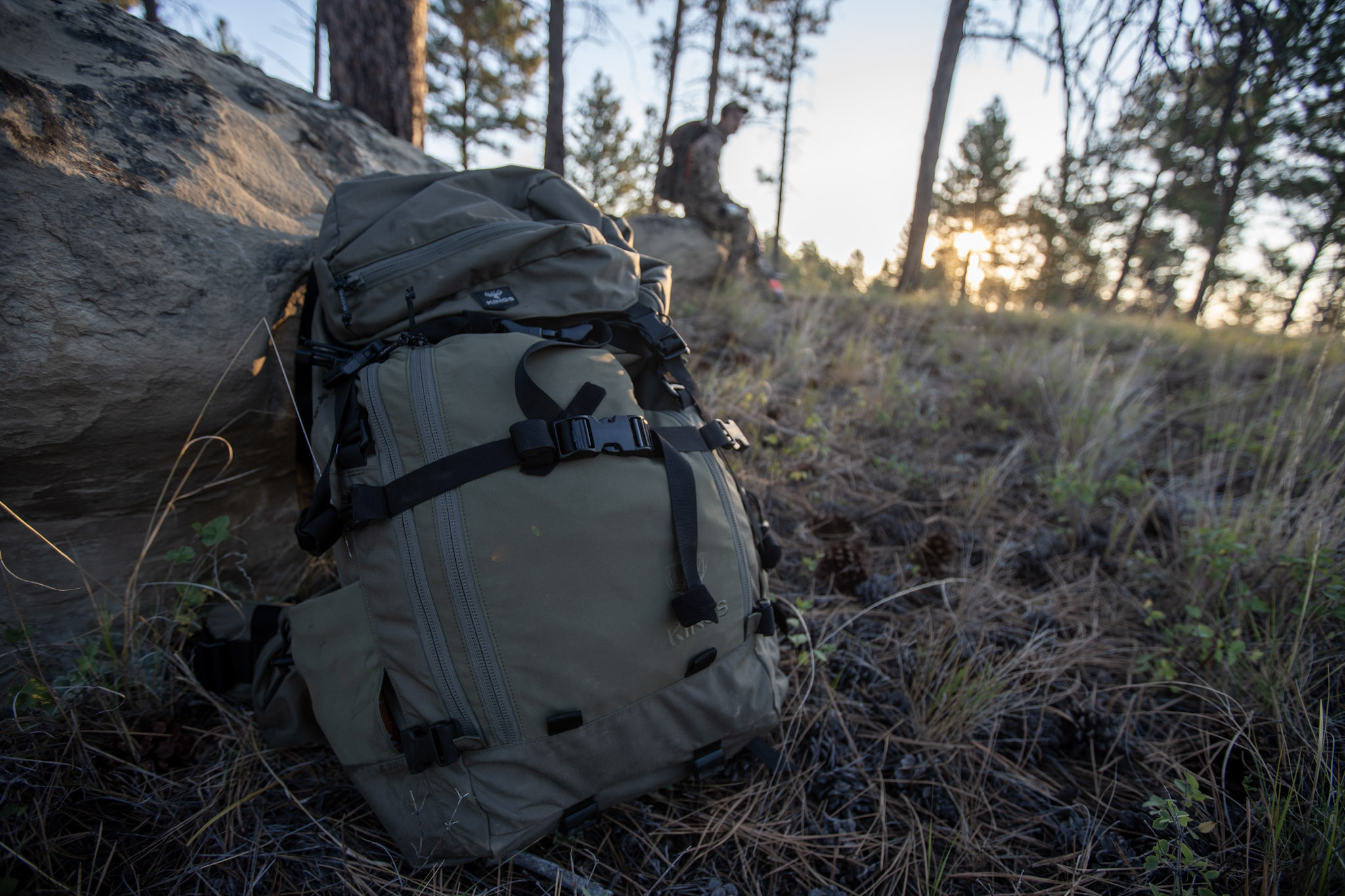
Aside from packing heavy loads, my favorite thing about this pack is how streamlined it is. In my opinion, most hunting packs with integrated meat shelves and frames end up as a chaotic wad of straps and buckles. I refer to that as “strap noise,” not in reference to an audible sound, but general messiness.
Nothing annoys me more than trying to sort through and mess with piles of buckles on the side of a mountain to get something out of my bag. It’s especially annoying after the hard work of quartering out an elk and trying to get it onto my pack.
The straps for the Summit 5200 meat shelf disappear when you’re not using them. The pouch has just enough straps to attach tripods, a tent, or whatever else you want on the exterior without going overboard. It’s a clean, simple rig.
Organization of the Kings Camo XKG Summit 5200

The Kings Camo Summit XKG 5200 has no internal dividers in the main pouch, which I really appreciate. Again, it’s streamlined without a bunch of noise on the interior. The main pouch is for bulk storage. It’s simple, and you can load it with enough equipment for a week-long hunt if necessary.
That said, there are still pockets to keep smaller items separate. Two zippered pockets line the interior of the front flap of the pack. It’s a perfect spot to store a kill kit, knife, tags, car keys, a wallet, and any other small things that would be crushing to lose in the mountains.
The 300–cubic-inch lid also helps organize smaller items. It’s removable as well. I removed it during a few day hunts to keep overall bulk down, but appreciated having it when hauling extra gear.

But one of my favorite pockets on the 5200 is the hip pouch. It is included with the backpack (something that annoyingly isn’t the case with every brand) and attaches to MOLLE webbing on the hip belt. I love it because it is the largest hip belt I’ve ever seen on a backpack. It’s not some tiny thing that you can cram a single protein bar into. I stuffed an entire sandwich in it. Sure, it didn’t come out pretty, but dang, a functional hip pocket makes me smile.
The backpack includes only one waist pouch. The other side of the waist belt is bare MOLLE, presumably so hunters can attach bear protection there. However, Kings offers a second waist pouch for purchase if you want to double up.
Other Nifty Things

Throughout the day, I found the interior of the pack to be extremely easy to access. The entire front of the Kings Camo XKG Summit 5200 zips open. You can crack open a side to stuff a layer in or pull it out, or open the whole thing to reorganize the backpack if needed. Every square inch of the interior is accessible without opening the top.
I also really appreciate how Kings designed the hydration bladder pocket. It is not a flap located inside the main pouch, leaving all of your gear potentially exposed to water if a leak happens. It is completely sealed off from the main pouch. No, the separator isn’t waterproof, but I appreciate the separation. That particular pouch also has a drain hole at the bottom and can double as a great place to store wet gear away from your dry gear.
If hydration bladders aren’t your thing, the side water bottle pouches are massive. They can hold giant water bottles and cinch down tight.
Kings also includes a waterproof cover for the backpack and a sling that attaches to the front of the pack to support a rifle stock or a bow cam. I strapped my bow to it on a particularly nasty hike, and it held it very securely.
Only One Significant Complaint

I really enjoyed using this pack on my elk hunt this year. But it isn’t perfect, and there is one thing I would love to see changed on it: the torso adjustment system.
To adjust the torso length, you pull the shoulder straps off a chunk of Velcro and reattach them where they fit you. The Velcro is a problem.
At first, I was nervous that it wouldn’t hold up under extremely heavy loads. I can say, without a shadow of a doubt, that it absolutely will not come free from the back under load. That’s because the Velcro is extremely strong, and there are two metal clips on the shoulder straps that you attach to a hook-and-loop system built into the Velcro to act as a “safety net” of sorts. The shoulder straps didn’t come off the pack, even when I carted over 100 pounds in the bag.
However, I have found that as I shift around in the mountains, tiny Velcro fibers from the system shift and make noise. It’s not loud by any means; in fact, it’s more of a slight creak. But it is an unnatural noise, which is bad. It doesn’t make noise constantly while hiking, but it’s apparent when you put the pack on and take it off. A different adjustment system would perfect this pack.
Final Thoughts: Is the XKG Summit 5200 the Big Game Hunting Backpack I’d Buy?

Looking back on my time in the field with the Kings Camo XKG Summit 5200, I’ve come to the conclusion that, while imperfect, I would recommend this pack. Yes, the Velcro is a slight annoyance, and yes, a slight tweak to the meat shelf would make it perfect.
Sure, if money were no object, I would probably look in another, more expensive direction to get a truly perfect pack. Unfortunately, though, those options will cost you more than $700. This pack has a very reasonable price of $550, which is a bargain given the current market.
And the reality is that there’s a lot to like about this pack. It is more than capable of comfortably carrying extremely heavy loads through the hills. That is the most important part of a big game hunting backpack.
I also really appreciate the size. I would feel comfortable relying on this pack to carry enough gear for a week-long backcountry hunt. However, it’s not giant like a multi-week expedition-style pack, and it compacts down into a small enough size for functional daypack use.
It keeps things organized, and the 500D CORDURA construction, while a touch heavy, can take an absolute beating. After a week of beating it up, my pack looks no worse for wear. When I draw my next Western hunting tag, I’ll be loading it up for another road trip, because I know I can rely on it.