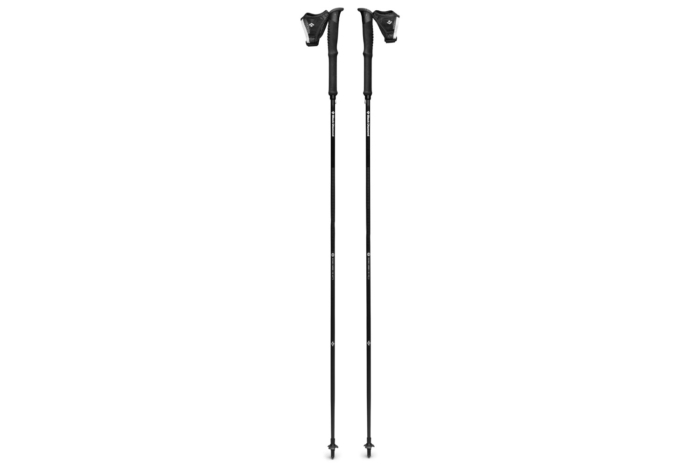
I’ve been using the same Black Diamond trekking poles for 10 years. I would estimate that I’ve easily covered over 1,000 miles with the Distance Z Poles. Given my history with these poles, it would take a lot for me to change my allegiance. After using the brand’s Distance Carbon Z FKT Poles ($280) for the last few months, it’s safe to say I’ve got a new favorite pair of poles.

These poles have a removable, magnet-based wrist strap that is unlike any other model, and they’re among the lightest poles on the market. Black Diamond markets the FKT as the poles for high-performing trail runners and racers who need to deploy and stow their poles in a flash. I won’t be competing in the UTMB or Western States any time soon, but I still found a lot to love about these poles.
In short: The Distance Carbon Z FKT poles deliver on weight savings and performance. The wrist strap takes some getting used to, but ultimately makes for a more ergonomic and comfortable user experience.
Specifications
Pros & Cons
Pros
- Comfortable
- Lightweight
Cons
- Expensive
- Hard to use hands when attached
Testing
I tested these poles on two major backpacking trips in Yosemite National Park and Germany’s Black Forest over the summer, hiking with them for a total of approximately 150 miles. I used them on a variety of terrain, including loose talus and slate, river crossings, and muddy dirt paths.
In Yosemite, I hiked with these poles on the 32-mile High Sierra Camp Loop, which involved many steep ascents and descents of 1,000 feet at a time on uneven granite. On backpacking trips, I typically hike at a snail’s pace, but since these poles are made for speed, I did jog parts of the trail with them, in 10- to 20-minute chunks.
Design & Materials
The Poles
Most trekking poles are either made out of carbon or aluminum. The FKT’s shafts are made from carbon, which has the advantage of being much lighter. It also excels at absorbing impact. Some people online report that aluminum is sturdier and that they’ve easily broken carbon poles in the past. Maybe I just don’t go on extreme enough trails, but I’ve never broken a carbon pole.
The poles are non-adjustable and are available in six lengths ranging from 105 cm to 130 cm. I am 5’6″ and used the 110cm length, and that was the perfect fit. When it comes to sizing, “on flat ground, the top of the trekking pole handle should be at waist or hip level and your elbow at 90 degrees,” according to Black Diamond.

Whether or not you choose an adjustable or non-adjustable pole is all about personal preference. Some people choose adjustable ones so they can adapt the poles’ height to better suit big uphills or downhills.
I always choose non-adjustable poles. I know myself well enough to know that I am too lazy and apathetic to ever stop my hike to adjust the length of my poles. I also worry about the durability of adjustable poles. When you have more components and parts, there are more opportunities for things to break, or dirt and sand to get into levers and locks, causing them to fail. Non-adjustable poles are also almost always lighter.
The Strap
The glove is the most innovative and unusual part of these poles’ design. Most trekking poles have some kind of looped strap. You stick your hand through the loop and then grasp the pole.
The FKTS, however, have something that resembles a fingerless driving glove. You stick your thumb in the hole, close the glove over your hand, and Velcro the strap. There’s a small magnet threaded to the glove; you match that up with the magnet in the pole, and then pull down until it clicks into place.
From there, your hand is somewhat locked to the pole. To release it, you push down on the front of the pole until you’ve freed the magnet.

The glove is made from a combination of mesh, polyester, and nylon. The gloves come in three sizes (small, medium, and large). I have pretty small hands, and the small just barely fit my hands.
The Setup
The poles collapse into three pieces, connected by pieces of thin, stretchy rubber. Setting them up takes less than 10 seconds. Join the three pieces together, and then pull on the handle to lock the poles in place; you’ll know you’re good to go when you hear a loud “click.”
I brought these poles in my carry-on bag on multiple flights and didn’t have any issues; I appreciated how small they packed up. I easily fit them into one of the water bottle pockets on my bag.
What’s Going On With the Gloves?
I’ll be honest: The whole fingerless glove thing really threw me when I started using these poles. If I’m on trail and want to stop to grab something from my pack or use my phone, with standard loop straps, I just let the poles fall below my wrist. I can keep my poles on my person and still have free use of my hands.
With the gloves, it’s hard to do anything when you’re locked into the poles. I could check the trail map on my phone, but that was about it. Even texting was too hard. At first, I was annoyed that whenever I wanted to use my hands, I had to press the buttons and unlock the gloves’ magnets from the poles.
Over time, however, I got used to it. I just kept the gloves on the whole hiking day, and whenever I needed to go to the bathroom or eat a snack, I’d simply unlatch them, and either stick the poles between my legs or under my armpit, or toss them aside if I was taking a longer break. There’s definitely a learning curve, but after a few days on trail, it becomes second nature.

I was also initially worried about chafing. I was hiking in 90-degree–plus temps, and every part of my body, including my hands, was sweaty. And yet, in all the times I used these poles, I never once got a blister, rash, or any other kind of skin irritation.
Most of the glove is mesh, which means it does a pretty good job at airflow. The fabric definitely does absorb sweat and dirt (the white stripe on the gloves is now almost brown), but you can hand-wash the gloves.
The gloves aren’t just a gimmick. They actually translated into a more comfortable user experience. Sometimes with other poles, my wrists or pisiform (the tiny bone in the palm of your hand) can get sore and tired, but that didn’t happen with the FKTs.
The gloves attach to the pole at the very top, meaning that the glove and strap are taking more of your weight. I ended up holding the pole more often with just a bit of my palm and my thumb, index, and middle fingers, rather than gripping the whole pole in my hand. This setup ended up proving to be more ergonomic.
Stability and Performance
The whole point of poles is to help stabilize you on trail, and the FKTS delivered. On the High Sierra Camp loop, I faced steep descents on really uneven, loose rock; sometimes the trail became more of a vague suggestion than an actual path.
I tick-tacked my way down with the poles, and it definitely helped with my footing. There were also frequently big step-ups (or downs) on crude rock steps, and the poles helped control my momentum. There were several instances where I slipped on wet granite, and the poles kept me upright.
The carbon shafts did an excellent job of absorbing impact. With other poles I’ve tried, I’ve definitely felt the impact radiate up my arm if I’ve made a big move with the poles, but that didn’t happen with the FKTs. Even when I ran with the poles, I didn’t feel any shocks.
Durability
In all my years of hiking, I’ve never broken a pole, and I didn’t start with the FKTs. Given how thin and lightweight they are, I don’t think it would take that much force to snap one. As with all gear, as long as you’re somewhat careful, I think the FKTS will hold up fine.

The biggest area of concern is a small piece fabric on the glove. The magnet, which endures the force of snapping into place on the pole, is connected to the glove by a thin, small piece of Dyneema. If that rips, you’ve lost the ability to connect the gloves to the poles, rendering them useless. While Dyneema is a famously durable fabric, it is a key point in the design.
After 150 miles of use, I observed a slight bit of fraying on this connector, but nothing major. I think Black Diamond could’ve made this a little thicker and more robust, given how often people will be snapping the gloves in and out of place. This is the one real weak point in the design that could use some toughening up.
How Lightweight Are They?
Interestingly enough, despite being marketed as for FKTers, these are not actually Black Diamond’s lightest poles. They weigh 1.2 ounces more than the Black Diamond Distance Carbon Z, and cost $60 more. If you’re a true gram saver, it may be worth checking out those poles instead.

Compared to our picks for best trekking poles as a whole, however, the FKTs are definitely on the lighter side. Almost all of our other favorite poles weigh more than a pound, so the FKT’s weight of 10.5 ounces (for the 110cm height) is definitely on the low end. A few ounces might not seem like it makes much of a difference, but with every step, you’re lifting your poles slightly, and over 50 miles, that does add up.
A Note on Price
Let’s be real: The FKTs are silly expensive. A trekking pole costing $280 is unheard of. Most of our top-performing trekking poles fall somewhere in the $130-220 range. You can definitely get a quality pair of poles for under $200; even poles from Gossamer Gear — a fancy, ultralight brand — only cost $195.
As much as I enjoyed the FKTs, I don’t think I’d pay $280 for them, especially considering my Distance Z poles, which once again lasted a decade, only cost $180. The FKTS definitely count as a splurge, so I’d wait for a sale at REI to try to get a good deal.
Conclusion: Who Are They For?
Like any trekking pole worth its salt, the FKTs kept me feeling stable, upright, and steady on uneven terrain. It was a snap to grab them from my pack, lock them into place, and then later stow them again, all without taking my pack off. They prove once again that Black Diamond can make a darn good pair of trekking poles.
As pricey as the Distance Carbon Z FKT Poles are, they are also the most comfortable pair of poles I’ve ever used. If you struggle with wrist or hand soreness when hiking with traditional poles, the FKTs are worth checking out.
The glove-magnet design makes it so that less of your weight is in your palm. The fingerless glove is just enough of an unusual feature to justify shelling out some major cash to try the most cutting-edge design on the market.