Gather round, children of the ’80s and ’90s. RadioShack is back — it was right between Blockbuster and Kmart, remember? And with it comes a renewed line of in-house offerings spanning batteries, tech accessories, and, of course, radios.
It’s the final category I jumped into this summer, and the RadioShack Multi Band Weather Radio is a blast from the past in all the right ways. Emergency radios today can feel like your entire junk drawer combined in a mix of features you may never use. Not so with this radio — it’s only got what you need.
In short: This emergency radio from RadioShack harkens back to an earlier era, but it absolutely holds up to the needs of today. Here’s what I learned (and loved) about it during my 6 months of testing.
Looking for a new emergency radio? Check out the rest of our favorites in GearJunkie’s Best Emergency Radios Buyer’s Guide.
-

-
(Photo/Nick Belcaster)
-
(Photo/Nick Belcaster)
-
(Photo/Nick Belcaster)
-
(Photo/Nick Belcaster)
Specifications
Pros & Cons
Pros
- Price
- Simple design and function
- Worldwide reception
- Dual power options
Cons
- Plastic case and simple dials
- Antenna feels lighter duty than most

RadioShack Multi Band Weather Radio: Review
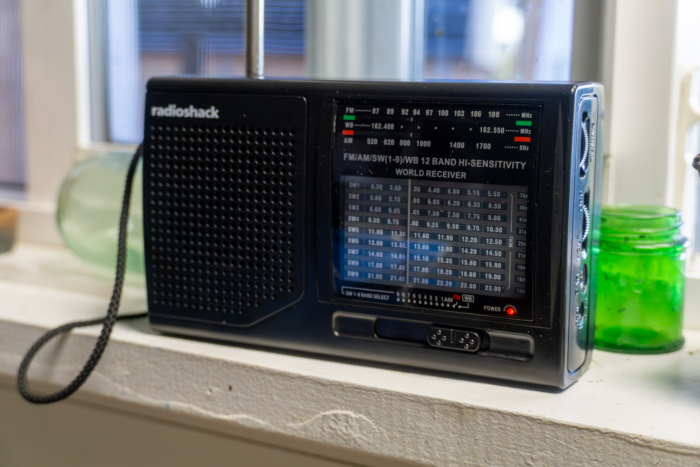
The Multi Band Weather Radio is, straight out of the gate, delightfully anachronistic. It has a wonderful plastic echo when you rap on the shell with your knuckles. It feels empty without batteries in it. The dial moves via a mechanical scroll wheel. All come together to make a classic-feeling emergency radio.
To test it, I folded this radio into my everyday life (thankfully without actual emergency need) and sought to challenge reception, battery life, and overall functionality.

Radio Reception Coming in Clear
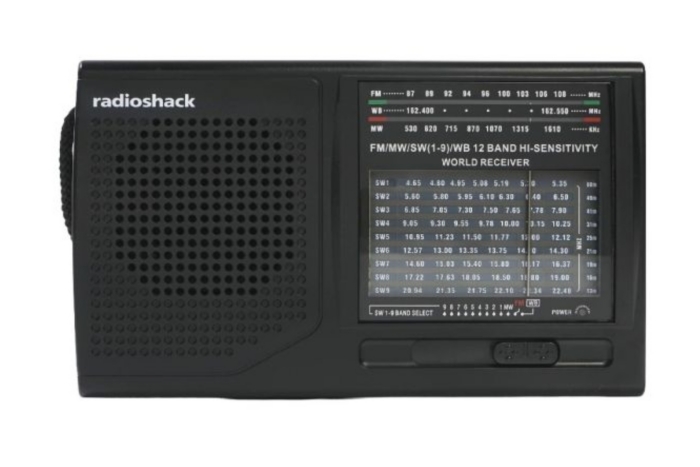
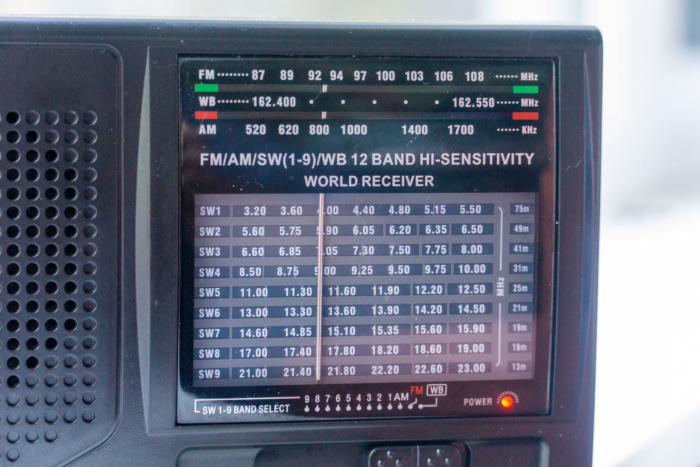
The RadioShack Multi Band Radio (as it is so named) jams in a surprising number of radio bands you can receive on. You’ve got your standard AM/FM bands for music, news, and more, along with all of the NOAA weather bands and shortwave radio.
That last one is especially interesting for anyone looking to stay apprised of global comings and goings, and shortwave reception is getting tougher to find on emergency radios. On the RadioShack model, the stations are there, but I won’t say that the receiver is exceptional. Still, I was able to listen to some Spanish-language stations with decent clarity.
Across all of my testing, the AM/FM bands both came in clear across the spread. The antenna on the radio is a fairly simple, collapsible unit that extends ~18” and is tiltable in only one vector (that is, it cannot swivel in any direction to chase a signal). In some cases, I needed to manipulate the radio itself to get a perfect signal.
Where I’m located, I can receive two NOAA weather frequencies: one typically crystal clear, and one a bit more garbled. Comparing the reception of these channels on the RadioShack unit to other emergency radios I’ve got in rotation, I’d say the weather band reception on this radio is top-notch.

Old-School Battery Power
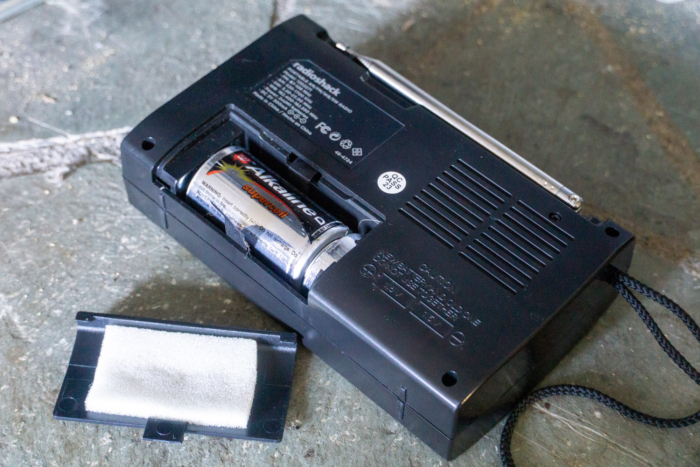
When I first aimed at powering up the radio, I flipped it over to inspect the data sticker and find out what juice it was after. “UM1s?” Surely some bleeding-edge, next-generation competitor to the now-ubiquitous 18650 lithium-ion rechargeable cells? Nope. Another name for D-cells. The big ones.
It’s enough to make you smile, really. Of course, it runs on D-cells when nothing else these days does. I had to make a special trip and everything to buy some for the radio, and loading them into the back felt more like racking a few shells of buck than anything else. Once they’re in, the radio has some good heft to it.
There are some good reasons for sticking with D-cells to power an emergency radio, even today. The first is total energy stored per cell, with your average D-cell packing away 18-27 Wh of power, and a 18650 cell typically storing 10-13 Wh. The storage life is also much better for D-cells, with 7-10 years of unmaintained shelf life (versus 1-3 for the 18650).
The radio also offers the ability to power itself from an AC plug-in adapter (though it does not ship with one). I actually had a little bit of a hard time finding an adapter that should work, but this 7-Tip Universal Power Adapter ($23) should do the trick.

Emergency Functionality
This is where you’ll either decide to pull the trigger on this radio, or look for something else. The RadioShack unit is a slim device functionally, and when compared to dedicated emergency radios today, it can seem a little undergunned.
For example, there’s no built-in flashlight, something I believe all emergency radios should have. A simple LED light presumably wouldn’t be tough to shoehorn into the shell, and while it might nibble away at the battery life a bit, it would be a welcome addition.
Beyond that, the benefits begin to diminish with added features. For example, some of the leading emergency radios today incorporate sub-audible dog whistle tones, which feels like an extraneous function with little practical application.”
In the end, the true genius of the RadioShack radio may be that it doesn’t try to do it all, and instead, it does being a radio very well. Better to have the real deal in an emergency than a multitool that does it all poorly.

What Could Be Better?
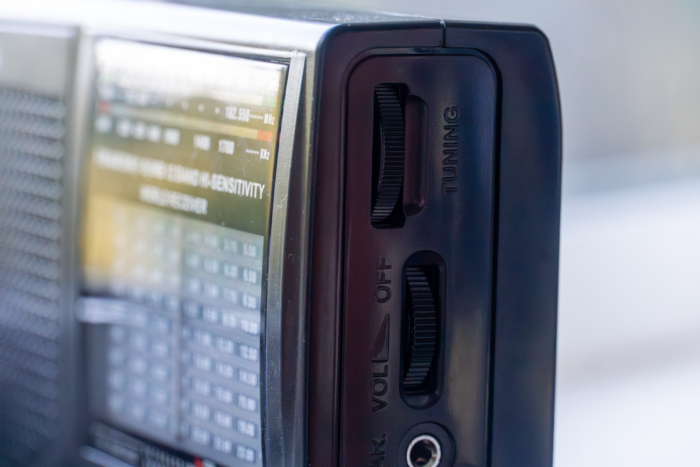
As previously mentioned, the speaker has a great amount of possible volume, but the range you’d often like to actually listen to is a small amount of the dial, and makes keying in on the perfect volume a bit difficult.
Second, those D-cell batteries that power the radio (while a nice solution for long-term storage) are getting harder to find in other electronic goods, meaning your battery-sharing possibilities are limited. And (probably the more important matter), unless you get some fancy rechargeable D-cells, once the batteries are done, that’s it. Modern emergency radios all use rechargeable lithium-ion cells, and likely for a good reason.
Finally, without a backlight to illuminate the radio dial, it could be tough in an emergency situation to get serious about keying into an exact station (say, to catch an evening update). The absence of the backlight does likely extend the radio’s runtime, however.

RadioShack Multi Band Weather Radio: Conclusion
For anyone looking for a simple emergency radio to chuck in their go bag, the RadioShack Multi Band Weather Radio makes a great case for itself. At an MSRP of $45 (and regularly on sale for $30), the value is high, and you’ll net a unit that should last a good while into the future.
The radio likely isn’t for folks who want all the bells and whistles in a radio, however, as the unit lacks much in the way of emergency features (save for NOAA weather band alerts). If that’s what you’re after, I’d suggest the Midland ER310 Pro (a new-age radio with all the features, and reviewed by our team).
At $100, however, you’ll pay for those features on the Midland. After just simple listening (with the ability to stay aware in real-deal weather emergencies), I’m sticking with RadioShack.