I’ve had a thing for pocket-carry fixed blades for a while; they’re just incredibly handy. No muss, no fuss — just pull it from the sheath and it’s ready to work. The only thing faster is an automatic knife. And while I do love a great switchblade, they still give some folks pause when you whip it out to open your mail.
The downside of the small fixed blade is cost. If you want to avoid the gas station knife end of the spectrum, you’re usually looking at a three-digit price tag. That can be a deal-breaker for many people, as budgets seem to grow tighter every day.
That’s where the High Grass Field Knife comes into play. At about the same cost as a tank of gas, it’s a pocket-friendly fixed blade that is ready for real-world use.
In short: The High Grass Field Knife from CIVIVI retails for around $60, but punches well above its weight class. With a cutting edge that’s under 3 inches, it’s a fixed-blade EDC option that’s suitable for the office or worksite, as well as weekend trips. It’s slim and has great lines, with just enough handle length for a comfortable grip. I really like this one as a budget-friendly daily-carry blade.
Specifications
Pros & Cons
Pros
- Exceptionally ergonomic
- Suitable for belt or pocket carry
- Budget-friendly MSRP
Cons
- Sheath requires some attention before it’s ready for your pocket
CIVIVI High Grass Field Knife Review
Design Background

The High Grass Field Knife was designed by Matt Gentry from Gentry Custom Knives. I asked Gentry about the design process for this knife. He said that he’d been super into trout fishing for a while, and designed a blade perfectly suited for processing the daily catch. Then, when his son started squirrel hunting, they found the knife was ideal for processing small game. He tweaked the design a little here and there; thus was born the High Grass Field Knife.
CIVIVI often partners with designers to do production runs of knife models. It’s a great way for makers to get their designs into a lot of hands at once. Buyers also benefit by being able to pick up a custom-designed knife at a lower cost.
This isn’t my first Gentry-designed production knife. Last year, I picked up the Pocket M.U.K., which is a collaboration he did with Boker Plus. It’s an amazing knife, so I knew going in that the High Grass Field Knife wasn’t likely to be disappointing.
First Impressions

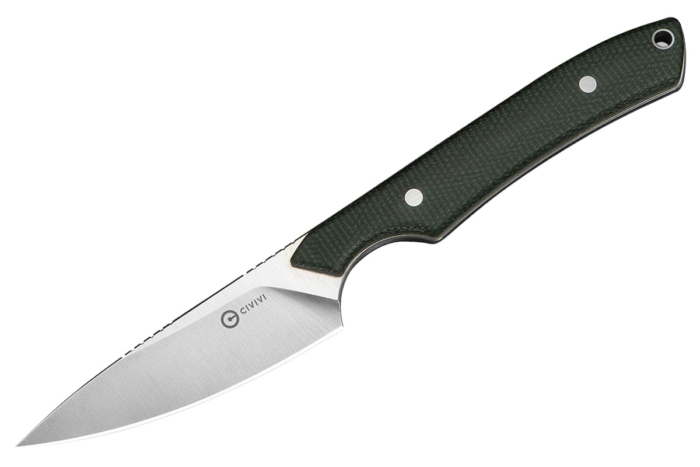
Right off the bat, I noticed that the ergonomics of the High Grass Field Knife are exceptional. This isn’t a big knife, but it doesn’t feel lost in my hand. The handle has just the slightest palm swell. A finger choil helps lock the knife in my grip.
When I ordered the knife, I went with green canvas micarta handle scales. It’s also available in Guibourtia Wood or orange G10 handle materials. The tang is slightly proud all the way around the handle. But the steel has been chamfered, so there aren’t any sharp or rough edges.
There’s a narrow lanyard hole at the end of the handle. While the knife comes with a nice woven lanyard, I chose not to attach it. I don’t typically adorn my knives in that fashion.

Larrin Thomas is one of the leading experts in the knife steel world. He has opined that 14c28n is the best budget steel around. In my limited experience with it, I tend to agree with him. It’s a very tough steel that takes and keeps a stable edge.
The blade is razor-sharp right out of the box. The steel is thin, about 0.12 inches, making this a wicked slicer of a knife. The sharp edge is just short of 3 inches, keeping you legal in most areas where blade length determines whether you receive a ticket or not.
There are two areas of jimping on the spine, one near the handle and another up toward the tip. They’re ideal for your thumb or your index finger, respectively.
The balance point is right where you want it, just behind the finger choil and right about where that first pin is located on the handle. It’s also well-balanced in a visual sense, as the blade length doesn’t seem too short for the handle. The High Grass Field Knife has great lines and is quite eye-catching.
Sheath

The High Grass Field Knife comes with a Kydex sheath. It’s well-made and holds the knife securely. The knife clicks into place with nary a wiggle or wobble. The sheath is equipped with a T-Clip. This is an adjustable belt attachment device. While I’ve seen this before, this is the first knife I’ve had that came with one. It’s similar to a Tek-Lok, but with a bit of added functionality.
By squeezing the sides of the T-Clip, it flips open. There, you’ll find an adjuster that allows you to customize the clip to the width of your belt. You can also change the configuration of the clip in relation to the sheath in any number of ways. Carry the knife vertical, horizontal, or canted however you’d like.
However, if you’re going to carry the knife in your pocket, you might want to skip the clip entirely, as it’s a little bulky. It more than doubles the overall thickness of the sheath.
On the back of the sheath, near the tip, is a weep hole. This little detail is something that’s often overlooked in sheath designs. If you put your knife away wet, the weep hole allows that moisture to escape so it isn’t just held against the steel.
Putting It to Work

I’ve had the High Grass Field Knife for a few weeks. It’s gotten a fair amount of pocket time, including during a couple of short hikes with my wife.
It didn’t get as much use as I’d hoped when we were out and about, though. Sure, I whittled a few branches, and I used it to harvest some veggies from our community garden plot. But I didn’t feel like the knife had gotten a true workout. So, with that in mind, I set up a few tests at home to better evaluate how the knife handles.
Back in the day, we used to use old telephone books for knife tests. They were easy to source, and many knife reviewers had a small stack of them sitting around in their offices. Nowadays, not so much. But, I happened to come across an old catalog, so I used that instead. The blade’s edge carved off a corner of the catalog quite easily, with just a little rocking back and forth.

The next victim was an old webbed belt that I’ve slowly been winnowing down over the last year or so. The High Grass Field Knife easily nipped off several pieces in short order. Despite the belt’s relative thickness, I didn’t need to exert a ton of force to slice through the material.
Next was a thick sisal rope. I chose this specifically because it’s a very abrasive material, and some knives struggle with it. This knife, however, cut through the rope exceptionally well. I had to saw my way through it, but the knife didn’t hesitate in the least.

Finally, I tossed a section of corrugated cardboard onto the workstation. The needle-sharp point of the blade was like a precision instrument and cut like a laser. I also stood strips of cardboard on edge and sliced downward through them without a problem.
As with most knife evaluations, it isn’t so much a question of whether the knife will cut the material, but how the knife handles while doing so. The High Grass Field Knife gets high marks from me. It was comfortable in any grip I used, no matter how I was using it.
Who Needs This Knife?

Something I discovered a few years ago is that most bird and trout knives often make for great EDC options. They’re small, with blades no more than 3 inches in length, and fairly narrow.
The handle is comfortable for extended use. They’re made explicitly for regular carry, not just sitting at home. The steel chosen will be one that’s going to keep a razor-sharp edge. All of that holds true with the High Grass Field Knife.
As I said at the outset, I’m a big fan of pocket fixed blades. I’ve also grown to be fond of Gentry’s designs, as they’re intelligent and well-informed. All in all, the High Grass Field Knife is a truly exceptional EDC knife.