There’s exactly one way to guarantee an untracked powder run on a busy resort like Vail. You’ve got to get to the top under your own power, before the lifts open or after they close.
With powder days few and far between this season, I clicked into my touring bindings and started striding uphill into the morning darkness. After an aerobic 90 minutes of climbing, I ripped skins, snapped my La Sportiva Sender boots into ski mode, and pointed it down the fall line. Fast, loose, and powerfully, I slashed down my favorite powder-coated glade, not a track in sight yet.
I eventually hit the base area, bustling with skiers and lifts spinning. But there was plenty more powder to be had. I racked my touring skis and pulled my alpine skis out — the ones I had stashed before the sun rose. The Senders’ GripWalk soles allowed me to keep skiing the goods without swapping boots. I was able to soak in the last of the powder with big, burly alpine skis thanks to the Senders’ stout build and poised demeanor.
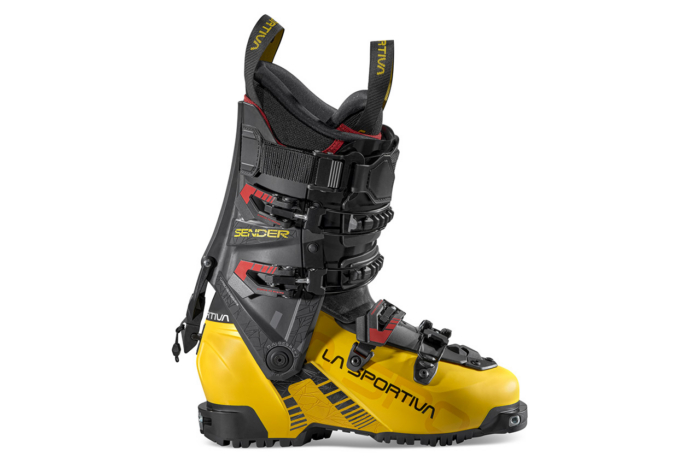
La Sportiva’s new Sender boots are a strong re-entry into the growing crop of muscular category-bending touring boots. I say “re-entry” because the Senders are an updated (and much improved) version of La Sportiva’s previous overcomplicated power boots, the Vanguards. Now simpler and more durable, the Senders prove touring boots can push well beyond their niche, even if there’s one subtle tradeoff for resort skiers.
In short: La Sportiva’s Sender boots are low weight, have a ski/walk lever that yields a huge range of motion, and has tech binding compatibility. The new and improved Sender is a touring boot masquerading as a full-blown 130 flex alpine boot. The Senders are designed to work with nearly all binding norms, meaning they’ll pilot your entire ski quiver, from lightweight touring skis to metal-laden freeride skis.
Check out GearJunkie’s guide to the Best Ski Boots and the Best Backcountry Ski Boots.
Specifications
Pros & Cons
Pros
- Super-stiff and supportive in downhill mode
- Large range of motion for four-buckle touring boots
- Tech and GripWalk binding compatibility
- Comfortable, accommodating fit
Cons
- Too stiff for lighter skiers
- Unforgiving in firm conditions
La Sportiva Sender Review

Nothing about the Sender’s aesthetic screams ultralight. It’s a chunky boot, and it skis downhill like one (in a good way). Yet by some miracle, those Italian boot tinkerers managed to sneak the 26.5 Sender under the 1,500g mark at a svelte 1,480g. That’s even light for the weight class underneath the Sender.
For comparison, Scarpa’s similarly intentioned 4-Quattro Pro clocks in at a slightly heavier 1,555g. One of the best touring midweight boots on the market, the Scarpa Maestrale RS, weighs in at 1,470g. It’s a long way of saying that the Sender is really dang light for being such a powerhouse.
La Sportiva clearly went to great lengths to make that happen. The Sender utilizes a three-piece quasi-cabrio construction. The shell and tongue are constructed from a stiff and somewhat elastic Pebax derived from castor oil.
The cuff is a special formula: Grilamid Bio-Based Lf Carbon. It’s exclusive to La Sportiva, and is both light and very stiff. Both materials are downright thin from toe to cuff, yielding the impressive overall weight. Those Italian designers didn’t leave much fat on the bone here.
Fit

The Senders have proven surprisingly comfortable so far despite my mangled, high-arched, though average-width feet. I was relieved as I forced my feet in, and it was a relatively easy entry. That’s thanks to a tongue that can fold fully out of the way and an instep that didn’t crunch the tops of my feet.
An accommodating 102.5mm last yields a roomy toe box for average to wide feet, even after many hours of touring. Skiers with narrow feet will probably find them too roomy without some thoughtful shimming.
A secure heel cup felt solid and comfortable. The only tinge of discomfort I felt was low down on my heel when I pushed deep into the flex. My heel spurs certainly aren’t doing me any favors, but it’s worth noting nonetheless.
Touring

The two primary characteristics that make a touring boot excel on the uphill are low weight and range of motion.
The Sender’s range of motion is impressive for a boot this sturdy. La Sportiva claims 64 degrees. Without my foot in the boot, that range checks out. Once I stuffed my feet in there, it felt a little less than that. But I will say that it’s less limited by the heel than the two other highly regarded touring boots, the Tecnica Zero G Tour Pro and the Fischer Transalp Carbon Pro.
Unlike a much sportier uphill boot like the brand’s own Kilo XTR, there’s some friction in the articulation. It’s not unexpected. Having four buckles and a fixed tongue generally comes with a tradeoff.
It was possible to reduce the friction when I toured with the upper buckles fully unlatched from the keeper hooks. I’d call the overall articulation a B+ in the grand scheme of touring boots. That’s a high mark for boots this downhill-oriented.
The ski-walk mechanism is shared with the brand’s lighter boots. It’s a big swinging lever that locks securely in ski mode. It also allows for an angle adjustment from 12 degrees to 14 degrees with the flip of a small bolted chip.
One quick note here: The lever does touch the heel piece of my Look Pivot alpine bindings. That means I can’t adjust the ski/walk mechanism while attached to my skis. There doesn’t appear to be a compromising conflict, but some alpine bindings theoretically could present a compatibility issue here. Double-check before you buy.
Skiing the La Sportiva Sender

The Sender is one of those boots that can legitimately straddle the line between ski touring and alpine skiing, given the burly build, four buckles, and beefy power strap. But this boot actually lands in one of those categories.
As I pushed off into a soft mogul run, basking in morning light, it was easy to feel their support right away. I was aboard a pair of K2’s Titanal-reinforced Minbenders, which are far from welterweights and require some muscle to activate. These boots are stiff from the top of the flex to the bottom (or as close to the bottom as I could get). They flex lightly with each compression, but kept me upright and poised for the next big mogul smash.
Faster and faster, I pointed it straight. They kept my skis on track, refusing to flinch or fold — significantly more stalwart than most other ski touring boots I’ve reluctantly dragged into the ski resort.

The support carried through to open piste when I leaned into deep carving turns. They stayed high in the flex, ready for each successive turn. It was confidence-inspiring support.
Did it feel like an alpine boot? In stiffness and support, yes. But they didn’t offer the same vibration-gobbling suspension of a true alpine boot (more on that in a minute).
I took them into more freeride terrain a few days later — chunky steeps, a few small drops, and open glades. This time on Scott SEA 108’s, much bigger, wider freeride skis. They performed there too. Yes, plentifully stiff, but it’s the fit that made a big difference in this type of terrain. I loved that the buckles and tongue cinched together to create a solid, no-slop fit despite the relatively wide last.
With my aftermarket Remind Medic Impact insole, there was no heel lift. And it was comfortable overall, too, even with a performance fit.
Sole

A lot of skiers will look at the Sender’s sole and be confused about their primary intentions. They essentially offer a GripWalk alpine sole and tech binding compatibility at the toe and heel. It will work great with most modern bindings on offer. They’re more than capable of driving your entire ski quiver.
But ironically, the GripWalk sole comes with compromises in grip compared to a lugged touring sole, which is more akin to a mountaineering boot. That won’t matter to skiers who aren’t scrambling around on rocks in their ski boots. But on technical rock, sans crampons, GripWalk can feel pretty insecure.
Thankfully, La Sportiva added its signature Frixion climbing rubber under the arch. Boots like these are, of course, compatible with crampons, too, for booting up couloirs and icy faces.
Touring vs. Alpine

We’re always trying to put ski equipment in a box. I’m one of the worst offenders. There are times when that dichotomy is needless — when a product legitimately covers both bases. And sometimes it comes with the good at everything, great at nothing paradox.
That’s a long lead-up to my point: The La Sportiva Sender could fall into that discipline-bending category. It can basically do anything you want it to. It’s light enough and has plenty of articulation for the skin track. The GripWalk sole and true 130 flex can push your biggest skis around all day at the resort.
But it dawned on me after a full day of resort skiing the Senders that these boots are as far as you can go on the ski touring spectrum without crossing into dedicated alpine boot territory. In other words, these are ski touring boots that can pull double duty at the resort without flinching rather than the other way around.
My main reasoning comes down to the flex profile. The Grilamid Bio-Based LF Carbon cuffs and Pebax shells are stiff and thin. These are two of the stiffest ski boot materials available. The tradeoff is that they’re not particularly damp. They just don’t have much suspension to soften abrasive forces or vibrations.
That’s something I’ve been acutely aware of this season, given the icy, low-tide conditions in Colorado. True alpine boots, on the other hand, typically employ much softer materials in greater quantities and thicknesses, such as polyurethane. You still get a stiff flex, but they absorb more shock and chatter at the cost of much more weight.
La Sportiva Sender: Who It Is For

The Senders prove that more complicated isn’t always better. By reducing the complexity of its predecessor, the Vanguards, La Sportiva cut the boots’ weight and simplified the closure mechanisms, while retaining the chassis’s power, skiability, and range of motion.
So who are they for? The Senders will be an ideal boot for powerful freeride skiers earning big lines in any snow conditions, especially those who will occasionally call on the Senders to pilot alpine skis at the resort. Pointing it straight or hucking cliffs? The Senders have heaps of power and support to keep you upright.
However, given that they’re only offered in 130 flex, they’ll be overkill for lighter skiers and backcountry skiers pushing lighter, narrower skis around. Those folks could get away with an even lighter boot with an enhanced range of motion, like the brand’s own Kilo XTR.
There are now a handful of boots on the market that straddle the line between touring and alpine skiing and could reliably work on either side of that spectrum. The Senders certainly fall into that category, thoroughly powerful for big-ski-resort shredding and mobile enough for dedicated backcountry days.
From early on, the Senders stuck out from that crowd with a distinct lean toward human-powered ski touring. They prioritize light weight, sheer stiffness, and range of motion over damping and soft-to-stiff progressive flex ramp-up. That combo works. The Senders are some of the most powerful ski touring boots on the market right now for big skis and big mountains.