Even in a tech-filled world, a good compass still deserves a permanent place in your backcountry kit. Phones die, batteries freeze, GPS signals fade, and well-traveled trails disappear quickly in whiteouts, thick timber, or wide-open desert. This guide will show you which compasses are worth your money.
Most recently, lead tester Chris Kassar tested three compasses over six months while hiking and scouting routes. She compared models for accuracy, readability, durability, ease of use, features, and overall value — as we do with every compass we assess.
Whether you want the all-around reliability of our best overall pick, the Suunto M-3 NH, or the straightforward value of our best budget pick, the Suunto A-10 NH, these are the navigation tools we trust when the trail gets faint, and your phone won’t cut it.
Our compass-testing team includes hunters, anglers, climbers, backpackers, paddlers, thru-hikers, and orienteers who regularly travel beyond reliable cell service. Since 2021, we’ve evaluated 20 compasses on trips across Alaska, Yellowstone, the Rockies, and beyond.
Editor’s Note: We updated our compass guide on November 6, 2026. Each product review now has a new format, and we added a new compass comparison chart.
The Best Compasses of 2026


Suunto M-3 NH Compass

Specifications
Pros & Cons
Pros
- Reliable
- Easy to adjust declination
- Durable
- Luminescent markings
- Handy wristlock lanyard
Cons
- Small degree markings on the device can be hard to read, especially in low light
Bottom Line: Simple yet effective, this compass contains everything you need to find your way and nothing you don’t. It’s popular with backpackers and hunters for its reliability and toughness.
Suunto makes many compasses, and the Finnish brand’s M-3 NH ($65) is a big step up to a powerful navigation tool for those who desire more precision than basic models can offer.
The Tech: It uses metric and imperial scales and is balanced for use in the Northern Hemisphere, with 2-degree increments. The adjustable declination orientation is smooth for easy adjustment but firm enough to keep its orientation while you move. If you need a premium option with declination adjustment that can find true north in both the northern and southern hemispheres, you’ll prefer the Suunto MC-2 Global Compass, which goes for $95.
What We Like: A baseplate with a magnifying lens and glow-in-the-dark markings makes it easy to use on a map, even in low light. The detachable locking lanyard keeps it handy and prevents drops while moving over rugged terrain. Thanks to its optimal durability and functionality, along with its price, the M-3 NH is the best compass on the market today.
What We Don’t: There are lower-priced and lighter compasses that still get the job done.
Should You Buy It? Anybody who wants a dependable orienteering tool for backcountry use would do well to snag this compass. Its combination of traits and value makes it a can’t-miss option.
Suunto A-10 NH Compass
Specifications
Pros & Cons
Pros
- Light
- Easy to use
- Accurate
Cons
- Not ideal for beginners
- No magnification
Bottom Line: This compass will help you save some cash without scraping the bottom of the barrel. It’s highly functional without venturing into premium territory.
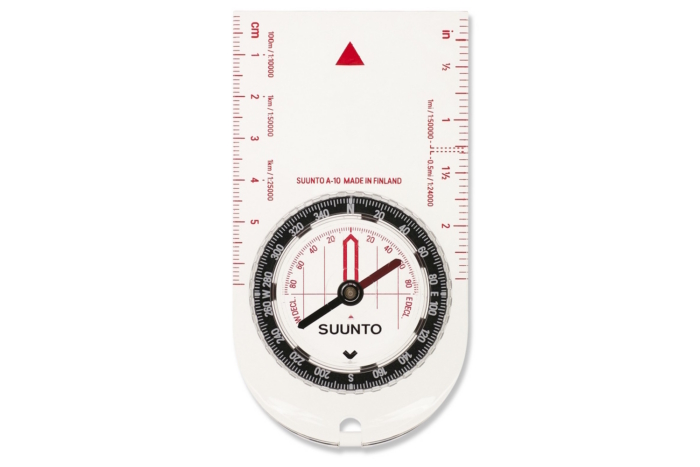
The Suunto A-10 NH ($28) is far from one of the brand’s top-shelf compasses, but for the vast majority of users, it does everything you’ll need at a great price.
The Tech: It has a liquid-filled chamber that results in a “quick-damping needle.” This, according to GearJunkie founder and U.S. champion adventure racer Stephen Regenold, is the most important element in a compass.
What We Like: This compass consistently and quickly points north. The A-10 NH has proven reliable over thousands of hours of use, and it’s so affordable that you have no excuse not to put one in every kit to ensure you find your way home every time.
What We Don’t: This isn’t the smallest compass available, and there are models that find even north quicker. If you want a more accessible and user-friendly option, consider the thumb-mounted Suunto AIM-6 NH — though at $79, it’s not nearly a budget option.
Should You Buy It? If you’re an outdoor novice and looking to build your kit from scratch, this compass makes a great addition. It’s not just relegated to that role, though, and will suffice for anyone seeking an affordable, reliable model.
Silva Ranger 2.0
Specifications
Pros & Cons
Pros
- Great value
- Accurate sighting mirror
- Useful map-scale lanyard
- Adjustable declination
Cons
- Not beginner-friendly
- Separate slope card
- Slightly heavier build
Bottom Line: This compass has an enticing blend of build quality, ease-of-use, and affordability. It might not be the best for beginners, but those with experience will find it a good deal.
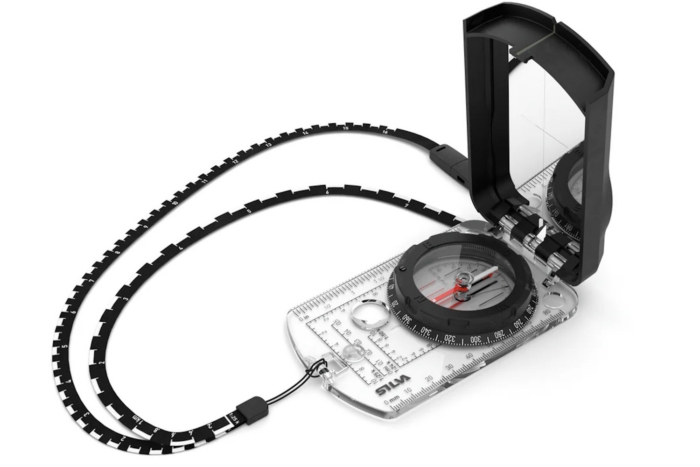
The Silva Ranger 2.0 ($75) is a strong choice for hikers, hunters, bushwhackers, and other backcountry travelers who want more than a basic baseplate compass but don’t want to spend top dollar. It is not quite as refined or feature-rich as some competitors, but it gets impressively close — for less money.
The Tech: The Ranger sits in a category similar to the Suunto MC-2, with a mirrored design, a sighting hole, a clear baseplate, a magnifying lens, and adjustable declination. It also includes a separate slope card. This can be used to measure grade on a map or help assess avalanche terrain. We prefer having that tool built directly into the compass (as on the MC-2), but the included card still adds value for winter travelers and anyone doing more detailed map work.
What We Like: In the field, the Ranger felt intuitive once we were familiar with using a mirrored compass. The sighting mirror made it easier to take precise bearings across longer distances, while the bold markings helped keep readings clear. We also appreciated the lanyard with built-in distance scales. It is genuinely useful when tracing routes on a map because it bends around trail curves better than a rigid straightedge.
What We Don’t: The Ranger’s main drawback is that it feels like a lot of compass for true beginners. The mirror, declination adjustment, slope card, and map scales are useful, but only if you know how to use them. For simple trail navigation, a more basic model like the Suunto A-10 NH will be easier to learn on.
Should You Buy It? For users who already understand the basics and want a capable, affordable mirrored compass, the Ranger 2.0 is one of the better values in the category. It has a couple of flaws, but it’s a capable tool overall.
Brunton TruArc 15 Compass

Specifications
Pros & Cons
Pros
- Balanced for use in both hemispheres
- Isn’t prone to interference
- Includes inclinometer
- Numbers are magnified
- Lights up
Cons
- Bearings are difficult to read
- Setting declination is difficult
Bottom Line: Interference can be a genuine issue in some instances when you’re using a compass, but not with this one. It offers a handy solution along with a host of other features; however, it does have one major design flaw.
The Brunton TruArc 15 ($80) is an advanced compass with an inclinometer, a sighting mirror, and a global needle that can find magnetic north anywhere on Earth. It’s well-suited for anyone serious about blazing a path through the wilderness.
The Tech: What makes this compass particularly interesting is the inclusion of Brunton’s “rare earth EverNorth magnet,” which is meant to eliminate interference from metal or magnets so you stay on track no matter what. This is particularly helpful when you’re around other people or a lot of other gear like radios or avalanche transceivers, which is why this compass is ideal for search-and-rescue teams or snow safety professionals.
What We Like: A built-in inclinometer is convenient for evaluating slope angle and avalanche terrain, while a leveling bubble increases accuracy over long distances. The TruArc 15 has glow-in-the-dark markings and a magnifying lens that make it easy to use on a map, even at dawn and dusk. If you want a glow-in-the-dark phosphorescent azimuth ring, magnetic needle, direction-of-travel arrow, and needle house, give the luminescent version a shot. As far as full-featured compasses go, this one is up there with the Suunto MC-2 G Mirror Compass, which is a hair lighter.
What We Don’t: Though the magnifying bubble on the dial does make it easier to see the tiny bearing numbers, we find it odd that the reverse bearing is right side up, but the bearing (i.e., the direction you are actually traveling) is upside down. Once you get used to reading upside down, it gets easier, but this is an easily fixed design flaw. And though Brunton boasts that declination adjustment doesn’t require a tool, we found it very difficult to do. We needed a hand from a friend; one of us held the compass while the other pushed down and moved the declination vial. We got better at this over time, but we hope Brunton can fix this for its next iteration.
Should You Buy It? For pros who need an accurate tool for global navigation and slope assessment that is less prone to interference than other compasses, the Brunton TruArc 15 is a solid choice
Suunto MC-2 Global Compass
Specifications
Pros & Cons
Pros
- Good features for its weight
- Global needle
- Protective case doubles as mirror and sighting notch
Cons
- Lid snap takes a good amount of force to lock
- Expensive
Bottom Line: A compass might not be the first place you’d look to shed weight, but for thru-hikers and fastpackers, every ounce counts. This reliable model boasts a lot to like in a highly packable design.
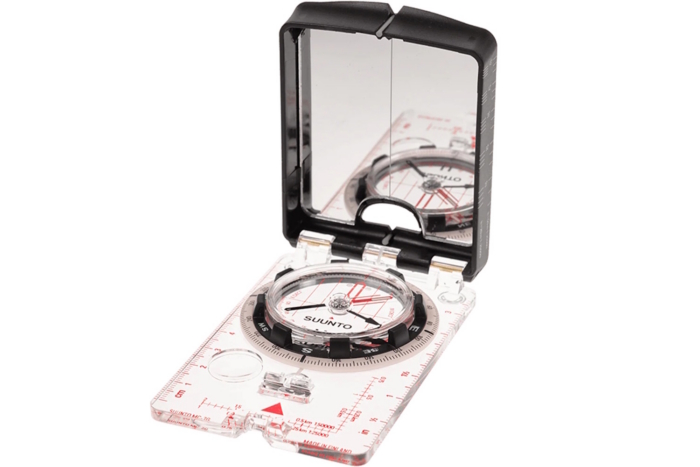
Compact and feature-rich, the Suunto MC-2 G Mirror Compass ($92) is nicely dialed for hiking, thanks to a wide variety of perks harnessed into a small package. It should be on the radar of anyone who wants a full-featured compass but doesn’t want to pay too much of a weight tax.
The Tech: A liquid-filled capsule provides stability for the needle, while the clinometer indicates incline and elevation within 2 degrees. The luminescent bezel, orientation markings, and direction of travel make it easier to read in low light, and the clear red direction arrow makes it easy to see your way when you’re moving fast.
What We Like: At only 2.5 ounces and attractively compact, the MC-2 might be the best compass for thru-hikers or anyone who spends a lot of time going fast and light in the backcountry. The global needle aligns with magnetic north in both the Northern and Southern Hemispheres. It’s also a mirrored compass, sporting a large sighting mirror that allows not only better bearing but also signaling if you manage to get lost.
What We Don’t: This is one of the most expensive models in this guide. We’re not saying the MC-2 isn’t worth it, but not everybody (beginners especially) needs to pay top-dollar for a compass. For pure value, something like the Suunto M-3 NH is a better pick.
Should You Buy It? If you’re someone who obsessively weighs your gear to spot where you can shave some grams, this is probably the best compass for you. You won’t give up a lot in the way of functionality, and you might be able to bring one more protein bar.
SOL Deluxe Map Compass
Specifications
Pros & Cons
Pros
- Affordable
- Simple to use
- Good backup compass
- Built-in magnifier
Cons
- Limited features
- No sighting mirror
- Less precise at distance
Bottom Line: When all you need is a bare-bones compass — and a bottom-dollar price — this one is right on the money. It’s a great fallback option if you can’t find your main compass, or for stashing in a convenient location.
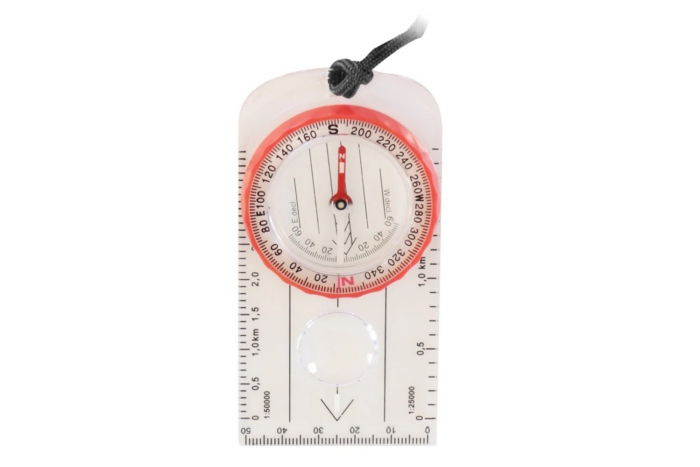
The SOL Deluxe Map Compass ($11) is a straightforward baseplate compass built for simple navigation and emergency preparedness. It isn’t as feature-packed as more expensive mirrored options like the Silva Ranger 2.0 or Suunto MC-2, but that’s the point.
The Tech: The liquid-filled capsule helps steady the needle, while the clear baseplate makes it easy to line up the compass with a map. We also like the integrated magnifying glass, which is useful when reading tight topo lines, small trail junctions, or other fine map details. Extended rulers along the baseplate add another practical touch for basic route planning.
What We Like: Thanks to its bargain-bin price and usability, this is the kind of compass we would toss in a survival kit, glove box, hunting pack, or daypack as a low-cost backup. At this price, there’s no reason not to.
What We Don’t: This compass is best for users who want a no-nonsense tool for general map work rather than a precision instrument for long-distance bearings. It lacks a sighting mirror, adjustable declination, or the advanced field tools found on higher-end models. That makes it less capable for serious off-trail navigation, but also easier to understand.
Should You Buy It? For the price, the SOL Deluxe Map Compass is a solid pick for beginners, casual hikers, and anyone building out an emergency kit. It’s simple, affordable, and useful enough to earn a permanent place in a bugout bag or backup pouch.
Suunto AIM-6 NH

Specifications
Pros & Cons
Pros
- Quick to read
- Attaches to thumb for use on the go
- Super light
Cons
- Specialized for racers
- No measurements or sighting tools
Bottom Line: Built for a narrow field of users, this speed-focused orienteering compass fills its small niche quite well. It’s just not a good pick for the average outdoorsperson.
For orienteers or other adventure racers, running with a compass means attaching it to your thumb, where you can easily reference your direction with a map. If that’s how you roll, the Suunto AIM-6 NH ($79) is purpose-built for keeping you on your heading while maintaining your speed.
The Tech: As with other high-end compasses, this one’s quick-damping needle allows for fast reads. The AIM–6 NH (optimized for the Northern Hemisphere) is light, powerful, and easy to read in low light, making it a strong choice for elite users.
What We Like: GearJunkie founder Stephen Regenold uses this compass during his frequent orienteering races. While he admits models like the AIM-6 NH are somewhat esoteric navigation tools, it provides a quick-to-read arrow to guide a user who’s moving quickly through the landscape.
What We Don’t: This is an extremely niche compass, and hikers, backpackers, and other folks will want to grab a much more well-rounded option. For more general use, look to the Suunto M-3 NH or the Silva Ranger 2.0.
Should You Buy It? If you’re frequently checking your position on off-trail races, the answer is an easy “yes.” For everybody else, we don’t recommend the AIM-6 NH.
Field Tested: More Compasses to Keep You On Track
Not every compass is an award winner, and these models are still highly functional for finding your way.
Specifications
Pros & Cons
Pros
- Compact
- Durable
- Balanced for use in both hemispheres
- Has a an inclinometer
Cons
- Much more expensive than others on this list
Bottom Line: For frequent equator-hoppers, this compass simplifies the equation. It works anywhere on the globe and has a high-quality build to boot.
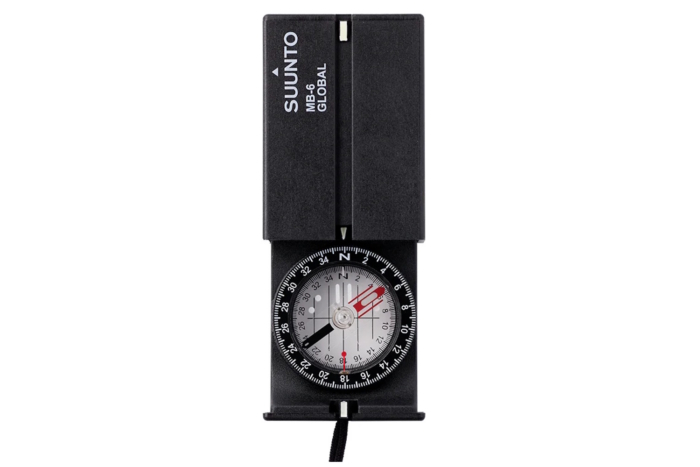
Balanced for both the Northern and Southern Hemispheres, the Suunto MB-6 Global ($119) is built for use wherever your travels may take you. The high-grade steel needle provides specific navigational directions, and the integrated inclinometer tells you the steepness of the hill you’re climbing, which comes in handy during avalanche season.
The Tech: The matchbox has a sighting mirror that lets you view the compass dial and the background simultaneously, making it easier to take accurate bearings. If you plan to take global excursions, the MB-6 Global might be the best compass for you. If you want the same capabilities at a slightly lower price, check out the Suunto MC-2.
What We Like: We love the matchbox design, which adds durability by protecting the compass from cracks and scratches when tumbling around in your pack or down a rock face and eliminating the weak point of the hinges that hold flip-top compasses together.
What We Don’t: This is the most expensive compass in this guide. Perhaps Suunto’s rationale is that if you can afford to bop between hemispheres, you can afford this compass.
Should You Buy It? If you have a trip planned across the equator and want a compass that can keep up — and that you can also use at home — this is the one to get. It’s overkill for sticking on your side of the globe, though.

Specifications
Pros & Cons
Pros
- Lowest-possible price
- Makes a great backup option
- Great to learn on
Cons
- No declination feature
- No direction box
Bottom Line: First-time compass users should take a look at this no-frills, affordable entry. They might move on to another one fairly quickly, but this is a great starter model.
Getting into orienteering can be daunting for the uninitiated, and some of the more feature-heavy compasses on this list can be intimidating for someone looking to learn to navigate without GPS. For beginners, we recommend the TurnOnSport Orienteering Compass ($10), a simple, inexpensive option for learning the basics.
The Tech: Though spartan, it has all the features needed for learning compass-and-map navigation without the restrictive cost of higher-end compasses. The durable acrylic baseplate has an adjustable bearing, a compass ruler, a magnifying glass, and a 1:24,000 scale. The liquid-filled needle case provides a quick, responsive magnetic north bearing, and the waterproof bearings allow it to be used in any weather.
What We Like: This is easily the best orienteering compass we’ve seen for the price. Offering only the necessary features, it’s designed to help you learn basic navigational skills with minimal investment. You can upgrade to a more feature-rich compass like the Silva Ranger 2.0 and keep this as a backup, or buy a dozen and teach a group.
What We Don’t: It’s hard to complain about anything that costs $10, but hikers looking for anything other than an extremely bare-bones compass will be disappointed.
Should You Buy It? This is a smart buy from a value-and-usage perspective if you’re looking to learn how to navigate, have a reliable backup compass, or add one to a just-in-case kit. Even if you already have a nicer model, there’s really no downside.
Compass Comparison Chart
| Compare |
|
|
|
|
|
|
|
|
|
|---|---|---|---|---|---|---|---|---|---|
| Price |
$65
|
$28
|
$75
|
$80
|
$92
|
$11
|
$79
|
$120
|
$10
|
| Weight |
1.6 oz.
|
1.1 oz.
|
3.9 oz.
|
3.2 oz.
|
2.5 oz.
|
6.7 oz.
|
1 oz.
|
2 oz.
|
1.6 oz.
|
| Type |
Baseplate
|
Baseplate
|
Mirrored baseplate
|
Mirrored global
|
Mirrored global
|
Baseplate
|
Thumb compass
|
Matchbox global
|
Baseplate
|
| Best For |
Most hikers and backpackers
|
Budget-friendly basic navigation
|
Sighting and longer-distance bearings
|
Pros and snow-safety use
|
Advanced backcountry navigation
|
Emergency kits and backups
|
Orienteering and racing
|
International travel
|
Beginners and group instruction
|


How We Tested the Best Compasses
Our Expert Testers
Lead tester Chris Kassar is based in Salida, Colorado, and writes frequently about gear. She’s also a guide, mountaineer, and practitioner of a wide array of adventure sports. For this edition of the guide, she evaluated three compasses over six months while hiking, scouting new routes, and practicing her orienteering skills.
The rest of the testing team includes hunters, anglers, climbers, backpackers, paddlers, thru-hikers, and orienteers who rely heavily on compasses to find their way. In particular, GearJunkie founder Stephen Regenold is one of the top adventure racers in the country and has used map-and-compass navigation extensively in race scenarios.

Our Testing Process & Grounds
We test compasses on and off the trail to see how they handle common navigation tasks. Each model requires multiple field outings and side-by-side map checks before earning a spot in this guide.
We use them to orient maps, follow bearings, measure distances, and read fine topo details. Our testing has spanned from the Alaskan backcountry and Yellowstone National Park to the Rockies and local day hikes, with a strict focus on how each model performs in low light, harsh weather, and with awkward map positions.
During testing, we pay close attention to accuracy, readability, declination adjustments, sighting tools, and how well each model serves users ranging from beginners building a backup kit to advanced wilderness navigators. We continuously test new models year-round and update our recommendations seasonally.
Our Compass Rating System
To give them the helpful scores you see in this guide, we rate compasses on a scale of 1 to 10 across four core criteria.
Accuracy: How consistently the compass holds a bearing and supports dependable map-and-field navigation.
Ease of Use & Readability: How intuitive it is for newer users, and how easily you can read the dial, markings, and map scales in different light and weather.
Features: Useful extras like adjustable declination, sighting mirrors, magnifying lenses, clinometers, slope cards, luminous markings, and lanyard scales.
Durability: How well the compass withstands field use, storage in a pack, rough handling, weather, and repeated map work.
We then award each compass an Overall Rating that reflects our extended real-world use, direct comparisons with its competitors, and its value within the category. Overall Ratings are not an average of the four criteria.

Buyer’s Guide: How to Choose a Compass
Compass Types
There are three main types of compasses: the basic compass, the sighting compass, and the baseplate (or orienteering) compass. Some compasses contain elements of all three.
The basic compass has only one feature: a needle that points toward magnetic north. While we don’t have any basic compasses in this guide, one example is the Coghlan’s Four Function Whistle, a great model for kids (and which also has a whistle). The basic compass is handy for any situation where you only need to know your approximate direction, and it tends to be inexpensive.
Sighting compasses have flip-up lenses that allow users to take bearings on distant objects, such as nearby peaks. To operate them, use the sight notch to identify your desired location, adjust the bezel to align the needle with the direction you need to go, and then follow the heading. The Silva Ranger 2.0 is our top sighting compass.
Orienteering (baseplate) compasses are designed to be used with a map, as the base plate lies directly on the map for easy triangulation and orientation. Suunto’s M-3 NH has a baseplate with a magnifying lens and glow-in-the-dark markings that make it easy to use on a map, even in low light.
Many compasses, like the Suunto MC-2 G Mirror, combine a baseplate for map navigation with sighting accessories to integrate the two functions. This allows for whatever navigation method is most useful at any time. Others, like the stripped-down Suunto AIM-6 NH, are extremely light and minimalist, which is ideal for racers or others moving quickly through the landscape who need quick access.

How to Use a Compass
The short version of this is very simple: The compass needle always points to magnetic north. With that knowledge, you can maintain a consistent direction of travel relative to north.
The longer version is much more nuanced and complicated, but well worth the time of anybody who spends time in the backcountry and wants to get the most out of their compass. Check out our full explainer on how to use a compass here.

Compass Features
By definition, a compass has a magnetic needle that always points to magnetic north. Beyond that, compasses can sport a bevy of features, from liquid-filled needle casings and rotating bezels to whistles and thermometers, generally depending on the price range.
A basic compass is fine for general direction-finding in a casual setting. For more in-depth orienteering, you’ll want one with the following features:
High-Quality Needle
A magnetic needle that always points north is the most basic and essential feature of any compass, but they’re not all created equal. One of the more important features of a good compass is a quick-but-stable needle that finds north fast and consistently, like the one on the Suunto A-10 NH.
Housing
The mounting case — also known as the housing — holds the needle. It’s often filled with liquid to allow the needle to float freely and quickly find magnetic north. The liquid also dampens the needle’s motion, making it easier to read.
Baseplate
The mounting for the housing, called the baseplate, is printed with tools such as a ruler and map scale options that help determine direction and distance. It also provides a straight edge for identifying your location via triangulation.
Bezel
The bezel is a rotating ring that surrounds the housing. It is printed with direction indicators (N, S, E, W) and varying points in between. The Suunto MC-2 G Mirror has a luminescent bezel, which means it’s easier to see in low light.

Orienting Lines
Fixed within the housing, these lines are designed to align with the vertical grid lines on maps.
Orienting Arrow
Also fixed within the housing, the orienting arrow aligns with magnetic north.
Direction-of-Travel Arrow
Fixed parallel to the sides of the baseplate, the direction-of-travel arrow points to the direction you want to travel.
Index Line
This is fixed on the bezel and is an extension of the direction-of-travel arrow. It marks the direction you set via rotating the housing.
Magnifier
Many baseplates feature a small magnifying lens for easier map reading.
Compass Scale
Located at the edges of the baseplate, the scale allows you to measure distances on maps.

Advanced Features
In addition to the basic traits mentioned above, these additional features — often found on pricier models like the Suunto MB-6 Global — can make navigation easier or more accurate.
Declination Adjustment
Declination adjustment allows you to adjust your compass for the varying difference between magnetic north and true north. Magnetic north follows the direction of north in the Earth’s magnetic lines, and true north represents the direction of the North Pole.
Magnetic declination varies from place to place due to the changing nature of the Earth’s core. To compensate, many allow you to adjust your compass readings to account for the magnetic declination at your location.

Sighting Mirror
These are mirrors on a hinged lid that attach to the compass body. They allow you to look in a direction or focus on an object in your sight and your compass capsule at the same time. Using a compass like the Brunton TruArc 15, which has a sighting mirror, is great for maintaining a heading even when you can’t see your marker.
Clinometer
Clinometers measure the angle of elevation, a slope angle, or height above the ground, the first two of which make them especially useful for assessing avalanche terrain. (We also like using them for gauging the height of a bear hang.) The TruArc 15 and the MB-6 Global have clinometers that make them highly suited for winter adventures.

Global Needle
Because the Earth’s magnetic field varies in different locations, a needle that balances well in one place may dip, drag, or stick in another, making it useless. A compass with a taller dial allows the needle to tilt without hitting the casing, preventing that drag. If you’ll be navigating globally, choose a model like the Suunto MC-2 Global, which can locate magnetic north in both the Northern and Southern hemispheres.
Compass Care
In the past, caring for a compass meant not dropping it or crushing its casing. Now, people need to consider the plethora of electronic devices at home and outdoors. Be sure to store a compass away from computers and other electronic devices — their magnetic fields can damage it.
The speakers in those devices can also demagnetize the needle, rendering it useless. And don’t let your compass sit near fires, heaters, and other hot places like in a hot car; any warping of the casing can affect the needle’s accuracy.

Price & Value
A good compass must be accurate, readable, and reliable. You do not need to spend a lot for basic safety, but paying more gets you more features and user-friendliness, which often results in better accuracy. The right price depends entirely on your specific backcountry needs.
Budget
The TurnOnSport Orienteering Compass ($10) is our most affordable option. It works well for emergency kits or beginners, and boasts a liquid-filled capsule and magnifying glass but lacks advanced tools. For a step up in quality, the Suunto A-10 NH ($28) is our best budget pick. This is a highly dependable everyday hiking compass; it offers a quick-damping needle and proven reliability at a very reasonable price.
Mid-Tier
For most hikers, this tier offers the best balance of price and performance. The Silva Ranger 2.0 ($75) provides excellent value. It gives users a mirrored design, adjustable declination, and a map-scale lanyard without a premium price tag. The Suunto M-3 N ($65) costs even less and is our best overall pick. It hits the sweet spot for most hikers, thanks to a combination of accuracy, durability, and easy-to-read maps without feeling complicated.
Premium
These expensive models are excellent for serious off-trail travel. However, they offer more tools than casual hikers usually need. For example, the Brunton TruArc 15 ($80) targets advanced users: It has a global needle, a leveling bubble, and magnetic interference protection. It’s a great tool for pros, though the declination adjustment is tricky. And the Suunto MC-2 Global ($95) adds a large sighting mirror, clinometer, and luminous markings.

Frequently Asked Questions
The most accurate compass depends on several factors. Most importantly, you should know how to use it. Every compass can find north, but it’s up to you to know what to do with that information.
Your ability to read your bearings and follow them, or transfer a compass’s information to a map to find your location and put it to use accurately, is paramount. For more information on how to get the most out of your compass, check out our article on orienteering basics.
A good compass can cost anywhere from $10 for a simple compass with basic orienteering features to over $100 for a compass with a global needle, clinometer, mirror sight, and a plethora of other features. Consider the features you need versus what you’re willing to pay when choosing the best compass for you.
In addition to the standard needle and rotating bezel, look for a cover with sighting wire and luminous lighting dots for evening navigation, a flip-up sighting slot and lens (or rear sight), and a thumb loop for stability while sighting your visual marker.
Although a good lensatic compass is great for finding bearings, we prefer one that also incorporates the features of a baseplate compass. Look for a compass that combines the two to give you several methods of finding your way.
While compass apps may be less accurate than traditional compasses and rely on a battery, they’re very convenient. Most people already have their phones with them on adventures, and smartphones can sport a wide range of features that a traditional compass does not, like barometers, altimeters, and, of course, GPS.
We’re fans of the Gaia GPS app (free for iOS and Android) because of its map integration, which allows you to use topo maps, aerial photos, or a hybrid of the two. It also shows your altitude, allows you to share that data to keep others informed of your location in case you get lost, and tracks data like speed, time, location, and direction. It can also estimate your GPS accuracy to let you know if you start going off course.
Remember, if you’re relying on an app for navigation, you’re also counting on the performance of the technology. We recommend always having a traditional compass on hand in case your phone ends up at the bottom of a lake.