Electric coolers have officially replaced the ice chest. Forget hauling bags of ice or draining a slushy mess at the end of every trip. Today’s models bring true, compressor-powered refrigeration to campsites, road trips, and overland rigs. They chill faster, run longer, and keep your food fresh for days without ever touching an ice cube. (Although, some electric coolers can make those too!)
A dozen overlanding and camping experts have heavily field-tested 13 e-coolers over the past three years since this guide’s inception. In the past ten months, three testers have analyzed three electric coolers across thousands of miles including Erica Zazo’s 1,200-mile cross-country road trip from Chicago to Colorado.
Looking for a sophisticated, aesthetic cooler that can chill food while making ice? Check out the dual-compartment Dometic CFX5 55IM with app-controlled temperature. If you want an e-cooler that handles day trips but still saves you some cash, consider the Travoca Rigel Dual Zone eCooler. For more intel, check out our article on the seven things you should know before buying an electric cooler.
Editor’s Note: This guide was updated on August 14, 2026, with product comparisons, Bottom Line takeaways, and signposts to help you find the best e-cooler.
The Best Electric Coolers of 2026


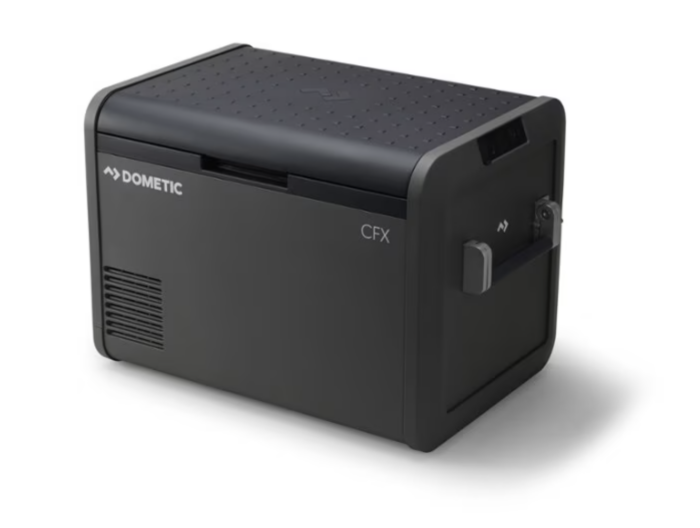
Dometic CFX5 55IM
-

-
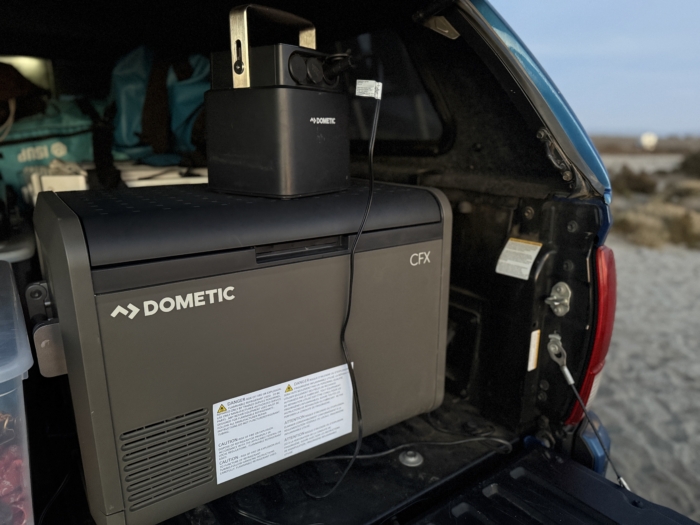
Testing the Dometic CFX 55IM Electric Cooler while road tripping in Baja California, Mexico; (photo/Morgan Tilton)

Specifications
Pros & Cons
Pros
- Highly efficient
- App controlled
- Battery protection system
- Vacuum insulated panels
Cons
- Expensive
- Completely closing requires close attention
Bottom Line: An elite portable electric fridge that combines incredible thermal efficiency with smart battery protection for multi-day off-grid travel. It provides precise, ice-free refrigeration down to sub-zero temperatures without risking a dead vehicle battery.
The Dometic CFX5 55 ($1,200) sets the standard for high-performance electric coolers, delivering massive efficiency upgrades over older generations. GearJunkie Senior Editor Morgan Tilton put this series through rigorous multi-day field testing on an off-road adventure camping and surfing along the rugged, remote Pacific coast of Mexico’s northern Baja California Peninsula. She evaluated its rapid cooling speeds, integrated ice-making function, and real-world power draw in demanding outdoor conditions. If you want a dependable plug-and-play solution that transforms vehicle camping into a full-fledged mobile kitchen, this portable fridge is a premier pick.
The Tech: Efficiency is where this unit shines. Dometic integrated Vacuum Insulated Panels (VIP) into the walls, which drastically slow heat transfer while keeping the shell thinner and lighter than traditional foam-heavy designs. That insulation pairs with an upgraded VMSO 3.5 variable-speed compressor that automatically reduces output as ambient temperatures drop to conserve energy. It features dual AC/DC power options, Bluetooth and Wi-Fi mobile app controls for temperature monitoring, an internal LED light, a USB device charging port, and a built-in 3-stage dynamic battery protection system that cuts power before your vehicle’s starter battery drains.
What We Like: The generous 55-liter storage volume accommodates up to 84 12-ounce cans — or several days worth of fresh meat, produce, and beverages for a family road trip. Because the unit operates across a wide temperature range from 68°F down to -7°F, it functions seamlessly as either a deep freezer or a standard refrigerator without the soggy mess of melting ice. Rugged spring-loaded handles, reinforced Exoframe corner protection, removable wire organizer baskets, and an integrated bottle opener make day-to-day packing and campsite chores noticeably easier.
What We Don’t: The $1,200 price tag is a significant investment, especially when budget-minded options like the Worx 20V Electric Cooler cost less than half as much for short day trips. While more accessible models like the Dometic CFX2 45 ($880) provide ample single-zone cooling for smaller setups, the larger footprint and 44-pound empty weight of the 55L version take up considerable cargo space. Additionally, wireless app pairing can occasionally feel finicky during initial Bluetooth setup.
Should You Buy It? For dedicated overlanders, vanlifers, and road trippers who demand pro-grade temperature regulation and zero ice hassle, this unit is well worth the investment. It offers top-tier build quality, reliability, and battery safety for long-term off-grid travel.
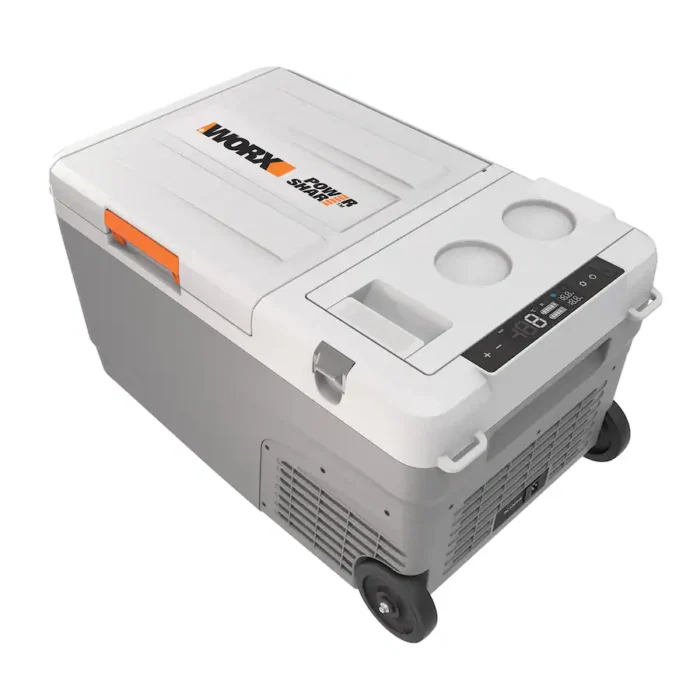
Worx 20V Electric & Battery Powered Cooler

Specifications
Pros & Cons
Pros
- Portable refrigerator/freezer you can take anywhere
- 10-hour battery life
- Maintains temperature settings very well
- Built-in handle and wheels
Cons
- Heavy
- Limited carrying capacity
- Power button doesn’t actually turn it on
Bottom Line: Without spending an arm and a leg, this iceless fridge that brings cord-free mobility to tailgates, beach trips, and weekend outings. Its direct integration with the brand’s power and outdoor tool batteries makes it a uniquely convenient option for anyone already invested in the platform.
The Worx 20V Electric & Battery Powered Cooler ($530) is an appealing option for car campers, van lifers, or anyone spending the day at the beach. GearJunkie contributor Kraig Becker field-tested this unit on multi-day vehicle trips, assessing its real-world battery drain, temperature stability, and wheel maneuverability. Having a universal power source compatible across a wide ecosystem of more than 140 outdoor tools brings convenience, making cordless cooling more accessible.
The Tech: Powered by two 20V Power Share battery packs, this unit provides up to 10 hours of runtime when set to standard refrigeration temperatures near 40°F. Its variable thermostat ranges from -4°F to 68°F, cooling down to 32°F in roughly 15 minutes without requiring ice. You can run or charge it using the included 12V DC vehicle adapter, standard 120V AC wall plug, or on-board battery power. A bright digital readout panel displays real-time interior temperatures, active charge indicators, and current operational modes. It also includes dual USB ports for charging mobile devices on the go.
What We Like: The 24-quart single-zone compartment offers enough space to store 32 to 35 standard 12-ounce beverage cans with zero space wasted on ice. Helpful campsite features include integrated lid cup holders, a built-in bottle opener, an extendable pull handle, and an internal LED light that illuminates the contents at night, all of which Becker appreciated. Because the energy cells recharge directly inside the unit whenever it is connected to wall or vehicle power, managing battery power between transit and setup feels seamless.
What We Don’t: Carrying capacity is noticeably limited compared to its overall physical footprint because the internal compressor and battery bays consume a large section of the frame. At 33 pounds empty with power cells installed, it is relatively heavy for its size, and the small plastic wheels struggle over soft sand or rocky terrain. Unlike larger dual-zone competitors such as the Dometic CFX5 55 ($1,200), you cannot freeze ice cream and store fresh produce simultaneously in its single bin. Additionally, the control interface has an odd quirk where the main power button turns the device off but will not turn it back on. You’ll also want to consider if you like Worx power tools or lawncare equipment, since this e-cooler is only compatible with the Worx-built battery pack.
Should You Buy It? If you already own compatible lawn care or shop tools from Worx and want an affordable, iceless setup for single-day excursions, this model delivers solid value. It provides dependable cooling performance without the steep price tag or bulk of high-end expedition fridges.
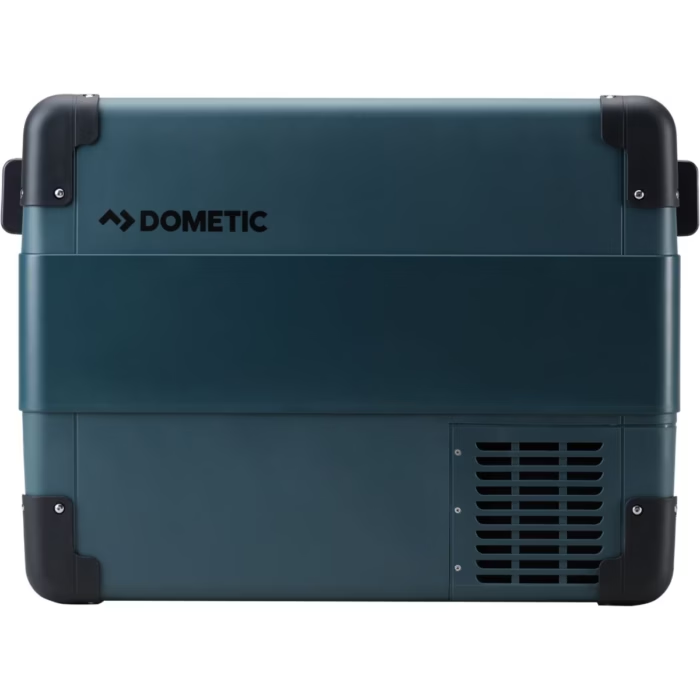
Dometic CFX2 45
-
-
(Photo/Seiji Ishii)
-
(Photo/Dometic)
-
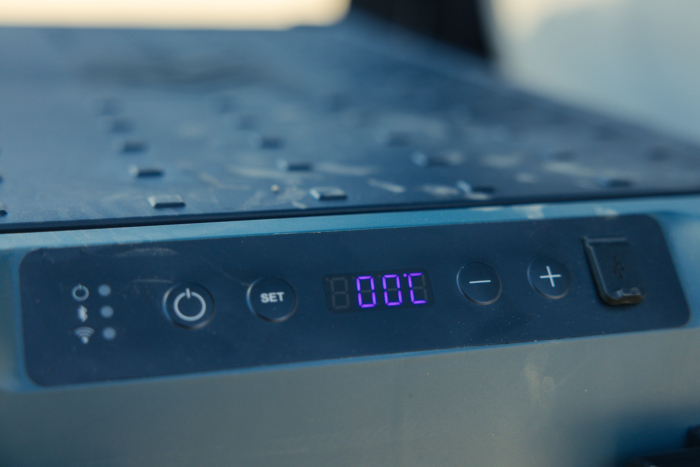
The control panel displays all the pertinent information and has a USB charing port; (photo/Drew Martin for Dometic)
Specifications
Pros & Cons
Pros
- Reliable and consistent temperature regulation in demanding conditions
- Robust construction
- Bluetooth and Wi-Fi connectivity and app
Cons
- Costs more than bargain brands
- No wheels and extended handle
Bottom Line: A high-value single-zone electric fridge that matches the cooling muscle and thermal insulation of flagship models for a moderate cost. It provides rock-solid temperature regulation and energy conservation during scorching summer road trips.
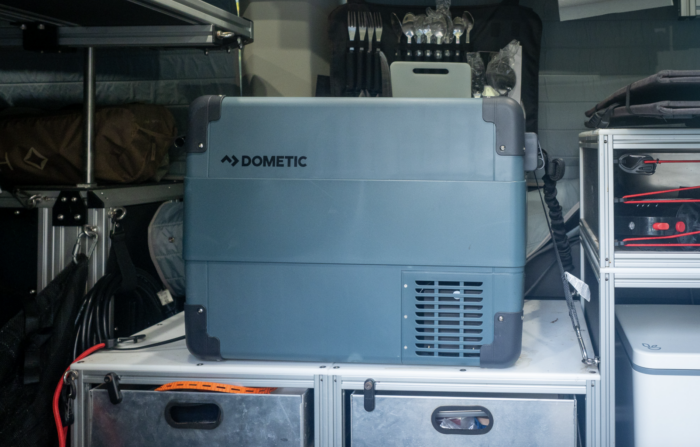
The Dometic CFX2 45 ($880) delivers all the core cooling performance and user-friendly features most vehicle campers need without the premium price tag. GearJunkie contributor Seiji Ishii put this unit through weeks of testing during a Texas expedition, evaluating its rapid pull-down speeds in 100-degree van conditions, low energy draw, and overall ruggedness when jostled by gear. If you want a dependable workhorse that maintains food safety across hot summer adventures, this model delivers exceptional overall value.
The Tech: Efficiency and rapid chilling drive this unit’s impressive performance. Starting from an ambient 80°F, the compressor pulls the 45-liter interior down to a food-safe 39°F in roughly 20 minutes. Its variable thermostat spans from -7°F to 68°F, managed easily via a digital control panel or a dedicated Bluetooth and Wi-Fi mobile application. Equipped with dual AC/DC power options, it features a built-in 3-stage dynamic battery protection system that automatically cuts power before your vehicle’s starter battery drains flat.
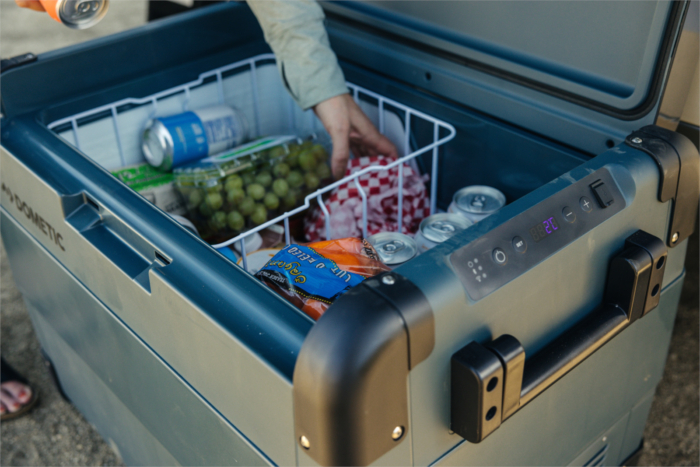
What We Like: Tight seals and polyurethane insulation keep cold air trapped so effectively that the compressor cycles on far less than expected. The single-zone compartment accommodates up to 60 standard 12-ounce cans, equipped with a removable wire basket and an upper crisper section for organized packing. Stout ABS carrying handles double as robust tie-down anchor points, while reinforced composite corner bumpers protect the outer shell from impacts during rough off-road travel.
What We Don’t: Unlike larger flagship models in the guide like the Dometic CFX5 55 ($1,200), the CFX2 line lacks advanced power history metrics, specialized vacuum insulated panels, and integrated ice-making trays. At 36.6 pounds empty, it still requires substantial lifting effort when fully loaded, and it does not house an internal battery — meaning you will want a portable power station for long off-grid stays when the vehicle engine is turned off.
Should You Buy It? For budget-conscious van lifers, car campers, and road trippers who want top-level refrigeration without paying top-shelf prices, this cooler hits the sweet spot. It provides proven thermal retention, intuitive mobile app monitoring, and essential battery safeguards for multi-day campouts in remote havens.
ARB Zero Portable Fridge & Freezer
-
-
(Photo/ARB)

Specifications
Pros & Cons
Pros
- Dual zones
- Tall storage
- Very durable
- Matching power pack (not included)
Cons
- Very expensive
- Heavy
Read Review: Power Your Off-Road Picnics: ARB ZERO Fridge Freezer Power Pack Review
Bottom Line: A rugged steel-clad e-cooler engineered for off-road durability featuring deep vertical storage and modular internal baskets. Its robust casing and versatile single or dual-zone flexibility make it a prime investment for overlanders who need maximum food organization.
The ARB Zero Portable Fridge Freezer ($1,136) is a heavy-duty option built to endure harsh trail conditions while keeping your supplies properly chilled. GearJunkie contributor Mercedes Lilienthal put the ARB Zero line through extensive off-road testing during vehicle expeditions, evaluating its ruggedness over bumpy tracks, rapid cooling performance, and seamless integration with external battery accessories. While it carries a higher price tag than several rivals, its tall profile, steel outer shell, and clever compartment customization deliver outstanding long-term utility.
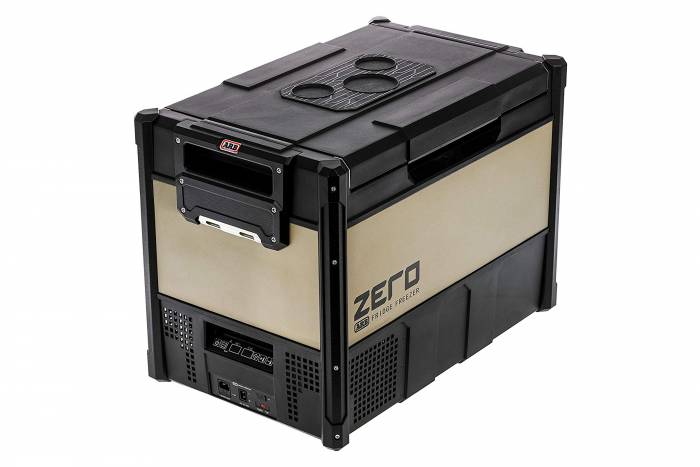
The Tech: Constructed with powder-coated steel casing and full-height rubberized corner moldings, this unit withstands heavy impacts inside a vehicle bed or camper rig. A variable-speed compressor cools internal temperatures from -7.6°F to 50°F, backed by anti-condensation technology that prevents moisture buildup around delicate groceries. Dual DC inputs located at opposite ends allow clean power cable routing, alongside a front AC connection, a USB charging port, Bluetooth mobile app controls, and an optional snap-on magnetic battery pack for true cord-free operation.
What We Like: Vertical clearance is a major advantage here. Standing over half a foot taller than the Dometic CFX5 55 ($1,200), the main bay easily accommodates upright wine bottles, large cut meats, or tall beverage containers. Three removable wire baskets keep food groups separated, and pulling out the central divider unlocks up to 69 liters of open interior storage. An internal insulating lid shields frozen items when opening the primary compartment, while dimmable LED control displays and molded lid cup holders make camp life much easier.
What We Don’t: Weight and bulk are noticeable drawbacks when handling this cooler without assistance. At over 50 pounds empty, the heavy steel frame requires significant muscle to lift, and its tall height may interfere with shallow vehicle cargo drawers or tight tonneau covers. It also requires a heftier financial outlay than entry-level single-zone options like the Worx 20V Electric Cooler ($530).
Should You Buy It? For dedicated off-roaders who demand impact-resistant construction, deep storage, and reliable temperature control across backcountry miles, this cooler is worth every penny. It’s an investment-grade mobile fridge that will reliably serve through years of demanding outdoor use.
Anker Solix Everfrost 40
-
-
(Photo/Daniel Deemer)
Specifications
Pros & Cons
Pros
- Built-in battery provides cooling without needing to stay plugged in
- Removable basket makes it easy to transfer food in and out
- Includes roller wheels and a built-in camp table
- Can be controlled with smartphone app
Cons
- Heavy
- Other e-coolers can reach -7 to -8 degrees on the low end
Read Review: The Anker Everfrost Powered Cooler 40
Bottom Line: A feature-packed e-fridge that combines a detachable battery pack, smooth-rolling wheels, and an integrated fold-out table into a complete mobile kitchen station. It offers versatile cord-free refrigeration and device charging for multi-day road trips without requiring a standalone power station.
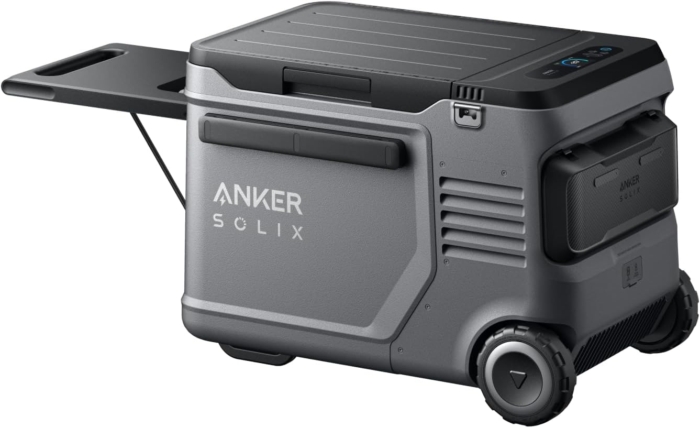
The Anker Solix Everfrost 40 ($750) stands out as one of the most user-friendly designs on the market, offering an array of thoughtful conveniences for car camping and vehicle travel. GearJunkie reviewer Natasha Buffo field-tested this series during a multi-week road trip from California through the Pacific Northwest into Canada, evaluating its battery runtime, rapid temperature pull-down speeds, and camp setup convenience. If you want a self-contained refrigeration system that frees you from messy ice runs and complicated wiring, this all-in-one unit delivers impressive utility.
The Tech: Central to its design is a removable 299Wh lithium-ion battery pack that powers the unit for up to 36 hours at 39°F without needing an external outlet. The variable compressor rapidly chills the 43-liter compartment from 79°F down to 39°F in 30 minutes, operating across a wide thermostat range from -4°F to 68°F. Recharge options include standard 120V AC wall power, 12V/24V DC vehicle connections, a 60W USB-C port, or direct 100W solar panel inputs. The detachable battery also functions as a standalone power bank, equipped with dual 12W USB-A output ports and a 60W USB-C port to keep phones and headlamps charged around camp.
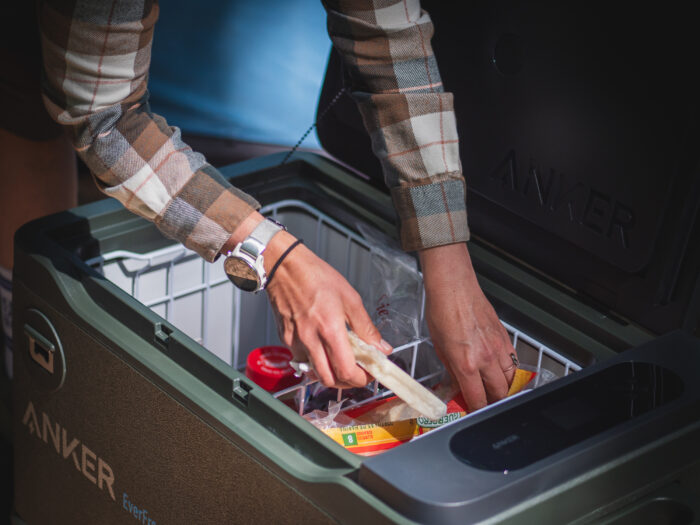
What We Like: Accessibility is where this model excels. A drop-in wire basket lets you load, transfer, and unload food instantly — making it effortless to carry entire meals straight to an Airbnb or campsite picnic table. High-density 6-inch wheels and an extendable handle solve the awkward waddle typical of heavy coolers, while the handle itself doubles as a sturdy fold-out prep table. Additional details like a built-in bottle opener, interior LED illumination, and wireless smartphone app controls make daily organization seamless.
What We Don’t: Tipping the scales at 56 pounds empty with its battery installed, the physical bulk can make loading into smaller vehicle trunks challenging. The rolling wheels lack an integrated brake or locking mechanism, requiring careful placement inside a vehicle bed so it does not shift while driving. While its single-zone storage handles daily trip needs, overlanders looking for simultaneous freezing and refrigeration may prefer dual-zone alternatives like the BougeRV CRD45 Dual Zone ($540).
Should You Buy It? For car campers and road trippers seeking a self-powered cooling system with built-in table space and rolling transport, this setup is a premier choice. It provides an intuitive, high-tech alternative to traditional iced coolers without demanding an expensive off-grid electrical setup.
TRAVOCA Rigel 35 Dual Zone eCooler
Specifications
Pros & Cons
Pros
- Excellent insulation and cooling performance
- Dual-zone flexibility
- Double-sided handles on lid
- Fun aesthetic with possibility for future personalization
Cons
- Heavy
- Wider than competitors
Bottom Line: An exceptionally efficient dual-zone electric cooler that uses full-surround vacuum insulation panels to stretch battery runtime during multi-day off-grid journeys. It offers flexible fridge-freezer storage and premium aesthetics for a far lower cost than top-tier rivals.
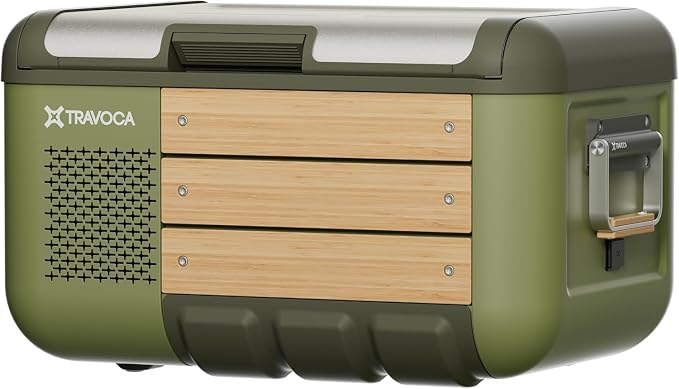
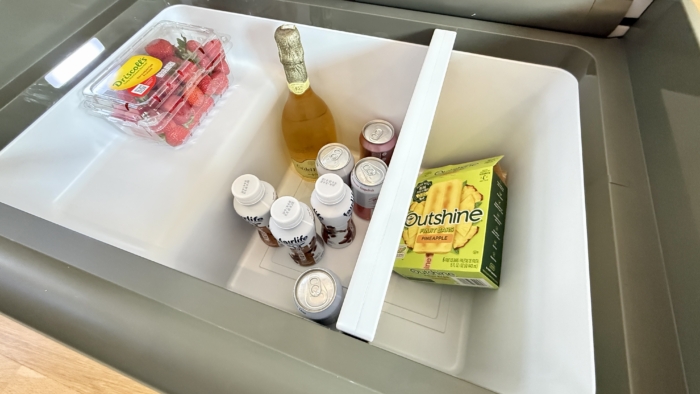
The Travoca Rigel 35 ($750) recently made a compelling entry into the powered refrigeration market. Available in four sizes (25, 35, 45, and 60L), every model in the Rigel lineup features a dual-zone design. This means you can run one side as a fridge and the other as a freezer (or pull the divider to create a single compartment). Its standout upgrade? Vacuum-insulated panels (VIPs) that drastically reduce heat loss, helping the cooler stay cold longer and use less power.
The Tech: GearJunkie contributor Heather Balogh Rochfort field-tested the Rigel against the similarly priced Dometic CFX2 45. Both were set to 0 degrees Fahrenheit with a popsicle inside. After two hours, the Dometic had climbed to 5 degrees Fahrenheit while using 10% of the battery power while the Travoca held one side at 0 degrees Fahrenheit, using just 4% of battery power. With the power shut off entirely for 90 minutes, the Dometic rose to 25 degrees Fahrenheit; the Travoca only hit 16 degrees Fahrenheit, again proving the VIPs significantly slow heat gain. An upgraded Toshiba variable compressor provides rapid chilling down to -4°F, while digital controls and a dedicated mobile app allow independent temperature adjustments for both zones. The unit operates on standard 120V AC wall current or 12V/24V DC vehicle connections, making it fully compatible with portable power stations and solar arrays.
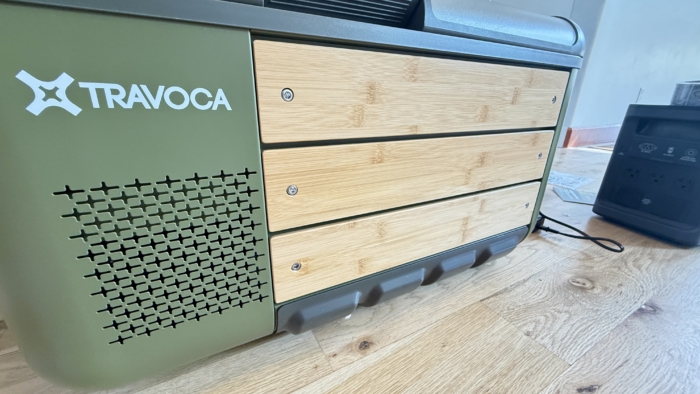
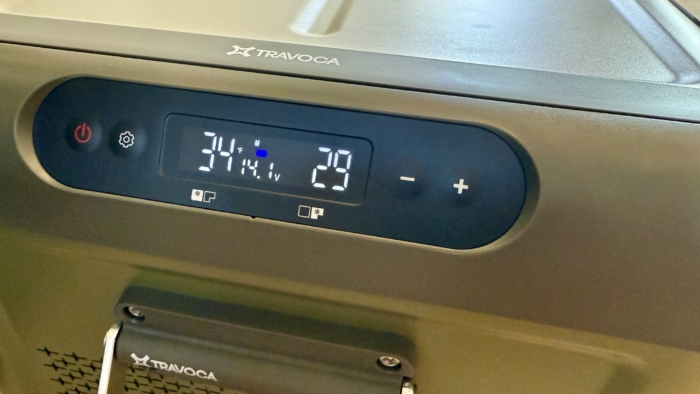
What We Like: Day-to-day use is intuitive thanks to a clear, dual-zone control screen that adjusts each side down to -4 degrees Fahrenheit. A smart dual-opening lid makes it easy to access from either direction, which is useful when you’re trying to ensure access from inside a car or letting your kid dig out some snacks from the backseat. (Ask us how we know…). The Rigel can run on AC or DC, and pairs seamlessly with the Travoca Vega 1500 Power Station and Travoca Vega Sol 200 Solar Panel for off-grid use. The bamboo side panels also add a nice design aesthetic, and Travoca claims customizable panels will be coming soon. Rugged corner guards, an internal LED light, removable wire organizer baskets, and integrated tie-down points add everyday convenience around camp.
What We Don’t: The tradeoff for all that insulation and heavy-duty steel frame is weight. At nearly 52 pounds, the Rigel is heavy. That’s 15 pounds more than the single-zone Dometic CFX2 45 and a few pounds more than the larger CFX5 55IM. It’s also a bit wider, so overlanders with fridge slides should confirm fit. Still, for most users, the efficiency gains and unique features far outweigh those drawbacks. Also, while it lacks the built-in rapid ice-making compartment of the premium Dometic CFX5 55IM, it costs $450 less while serving up better overall energy conservation.
Should You Buy It? For vehicle campers and overlanders who prioritize low power consumption, dual-zone flexibility, and clean style, this e-cooler offers exceptional value. It delivers top-tier thermal efficiency and smart features at a price point that undercuts most competition.
BougeRV CRD45 Dual Zone Car Refrigerator
-
-
(photo/Tucker Adams)
-
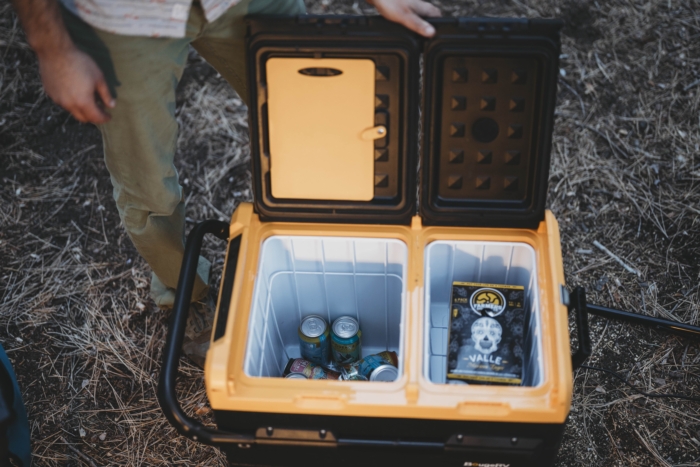
The dual compartments can be set to the same or different temperates; (photo/Tucker Adams)
-
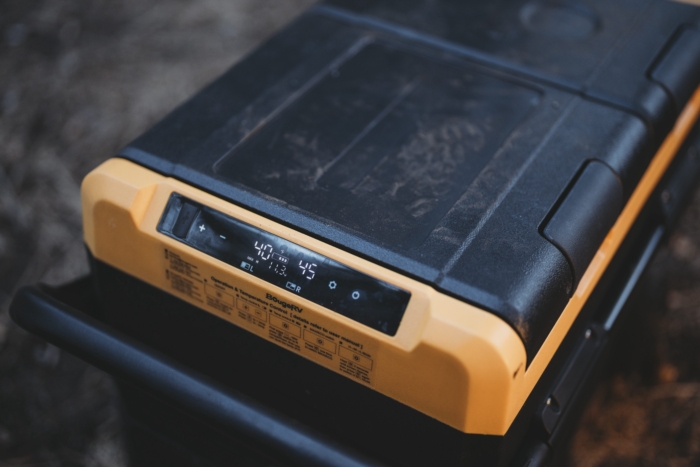
The display screen has simple controls to set the temperature for each compartment; (photo/Tucker Adams)
Specifications
Pros & Cons
Pros
- Includes two completely separate compartments that can be set to different temperatures
- Cools down from ambient temperature very quickly
- Comfortable padded and retractable grab handle
- Can be controlled by phone app
Cons
- Power cord became unplugged from AC/DC adaptor easily
- Warms up fairly quickly after disconnecting from power source
Bottom Line: A budget-friendly dual-zone electric cooler that brings fast chilling and effortless rolling to car camping. Independent temperature controls and removable doors make it a functional choice for outdoor travelers wanting fridge and freezer flexibility without breaking the bank.
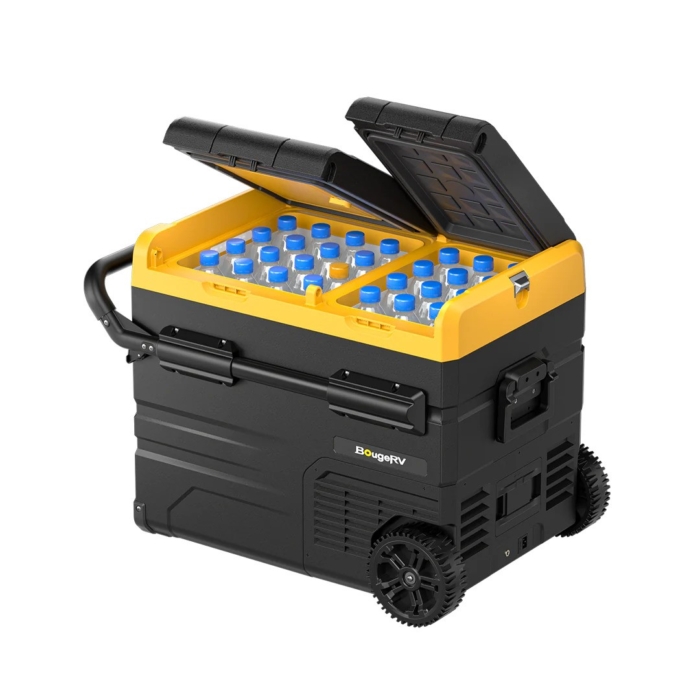
The BougeRV CRD45 Dual Zone ($540) is an appealing choice if you want independent fridge and freezer capability at an accessible price point. Contributor Matt Bento evaluated this model over a 5-week summer road trip across western highways, assessing its dual-compartment chill rates, truck-bed accessibility, and off-grid performance when paired with the optional detachable battery system. Having dual temperature zones running anywhere from -4°F to 68°F allows you to bring ice cream and frozen goods right along with fresh produce and beverages.
The Tech: Rapid chilling is a standout capability. In bench testing, the internal temperature plunged from an ambient 79°F down to 36°F in under 30 minutes. The unit features two isolated bays with independent thermostat settings, allowing distinct climate zones or unified cooling. It operates on 12V/24V DC vehicle outlets, standard AC shore power,or the optional 173Wh snap-in battery pack ($200). Digital controls allow simple adjustments, and smart battery protection prevents your vehicle’s starter battery from draining flat.
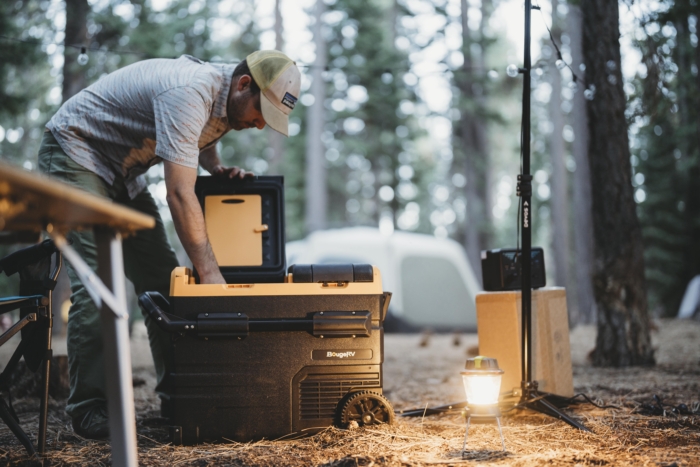
What We Like: Convenience features are well-thought-out across the frame. Sturdy roller wheels and a padded, telescoping drag handle make hauling the loaded 42.5-pound cooler across flat campsites simple. The removable doors reverse easily to open from either side, which proves invaluable when reaching into the back of a crowded truck bed.Built-in interior LED lights, a integrated bottle opener, and a stowable cutting board add practical value during late-night meal prep.
What We Don’t: Running on the optional detachable battery requires minor troubleshooting. Setting the unit to high-power mode while on battery power triggers an “F1” low-voltage protection code, meaning you must pre-chill the interior on vehicle or wall power before switching to eco-friendly battery power. The power cord also tends to vibrate loose from its in-line adapter during rough vehicle transit. Compared to heavy-duty options like the Dometic CFX5 55 ($1,200), the insulation is less substantial, causing temperatures to rise more quickly once unplugged.
Should You Buy It? If you need versatile dual-zone functionality and rolling convenience without spending over $1,000, this setup delivers immense utility. It is a smart, cost-effective mobile refrigeration solution for road trips, weekend camping escapes, and tailgate events.
Chilling in the Second Row
While these electric coolers didn’t claim our top award spots, their performance, feature sets, and overall value make them strong contenders for your vehicle setup.
-
-
(photo/Matt Bento)
-
(photo/Matt Bento)
-
(photo/Matt Bento)
Specifications
Pros & Cons
Pros
- Spacious
- Good cooling performance for price
- Built-in ice maker
- Plug-and-play solar charging
Cons
- Wheels a little small for gravel or dirt surfaces
- Delicate components
Bottom Line: A very efficient e-cooler with a novel ice maker that brings luxury and convenience to off-grid camping setups. Its multi-day battery power and direct solar compatibility make it a fantastic option, though delicate exterior hardware requires careful handling.
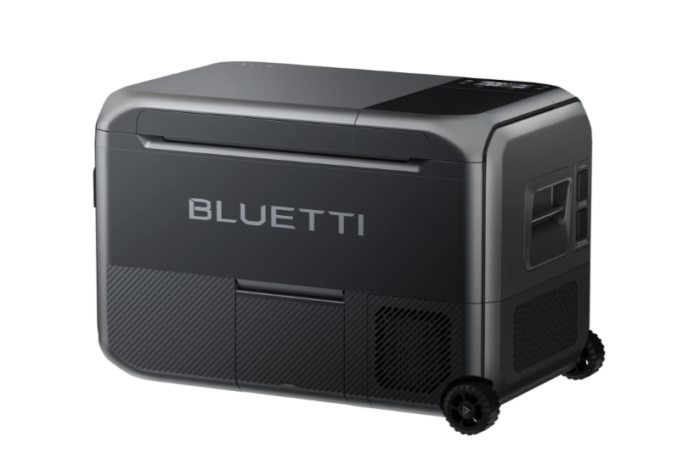
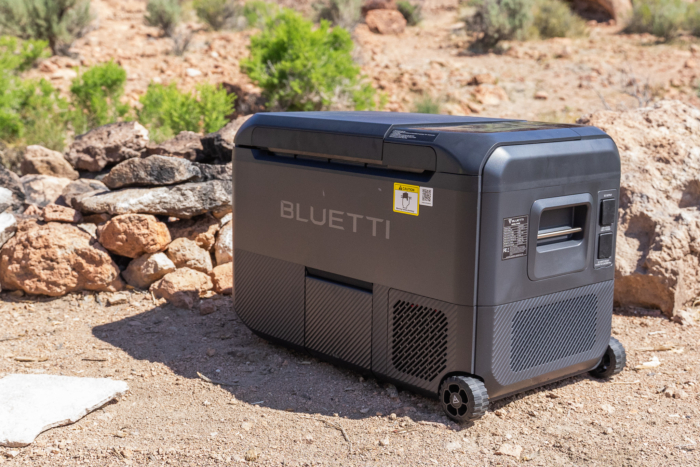
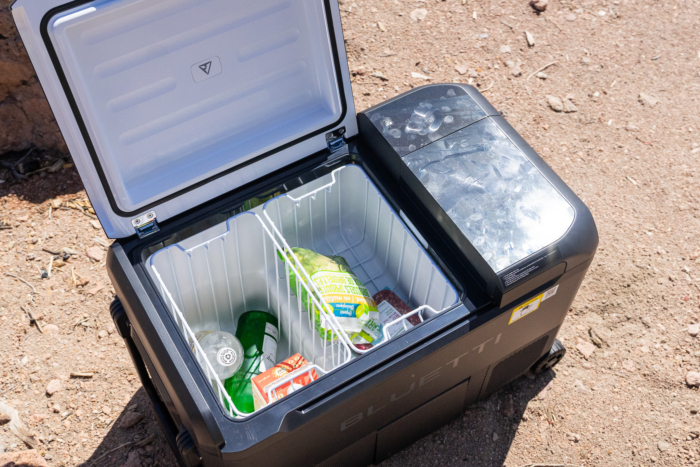
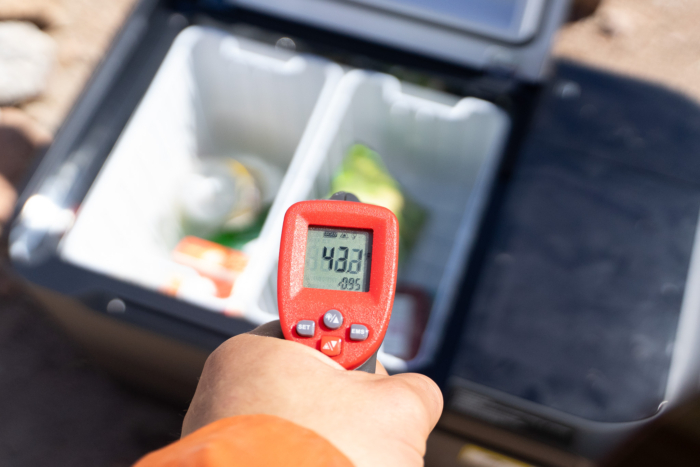
The BLUETTI Multicooler ($699) is a very efficient cooling machine with an icemaker, making it up to the task for quick weekend jaunts or as a mobile cocktail station. GearJunkie tester Matt Bento evaluated this unit during multi-day trips, testing its power draw inside a living room and in the back of his hot Prius where lid surface temperatures reached 130 degrees Fahrenheit. It easily kept food fresh for a weekend in the vehicle trunk, and with the charging station and a secondary battery, you can easily extend that off-grid performance to six days.
The Tech: Starting with the good, this unit can reach safe refrigerated temperatures in about 15 minutes, as advertised.Once it reaches refrigeration temps, it can make enough ice for at least two drinks in under 25 minutes. While testing inside at ambient temperatures around 70 degrees, Matt got four full days of refrigeration from a single battery charge.The battery powered the unit for three days in the back of a hot car. Combining it with the BLUETTI AC180T power station creates a solid portable off-the-grid power rig, with all necessary attachments included to plug directly into an array of solar panels or an existing DC system without needing an additional charge controller. It also charges off any standard AC outlet or directly from your vehicle battery.
What We Like: Quick temperature pull-down and impressive energy conservation make this a great choice for travelers who want to skip calculations for charge controllers, battery banks, and watt-hours. Having built-in ice production adds a fun, luxury element to fireside cocktails without relying on bagged ice. Furthermore, having multiple charging options provides plenty of versatility to keep your setup running for the long haul.
What We Don’t: Durability of the components raises some real concerns. The plastic lid, battery compartment hatch cover, and silicone drain plug all feel pretty delicate, plus testing revealed some leakage issues. The small hard-plastic wheels do not roll very well over the gravelly, uneven terrain typically encountered on the way to a campsite. Additionally, the silicone ice maker drain plug relies on friction alone and popped loose on its first use, draining water all over the floor of the car. Duct tape proved a useful fix, but on a $700 unit, duct tape shouldn’t be necessary. Compared to more rugged options in our guide like the Dometic CFX5 55 ($1,200), the BLUETTI isn’t built like a tank and offers less structural durability.
Should You Buy It? For the off-the-grid curious, this cooler and charging station offer a quick and easy way to add power and luxury to your camping experience. However, if all you need is a rugged, iceless cooler for long weekends, models from Dometic are a better choice if you’re able to stomach the price.
Specifications
Pros & Cons
Pros
- Affordable
- Has a “Fast Freeze” mode
- Great minimum temperature and temperature control
Cons
- Small handles
- Not particularly stylish
Bottom Line: An affordable electric cooler offering precise temperature control and sub-zero freeze capability that matches far pricier competitors. It delivers reliable single-zone refrigeration and deep-freeze performance for hunters and outdoor travelers wanting no-frills functionality.
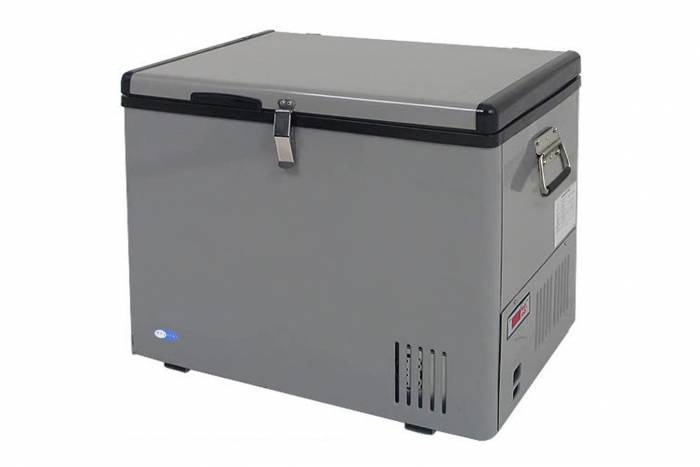
The Whynter Portable Refrigerator ($595) is a high-performing cooler with a lot going for it at a relatively accessible price point. Tying with the much more expensive ARB Zero ($1,137) for the lowest minimum temperature in our guide, this unit delivers impressive sub-zero cooling without requiring a massive financial outlay.
The Tech: Operating as either a dedicated refrigerator or a deep freezer, this single-zone unit reaches temperatures as low as -6°F. It features a secondary Fast Freeze mode that ramps up compressor power to drop internal temperatures as quickly as possible. Temperature regulation is exceptionally precise, maintaining a minimal variance of just 1.6°F. It plugs into standard 12V/24V DC vehicle outlets or 115V AC wall power, equipped with voltage protection safeguards to prevent draining your starter battery.
What We Like: Construction is solid and durable throughout the frame. Removable wire storage baskets simplify organizing and transferring groceries, while an integrated bottom drain plug makes post-trip washing effortless. For hunters and outdoorsmen who spend extended time in the woods, Whynter also offers a tactical camouflage exterior finish.
What We Don’t: Carrying comfort could be improved, as the side handles feel basic and less ergonomic than those on rival models. However, you can purchase an optional Transit Bag accessory that provides padded handles alongside exterior storage pockets. Unlike multi-zone models like the BougeRV CRD45 Dual Zone ($540), you cannot freeze meat and chill fresh drinks simultaneously within its single compartment.
Should You Buy It? If you want ultra-low freeze capability, outstanding temperature accuracy, and rugged durability without breaking $600, this cooler is a stellar pick. It provides dependable, no-nonsense cooling performance for hunting trips and multi-day camping adventures.
Electric Cooler Comparison Chart
| Electric Cooler | Price | Size | Capacity | Weight | Temp. Range |
|---|---|---|---|---|---|
| Dometic CFX5 55 | $1,200 | 28.3 x 18.9 x 17.9 | 55 L | 47 lbs. | -7 to 68°F |
| Worx 20V Electric & Battery Powered | $530 | 24″ x 15″ x 13″ | 22.7 L | 33 lbs. | -4 to 68°F |
| Travoca Rigel 35 Dual Zone | $750 | 25.8″ x 16.9″ x 17.7″ | 35 L | 51.1 lbs. | -4 to 50°F |
| BougeRV CRD45 Dual Zone | $540 | 28″ x 18.1″ x 19.9″ | 45 L | 42.5 lbs. | -4 to 68°F |
| ARB Zero Portable Fridge & Freezer | $1,136 | 33″ x 21″ x 25″ | 69 L | 62.9 lbs. | -8 to 50°F |
| Anker Solix Everfrost 40 | $750 | 32.8″ x 16.9″ x 19.1″ | 40 L | 56.2 lbs. | -4 to 68°F |
| Dometic CFX2 45 | $880 | 26.69″ x 19.41″ x 15.79″ | 45 L | 36.6 lbs. | -7 to 68°F |
| BLUETTI Multicooler | $699 | 29.1”x 17.3”x 18.7” | 40 L | 52.9 lbs | -4 to 68°F |
| Whynter FM-45G Portable Refrigerator | $595 | 16.5″ x 23.5″ x 20.5″ | 42 L | 45 lbs. | -8 to 50°F |

How We Tested the Best Electric Coolers
GearJunkie’s editors have reviewed quite a few electric coolers as well as standard ice chests, soft and hard shells, and even backpack coolers.
Our Expert Testers
Twelve field testers have analyzed 13 electric coolers that have been featured in this guide since 2023.
Most recently, former Staff Writer Heather Balogh Rochfort tested and reviewed electric coolers — a born-and-raised Colorado gal who would always rather be outside than in. She currently lives outside of Aspen where she spends all of her free time camping, mountain biking, backpacking, skiing, and generally exploring the surrounding mountains with her husband, daughter, and rescue pup. Since first testing electric coolers five years ago, Balogh Rochfort is a complete convert to dining al fresco, around a campfire, and without a side of ice.
Our fancy e-cooler analysts have included:
- Senior Editor and adventurer Morgan Tilton: 2 weeks boondocking and off-roading along the Pacific coast of northern Baja California, Mexico
- Freelancer writer and backpacker Natasha Buffo: 3-week road trip through California, Oregon, and Washington then into British Columbia and Alberta, Canada
- Freelancer contributor Erica Zazo: 10-day road trip from the Midwest to Colorado covering 1,200 miles in a 1992 Toyota Hiace
- Contributor Meghan LaHatte: Camping trips in Colorado while testing rooftop tents
- Former Staff Writer Heather Balogh Rochfort: Family road trips (including testing the Travoca Rigel during regional camping trips)
- Hunter and Editorial Director Sean McCoy: Testing in Colorado and Wyoming over remote work and elk camp setups spanning multiple weeks.
Additional contributors include overlanding expert Bryon Dorr, climber and cyclist Seiji Ishii, family road-tripper and beach aficiondo Nick Bruckbauer, tech specialist and global traveler Kraig Becker, off-roading specialist Mercedes Lilienthal, and climber Matt Bento.
Our Testing Grounds
We test electric coolers while camping and on road trips from Texas and Colorado to Canada.
From the sunny alpine beaches of Lake Tahoe to the wild expanses of Baja, we used these coolers while connected to small solar-powered systems or hooked up to our car batteries.
We hauled them down to hot, sunny beaches to ensure they could maintain their temperatures in the hot sun and brought them out to campsites and cookouts.
Testing Benchmarks
- Side-by-Side Efficiency & Insulation Test: We tested the Travoca Rigel 35 against the Dometic CFX2 45 by setting both units to 0°F with a popsicle inside, measuring battery consumption over 2 hours (Travoca used 4% battery vs. Dometic’s 10%), followed by a 90-minute power-off test to measure passive temperature rise (16°F vs. 25°F).
- Indoor Battery Baseline Test: Powered the unit in a living room at 70°F or less with a battery to confirm duration.
- Battery Runtime & Temperature Retention Test: We evaluated the Worx 20V Electric Cooler for battery runtime (verifying its ~10-hour battery life) and temperature maintenance (-4°F to 68°F range). We examine the continuous battery runtime recorded at 39°F using the cooler’s internal battery and backup battery without being plugged into the vehicle alternator or an outlet.
- Cooling Power Test: Time required for units to pull down to target refirefrigeration temperature from room temp.
- Solar & Portable Power Integration Test: Evaluation of cooler performance paired with portable power stations (e.g., Jackery Explorer units) and solar setups, focusing on power draw, battery depletion, and off-grid reliability.
- Ice Maker Test: Speed, volume, and reliability of built-in ice-making trays.
- Technology Test: Functionality and performance of high-resolution app controls.
- Acoustic & Sleep Test: Evaluate noise levels as compressor cycles on and off, especially while snoozing.
- Ergonomics & Usability: Handles, lid closure, wheels, feet, buttons, plugs, and shape.

Our Electric Cooler Rating System
When testing electric coolers, we break down performance into four key categories. This helps us evaluate models consistently and compare how they perform in real-world conditions, from scorching desert campsites to long overland trips powered by portable batteries.
Cooling Performance
Cooling power is at the heart of every electric cooler. We measure how quickly each model reaches target temperatures, how evenly it cools throughout the compartment, and how well it maintains those temps in hot environments. Dual-zone coolers are tested for accuracy between compartments and recovery time after the lid is opened. The best units chill fast, hold steady, and deliver reliable refrigeration no matter the conditions.
Power Efficiency & Insulation
A great electric cooler should sip power, not guzzle it. We track watt draw at startup and during steady-state operation, then compare runtime across common battery setups and 12V systems. Insulation plays a huge role here — so we note the type (foam or vacuum-insulated panels), wall thickness, and real-world cold retention once the cooler is unplugged. The most efficient models balance smart compressors with premium insulation to stretch battery life as long as possible.
Design & Durability
From lid hinges to handles, every design choice affects usability. We assess how easy each cooler is to lift, pack, clean, and organize, along with build materials and protection against dust, water, and vibration. Features like lighting, baskets, and app control also factor into overall usability. The top performers combine rugged construction with thoughtful design that holds up to daily use in camp, in the car, or out on the trail.
Value & Features
Finally, we consider what you get for the price. That includes performance, capacity, smart features, and warranty support. We also look at how each cooler compares to similarly priced models in terms of cooling power, insulation, and convenience. The best values deliver top-tier cooling and efficiency without pushing into premium price territory.

Buyer’s Guide: How to Choose the Best Electric Cooler
First off, you’ll need power if you’re going off-grid, so be sure to head over to GearJunkie’s guide to the best portable power stations. If you’re looking to expand your camp kitchen setup, also check out our Best Portable Grills Buyer’s Guide.
Size & Capacity
As you can already tell from our list of recommendations, electric coolers are available in a wide range of sizes. For the most part, the bigger the size, the more capacity the cooler will have. However, bigger is not necessarily better. A larger size will also increase its weight and footprint in your car.
On average, electric coolers weigh about a pound per liter of storage capacity. Keep this in mind as you compare coolers to see which has the best compromise of portability to capacity.
When choosing the right size for your electric cooler, consider your average trip length and the number of people in your group. For quick weekend getaways, you might choose a smaller cooler. If you have a large family, even a short trip could require a bigger cooler with a lot of storage space.
Temperature Zones
Multiple temperature zones add versatility to your cooler, but they tend to add cost. If you plan to bring both refrigerated and frozen foods, you’ll need an electric cooler with dual zones.
Dual zones could also be necessary for people who travel with medications that need to be refrigerated, as found in the ARB Zero Portable Fridge. This allows storing prescriptions at the correct temperature no matter what else is in the cooler. Both zones have the same temperature range, so you can use either side as a fridge or freezer, depending on your needs.

Weight & Portability
For many electric coolers, size goes hand-in-hand with portability. Smaller units are easier to carry or store (like between the bucket seats of a van, so your kids can access snacks during a road trip), whereas larger electric coolers would need to go in the trunk.
As you read the weights listed in these product specs, keep in mind these are the weights of the coolers when empty. If it seems like a lot, it is. These miniature portable refrigerators have more mechanical parts than simple ice coolers, and they can add up to a lot of weight. For example, the BougeRV CRD45 Dual Zone Car Refrigerator weighs 43 lbs. That’s not a featherweight.
Once you include beverages and food, you can easily increase the weight listed to something difficult to carry. So consider how you will load it, and whether you need to regularly remove your fridge from the vehicle while in use. Some coolers, such as the Anker Everfrost Powered Cooler 40, include wheels to make transport even easier.
Shelves & Organization
Some electric coolers have different areas separated by shelving and baskets. This can be helpful for keeping your food and drinks organized so you always know where everything is. Even in an electric cooler that does not have multiple zones (such as the Dometic CFX2 45), baskets, and shelves are vital to food organization.
For example, the Dometic CFX5, our best overall pick, has a removable basket. That makes it easy to access large items stored at the bottom of the cooler. The Travoca Rigel 35 has a removable divider so you can turn the refrigerator/freezer combination into one large storage compartment, should that be easier for your lifestyle.
The single basket can also move back and forth depending on where you choose to keep tall items. Keep in mind that more organization usually increases the price. If you don’t need that, take a look at an electric cooler such as the Worx 20V Electric and Battery Powered Cooler that comes with a single compartment.

Temperature Control
While it may not be necessary to keep your electric cooler at a specific temperature down to the degree, you’ll want the precision of setting it within a couple of degrees. For wine, ice cream, or medication, having decent temperature control is an important factor in your decision of which electric cooler to purchase.
That said, keep in mind the temperature may vary within the cooler by a couple of degrees, depending on where the cooling mechanism and thermostat are located. Depending on your use, keep an eye on the minimum temperature available in your cooler choice, too. Coolers such as the Whynter FM-45G Portable Refrigerator go as low as -6 degree Fahrenheit (on paper).
And, don’t forget: some newer coolers now come with fancy features like ice-making machines (such as the Bluetti Multicooler).
Cooling Mechanism
Related to temperature control is the cooler’s temperature range capability. There are different types of electric coolers, the two most common being compressor coolers and thermoelectric coolers. All of the coolers featured on this list are compressor coolers because they offer a wider range of temperatures.
Thermoelectric coolers are reliant on the ambient temperature in their cooling mechanism and can offer an average of 40 degrees of cooling capability compared to the outside temperature. Compressor coolers, by comparison, can maintain sub-freezing temperatures no matter the ambient temperature.
One benefit of thermoelectric coolers is they require less power, meaning less cost, but this comes at a great loss of functionality.

Durability
One final feature you shouldn’t overlook is durability. Electric coolers are made from many different materials, including ABS plastic, metal composites, and steel casing. If you’re going to spend a pretty penny on an electric cooler, make sure it’s a solid investment and that it will last.
The level of durability you need will depend on where you plan to take the cooler. For example, if it will be stored in the bed of your truck during an off-road adventure, you’ll need something that can withstand some bumps and bruises.
Price & Value
The price and value breakdown for electric coolers is pretty straightforward — you get what you pay for. Higher prices translate to more efficiency, battery monitoring features, longer run times, and lower cooling temperatures. The least expensive coolers in our guide will keep your food refrigerated for the day, and the higher-priced models are portable refrigerators for life on the road or going off the grid.
Budget: $500-$700
The budget range for e-coolers is $500-$700. Spend less, and you’ll end up with something with marginally better cooling performance than a YETI Tundra ($300), and that’s debatable. In our thorough testing of the YETI, we found the 45L model retained ice for 10 days. And you can still get a great cooler in this price range, such as the Bluetti Multicooler ($699) or the Whynter FM-45G Portable Refrigerator ($595).
Our budget pick is the Worx 20V Electric & Battery Powered Cooler ($530), which runs off two rechargeable batteries. It has a 10-hour max run time off the batteries and can run off your car battery (keep that car running!) or AC power. You could always purchase more Worx batteries to make run longer, but that’ll cost you. You can also take a look at the BougeRV CRD 45 ($540), an affordable pick with two zones.

Mid-Tier: $750-$1,000
For $750-1,000, you can get yourself into some truly road-worthy models with more efficient compressors, dual cooling zones, and better insulative properties. The Dometic CFX2 45 is part of Dometic’s more affordable line and a great pick. However, the new-to-market Travoca Rigel 35 is slightly cheaper ($750) and comes with more features like a refrigerator/freezer option in all sizes, a lid that can be opened from both sides, and most importantly, vacuum-insulated panels.
The Anker Solix Everfrost ($750) is another solid choice if you need a little more than what the budget models have to offer. This cooler can be controlled and monitored via smartphone and has loads of extras, including charging ports for additional devices and a fold-out table, but the biggest upgrade from the budget tier is that it can run for 36 hours on a single charge.
Premium: $1,000+
Spending over $1,000 will get you a high-capacity, super-efficient portable refrigerator, such as the ARB Zero Portable Fridge. In this case, we believe spending a little extra for a premium model is worth it. If you’re van life-ing or overlanding, refrigeration is often the biggest draw on your power system. Top-of-the-line electric coolers are designed to run off the solar systems typically found on camper vans and truck campers.
Our top pick, the Dometic CFX5 ($1,100), has an extremely efficient compressor that automatically adjusts to maintain temperature, saving you power when the external temps drop. Most importantly, it has a battery protection feature that automatically shuts the cooler off if your battery power gets too low.
This can save you from accidentally draining your starter battery and protect your auxiliary battery bank from getting overdrained, extending the life of your batteries in the long run. Coolers like the CFX5 have larger capacities than the cheaper models, and they can even make ice.

Frequently Asked Questions
Absolutely. Electric coolers offer genuine refrigeration power on the go; no more dealing with melted ice and soggy food. They can reach sub-freezing temps and maintain them for days when you’ve got the right power setup. If you’re road-tripping, overlanding, or just camping with perishables, they’re a smart upgrade. That said, if you’re only using it for drinks at a beach day, a regular cooler may still be the simpler, cheaper choice.
One Caveat: If you’re only using your cooler for drinks and snacks during a day at the beach, an electric cooler is probably not worth the expense. In this case, you should check out our reviews of the best coolers and the best soft coolers to find the best brands of traditional ice coolers. For hikers looking for super-portable soft coolers, head over to our review of the best backpack coolers.
Most 12V electric coolers draw between 40 and 70 watts when running, though startup power can briefly spike higher. Energy-efficient models with advanced compressors or vacuum insulation use less power overall. For off-grid trips, pair your cooler with a portable power station or solar setup to extend runtime.
You can — but it’s rarely necessary. Most high-end electric coolers can reach freezer-level temps on their own. If you load it up with ice, you’ll actually lose valuable space for food and drinks, and you’ll carry extra weight. If your setup is already plugged in and powered, let the cooler do its job. For purely passive use (no power), a standard ice chest might be a better plan.
One brand that consistently tops the charts is Dometic — they offer a wide range of high-quality electric coolers with premium features and build quality. That said, there are other excellent players too: Engel, ARB, and National Luna all produce strong models. It really comes down to fit: size, insulation, power efficiency, and how much you want to spend.
Yes, they absolutely can. Any electric cooler plugged into your vehicle’s battery will draw power. But, there’s good news. Premium models include battery-protection features that shut the unit off before it drains your starter battery. How fast they drain depends on cooler size, temperature setting, and ambient heat. If you’re stationary for long periods, consider supplementing with a secondary battery or portable power station.
Not fully. Some models have tight seals and are splash-resistant, but most electric coolers aren’t designed to be fully waterproof or submerged. Many have exposed vents, USB or power ports, or electrical components that shouldn’t be exposed to heavy rain or flooding. If you’re looking to leave one outside in all weather, you might consider a model marketed explicitly as “fully weather-proof.”
Definitely. In fact, an electric “e-cooler” often functions just like a portable refrigerator or freezer — especially with the right setup. Many van lifers and overlanders use models like the Dometic CFX5 55IM as full-fledged fridges. Just make sure you’ve got a reliable power source (AC, DC, or solar) and you’re good to go.
It depends on how you use it. For solo trips or weekends away, a 25–35L cooler is plenty. Couples or small families should size up to 40–50L, while overlanders or long-haul campers often prefer dual-zone models around 60–75L for maximum space.