Working from home has its challenges. Such as recently: as I’ve been moving through a renovation, constantly having to de-power parts of my house, and finding that — surprise — the circuit I just killed also kept the router on. There goes my save file.
To buoy me through these part-time outages, I recently leaned on the new Jackery HomePower 1000 Plus V2 portable power station. In its newest V2 version, the station comes fully up to date with modern portable power units, and the sub-10-millisecond uninterrupted power supply switchover is just one of the updates. 1kWh stations are the bread-and-butter size for casual home use, and the V2 impressed me with its performance across a solid week of home and camp needs.
Here’s everything I learned about this new power station, and where it stacks up in the wider market of portable power.
In short: The new Jackery HomePower 1000 Plus V2 adds all that we’re looking for in a 1kWh unit, from quick power supply switching to fast AC wall charging and split inverter outlets.
Looking for a new portable power station? Check out GearJunkie’s Best Portable Power Stations Buyer’s Guide for more of our top picks.
-

-
(Photo/Nick Belcaster)
-
(Photo/Nick Belcaster)
-
(Photo/Nick Belcaster)
-
(Photo/Nick Belcaster)
-
(Photo/Nick Belcaster)
-
(Photo/Nick Belcaster)
-
(Photo/Nick Belcaster)
-
(Photo/Nick Belcaster)
-
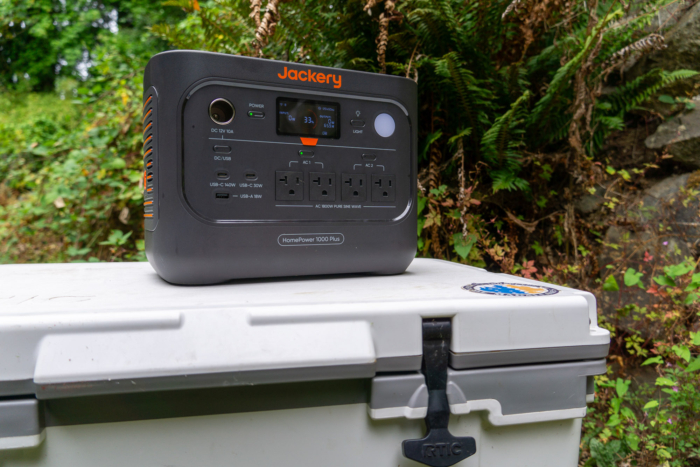
The new Jackery HomePower 1000 Plus V2 adds everything we expect in a modern portable power station; (photo/Nick Belcaster)
-
(Photo/Nick Belcaster)
-
(Photo/Nick Belcaster)
Specifications
Pros & Cons
Pros
- Modern feature-suite with good mix of outputs
- V2 version updates to LiFePO4 battery chemistry
- Sub–10 millisecond UPS performance
- Better sustained AC output of 1,500W
- Small profile
Cons
- Emergency charging requires the app to access
- DC8020 ports for solar input

Jackery HomePower 1000 Plus V2: Review
The new Jackery HomePower 1000 Plus V2 ($749) improves on the previous version in a few important ways. All of them make it a modern power station that stretches from utility as a home backup all the way to powering remote job sites. I used the unit through all of those tasks during a solid week of testing, where I relied on it heavily to keep life running around the house.
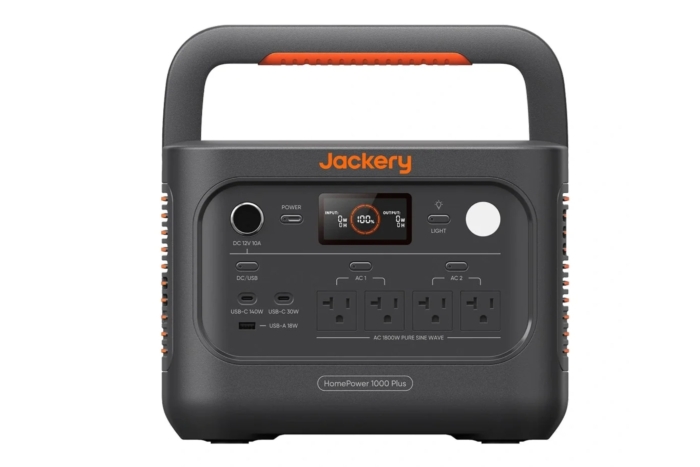
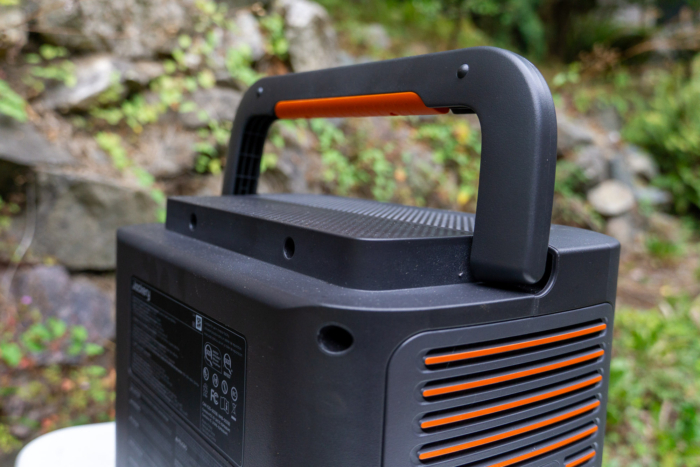
Much of that updated versatility comes down to its physical footprint. Jackery managed to trim down the overall shell size while adopting a flush, fold-down handle up top. At just under 24 pounds, it drops into a vehicle trunk or gear closet far easier than older 1kWh blocks, making it more practical to haul out to a campsite or job site without feeling like you’re hauling a cinderblock.


A Modern Feature Set
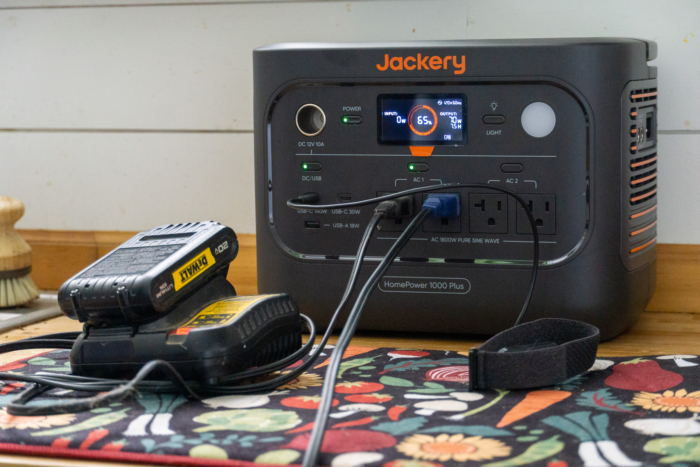
Lately, portable power stations have been tweaking themselves toward a few very handy new trends. One of those is performance as an uninterrupted power supply (UPS), which is essential when using the unit as pass-through power to run essentials that you don’t want to power off — even in an outage. This includes things like a router (as I found out recently), as well as computer desktops, CPAP machines, or security systems.
Typically, 20 milliseconds is around the transfer time that many appliances will lose power and restart, such as computers. With a UPS transfer time of sub-10 milliseconds, the HP 1000 Plus V2 will easily keep things like routers and refrigerator pumps running even when the power drops out unexpectedly.
Underneath the hood, the shift to Lithium Iron Phosphate (LiFePO4) cell chemistry is the biggest functional upgrade. Rated for roughly 4,000+ charge cycles before dropping to 70% capacity, it vastly outlasts older NMC-based power stations that degraded after just a few hundred cycles. That longevity gives you peace of mind if you intend to leave it plugged into the wall full-time as an emergency backup.
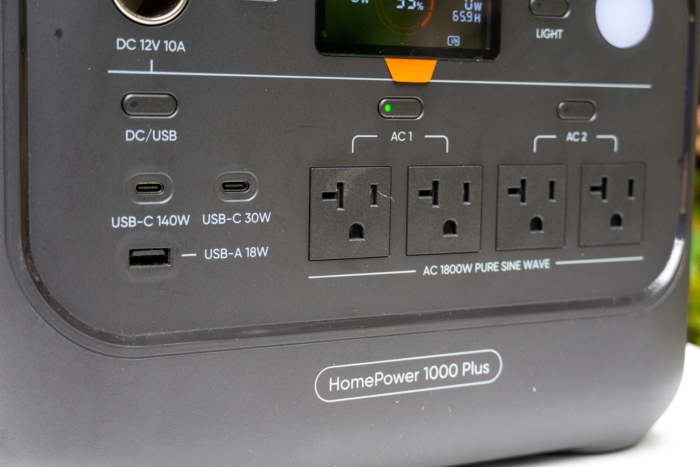
Another of those trends is splitting up the AC outlets into a few different toggled circuits, allowing you to selectively power sets of different appliances, such as one side of the inverter dedicated to your gotta-haves like a fridge, while the other side might handle some luxuries like fans (while you’ve got the spare juice).
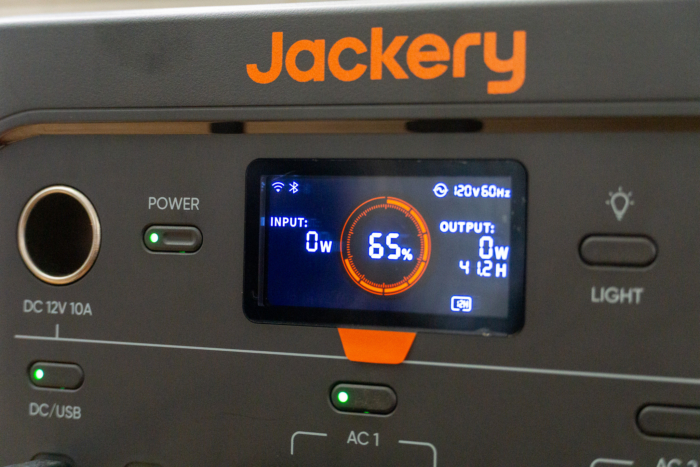
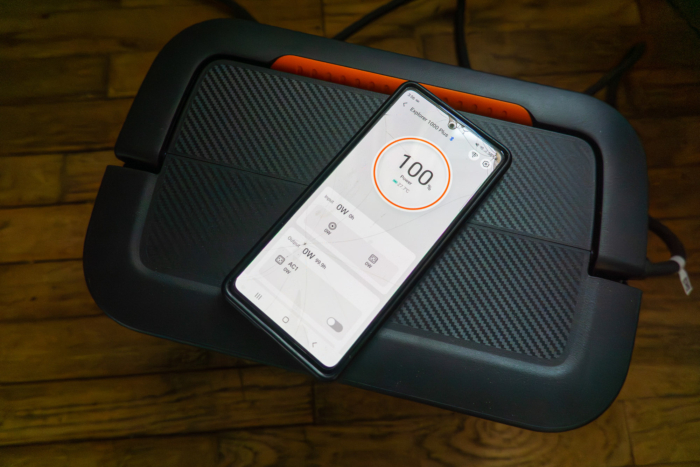
Finally, app integration is always appreciated, and I found the Jackery app to pair quickly and to be easy to use. From the app, you can control the unit remotely, including toggling ports on and off and setting timers for when you would like certain appliances to come on and off. The app is also the only way that you’ll be able to access “Emergency Charging” on the unit, which supercharges from the wall (but isn’t recommended for frequent use).
Time of Use mode is also available on the app, which allows you (with the appropriate time-of-use prices for your area added) to selectively bank power from the grid when it is available for the cheapest (overnight and weekends), and then use it from the power station when grid power is most expensive. That’s smart.

Powering an Off-Grid Woodshop
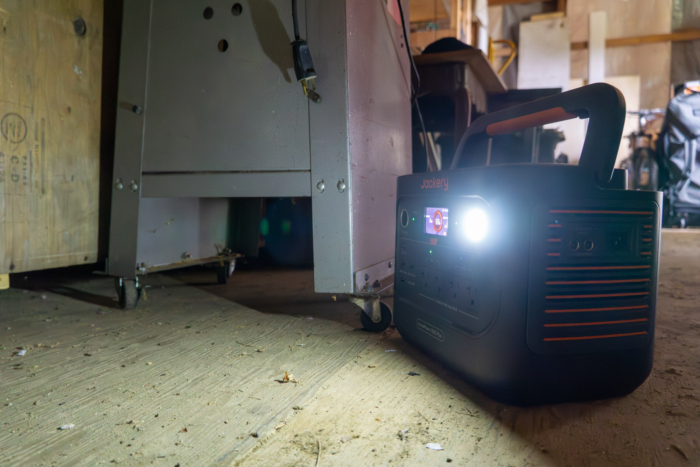
To thoroughly test the 1000 Plus V2, I hefted it out to my shop for some heavy lifting. First, I had to get the lights running, which had me leaning on the power station’s built-in flashlight to get back to the box. This little light is bright enough to get you rummaging around your dark garage, and also pulls double duty when deployed at camp.
The SOS function that follows the solid light state isn’t the most helpful, but it’s tacked on there anyway. I would have rather had a two-color LED and been provided with a red light for light-sensitive usage.
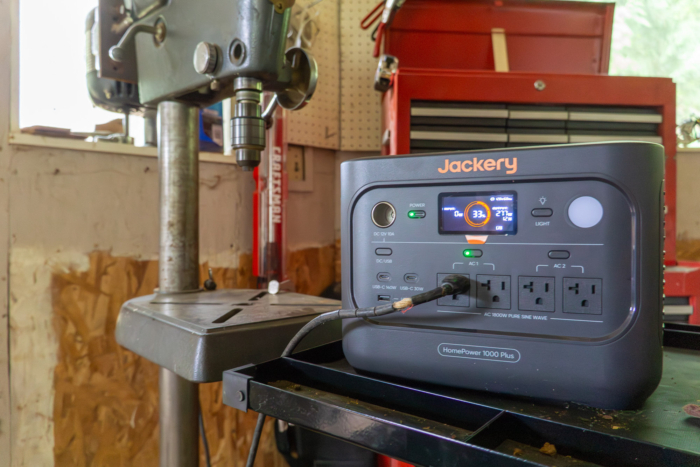
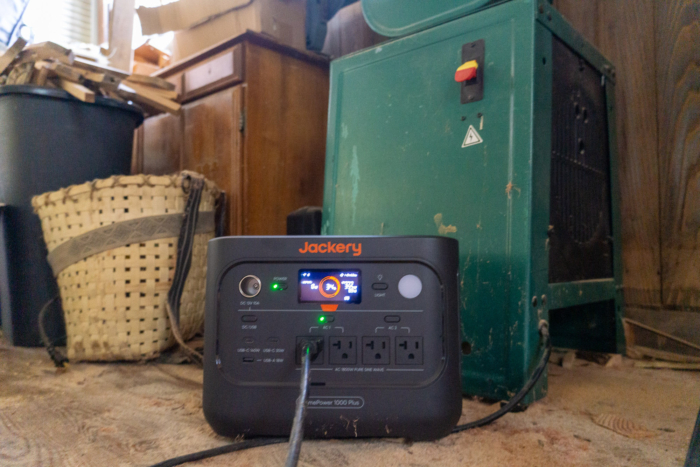
Then, I got the actual lights running on the power station, which again was simple enough, and four LED shop lights easily ran off the HomePower 1000 Plus V2. The heavy lifting started when I revved up a standing sander, and then again when powering my ancient Craftsman drill press.
The power station finally blinked when I attempted to run a 14-inch bandsaw, where the surge wattage must have gotten close to the 3,600W maximum it’s rated for. Even still, the unit recovered and got the saw humming along.
The 1,800W static output is on the high end for 1kWh portable power stations, and is well enough to maintain things like lights, charging laptops, and topping off power tools simultaneously. All things considered, the HomePower 1000 Plus V2 can hang in an off-grid shop, in my opinion.
Even under those heavy startup loads, fan noise remained surprisingly subdued. Cooling fans kick in quickly under sustained high draws, but they maintain a low-frequency hum rather than a whine, allowing you to work nearby or keep it running in a living area without distraction.

An Expandable 1kWh Station
The HomePower 1000 Plus V2 joins a short list of 1kWh power stations that offer the ability to be expanded to suit your power needs. Even the updated Gen2 Anker SOLIX C1000 lost the ability to be expanded, where the previous version hosted it.
The Ecoflow Delta 3 Plus is another station that currently hosts the ability, with added 1,024Wh expansion batteries running ~$390, which compares to the Jackery 1,264Wh expansion units that run $599.
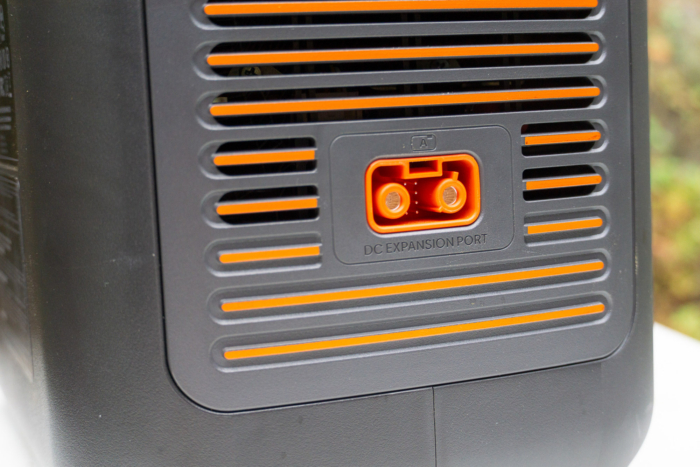
The power station itself can be expanded up to 11kWh by adding five of the brand’s 2kWh expansion batteries, which is quite a bit of juice. At that point, it likely makes more sense to run a larger power station and take advantage of the better inverters and better input charging wattages. Those considering buying the Home Power 1000 Plus V2 with the intention of expanding it down the road should be aware: the expansion cable from Jackery is a proprietary design and will run you $70.

What Could Be Better?
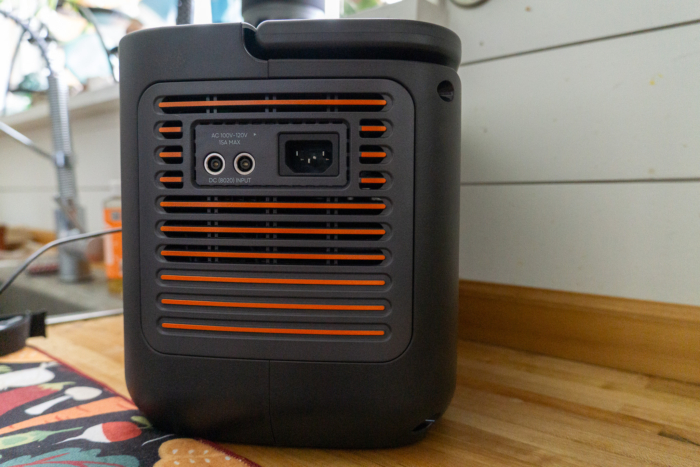
For one, Jackery’s choice to use the DC8020 ports instead of industry-standard XT60/XT60i connections makes things just a little harder for those who make a lot of power from the sun. The DC8020 cable isn’t hard to get or expensive, but it does mean adapting whatever is coming out of your panel — and that’s where things get fidgety and more prone to failure. Still, I typically wouldn’t anticipate charging from solar with enough frequency on a 1kWh unit like the HP 1000 Plus V2 for it to be a huge deal.
Second: the ability to emergency charge the unit (for, say, when you forget to charge it overnight for an important event) is a real boon, but it’s only available to use through the Jackery app. Not the worst thing in the world, but for those with enough apps on our phones already, it’s a little annoying. The app is worthy enough on its own for you to use (if you so choose to), but requiring the app to toggle some functionality doesn’t excite me.

Jackery HomePower 1000 Plus V2: Conclusion
Ultimately, the Jackery HomePower 1000 Plus V2 strikes a well-calibrated balance between daily home utility and rugged off-grid portability. While power users who rely heavily on third-party solar panels or prefer physical hardware switches over app controls might find a few minor friction points, its punchy inverter output, fast sub-10ms UPS transfer, and durable LiFePO4 chemistry make it one of the more reliable multi-use options in the 1kWh class.
If you’re considering power stations in the class, the Anker SOLIX C1000, EcoFlow DELTA 2, and BLUETTI AC180 all operate in the same ~1kWh tier. The Jackery leads in portability at roughly 23.4 pounds, the Anker SOLIX C1000 closely rivals its compact frame while delivering a higher 2,000W continuous output and faster 600W solar input. The EcoFlow DELTA 2 matches Jackery’s 1,024Wh capacity and fast wall-charging times, whereas the BLUETTI AC180 packs a slightly larger 1,152Wh base battery at the cost of a heavier build.
In all, the HomePower 1000 Plus V2 adds another excellent option to the range of modern 1kWh portable power stations.